Key Takeaways
- Peec AI costs more but offers a cleaner interface and better multi-language support -- GeoGen starts at €20/mo vs Peec's €89/mo
- GeoGen uses a credits-based system that can get expensive fast if you run many queries -- Peec has fixed monthly pricing with clear limits
- Peec tracks 3 core metrics (Visibility, Position, Sentiment) with smart suggestions -- GeoGen focuses on citation analysis and competitor rankings
- Both are monitoring-only platforms -- neither helps you create content or fix gaps (tools like Promptwatch handle that side)
- Peec is better for agencies managing multiple clients with its tagging and organization features -- GeoGen suits solo brands on a tight budget
- If you need deep multi-language tracking across regions, Peec wins. If you just want basic monitoring and have a small budget, GeoGen works.
Overview
Peec AI

Peec AI is a multi-language AI visibility platform built by ex-Google and DeepMind engineers. It tracks how your brand shows up in ChatGPT, Perplexity, and Gemini across countries and languages. The interface is clean and the metrics are straightforward: Visibility (how often you're mentioned), Position (where you rank), and Sentiment (how AI models talk about you). Peec is used by 1,500+ marketing teams including Wix, Glide, and Graphite. Pricing starts at €89/mo for the Starter plan.
GeoGen
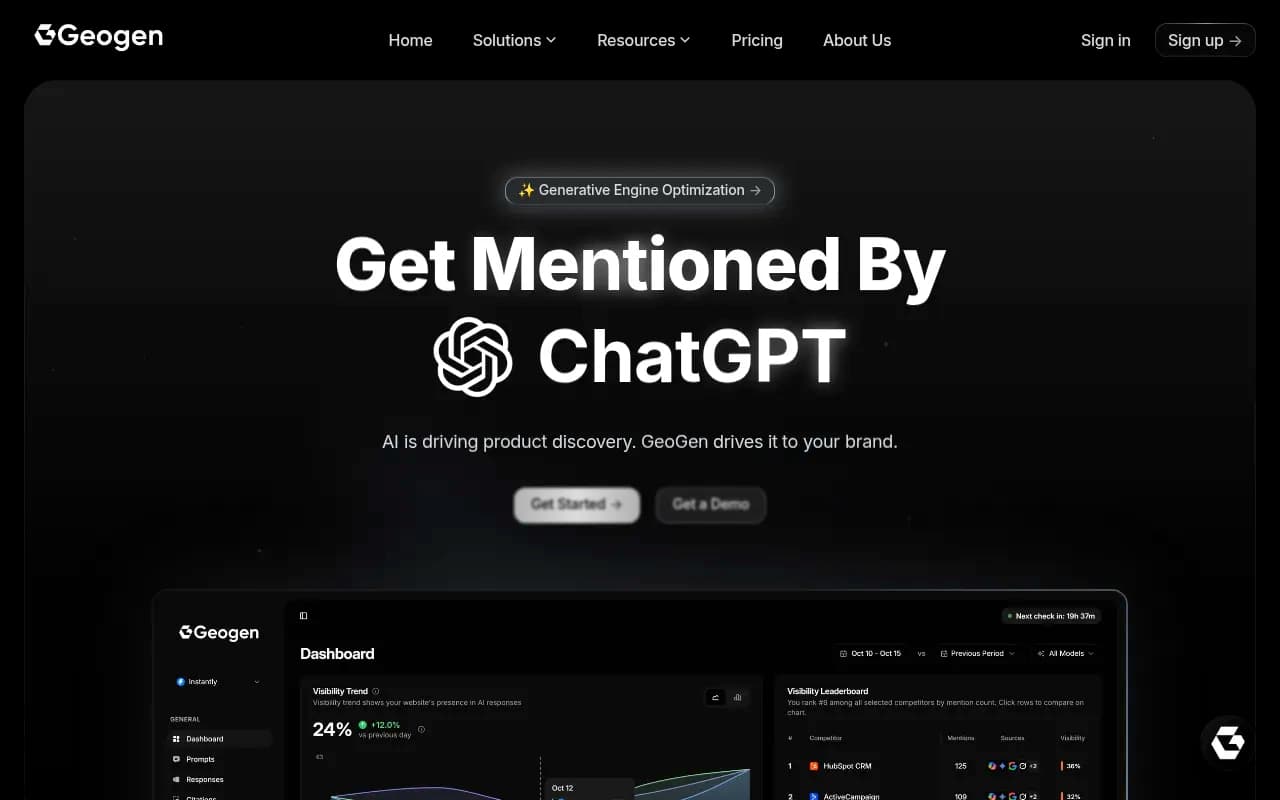
GeoGen is a Generative Engine Optimization (GEO) platform that monitors brand mentions across ChatGPT, Perplexity, Gemini, Grok, and Microsoft Copilot. It uses a credits-based pricing model starting at €20/mo for the Micro plan. GeoGen focuses on citation analysis and competitor benchmarking -- you can see which sources AI models are pulling from and how your competitors rank for the same prompts. The dashboard shows brand mentions, citation sources, and competitor comparisons. Customers include CloudBlast, ProxyScrape, and TextBroker.
Side-by-side comparison
| Feature | Peec AI | GeoGen |
|---|---|---|
| Starting price | €89/mo (Starter) | €20/mo (Micro) |
| Pricing model | Fixed monthly with prompt limits | Credits-based (can get expensive) |
| AI models tracked | ChatGPT, Perplexity, Gemini | ChatGPT, Perplexity, Gemini, Grok, Copilot |
| Multi-language support | ✓ Strong (all countries/languages) | ✓ Basic |
| Core metrics | Visibility, Position, Sentiment | Brand mentions, citations, rankings |
| Competitor tracking | ✓ Yes | ✓ Yes |
| Prompt organization | Tags and folders | Basic |
| Smart suggestions | ✓ Yes | ✗ No |
| Citation analysis | Basic | ✓ Deep |
| Agency features | ✓ Multi-client management | Limited |
| Free trial | ✓ Yes | ✗ No (but cheap entry) |
| Content generation | ✗ No | ✗ No |
| API access | Enterprise only | Not mentioned |
Pricing comparison
| Plan | Peec AI | GeoGen |
|---|---|---|
| Entry tier | €89/mo (Starter) | €20/mo (Micro, 100 credits) |
| Mid tier | €199/mo (Professional) | €99/mo (Starter, 500 credits) |
| High tier | Custom (Enterprise) | €399/mo (Pro, 2000 credits) |
| Billing | Monthly or annual | Annual only |
| Free trial | Yes | No |
| Overage costs | Upgrade required | Buy more credits |
The pricing models are fundamentally different. Peec gives you a fixed number of prompts per month -- you know exactly what you're paying. GeoGen's credit system means you pay per query, which can spiral if you're tracking aggressively. A single prompt check across 5 AI models might cost 5 credits, so that 100-credit Micro plan runs out fast.
User interface and experience
Peec's dashboard is polished. You see visibility trends, sentiment scores, and position rankings in a clean layout with charts that actually make sense. The tagging system lets you organize prompts by campaign, client, or topic. The "smart suggestions" feature highlights prompts where you're losing ground or where competitors are gaining.
GeoGen's interface is more utilitarian. You get the data -- brand mentions, citation sources, competitor rankings -- but the presentation is basic. No smart suggestions, no trend analysis that tells you what to do next. It's a monitoring dashboard, not a strategy tool.
For agencies juggling multiple clients, Peec's organization features save time. GeoGen works fine if you're tracking one brand and just want the raw numbers.
Multi-language and regional tracking
Peec was built for global brands. You can track prompts in any language, from any country, and see how AI models respond differently by region. The interface handles this smoothly -- set up a prompt in German, track it in Germany and Austria, compare results.
GeoGen supports multi-language tracking but it's less refined. You can run prompts in different languages but the regional breakdown and language-specific insights aren't as deep. If your brand operates in multiple markets, Peec is the safer bet.
AI models and coverage
GeoGen tracks 5 AI models: ChatGPT, Perplexity, Gemini, Grok, and Microsoft Copilot. Peec tracks 3: ChatGPT, Perplexity, and Gemini. On paper, GeoGen has broader coverage. In practice, most brands care about ChatGPT and Perplexity first -- Grok and Copilot are nice-to-haves, not must-haves.
Neither platform tracks Claude, Meta AI, or DeepSeek. If you need those, you're looking at a different tier of tools.
Metrics and insights
Peec gives you three core metrics:
- Visibility: percentage of prompts where your brand is mentioned
- Position: average ranking when you do appear
- Sentiment: how positively or negatively AI models describe you
These are actionable. You can see "visibility dropped 5% this month" and dig into which prompts you lost.
GeoGen focuses on:
- Brand mention frequency
- Citation sources (which URLs AI models are pulling from)
- Competitor rankings (who else shows up for your prompts)
The citation analysis is GeoGen's strength. You can see exactly which blog posts, Reddit threads, or news articles AI models are citing when they mention competitors. That's useful for content strategy -- you know where to publish or what to optimize.
Peec's sentiment tracking is something GeoGen doesn't offer. If you care about how AI models talk about your brand (positive, neutral, negative), Peec is the only option here.
Competitor analysis
Both platforms let you track competitors, but the depth differs.
Peec shows competitor visibility, position, and sentiment side-by-side with yours. You can see "HubSpot has 65% visibility vs your 47%" and drill into which prompts they're winning. The interface makes it easy to spot gaps.
GeoGen's competitor tracking is more granular on the citation side. You see which sources competitors are getting cited from, which AI models favor them, and how their rankings change over time. If you're trying to reverse-engineer why a competitor ranks higher, GeoGen gives you more raw data to work with.
Content optimization and action
Neither Peec nor GeoGen helps you fix the problems they surface. They show you where you're invisible or losing to competitors, then leave you to figure out what to do about it.
This is where monitoring-only platforms hit a wall. You see the gap, but you still need to:
- Figure out what content is missing
- Write or commission that content
- Optimize it for AI search
- Track whether it worked
If you want a platform that closes this loop -- showing you the gaps and helping you create content to fill them -- Promptwatch handles both sides. It does the monitoring Peec and GeoGen do, then adds content gap analysis and an AI writing agent that generates articles grounded in citation data.

For most teams, you'll end up using Peec or GeoGen for monitoring, then manually creating content or using a separate tool for optimization.
Agency and team features
Peec is built for agencies. You can manage multiple clients, organize prompts with tags, and generate client reports. The Professional plan (€199/mo) includes features like white-label reporting and team collaboration.
GeoGen doesn't emphasize agency use cases. The pricing is per-account, and there's no mention of multi-client management or white-label reporting. If you're an agency, Peec is the obvious choice.
Credits vs fixed pricing: which is better?
GeoGen's credit system sounds flexible but gets messy fast. You buy credits, each query costs credits (varies by AI model and prompt complexity), and you're constantly estimating whether you have enough. The Micro plan's 100 credits might last a week or a day depending on how you use it.
Peec's fixed pricing is clearer. Starter gives you a set number of prompts per month. You know the limit, you plan around it, and you upgrade if you need more. No surprises.
For budgeting, Peec wins. For occasional use where you only need a few checks per month, GeoGen's €20 entry point is cheaper -- but only if you stay disciplined.
Pros and cons
Peec AI pros:
- Clean, intuitive interface with smart suggestions
- Strong multi-language and regional tracking
- Sentiment analysis (unique vs GeoGen)
- Agency-friendly with client management features
- Fixed pricing makes budgeting predictable
- Free trial to test before committing
Peec AI cons:
- Higher starting price (€89/mo vs €20/mo)
- Only tracks 3 AI models (vs GeoGen's 5)
- No deep citation analysis
- Still monitoring-only -- doesn't help you create content
GeoGen pros:
- Cheapest entry point (€20/mo)
- Tracks 5 AI models including Grok and Copilot
- Strong citation analysis shows which sources AI models use
- Good for solo brands on a budget
GeoGen cons:
- Credits-based pricing can get expensive and unpredictable
- Basic interface with no smart suggestions
- Weaker multi-language support
- No sentiment tracking
- No free trial
- Not built for agencies
Who should pick which tool
Pick Peec AI if:
- You're an agency managing multiple clients and need organization features
- You operate in multiple countries/languages and need strong regional tracking
- You want sentiment analysis to see how AI models talk about your brand
- You prefer predictable monthly pricing over credits
- You value a polished interface with smart suggestions that tell you what to focus on
- You're willing to pay more for a better experience
Pick GeoGen if:
- You're a solo brand or small team with a tight budget
- You only need basic monitoring and don't care about sentiment or smart suggestions
- You want to see which sources AI models are citing (citation analysis)
- You need to track Grok or Copilot specifically
- You're comfortable with credits-based pricing and can estimate usage
- You don't need agency features or multi-client management
Final verdict
Peec AI is the better platform for most teams. It costs more, but the interface is cleaner, the multi-language support is stronger, and the smart suggestions actually help you prioritize. If you're an agency or a brand operating globally, Peec is worth the extra €70/mo over GeoGen's entry tier.
GeoGen works if you're on a strict budget and only need basic monitoring. The €20/mo entry point is appealing, but the credits-based pricing can spiral, and the lack of sentiment tracking or smart suggestions means you're doing more manual analysis.
Both platforms are monitoring-only -- they show you the problem but don't help you fix it. If you want a platform that does both (monitoring and content optimization), you're looking at a different category of tools entirely.