Key Takeaways
- Bear AI starts at $100/mo and focuses on ChatGPT tracking with content generation included, while GeoGen starts at €20/mo (~$22) with a credits-based system covering 5 AI models from day one
- GeoGen offers significantly cheaper entry pricing but charges per query via credits; Bear AI includes fixed prompt allowances with unlimited requerying
- Bear AI positions itself as a growth tool with built-in content creation (2 blog posts/mo on Basic), while GeoGen is primarily a monitoring and analytics platform
- GeoGen covers ChatGPT, Perplexity, Gemini, Grok, and Copilot; Bear AI's Basic plan only tracks ChatGPT (called "GPT-5" in their materials), with other models locked to Enterprise
- Neither platform offers crawler log analysis, Reddit/YouTube tracking, or the depth of citation data you'd get from more comprehensive platforms
- For budget-conscious teams just starting with AI search monitoring, GeoGen's €20/mo entry point wins. For teams that want content generation bundled in, Bear AI makes more sense despite the higher price.
Overview
Bear AI
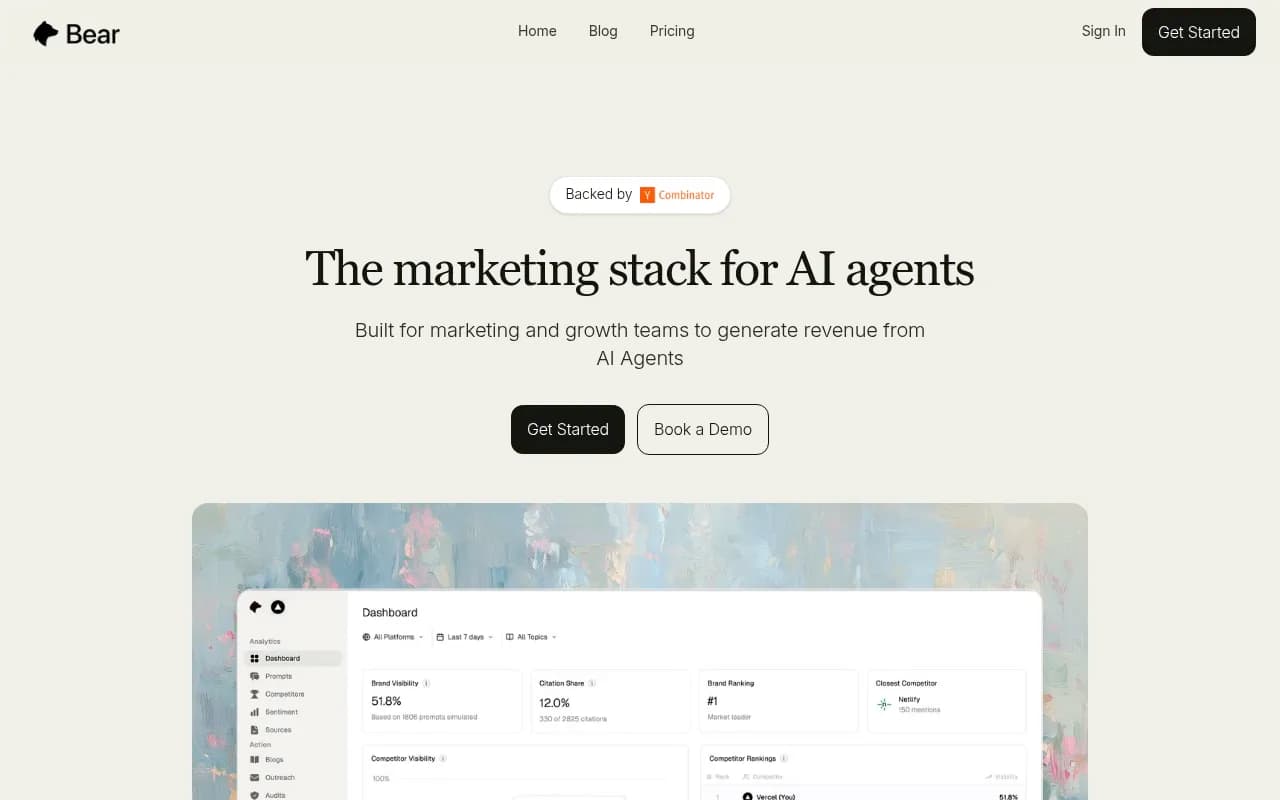
Bear AI markets itself as "the marketing stack for AI agents" and targets growth teams looking to generate revenue from AI search. It's a Y Combinator-backed startup that combines visibility tracking with content creation -- you get blog post generation included in every plan. The pitch is that Bear doesn't just show you where you're invisible, it helps you create content to fix it. Customers include Peerspace, Medal, and Wispr Flow.
The platform tracks how AI agents discover your brand and provides optimization guidance. Basic plans start at $100/mo and cover ChatGPT only (they call it "GPT-5" in their pricing, presumably referring to the latest GPT model). You get 30 prompts and 2 blog posts per month. Enterprise plans unlock all AI platforms with unlimited tracking, but pricing isn't public.
GeoGen
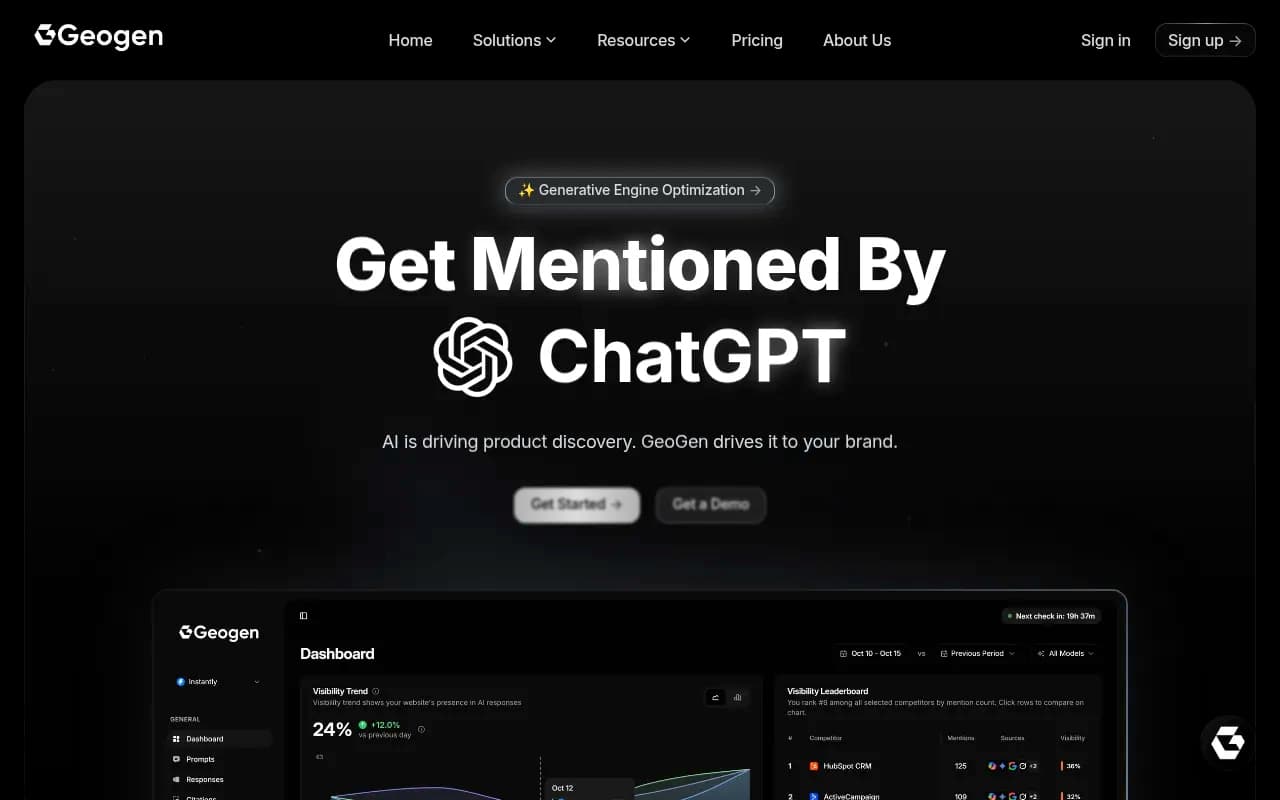
GeoGen is a European GEO platform (pricing in euros) that focuses on monitoring and analytics across multiple AI search engines. It tracks ChatGPT, Perplexity, Gemini, Grok, and Microsoft Copilot. The platform helps you monitor brand mentions, analyze citations, compare competitor rankings, and optimize content for AI-powered search.
GeoGen uses a credits-based pricing model starting at €20/mo for the Micro plan, scaling up to €399/mo for Pro. Each query you run consumes credits, so your actual cost depends on how often you check prompts. Customers include CloudBlast, GdprWise, ProxyScrape, and TextBroker. The platform is built for brands that want to understand their AI search presence without necessarily generating content in-platform.
Side-by-side comparison
| Feature | Bear AI | GeoGen |
|---|---|---|
| Starting price | $100/mo | €20/mo (~$22) |
| AI models (entry plan) | ChatGPT only | ChatGPT, Perplexity, Gemini, Grok, Copilot |
| Prompt allowance | 30 prompts/mo (Basic) | Credits-based (varies by plan) |
| Content generation | 2 blog posts/mo (Basic) | Not included |
| Competitor tracking | Yes | Yes |
| Citation analysis | Yes | Yes |
| Multi-language support | Not specified | Not specified |
| API access | Not specified | Not specified |
| Free trial | Not specified | Not specified |
| Billing | Monthly | Annual (monthly available at higher rate) |
| Target audience | Growth teams, marketers | Brands, agencies, SEO teams |
| Enterprise pricing | Custom | Custom |
Pricing breakdown
The pricing models are completely different, which makes direct comparison tricky.
Bear AI pricing
| Plan | Price | AI Models | Prompts | Blog Posts |
|---|---|---|---|---|
| Basic | $100/mo | ChatGPT only | 30/mo | 2/mo |
| Enterprise | Custom | All platforms | Unlimited | Custom |
Bear AI's pricing is straightforward but expensive for what you get at the Basic tier. You're locked to ChatGPT tracking only, which is a significant limitation when Perplexity, Gemini, and Claude are all major players in AI search. The inclusion of 2 blog posts per month is the differentiator -- if you value AI-generated content, that's worth something. If you don't need content generation, you're paying for a feature you won't use.
The jump from Basic to Enterprise is massive. There's no mid-tier option, so small teams that need multi-platform tracking are forced into custom enterprise pricing conversations.
GeoGen pricing
| Plan | Price (Annual) | Credits | AI Models |
|---|---|---|---|
| Micro | €20/mo | 100 credits | All 5 models |
| Starter | €49/mo | 300 credits | All 5 models |
| Growth | €149/mo | 1,000 credits | All 5 models |
| Pro | €399/mo | 3,000 credits | All 5 models |
| Enterprise | Custom | Custom | All 5 models |
GeoGen's credits-based system means your actual cost depends on usage. Each prompt query consumes credits (exact cost per query not specified on their site). If you're checking 50 prompts once per week, you'll burn through credits faster than if you check 10 prompts daily. This makes budgeting harder but gives you flexibility.
The big advantage: even the €20/mo Micro plan gives you access to all 5 AI models. You're not locked to ChatGPT only. For small brands just starting with GEO, this is a much better entry point than Bear AI's $100/mo ChatGPT-only plan.
AI model coverage
This is where the platforms diverge sharply.
Bear AI's Basic plan only tracks ChatGPT ("GPT-5" in their materials). That's it. If you want Perplexity, Gemini, Claude, or any other AI search engine, you need to upgrade to Enterprise with custom pricing. For a platform that positions itself as "the marketing stack for AI agents," limiting the entry tier to one AI model feels like a significant constraint.
GeoGen covers 5 AI models on every plan: ChatGPT, Perplexity, Gemini, Grok, and Microsoft Copilot. Even the €20/mo Micro plan gives you multi-platform tracking. This is a better reflection of how people actually use AI search -- they don't just use ChatGPT, they bounce between models.
Neither platform tracks Claude (Anthropic), Meta AI, DeepSeek, or Mistral. If you need comprehensive coverage across all major LLMs, you'll want to look at platforms like Promptwatch that monitor 10+ AI models.

Content generation and optimization
Bear AI includes content generation in every plan. The Basic tier gives you 2 blog posts per month, presumably optimized for AI search visibility. This is the platform's main differentiator -- it's not just showing you where you're invisible, it's creating content to fix the gaps.
The quality and targeting of these AI-generated posts isn't clear from their website. Do they analyze which prompts you're missing and generate content specifically for those gaps? Or is it more generic content creation? The details matter here, because generic AI content won't move the needle on AI search rankings.
GeoGen doesn't include content generation. It's a monitoring and analytics platform. You get visibility data, competitor comparisons, and citation analysis, but you're on your own for creating content. If you have a content team or work with writers, this is fine. If you need the platform to generate content for you, GeoGen won't do it.
For teams that want an all-in-one solution with content creation built in, Bear AI is the better fit despite the higher price. For teams that just need data and already have content production handled, GeoGen's lower price makes more sense.
Competitor analysis and citation tracking
Both platforms offer competitor tracking, but the depth isn't specified on either website.
Bear AI shows "trending prompts" and lets you see how AI agents recommend your brand versus competitors. Their dashboard screenshots show prompt volume indicators ("High-volume") and which AI model generated each prompt. You can presumably track which prompts competitors rank for that you don't.
GeoGen emphasizes citation analysis and competitor rankings. Their dashboard shows brand mentions across AI models and lets you compare your visibility against competitors. The interface looks clean and focused on analytics.
What both platforms are missing: neither shows you the actual sources AI models are citing (Reddit threads, YouTube videos, specific blog posts), and neither offers the kind of granular citation data that tells you why a competitor is winning for a specific prompt. You get high-level visibility metrics but not the forensic detail needed to reverse-engineer competitor strategies.
Tracking and reporting
Bear AI's dashboard shows trending prompts, AI model coverage, and brand mention frequency. The interface looks modern and focused on actionable insights. You can see which prompts are high-volume and track how often your brand appears in AI responses.
GeoGen provides visibility analytics across all tracked AI models with competitor comparison views. Their dashboard emphasizes brand mention tracking and citation analysis. The credits-based system means you can run queries on-demand rather than being locked to a fixed prompt allowance.
Neither platform appears to offer:
- AI crawler log analysis (which pages AI bots are reading on your site)
- Prompt volume estimates or difficulty scoring
- Reddit or YouTube discussion tracking
- Page-level attribution (which specific pages are getting cited)
- Traffic attribution from AI search to your website
These are table-stakes features on more comprehensive GEO platforms. If you need them, you'll be disappointed with both Bear AI and GeoGen.
User interface and ease of use
Bear AI's website and dashboard screenshots suggest a clean, modern interface focused on growth metrics. The "trending prompts" view makes it easy to see what people are asking AI about your category. The inclusion of AI model logos next to each prompt is a nice touch for quick scanning.
GeoGen's interface looks similarly polished with a focus on analytics and data visualization. The multi-brand comparison views are well-designed. The credits-based system adds a layer of complexity -- you need to think about credit consumption when running queries -- but it also gives you flexibility.
Both platforms appear to have a learning curve. Neither is as plug-and-play as traditional SEO tools. You need to understand how AI search works, what prompts matter for your business, and how to interpret visibility metrics.
Integration and API access
Neither platform specifies API access, webhook support, or integrations with other tools on their public websites. This is a gap. Modern marketing teams want to pipe GEO data into their existing analytics stack, trigger alerts in Slack, or export data to data warehouses.
If API access or integrations are critical for your workflow, you'll need to contact both companies directly to ask what's available.
Pros and cons
Bear AI pros
- Content generation included (2 blog posts/mo on Basic)
- Y Combinator backing suggests strong product development velocity
- Focused on growth and revenue generation, not just monitoring
- Clean, modern interface
Bear AI cons
- Expensive entry point ($100/mo)
- Basic plan only tracks ChatGPT -- other AI models locked to Enterprise
- No mid-tier pricing option between $100/mo and custom Enterprise
- Limited transparency on content generation quality and targeting
- Missing advanced features like crawler logs, Reddit tracking, traffic attribution
GeoGen pros
- Very affordable entry pricing (€20/mo)
- All 5 AI models included on every plan, even Micro
- Credits-based system offers flexibility
- European company (good for GDPR-conscious brands)
- Clean analytics-focused interface
GeoGen cons
- No content generation -- monitoring only
- Credits-based pricing makes budgeting harder
- Unclear how many queries you can run with each credit allowance
- Missing advanced features like crawler logs, prompt difficulty scoring, Reddit/YouTube tracking
- Annual billing required for advertised prices (monthly available at premium)
Who should choose which platform
Choose Bear AI if:
- You want content generation built into your GEO platform
- You're primarily focused on ChatGPT visibility (at least initially)
- You have budget for $100+/mo and value the all-in-one approach
- You're a growth team that wants a tool focused on revenue generation, not just analytics
- You're willing to pay for Enterprise to get multi-platform tracking
Choose GeoGen if:
- You need multi-platform AI search tracking from day one
- You're budget-conscious and want the cheapest entry point
- You already have content production handled and just need monitoring data
- You prefer a credits-based system that lets you control query frequency
- You're a European company or prefer working with EU-based vendors
Choose neither if:
- You need comprehensive coverage across 10+ AI models including Claude, Meta AI, DeepSeek
- You want AI crawler log analysis to see which pages AI bots are reading
- You need Reddit and YouTube discussion tracking
- You want prompt volume estimates and difficulty scoring
- You need traffic attribution to connect AI visibility to actual website visits and revenue
- You want content gap analysis that shows exactly which topics competitors rank for but you don't
For teams that need the full GEO stack -- monitoring, content gap analysis, AI-generated content grounded in citation data, crawler logs, and traffic attribution -- platforms like Promptwatch offer a more complete solution. But if you're just getting started with AI search optimization and want a simple monitoring tool, both Bear AI and GeoGen can work depending on your budget and whether you need content generation.
Final verdict
GeoGen wins on price and multi-platform coverage. Bear AI wins if you need content generation bundled in.
For most small teams just starting with GEO, GeoGen's €20/mo entry point with 5 AI models is the smarter choice. You get real multi-platform visibility without breaking the budget. The credits-based system is a bit annoying, but the flexibility is worth it.
Bear AI makes sense for growth teams that want an all-in-one tool and have budget for $100+/mo. The content generation is the key differentiator. If you're going to use those 2 blog posts per month and they're actually targeted at your visibility gaps, the higher price pays for itself. But the ChatGPT-only limitation on the Basic plan is a dealbreaker for many teams.
Neither platform is a comprehensive GEO solution. They're both entry-level tools that give you basic visibility tracking but lack the depth needed for serious AI search optimization. If you're competing in a crowded category where AI search visibility matters, you'll outgrow both platforms quickly and need something more robust.