Key takeaways
- GeoGen is the budget-friendly pick, starting at €20/mo vs Ranksmith's $69/mo -- a meaningful gap if you're just getting started with GEO tracking
- Ranksmith has a more developed analytics layer: its prompt performance scoring, AI Authority Index, and Reputation Score give you more structured KPIs to work with
- Both tools are monitoring-first platforms -- neither includes content generation or AI crawler log analysis, so they help you see the problem but leave the fixing largely to you
- Ranksmith covers Claude; GeoGen covers Microsoft Copilot -- the model coverage overlaps heavily but differs at the edges, so check which AI engine matters most to your audience
- Ranksmith's competitor intelligence feels more built-out, with share of voice, average position, and sentiment tracked side-by-side across LLMs
- GeoGen's credits-based pricing model is flexible but can get confusing -- Ranksmith's prompt-based tiers are simpler to reason about
Overview
Ranksmith
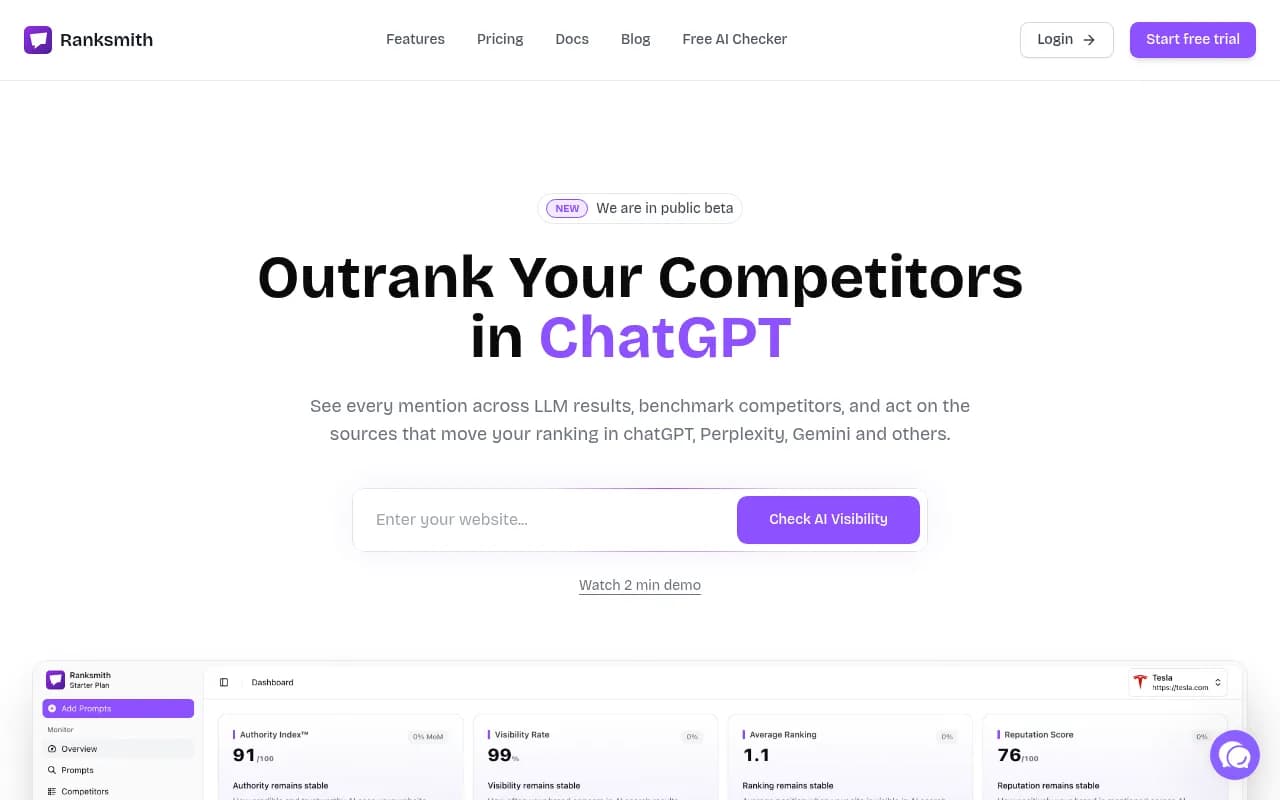
Ranksmith bills itself as the "first comprehensive platform for tracking and optimizing your brand's presence across AI search engines." It's currently in public beta, which is worth keeping in mind. The core pitch is turning raw LLM results into a structured set of KPIs -- Visibility Rate, Average AI Ranking, Reputation Score, and an AI Authority Index -- then mapping those metrics to specific citation sources so you know where to focus your outreach or PR efforts. The prompt prioritization system is one of its more distinctive features: it ranks every tracked prompt by a blended performance score so you're not guessing which ones to work on first.
GeoGen
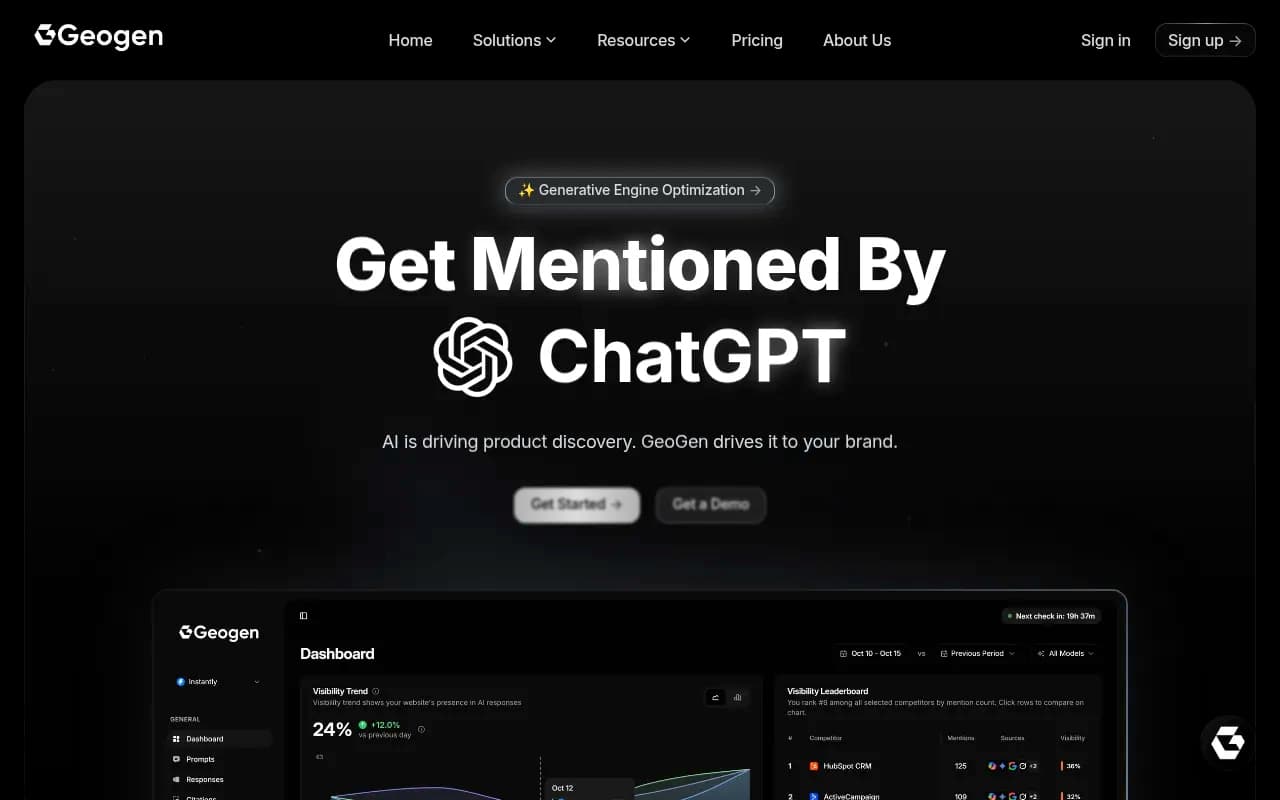
GeoGen takes a similar monitoring-and-optimization angle but positions itself as more accessible, particularly for smaller teams and growing companies. It covers ChatGPT, Gemini, Perplexity, Grok, and Microsoft Copilot, and uses a credits-based system that lets you pay for roughly what you use. The platform tracks brand mentions, citation analysis, and competitor rankings across AI search engines. It's a leaner product overall -- less KPI depth than Ranksmith, but also a much lower entry price.
Side-by-side comparison
| Feature | Ranksmith | GeoGen |
|---|---|---|
| Starting price | $69/mo | €20/mo (annual) |
| Top plan price | $549/mo | €399/mo (annual) |
| Free trial | 7-day, no credit card | Free sign-up available |
| Pricing model | Prompt-based tiers | Credits-based tiers |
| AI models covered | ChatGPT, Perplexity, Gemini, Grok, Claude | ChatGPT, Gemini, Perplexity, Grok, Copilot |
| Prompts (entry plan) | 25 prompts | Credits-based (varies) |
| Competitor tracking | Yes, with share of voice | Yes |
| Sentiment analysis | Yes | Not clearly documented |
| Prompt performance scoring | Yes (blended score) | Not documented |
| Citation source tracking | Yes | Yes |
| AI content generation | No | No |
| AI crawler logs | No | No |
| Reddit/YouTube tracking | Not documented | Not documented |
| API access | Not documented | Not documented |
| Annual billing discount | 20% | Yes (default billing) |
| Current status | Public beta | Live |
Head-to-head feature deep-dive
Prompt tracking and prioritization
Ranksmith's prompt prioritization system is one of the more thoughtful features in this space. Rather than just showing you raw mention data, it computes a performance score for each tracked prompt by blending current position, mention rate, and link rate across ChatGPT, Perplexity, and Gemini. You can filter by category, model, and region to find the "quickest wins" -- prompts where a small push could move the needle fast. That's genuinely useful when you're managing a large prompt set and need to decide where to spend time.
GeoGen tracks prompts and brand mentions across its supported models, but there's no equivalent scoring or prioritization layer documented publicly. You get the data, but the "what do I work on next?" question is left more to your own judgment.
Verdict: Ranksmith wins here. The blended performance score is a real differentiator for teams that want structure, not just raw data.
Competitor intelligence
Ranksmith's competitor benchmarking is a clear strength. You get share of voice, average position, and sentiment tracked side-by-side for any competitor domain, with trend data over time. The platform also claims to detect new entrants automatically, which is a nice touch -- you don't have to manually add every new competitor you become aware of.
GeoGen offers competitor ranking comparisons, but the feature depth isn't as clearly articulated. You can see how competitors rank in AI responses, but the share of voice and sentiment dimensions aren't prominently featured.
Verdict: Ranksmith has the more complete competitor intelligence suite.
Analytics and KPIs
Ranksmith tracks four named KPIs: AI Visibility Rate, Average AI Ranking, Reputation Score, and an AI Authority Index. Each comes with trend deltas and share of voice breakdowns. This structured KPI framework makes it easier to report progress to stakeholders -- you have named metrics you can track week over week.
GeoGen's analytics cover brand mentions, citation analysis, and ranking comparisons, but the KPI framework is less formalized. It's more of a "here's what's happening" dashboard than a "here's how you're performing against defined metrics" system.
Verdict: Ranksmith's KPI structure is more mature and easier to use for reporting.
Citation and source analysis
Both tools track which citations appear in AI responses and try to connect those citations to ranking changes. Ranksmith explicitly maps citations back to specific sources (G2, Reddit, LinkedIn, press) and suggests targeted outreach or PR campaigns based on what's driving rankings. That source-to-action mapping is a useful bridge between data and execution.
GeoGen also analyzes citations, but the action layer -- "here's what to do about this citation" -- isn't as clearly built out in their public documentation.
Verdict: Ranksmith's citation-to-action mapping gives it a practical edge.
AI model coverage
| AI Model | Ranksmith | GeoGen |
|---|---|---|
| ChatGPT | Yes | Yes |
| Perplexity | Yes | Yes |
| Gemini | Yes | Yes |
| Grok | Yes | Yes |
| Claude | Yes | No |
| Microsoft Copilot | No | Yes |
| Google AI Overviews | Yes | Not documented |
The coverage is broadly similar. Ranksmith includes Claude; GeoGen includes Copilot. If your audience skews toward Microsoft products and Bing-integrated search, GeoGen's Copilot coverage matters. If you care about Claude's growing user base, Ranksmith has the edge.
Verdict: Roughly tied -- it depends which models your target audience uses.
Ease of use and setup
Ranksmith's onboarding lets you start with AI-suggested prompts or import your own, with tagging by model, category, and topic. That's a low-friction way to get started. The dashboard is structured around the KPI framework, so there's a clear mental model from day one.
GeoGen's credits-based system is more flexible but also introduces some cognitive overhead -- you need to understand how credits map to queries and models before you can plan your usage confidently. The interface looks clean from screenshots, but the pricing model requires more upfront thinking.
Verdict: Ranksmith's prompt-based tiers are simpler to reason about. GeoGen's credits model offers flexibility but adds complexity.
Content optimization
This is where both tools show their limits. Neither Ranksmith nor GeoGen includes built-in content generation or AI writing tools. Both will tell you which prompts you're not ranking for and which sources are influencing AI responses -- but actually creating the content to fix those gaps is on you.
If content generation for AI search is a priority, it's worth knowing that platforms like Promptwatch include an AI writing agent that generates articles and comparisons grounded in citation data -- designed specifically to get cited by LLMs.

Verdict: Neither tool wins here -- both are monitoring-first, optimization-second, and content-generation-never.
Pricing comparison
| Plan | Ranksmith | GeoGen |
|---|---|---|
| Entry | $69/mo (Starter: 25 prompts, 2 models) | €20/mo (Micro, annual) |
| Mid-tier | $199/mo (Growth: 75 prompts, 4 models) | €99/mo (Starter, annual) |
| Upper-mid | $349/mo (Pro: 100 prompts, 5 models) | €199/mo (Business, annual) |
| Top plan | $549/mo (Enterprise: 150 prompts, 6 models) | €399/mo (Pro, annual) |
| Enterprise/Custom | Not listed | Yes |
| Annual discount | 20% | Prices above are annual rates |
| Free trial | 7-day, no credit card | Free sign-up |
GeoGen is cheaper at every tier. The gap is most pronounced at entry level -- €20/mo vs $69/mo is a 3x+ difference. For solo marketers or small startups just beginning to track AI visibility, that's a significant consideration.
At the top end, GeoGen's €399/mo Pro plan is still cheaper than Ranksmith's $549/mo Enterprise. But Ranksmith's Enterprise plan includes 150 prompts across 6 models with the full KPI and competitor intelligence suite, so the value equation depends on what features you actually need.
Pros and cons
Ranksmith
Pros:
- Structured KPI framework (Visibility Rate, Ranking, Reputation, Authority Index) makes reporting straightforward
- Prompt performance scoring helps prioritize where to focus
- Competitor intelligence is more developed, with share of voice and sentiment tracking
- Citation-to-action mapping connects data to specific outreach strategies
- 7-day free trial with no credit card required
Cons:
- More expensive at every tier compared to GeoGen
- Still in public beta -- feature set and stability may be less predictable
- No content generation or AI crawler log features
- 25 prompts on the Starter plan is tight for larger brands
- Maximum 6 models even on Enterprise -- not the widest coverage in the market
GeoGen
Pros:
- Significantly cheaper entry point (€20/mo vs $69/mo)
- Covers Microsoft Copilot, which Ranksmith doesn't
- Credits-based model offers flexibility for variable usage
- Clean interface with a focus on the core monitoring use case
- Custom enterprise pricing available
Cons:
- Less structured KPI framework -- harder to track progress formally
- No prompt performance scoring or prioritization system
- Competitor intelligence appears less developed
- Credits-based pricing adds complexity when planning usage
- Less documentation on advanced features like sentiment analysis
Who should pick which tool
Pick Ranksmith if:
- You need structured KPIs and a formal reporting framework for stakeholders
- Competitor benchmarking with share of voice and sentiment data is important to you
- You want prompt prioritization to tell you where to focus first
- Claude is an AI model you care about tracking
- You're willing to pay more for a more opinionated, analytics-heavy product
Pick GeoGen if:
- Budget is a real constraint and you need to start tracking AI visibility without a large commitment
- Microsoft Copilot is relevant to your audience
- You want a straightforward monitoring tool without a steep learning curve
- You prefer flexible, credits-based usage over fixed prompt tiers
- You're a smaller brand or startup that doesn't yet need the full KPI framework
Final verdict
Ranksmith is the more capable product for teams that want structured analytics, competitor intelligence, and a clear framework for prioritizing their GEO efforts. GeoGen is the better choice if you're cost-conscious or just starting out -- it covers the core monitoring use case at a price that's hard to argue with.
Neither tool will generate content for you or show you AI crawler activity on your site, so both leave a meaningful gap between "here's the problem" and "here's the fix." For teams that need to close that loop, the monitoring-only nature of both platforms is a real limitation worth factoring into your decision.