Key takeaways
- Goodie, Hall AI, Promptmonitor, and Ceyo AI are all entry-level AI brand trackers aimed at teams who want visibility into LLM mentions without enterprise pricing
- None of the four offer the full action loop (gap analysis + content generation + traffic attribution) that more mature platforms provide
- Hall AI has the most polished citation-tracking UI; Ceyo AI covers the most AI models for its price; Goodie leans into ease of use; Promptmonitor sits somewhere in between
- If you outgrow any of these tools quickly, that's a sign you need a platform built around optimization, not just monitoring
- For teams serious about improving AI visibility (not just watching it), Promptwatch is worth comparing directly
The lightweight AI brand tracker market has exploded. Eighteen months ago there were maybe a dozen tools doing this. Now there are dozens more, and a new one seems to launch every few weeks. Most of them look similar at first glance: connect your brand, set some prompts, watch a dashboard fill up with mentions across ChatGPT, Perplexity, Claude, and Gemini.
But "looks similar" and "works the same" are very different things. Goodie, Hall AI, Promptmonitor, and Ceyo AI are four of the more talked-about lightweight options in 2026. They're all targeting roughly the same buyer: a marketing manager or SEO lead who wants to understand AI visibility without committing to a $500+/month enterprise platform.
So which one is actually ready? Let's go through them honestly.
What "lightweight" actually means here
Before comparing, it's worth being clear about what we mean by lightweight. These tools are:
- Priced for small teams or solo marketers (roughly $0-$99/month entry points)
- Focused primarily on monitoring -- tracking brand mentions, sentiment, and citation frequency across AI models
- Not built around content generation, gap analysis, or traffic attribution
That's not a criticism. Monitoring is a legitimate starting point. But it does mean you should go in with realistic expectations. These tools will tell you where you stand. Most won't tell you what to do about it.
Goodie
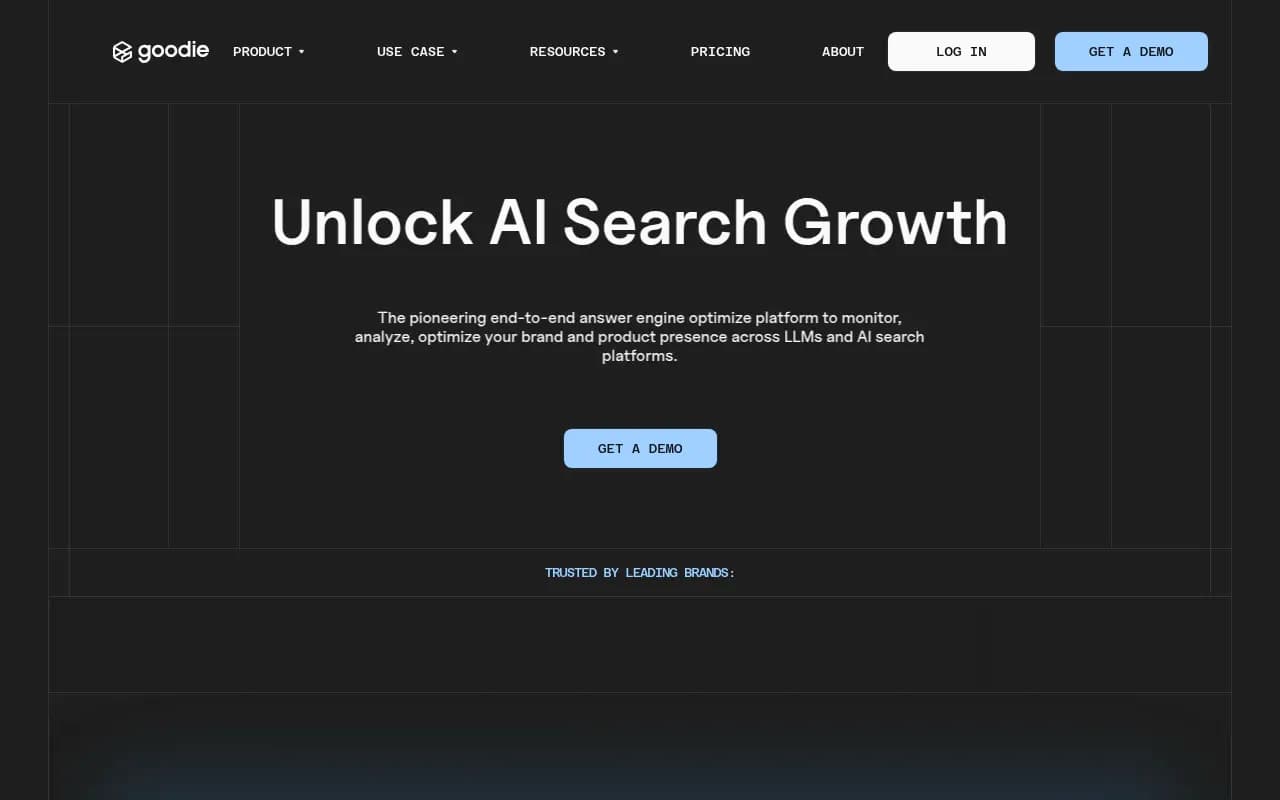
Goodie (higoodie.com) pitches itself as the simplest way to monitor and optimize your brand in AI search. The onboarding is genuinely fast -- you can have a brand set up and prompts running within minutes. The dashboard is clean, the prompt results are readable, and the sentiment tagging is good enough to be useful without being overwhelming.
What Goodie does well is surface the basics clearly. You can see which AI models mention your brand, how often, and in what context. For a team that's never tracked AI visibility before, it's a low-friction starting point.
The gaps show up when you want to go deeper. Prompt volume data is thin. There's no crawler log access, no competitor heatmaps, and no content generation to act on what you find. The "optimize" part of the pitch is more aspirational than functional at this stage.
Hall AI
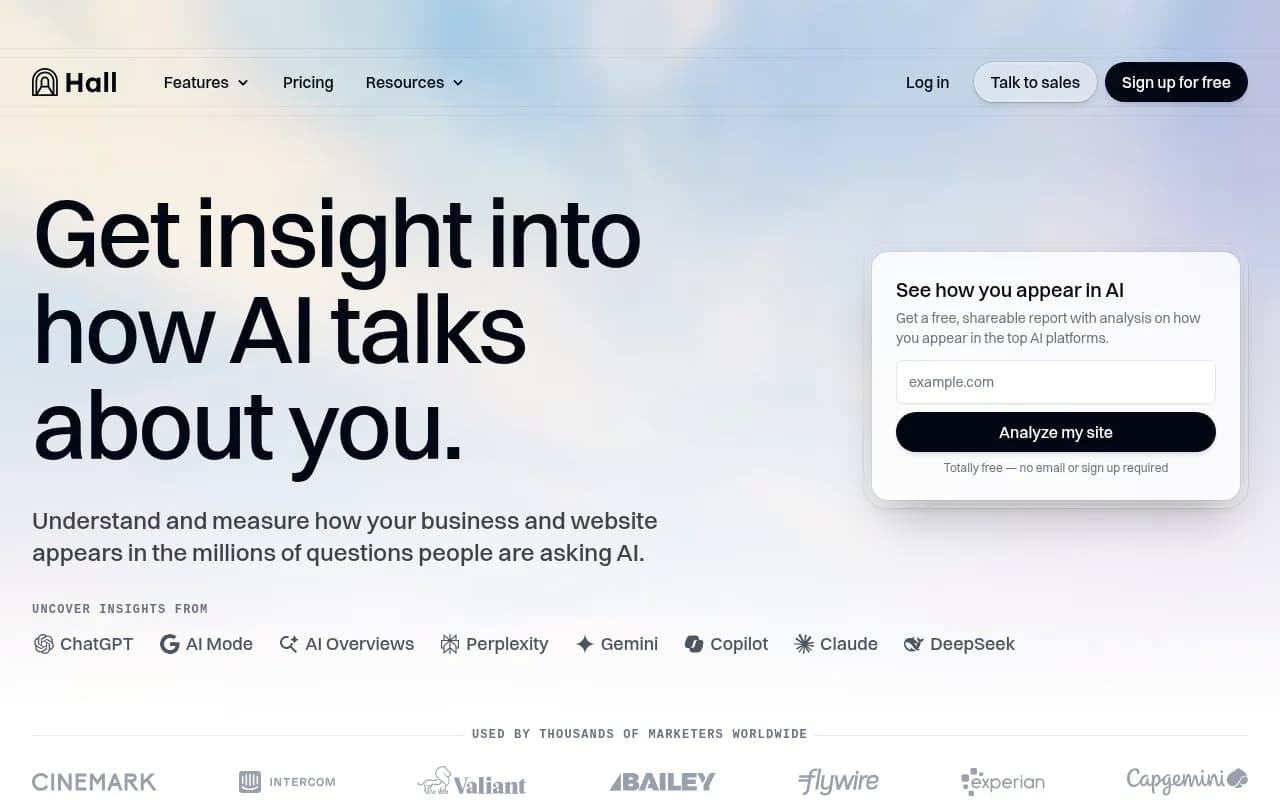
Hall AI (usehall.com) has a cleaner focus: it tracks how AI platforms cite and talk about your brand, with an emphasis on citation-level detail. Where Goodie shows you mentions, Hall AI tries to show you why you're being mentioned -- which pages are getting cited, which sources AI models are pulling from.
That citation-level view is genuinely useful. If you're trying to understand whether your blog posts or your product pages are driving AI mentions, Hall AI gives you more signal than most tools at this price point.
The trade-off is that the interface takes more time to learn, and the prompt setup requires more manual work. It's a better tool for someone who already understands AI visibility and wants more granular data, rather than someone just getting started.
Promptmonitor
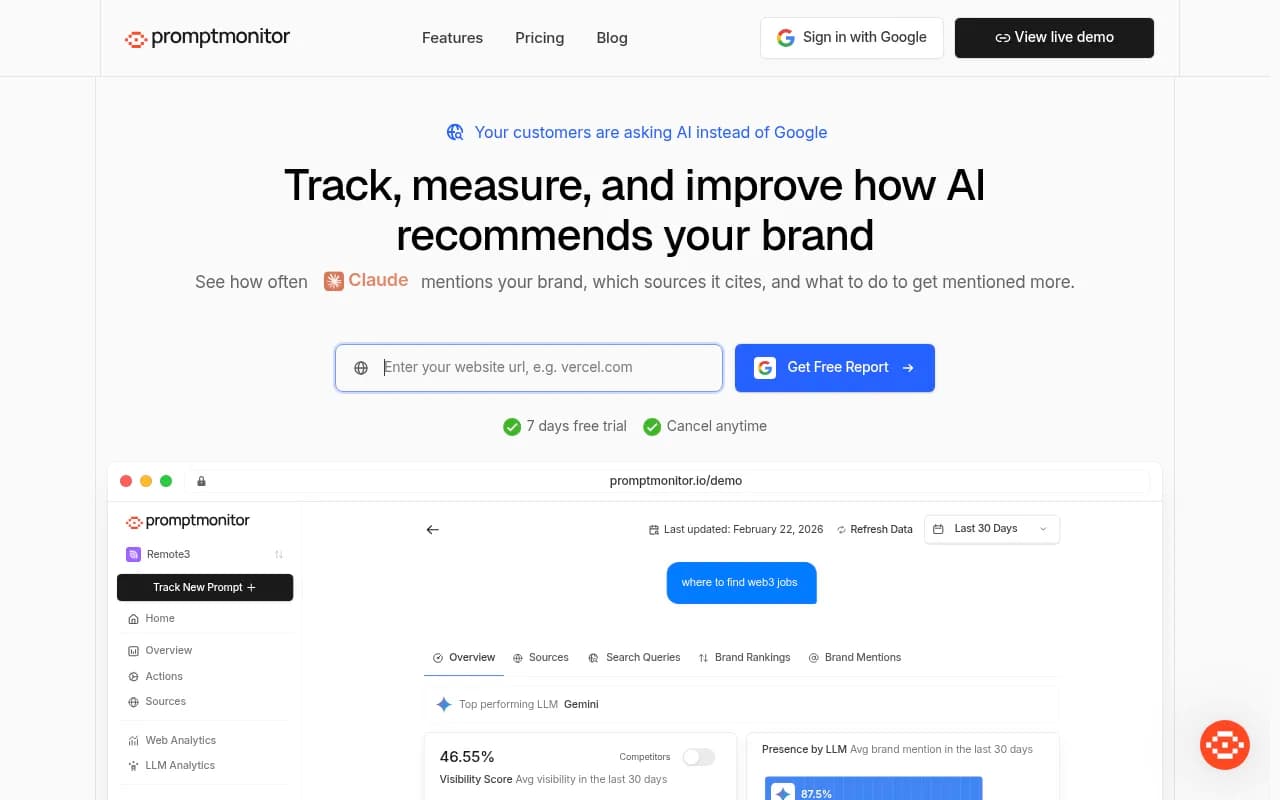
Promptmonitor (promptmonitor.io) sits in the middle of the four. It covers the core monitoring use case -- brand mentions across major LLMs, sentiment tracking, prompt-level results -- without trying to do too much or too little.
The standout feature is its alerting system. You can set up notifications for when your brand appears (or disappears) from specific prompt responses, which is useful for catching sudden drops or unexpected mentions. For teams that don't want to log in daily, that push-based approach makes it more practical.
What it lacks is depth on the competitive side. Competitor tracking exists but feels surface-level. You can see that a competitor is appearing in responses where you're not, but there's no analysis of why or what content is driving their visibility.
Ceyo AI
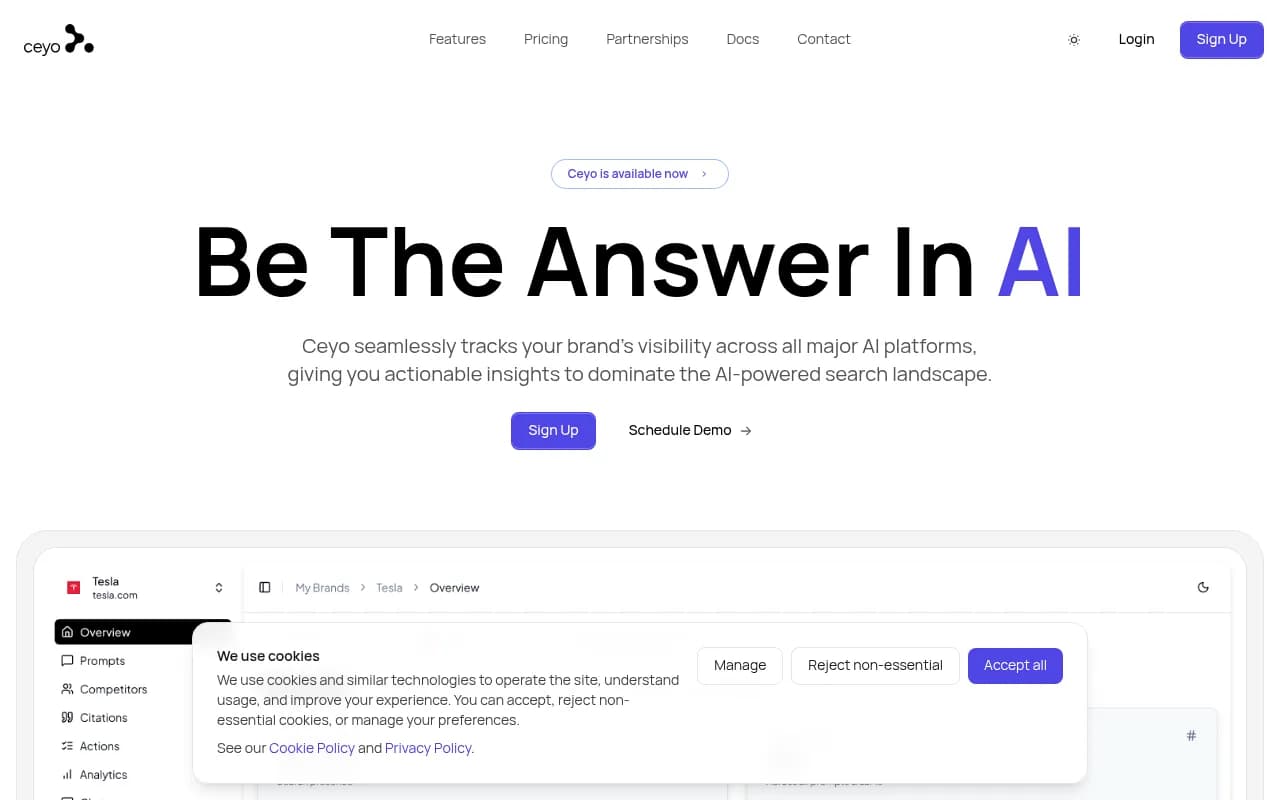
Ceyo AI (ceyo.ai) monitors your brand's visibility across ChatGPT, Perplexity, Claude, and Gemini. For its price tier, the model coverage is solid -- four major LLMs is more than some tools twice the price bother to track properly.
The UI is straightforward, and the prompt results load quickly. Sentiment analysis is present, though it's fairly binary (positive/negative) rather than nuanced. The reporting is basic but exportable, which matters if you're pulling data into a broader marketing report.
Ceyo AI feels like a tool that's still finding its footing on the product side. The core tracking works, but there are rough edges -- prompt management could be more flexible, and the onboarding documentation is thin. It's a tool to watch, but not necessarily to bet on as your primary platform yet.
Side-by-side comparison
| Feature | Goodie | Hall AI | Promptmonitor | Ceyo AI |
|---|---|---|---|---|
| AI models tracked | ChatGPT, Perplexity, Gemini | ChatGPT, Perplexity, Claude, Gemini | ChatGPT, Perplexity, Claude, Gemini | ChatGPT, Perplexity, Claude, Gemini |
| Citation-level tracking | Basic | Strong | Basic | Basic |
| Competitor tracking | Limited | Limited | Limited | Limited |
| Prompt alerting | No | No | Yes | No |
| Content generation | No | No | No | No |
| Answer gap analysis | No | No | No | No |
| AI crawler logs | No | No | No | No |
| Traffic attribution | No | No | No | No |
| Ease of setup | Very easy | Moderate | Easy | Easy |
| Best for | First-time AI visibility tracking | Citation research | Alert-driven monitoring | Multi-model coverage on a budget |
| Approximate entry price | Low ($0-$49/mo) | Low-mid ($49-$99/mo) | Low-mid ($49-$99/mo) | Low ($0-$49/mo) |
The honest problem with all four
Here's the thing none of their landing pages will tell you: monitoring your AI visibility and improving your AI visibility are two completely different problems.
All four tools solve the first problem reasonably well, at least at a basic level. None of them solve the second.
Knowing that ChatGPT mentions your competitor three times more than you in responses about "best project management software" is useful information. But what do you do with it? Which pages need to be updated? What topics are missing from your site entirely? Which prompts are high-volume and actually worth targeting?
That's where monitoring-only tools hit a wall. You end up with a dashboard full of data and no clear path to acting on it.
This is a real pattern across the broader AI visibility tool market. The SE Ranking team's analysis of AI Mode tracking tools in 2026 found that most platforms stop at visibility reporting, leaving optimization as an exercise for the user to figure out independently.
When to consider a more complete platform
If you're just starting out and want to understand whether AI models mention your brand at all, any of the four tools above will get you there. Start with Goodie if you want the lowest friction. Start with Hall AI if citation-level detail matters to you. Use Promptmonitor if you want alerts without daily check-ins.
But if you're past the "do I even show up?" question and into "how do I show up more?" -- you need something with more horsepower.
Promptwatch is the platform that closes that gap most directly. It tracks across 10 AI models (ChatGPT, Perplexity, Claude, Gemini, Grok, DeepSeek, Copilot, Mistral, Meta AI, and Google AI Overviews), but the tracking is only the starting point. The Answer Gap Analysis shows you exactly which prompts competitors are visible for that you're not -- not as a vague insight, but as a specific list of topics and questions your site isn't answering. From there, the built-in AI writing agent generates content grounded in real citation data from 880M+ citations analyzed, designed to actually get picked up by AI models. Then page-level tracking shows whether the new content is working.
That's a fundamentally different product than a monitoring dashboard. It's the difference between a speedometer and a GPS.

How to choose
If your question is "which of these four should I pick?", here's the short version:
- You want the easiest possible setup and a clean overview: Goodie
- You care most about understanding which specific pages and sources are driving AI citations: Hall AI
- You want to be notified when something changes without logging in constantly: Promptmonitor
- You want broad model coverage at the lowest possible price: Ceyo AI
If your question is "will any of these actually help me improve my AI visibility?" -- the honest answer is: not really. They'll help you measure it. Improving it requires content strategy, gap analysis, and a feedback loop that tells you whether your changes are working. That's a different category of tool.
The lightweight tracker market is useful for orientation. But for most marketing teams, it's a starting point, not a destination.
A note on the broader market
The AI brand tracking space is still sorting itself out. Tools are launching, pivoting, and in some cases quietly shutting down. The four tools in this comparison are all active and functional in 2026, but the category is young enough that product roadmaps can shift significantly in six months.
If you're evaluating any of these tools, check when their last product update was. A tool that hasn't shipped new features in three months in this market is probably not keeping pace with how fast AI search itself is evolving.
For context on the broader landscape, the research from Nightwatch and Zapier's roundups of AI visibility tools in 2026 both point to the same conclusion: the tools that are pulling ahead are the ones that connect monitoring to action. Pure dashboards are becoming table stakes.
The lightweight tools in this guide have a role to play -- especially for teams with limited budgets or teams that are just beginning to think about AI search visibility. But if you're reading this guide, you're probably already past the "is AI search real?" question. The next question is what you're going to do about it.