Key takeaways
- Semrush, Ahrefs, and Moz have added some AI search features in 2026, but they were built for Google rankings — not for understanding how ChatGPT, Perplexity, or Claude cite your brand.
- AEO (Answer Engine Optimization) requires a different data layer: citation tracking, prompt monitoring, AI crawler logs, and content gap analysis tied to what LLMs actually want to cite.
- Traditional SEO tools are still worth keeping for backlinks, technical audits, and Google rankings. The gap is in the AEO layer — and that's where purpose-built platforms fill in.
- For teams serious about AI search visibility, stacking a dedicated AEO tool alongside your existing SEO platform is the most practical approach in 2026.
- Several purpose-built AEO platforms now offer monitoring, content generation, and citation tracking that traditional tools simply don't have.
AI search engines handled roughly 40% of SaaS research queries in early 2026, according to AEO Engine's analysis of their client base. That number is almost certainly higher now. And yet most SEO teams are still running the same stack they had in 2023: Semrush or Ahrefs for keywords and backlinks, Moz for domain authority, maybe Screaming Frog for crawls.
That's not necessarily wrong. But it does raise an uncomfortable question: if nearly half your potential customers are getting answers from ChatGPT or Perplexity instead of clicking Google results, are your current tools even measuring the right thing?
This guide is a direct look at what Semrush, Ahrefs, and Moz can and can't do for AEO in 2026 — and where the gaps are large enough that you need something purpose-built.
What AEO actually requires (vs what SEO tools were built for)
Traditional SEO tools were designed around one core question: how does my content rank in Google's blue-link results? They answer that question well. Keyword volumes, backlink profiles, crawl errors, on-page optimization scores — all of it maps back to Google's ranking algorithm.
AEO asks a different question: when someone asks an AI model a question, does it cite my brand, my content, or my competitors?
That requires a fundamentally different data layer:
- Which prompts is your brand appearing in (and which ones are you invisible for)?
- Which specific pages are AI models citing, and how often?
- What content are competitors producing that gets cited but you're not covering?
- Are AI crawlers actually reaching your pages, or hitting errors?
- How does your visibility compare across ChatGPT vs Perplexity vs Google AI Overviews?
None of those questions are answered by a keyword rank tracker or a backlink index. They require live prompt monitoring, citation analysis, and AI crawler data. That's the gap.
What Semrush can (and can't) do for AEO
Semrush has made the most visible effort of the three to address AI search. CMS Wire noted in early 2026 that it has "evolved from a traditional keyword research tool into a comprehensive platform" that "now addresses both conventional SEO and AI search." That's fair, but it's worth being specific about what that actually means.
Semrush's AI-related additions include:
- ContentShake AI for AI-assisted content drafting
- Some integration with AI Overview monitoring for Google's AI results
- Keyword research that surfaces question-based queries (useful for AEO content planning)
What it still doesn't do well: Semrush uses fixed prompt sets for AI monitoring rather than dynamic prompt discovery. It doesn't track citations across ChatGPT, Claude, Perplexity, or Grok in any meaningful depth. There's no AI crawler log analysis, no citation-level page tracking, and no content gap analysis tied to what LLMs are actually citing. The AI features feel like additions to an SEO platform rather than a rethink of what AI visibility requires.
For pure SEO work, Semrush remains excellent — particularly for competitive research, keyword gaps, and content audits. But if you're asking "why isn't ChatGPT recommending us?" Semrush won't tell you.
What Ahrefs can (and can't) do for AEO
Ahrefs has one of the best backlink indexes in the industry, and its Site Explorer is genuinely intuitive for diagnosing link gaps. That's still true in 2026. For traditional SEO, particularly backlink-heavy strategy, it's hard to beat.
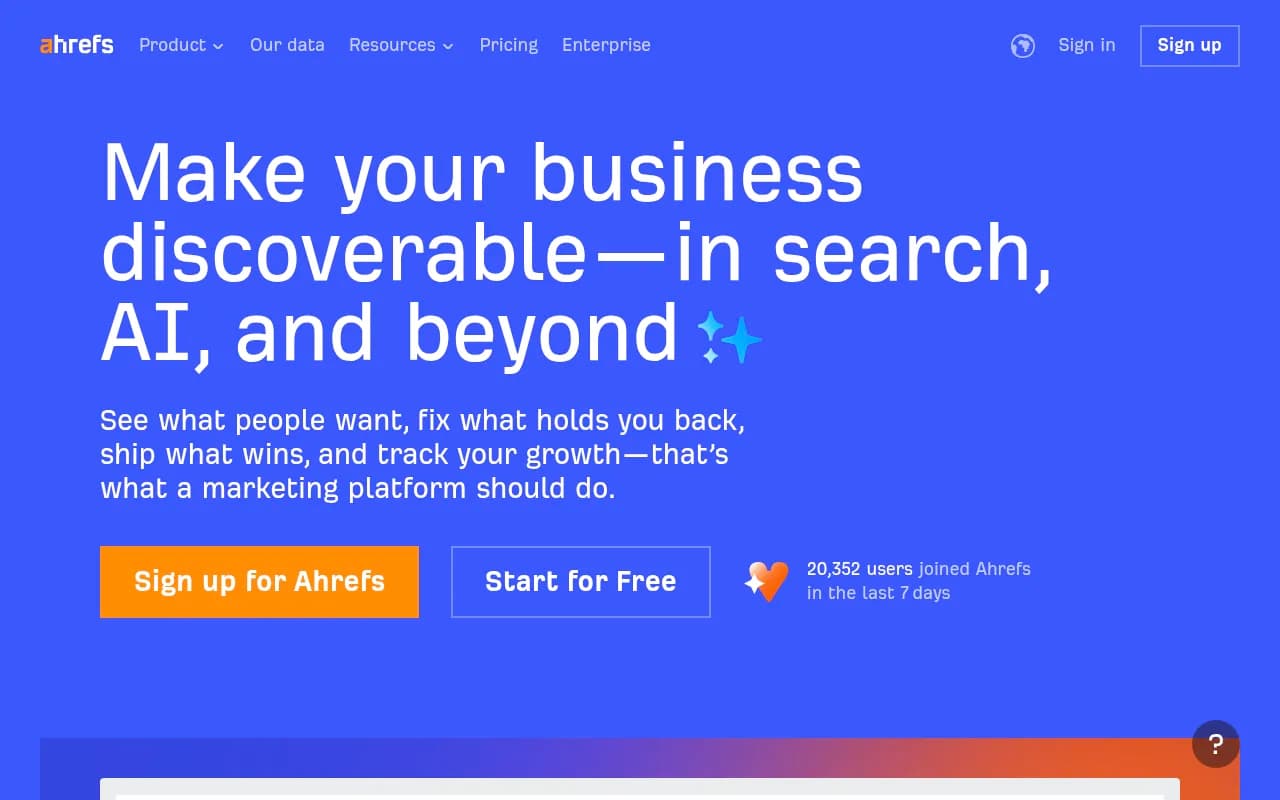
On the AEO side, Ahrefs launched Brand Radar, which tracks brand mentions in AI search results. It's a real feature, not just marketing copy. But it has two meaningful limitations:
- The prompts it monitors are fixed — you can't input your own queries or track the specific questions your customers are actually asking AI models.
- There's no AI traffic attribution. You can see that your brand appeared in an AI response, but you can't connect that appearance to actual website visits or conversions.
Tim Soulo, Ahrefs' CMO, wrote a breakdown of AI SEO tools in February 2026 that's worth reading for the honest framing: he distinguishes between tools that use AI to speed up traditional SEO tasks and tools that track whether AI engines actually mention your brand. Ahrefs Brand Radar sits in the second category, but it's an early version of what that tracking could be.
What Moz can (and can't) do for AEO
Moz Pro is the simplest of the three to evaluate for AEO: it doesn't really have AEO features yet. It's a solid mid-market SEO platform — good for teams that want a clean interface without the complexity of Semrush or Ahrefs, and the Domain Authority metric is still widely used as a benchmark.
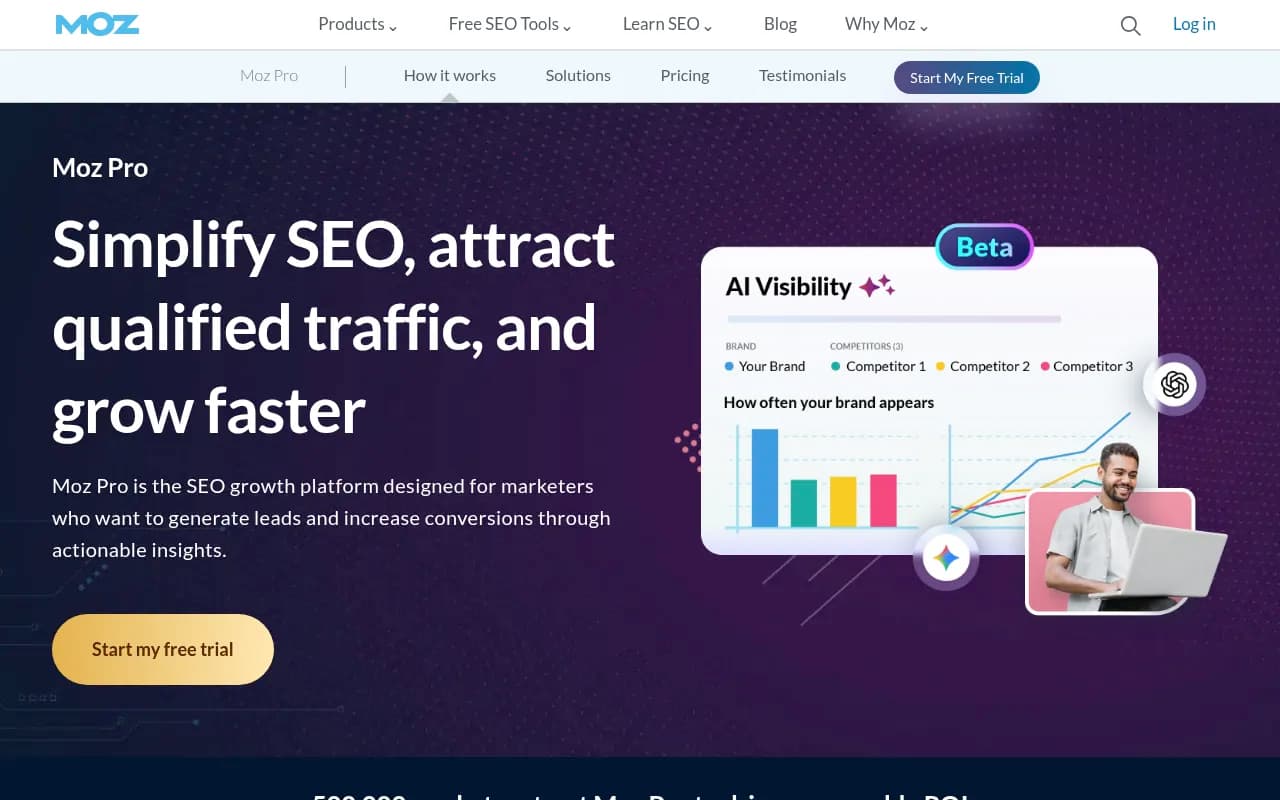
But for AI search visibility, Moz has the least to offer. There's no AI monitoring, no citation tracking, no prompt analysis. If you're evaluating tools specifically for AEO, Moz isn't in the conversation yet.
That said, Moz's core value proposition hasn't changed: it's the most approachable all-in-one SEO tool for teams that don't need enterprise-level depth. Keep it for what it does well.
The honest comparison
Here's a direct look at how the three traditional tools stack up against what AEO actually requires:
| Capability | Semrush | Ahrefs | Moz Pro |
|---|---|---|---|
| Keyword research | Excellent | Excellent | Good |
| Backlink analysis | Very good | Best in class | Good |
| Technical SEO audits | Very good | Good | Basic |
| Google rank tracking | Excellent | Very good | Good |
| AI Overview monitoring (Google) | Partial | No | No |
| ChatGPT/Perplexity citation tracking | No | Limited (Brand Radar) | No |
| Custom prompt monitoring | No (fixed prompts) | No (fixed prompts) | No |
| AI crawler log analysis | No | No | No |
| Content gap analysis for LLMs | No | No | No |
| AI traffic attribution | No | No | No |
| Reddit/YouTube citation insights | No | No | No |
The pattern is clear. These tools were built for a world where Google's algorithm was the only thing that mattered. They're adding AI features at the edges, but the core data model hasn't changed.
What purpose-built AEO tools actually do differently
The newer category of AEO platforms was designed from the ground up to answer the AI visibility question. The difference isn't just more features — it's a different underlying data model.
Promptwatch is a good example of what this looks like in practice. Rather than monitoring a fixed set of prompts, it tracks visibility across 10 AI models (ChatGPT, Perplexity, Claude, Gemini, Grok, DeepSeek, Copilot, Meta AI, Google AI Overviews, and Google AI Mode), with over 1.1 billion citations, clicks, and prompts processed. The platform shows you which specific pages are being cited, by which models, and how often — then helps you act on that data through content gap analysis and AI-native content generation.

That last part matters. Most monitoring tools show you where you're invisible. Promptwatch's Answer Gap Analysis shows you the specific prompts competitors rank for that you don't, and its built-in writing agent generates content engineered to get cited — grounded in real citation data rather than generic SEO optimization.
Other purpose-built tools worth knowing:
Profound focuses on enterprise AI visibility tracking with strong brand monitoring across multiple LLMs.

AthenaHQ covers 8+ AI search engines and is particularly strong for teams that want clean dashboards and structured monitoring.

Otterly.AI is one of the more affordable entry points for AI visibility monitoring, though it's primarily a monitoring tool without content generation.

Peec AI is worth noting for multilingual and multi-region monitoring — useful for brands operating across markets.

SE Ranking has built out an AI visibility toolkit alongside its traditional SEO features, making it one of the more complete hybrid options if you want to consolidate tools.
How to think about your stack in 2026
The practical answer for most teams isn't "replace Semrush with an AEO tool." It's "keep your SEO foundation and add an AEO layer."
Here's how that breaks down by team type:
Small teams and solo marketers: Start with one solid SEO tool (Semrush or Ahrefs) and add an affordable AEO monitor. Otterly.AI or Peec AI work at lower budgets. If you're serious about content optimization for AI search, Promptwatch's Essential plan at $99/month covers the basics.
Mid-market teams: You probably already have Semrush or Ahrefs. The question is whether your AI visibility is a real priority or a nice-to-have. If it's a priority, a dedicated platform with content gap analysis and citation tracking is worth the investment. The monitoring-only tools will tell you you're invisible; they won't tell you how to fix it.
Agencies: You need multi-client reporting, prompt customization, and ideally white-label options. Search Party and Promptwatch both have agency tiers. The key question is whether your clients are asking about AI visibility yet — because they will be.
Enterprise: BrightEdge and seoClarity have enterprise SEO with some AI visibility features. For deeper AEO work, Profound and Promptwatch both handle enterprise scale.
The content question: where most teams get stuck
Here's the thing that doesn't get discussed enough in the Semrush-vs-AEO-tools debate: even if you know you're invisible in AI search, creating content that actually gets cited is a different skill than creating content that ranks in Google.
Google rewards keyword density, backlinks, and technical optimization. AI models cite content that is specific, authoritative, and directly answers the questions users are asking. The overlap is real but incomplete.
Surfer SEO and Clearscope are still useful for on-page optimization, but they optimize for Google's signals. Content engineered for AI citation needs to be structured differently — more direct answers, more specific data, more coverage of the exact questions AI models are trained to answer.
This is why the most useful AEO platforms aren't just trackers. They show you the specific prompts you're missing, then help you create content that addresses them. That's a different workflow than traditional SEO content production.
Bottom line
Semrush, Ahrefs, and Moz are not going away. For Google rankings, backlink analysis, and technical SEO, they're still the right tools. But they were built for a search paradigm that now represents roughly 60% of the picture, at best.
The 40% (and growing) that happens in AI answer engines requires different data, different content strategy, and different measurement. Traditional SEO tools are adding features at the margins, but none of them yet offer the citation tracking, AI crawler analysis, prompt monitoring, and content gap analysis that purpose-built AEO platforms provide.
If AI search visibility matters to your business — and for most brands in 2026, it should — the honest answer is that you need both layers. Keep your SEO foundation. Add an AEO platform that actually helps you act on what it finds, not just measure it.