Moz Pro Review 2026
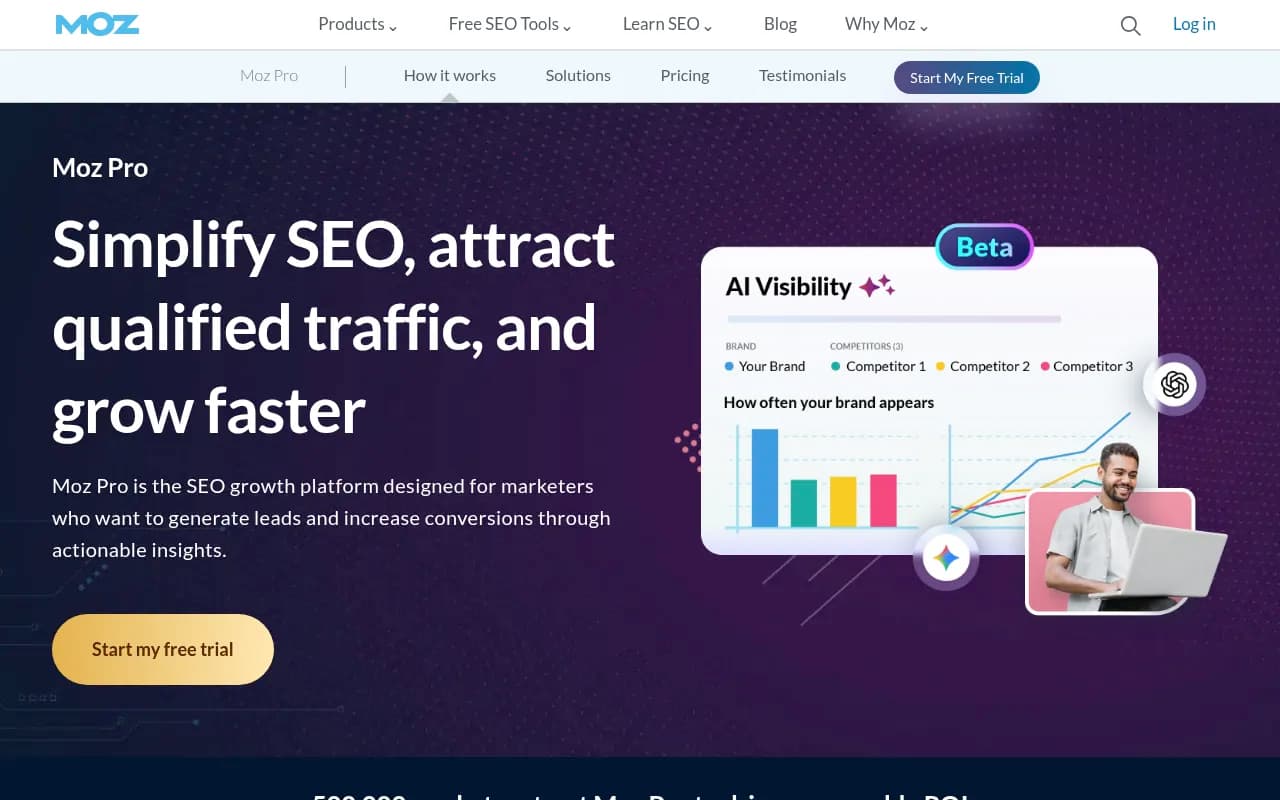
Moz Pro is a comprehensive SEO toolkit trusted by 500,000+ marketers to improve search visibility, drive qualified traffic, and grow conversions. Features keyword research, rank tracking, site audits, competitor analysis, and AI-powered search intent insights. Includes MozBar Premium, custom reporti
Summary
- Best for: In-house marketing teams, SEO agencies, and small-to-medium businesses looking for an all-in-one SEO platform with strong keyword research and site audit capabilities
- Strengths: Trusted data accuracy, beginner-friendly interface, excellent educational resources (Moz Academy, Whiteboard Friday), AI-powered search intent analysis, and comprehensive site crawling
- Limitations: Monitoring-only approach -- lacks content generation, AI crawler logs, and traffic attribution that Promptwatch offers. No AI search visibility tracking for ChatGPT, Perplexity, Claude, or other LLMs. Keyword data refresh can be slower than competitors like Ahrefs or Semrush.
- Pricing: Starts at $49/mo (Starter), scales to $299/mo (Premium). Free 30-day trial available.

Moz Pro has been a staple in the SEO industry since 2004, when Rand Fishkin and Gillian Muessig founded SEOmoz (later rebranded to Moz). Over two decades, it's evolved from a consulting firm into a full-fledged SEO software platform used by over 500,000 marketers worldwide. The company is known for creating industry-standard metrics like Domain Authority and Page Authority, and for its educational content -- the Beginner's Guide to SEO has been read by over 10 million people.
Moz Pro targets in-house marketing teams at small-to-medium businesses, SEO agencies managing multiple client sites, and solo consultants who need reliable data without the complexity of enterprise-grade tools. It's particularly strong for teams that value accuracy over volume and want a platform that won't overwhelm beginners. If you're managing 5-50 sites and need a balance of keyword research, technical SEO, and rank tracking, Moz Pro sits in a sweet spot.
Keyword Explorer and Research Tools
Keyword Explorer is Moz's flagship research tool and one of the most accurate in the industry. You enter a seed keyword and get back search volume, keyword difficulty (0-100 scale), organic CTR estimates, and priority scores that combine all three metrics. The data comes from Moz's proprietary index, which crawls billions of pages and processes clickstream data from real users.
What sets it apart is the Keyword Suggestions feature, which groups related keywords by search intent automatically using Moz AI. Instead of manually sorting through thousands of variations, you get clusters like "informational", "commercial", or "transactional" with one click. This saves hours when building content strategies. The SERP Analysis tab shows you exactly who's ranking for each keyword, their Domain Authority, page-level metrics, and how many backlinks they have. You can export all of this into CSV or push it directly into a Campaign for tracking.
Keyword Explorer also includes a Questions feature that surfaces "how", "what", "why" queries related to your topic -- useful for FAQ sections and featured snippet opportunities. The tool caps keyword lookups based on your plan tier (Starter gets 150 queries/month, Premium gets 5,000), which can feel limiting if you're doing heavy research across multiple clients.
Rank Tracker and Search Visibility
Rank Tracker monitors your keyword positions across Google, Bing, and Yahoo in any location (country, state, city, or zip code level). You set up a Campaign, add your target keywords, and Moz checks rankings weekly by default. You can trigger on-demand updates if you need fresh data faster.
The Search Visibility Score is a proprietary metric that estimates how much traffic you're capturing based on your rankings and the search volume of tracked keywords. It's a single number that makes it easy to explain progress to clients or executives. The Competitive Research tab lets you add up to three competitors per Campaign and compare visibility side-by-side. You see which keywords they rank for that you don't, and vice versa.
One limitation: Moz's rank tracking updates are slower than Ahrefs or SEMrush. If you need daily or hourly rank checks (common for agencies running PPC tests or tracking volatile SERPs), you'll hit friction. The on-demand crawl feature helps, but it's not as real-time as competitors.
Site Crawl and Technical SEO
Site Crawl is Moz's technical audit tool. It crawls your site weekly (or on-demand) and flags issues like broken links, duplicate content, missing meta tags, slow page speed, and crawl errors. The dashboard categorizes issues by severity: Critical (blocks indexing), High (hurts rankings), Medium (best practice), and Low (nice-to-have).
Each issue comes with a plain-English explanation and step-by-step fix instructions. For example, if you have duplicate title tags, Moz shows you which pages are affected, why it matters, and how to rewrite them. This is where Moz shines for beginners -- the guidance is clear and actionable, not just a list of errors.
The On-Demand Crawl feature lets you re-crawl your site immediately after making fixes to validate changes. This is critical for agencies that need to prove work was completed. The crawl depth is generous (up to 3 million pages on Premium plans), but the crawler itself is slower than Screaming Frog or Sitebulb. If you're auditing a 500,000-page e-commerce site, expect crawls to take hours.
One major gap: Moz doesn't track AI crawler activity. You won't see logs of ChatGPT, Claude, Perplexity, or other LLM bots hitting your site. If you're optimizing for AI search visibility (GEO/AEO), you're flying blind. Promptwatch offers real-time AI crawler logs that show exactly which pages AI models are reading, how often, and what errors they encounter -- something Moz Pro lacks entirely.
Domain Overview and Competitive Analysis
Domain Overview gives you a snapshot of any website's SEO health: Domain Authority, total backlinks, ranking keywords, top pages, and linking domains. The new Moz AI features (Domain Search Theme and Domain Keyword Topics) analyze your site's content and surface the main topics you're ranking for, plus gaps where competitors are visible but you're not.
This is useful for quick competitive research. You can see a competitor's top-performing pages, the keywords driving their traffic, and their backlink profile. The SERP Analysis tool shows you the top 10 results for any keyword, with metrics like Page Authority, number of backlinks, and on-page optimization scores. You can compare your page against the top rankers and get a checklist of what to improve.
However, Moz's backlink index is smaller than Ahrefs or Majestic. You'll see fewer total backlinks and linking domains, which can make competitive analysis less comprehensive. For link building campaigns, most agencies use Ahrefs or SEMrush as their primary tool and Moz as a secondary check.
On-Page Grader and Content Optimization
On-Page Grader analyzes a specific page and gives it a score (0-100) based on how well it's optimized for a target keyword. It checks title tags, meta descriptions, header tags, keyword usage, image alt text, internal links, and page speed. You get a prioritized list of recommendations with impact estimates (e.g. "Adding keyword to H1 could improve ranking by 5%").
This is helpful for optimizing existing content, but it's reactive -- you're fixing pages that already exist. It doesn't help you create new content from scratch or identify content gaps. Moz doesn't have a content generation tool or AI writing assistant. If you want to close content gaps and create articles optimized for AI search engines, you'll need a separate tool. Promptwatch includes an AI writing agent that generates articles, listicles, and comparisons grounded in real citation data from 880M+ analyzed citations, designed specifically to rank in ChatGPT, Claude, Perplexity, and other AI models.
Brand Authority and Reputation Tracking
Brand Authority is a newer metric that measures how often your brand appears in search results compared to competitors. It's calculated using branded search volume, SERP presence, and click-through rates. The idea is to quantify brand strength in a way that correlates with customer trust and purchase intent.
This is useful for tracking brand-building campaigns, but it's limited to traditional search engines (Google, Bing). It doesn't track brand mentions in AI-generated answers from ChatGPT, Perplexity, Claude, Gemini, or other LLMs. As AI search adoption grows (ChatGPT now has 300M+ weekly active users), brands need to monitor where they're being cited in AI responses. Moz Pro doesn't offer this. Promptwatch tracks brand visibility across 10+ AI models, showing exactly which prompts trigger citations of your brand, how often, and in what context.
Custom Reports and Client Dashboards
Moz Pro includes a flexible reporting engine that lets you build white-label PDF reports or live dashboards. You can pull in data from Keyword Rankings, Site Crawl, Backlinks, and Page Optimization, then customize the layout, branding, and metrics. Reports can be scheduled to send automatically (weekly, monthly) or generated on-demand.
This is a major selling point for agencies. You can create different report templates for different client types (local businesses get rank tracking + citations, e-commerce gets technical SEO + product page optimization) and save them as presets. The reports look professional and are easy to understand, which helps with client retention.
One limitation: you can't pull in data from Google Analytics, Google Search Console, or other third-party tools. If you want a unified dashboard that combines SEO, traffic, and conversion data, you'll need to use Looker Studio or a dedicated reporting tool like AgencyAnalytics.
MozBar Premium and Browser Extension
Every Moz Pro subscription includes MozBar Premium, a Chrome extension that overlays SEO metrics on search results and any webpage you visit. You see Domain Authority, Page Authority, backlink counts, and on-page elements (title, meta, headers) without leaving your browser. It's like having Moz Pro in a sidebar.
This is incredibly useful for quick research. You're browsing a competitor's site and want to know their DA? One click. You're looking at a SERP and want to see which results have the most backlinks? It's right there. The free version of MozBar is limited to basic metrics; the Premium version (included with Pro) unlocks full data and removes usage caps.
Integrations and Ecosystem
Moz Pro integrates with Google Analytics, Google Search Console, and Google My Business for pulling in traffic and ranking data. There's no native integration with Slack, Zapier, or project management tools, which means you can't automate workflows or push alerts to other platforms. The Moz API is available for custom integrations, but it's a separate paid product (starts at $20/mo for Starter tier).
For agencies managing multiple tools, this lack of integration can be frustrating. You're manually exporting data from Moz and importing it into client dashboards or reporting tools. Competitors like SEMrush and Ahrefs have deeper integration ecosystems.
Who Is Moz Pro For
Moz Pro is best for in-house marketing teams at companies with 10-500 employees, SEO agencies managing 5-30 client sites, and solo consultants who want a reliable, beginner-friendly platform. It's particularly strong for teams that value data accuracy over volume, need excellent educational resources, and want a tool that won't overwhelm junior marketers.
It's a good fit for local businesses, SaaS companies, and content publishers who focus on traditional search engines (Google, Bing) and want to improve rankings, traffic, and conversions through keyword research, technical SEO, and rank tracking.
Moz Pro is NOT ideal for enterprise teams managing 100+ sites, agencies doing heavy link building (Ahrefs has a better backlink index), or brands that need to monitor AI search visibility. If you're optimizing for ChatGPT, Perplexity, Claude, or other AI models, Moz Pro won't help -- it has no AI search tracking, no AI crawler logs, no content gap analysis for AI citations, and no traffic attribution for AI-driven visitors. For that, you need a dedicated GEO/AEO platform like Promptwatch.
Pricing and Value
Moz Pro has four pricing tiers, all with a 30-day free trial:
- Starter: $49/mo ($39/mo annual). 1 Campaign, 50 keyword rankings tracked, 150 keyword queries/month, 5,000 pages crawled. Good for solo consultants or single-site businesses.
- Standard: $99/mo ($79/mo annual). 3 Campaigns, 300 keyword rankings, 1,500 keyword queries/month, 30,000 pages crawled. Best for small agencies or growing businesses.
- Medium: $179/mo ($143/mo annual). 10 Campaigns, 1,500 keyword rankings, 5,000 keyword queries/month, 100,000 pages crawled. Fits mid-sized agencies.
- Premium: $299/mo ($239/mo annual). 25 Campaigns, 3,000 keyword rankings, 15,000 keyword queries/month, 3 million pages crawled. For larger agencies or in-house teams managing many sites.
All plans include MozBar Premium, 24-hour support, and access to Moz Academy. The annual discount (20%) is significant if you're committing long-term.
Compared to competitors: Ahrefs starts at $129/mo (more expensive but better backlink data), SEMrush starts at $139.95/mo (more features but steeper learning curve), and Promptwatch starts at $99/mo (Essential plan with AI search visibility tracking, content gap analysis, and AI writing agent -- capabilities Moz lacks entirely).
Moz Pro is competitively priced for traditional SEO, but if you need AI search optimization, you'll need to add another tool to your stack.
Strengths
- Data accuracy: Moz is known for reliable, conservative estimates. Search volume and keyword difficulty are trustworthy, which matters when making strategic decisions.
- Beginner-friendly: The interface is clean, the guidance is clear, and the educational resources (Moz Academy, Whiteboard Friday, Beginner's Guide) are industry-leading. Great for teams with junior marketers.
- Keyword research: Keyword Explorer with AI-powered search intent grouping saves hours of manual work. The SERP analysis and competitor research are solid.
- Site audits: Site Crawl is thorough and the fix instructions are actionable. On-Demand Crawl lets you validate changes quickly.
- Custom reporting: Flexible, white-label reports that look professional and are easy to customize. Good for agencies.
- Support and community: 24-hour support from real people, active Q&A forum, and a strong community of SEO practitioners.
Limitations
- No AI search visibility tracking: Moz Pro doesn't monitor brand mentions or citations in ChatGPT, Perplexity, Claude, Gemini, or other AI models. As AI search grows, this is a critical blind spot. Promptwatch tracks visibility across 10+ AI models, shows which prompts trigger your brand, and provides content gap analysis to help you rank in AI answers.
- No AI crawler logs: You can't see when ChatGPT, Claude, or Perplexity bots crawl your site, which pages they read, or what errors they encounter. Promptwatch offers real-time AI crawler logs that show exactly how AI models discover and index your content.
- No content generation: Moz Pro helps you optimize existing pages but doesn't help you create new content. There's no AI writing assistant or content gap analysis. Promptwatch includes an AI writing agent that generates articles optimized for AI search engines, grounded in real citation data.
- No traffic attribution for AI search: You can't track visitors coming from ChatGPT, Perplexity, or other AI models. Promptwatch offers traffic attribution via code snippet, GSC integration, or server log analysis.
- Smaller backlink index: Moz's backlink data is less comprehensive than Ahrefs or Majestic. For link building campaigns, you'll likely need a second tool.
- Slower rank tracking: Weekly updates by default, and on-demand updates aren't as fast as Ahrefs or SEMrush. Not ideal for agencies tracking volatile SERPs.
- Limited integrations: No native Slack, Zapier, or project management integrations. The API is a separate paid product.
Bottom Line
Moz Pro is a solid all-in-one SEO platform for teams that prioritize data accuracy, ease of use, and educational resources. It's best for in-house marketers, small-to-medium agencies, and consultants managing 5-50 sites who focus on traditional search engines (Google, Bing) and want reliable keyword research, technical audits, and rank tracking.
However, Moz Pro is a monitoring-only tool -- it shows you data but doesn't help you take action. It lacks content generation, AI search visibility tracking, AI crawler logs, and traffic attribution for AI-driven visitors. If you're optimizing for ChatGPT, Perplexity, Claude, or other AI models (which is increasingly critical as AI search adoption grows), Moz Pro won't help. For that, you need a dedicated GEO/AEO platform like Promptwatch, which offers content gap analysis, AI writing tools, real-time crawler logs, and visibility tracking across 10+ AI models.
Best use case in one sentence: Moz Pro is ideal for small-to-medium teams that want a beginner-friendly, accurate SEO toolkit for traditional search engines, but need to pair it with a GEO platform like Promptwatch to stay visible in AI search.
Tags:
Frequently asked questions
What is Moz Pro and what does it do?
How much does Moz Pro cost?
Who is Moz Pro best for?
Does Moz Pro offer a free trial?
What are the main features of Moz Pro?
How does Moz Pro compare to Ahrefs and Semrush?
What is Domain Authority in Moz Pro?
Does Moz Pro include educational resources?
Similar and alternative tools to Moz Pro