Key takeaways
- Local SEO in 2026 requires visibility in both Google's local pack and AI search engines like ChatGPT, Perplexity, and Gemini -- most traditional local SEO tools only cover the former
- BrightLocal is the strongest all-around platform for agencies and multi-location businesses that need citation management, rank tracking, and review monitoring in one place
- Semrush Local is the best choice if you're already paying for Semrush and want local features without adding another subscription
- Moz Local is the simplest option for small businesses that just need citation distribution to major data aggregators -- nothing more
- Yext is built for enterprise-scale listing management across 200+ directories, but the price reflects that
- None of these four tools offer deep AI search visibility tracking -- for that, you'll need a dedicated GEO platform alongside your local SEO stack
Local SEO used to mean one thing: show up in Google Maps. Get your citations consistent, collect reviews, optimize your Google Business Profile, and you'd rank in the local pack. That was the game.
In 2026, the game has two fields. The local pack still matters -- a lot. But AI search engines are now a meaningful source of local discovery. Someone asks ChatGPT "best dentist near me in Austin" or asks Perplexity to recommend a plumber, and those answers pull from a completely different set of signals than Google Maps. If you're only optimizing for one, you're leaving traffic on the table.
The tools in this guide -- BrightLocal, Semrush Local, Moz Local, and Yext -- are the four most widely used local SEO platforms. They're all solid at traditional local SEO. But they differ significantly in depth, price, and how much they've adapted to the AI search reality. Here's a straight comparison.
What actually matters in a local SEO tool right now
Before getting into the platforms, it's worth being clear about what you're evaluating. Local SEO tools generally cover some combination of these areas:
- Citation management (building and syncing your NAP data across directories)
- Local rank tracking (tracking where you appear in the local pack and organic results)
- Google Business Profile management and auditing
- Review monitoring and response
- AI search visibility (tracking how AI engines mention and recommend your business)
- Reporting and white-labeling (especially relevant for agencies)
No single tool does all of these equally well. The right choice depends on which of these you actually need -- and how much you're willing to pay.
BrightLocal
BrightLocal is the most widely used dedicated local SEO platform, and for good reason. It covers more ground than any other tool in this comparison: citation auditing, citation building, local rank tracking, GBP auditing, review monitoring, and white-label reporting for agencies.
The rank tracker is genuinely useful. You can track rankings at the city, state, or zip code level, and the geo-grid view shows you how you rank across different parts of a city -- not just one average position. If you manage a business with a physical location and you want to know whether you rank in the northwest corner of town versus the southeast, BrightLocal can show you that.
Citation management is where BrightLocal has historically been strongest. The platform audits your existing citations, identifies inconsistencies, and lets you build new ones through their managed service. One thing worth knowing: BrightLocal's citation building is partly manual (they have a team that does the work), which means it's slower than automated tools like Yext but often more accurate.
Review monitoring covers Google, Facebook, and dozens of other platforms. You get alerts when new reviews come in and can respond directly from the dashboard. It's not as sophisticated as a dedicated reputation management platform like Birdeye, but it's more than enough for most local businesses.
Where BrightLocal falls short: AI search visibility. The platform tracks Google rankings well, but it doesn't show you how your business appears in ChatGPT, Perplexity, or Gemini responses. If that matters to you -- and increasingly it should -- you'll need something else alongside it.
Pricing starts around $39/month for a single location, scaling up for agencies managing multiple clients. There's a 14-day free trial.
Best for: Agencies managing local SEO for multiple clients, multi-location businesses that need citation management and rank tracking in one place.
Semrush Local
Semrush Local is an add-on to the main Semrush platform, not a standalone product. That's both its strength and its limitation.
If you're already paying for Semrush (which starts at $139.95/month), adding Semrush Local gives you listing management, local rank tracking, and review management without adding a separate tool to your stack. The integration with Semrush's broader keyword research, site audit, and competitor analysis features is genuinely useful -- you can go from researching local keywords to tracking local rankings to auditing your site in one platform.
The listing management syncs your business information across major directories and data aggregators. It's not as comprehensive as Yext's 200+ directory network, but it covers the ones that actually matter for most businesses.
Where Semrush Local stands out is the connection to Semrush's AI search monitoring features. Semrush has been adding AI Overview tracking to its platform, so you can see when your content appears in Google's AI Overviews alongside traditional rankings. That's more AI visibility context than BrightLocal or Moz Local offer, though it's still focused on Google rather than ChatGPT or Perplexity.
The downside: if you're not already a Semrush user, the entry cost is high. You're paying for a full SEO platform to get local features. And Semrush's local-specific features aren't as deep as BrightLocal's -- the citation building, for example, is more limited.
Pricing for Semrush Local is around $20-40/month on top of a Semrush subscription.
Best for: Teams already using Semrush who want to add local SEO without managing a second tool.
Moz Local
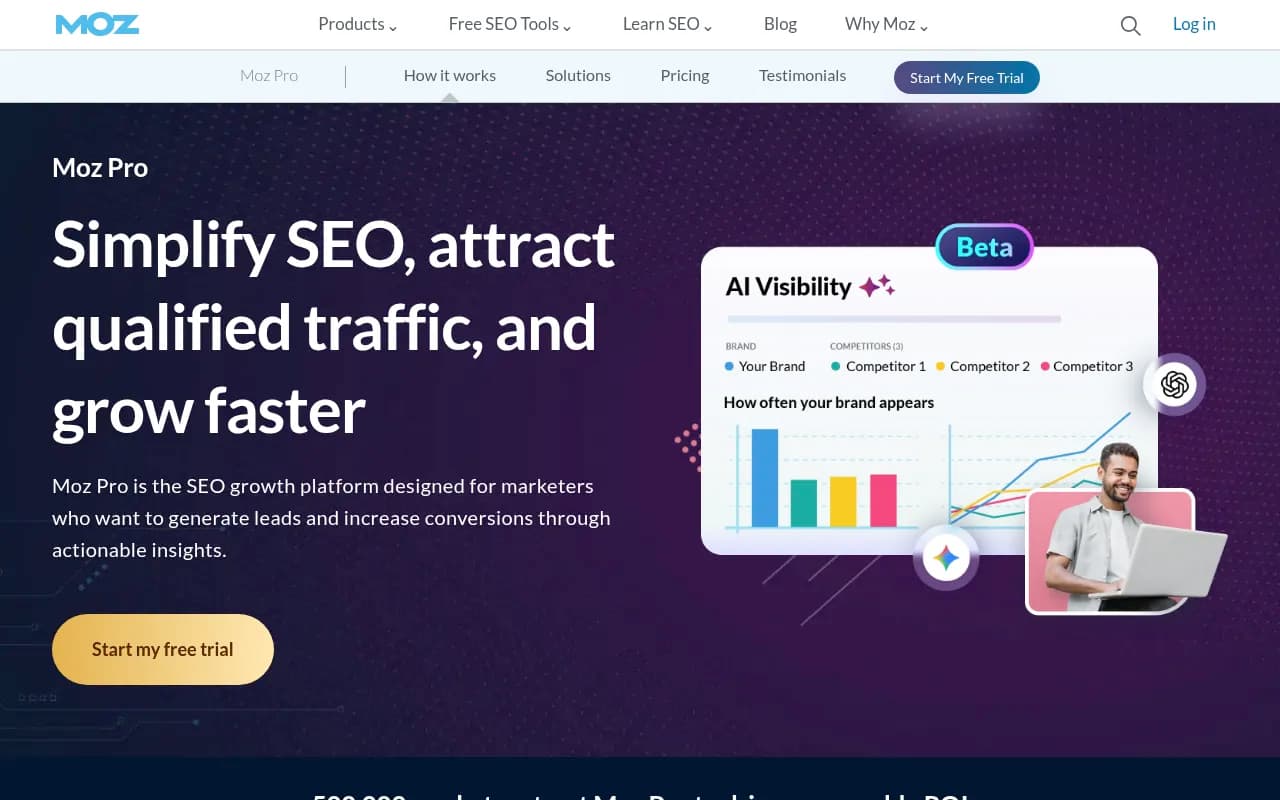
Moz Local is the simplest tool in this comparison. It does one thing well: distribute your business information to major data aggregators (Foursquare, Neustar Localeze, Factual, and others) and keep it consistent.
The setup is genuinely fast. You enter your business information, Moz Local pushes it to the aggregator network, and inconsistencies get cleaned up over time. For a small business that just needs its NAP data to be consistent across the web, this is probably all they need.
What Moz Local doesn't do well: advanced rank tracking, geo-grid visualization, deep citation auditing, or anything resembling AI search visibility. The reporting is basic. There's no white-label option for agencies. Review management exists but is limited compared to BrightLocal.
Moz Local is also the most affordable option here, starting around $14/month per location. That price point makes it attractive for small businesses with tight budgets, but you get what you pay for in terms of features.
One thing worth noting: Moz's broader SEO platform (Moz Pro) is a solid tool, but Moz Local and Moz Pro are separate products. If you want Moz's keyword research and site audit features alongside local SEO, you're paying for both separately.
Best for: Small businesses that need basic citation distribution and NAP consistency without complexity.
Yext
Yext operates at a different scale than the other tools here. It syncs your business information in real time across 200+ directories, apps, maps, and platforms -- including Apple Maps, Amazon Alexa, Bing, Google, Yelp, TripAdvisor, and dozens more. The real-time sync is the key differentiator: when you update your hours or address in Yext, it propagates immediately rather than waiting days or weeks.
For enterprise businesses with many locations, this is genuinely valuable. A restaurant chain with 50 locations can't afford to manually update each listing across 200 platforms every time something changes. Yext handles that automatically.
The platform also has a "Knowledge Graph" feature that structures your business data in a way that's meant to help AI and voice search engines understand your business better. Yext has been positioning this as an AI search readiness feature, and there's some merit to it -- structured, consistent data does help AI engines understand what your business is and where it operates.
The catch is price. Yext is expensive. Plans start around $199/year per location for basic features, and enterprise pricing can run into thousands per month for large multi-location brands. For a single-location small business, it's hard to justify the cost when BrightLocal or Moz Local can handle citation management at a fraction of the price.
There's also a lock-in concern that comes up frequently in local SEO communities: when you cancel Yext, your listings can revert to their pre-Yext state because Yext maintains control of those listings while you're a customer. That's worth understanding before committing.
Best for: Enterprise brands and franchise systems with many locations that need real-time listing management at scale.
Head-to-head comparison
| Feature | BrightLocal | Semrush Local | Moz Local | Yext |
|---|---|---|---|---|
| Citation management | Strong (manual + managed) | Basic | Aggregator-focused | Real-time, 200+ directories |
| Local rank tracking | Yes (geo-grid) | Yes | Limited | Limited |
| GBP auditing | Yes | Basic | No | No |
| Review monitoring | Yes | Yes | Basic | Yes |
| White-label reporting | Yes | No | No | No |
| AI search visibility | No | Partial (Google AI Overviews) | No | Partial (structured data) |
| Multi-location support | Yes | Yes | Yes | Yes (enterprise-focused) |
| Starting price | ~$39/mo | ~$20/mo add-on | ~$14/mo | ~$199/yr per location |
| Best for | Agencies, multi-location | Existing Semrush users | Small businesses | Enterprise / franchise |
The AI search gap all four tools share
Here's the honest assessment: none of these four tools give you real visibility into how AI search engines are treating your business. They're all built around Google -- the local pack, Google Maps, Google Business Profile. That made complete sense until recently.
But when someone asks ChatGPT for a restaurant recommendation, or Perplexity surfaces a local service provider, those answers aren't coming from the same signals as Google Maps. They're pulling from web content, reviews, citations across the broader web, and how well your business is represented in the sources AI models trust.
Tracking that requires a different kind of tool. Platforms like Promptwatch are built specifically to monitor how brands appear in AI search engines -- showing you which prompts trigger mentions of your business, which AI models cite you, and what content gaps are keeping you invisible in AI responses.

For local businesses that are serious about AI search visibility, the practical approach in 2026 is to run a traditional local SEO tool (BrightLocal or Semrush Local, depending on your situation) alongside a dedicated AI visibility platform. They're solving different problems.
Which tool should you actually use?
The answer depends almost entirely on your situation:
You're an SEO agency managing local clients: BrightLocal. The white-label reporting, citation management depth, and geo-grid rank tracking are built for exactly this use case. Nothing else in this comparison comes close for agency workflows.
You're already paying for Semrush: Add Semrush Local before you consider a separate tool. The integration is convenient and the cost is relatively low if you're already in the Semrush ecosystem.
You're a small business with one location and a tight budget: Moz Local gets the job done for citation consistency. If you want more depth -- especially rank tracking -- BrightLocal's entry plan is worth the extra cost.
You're a franchise or enterprise brand with 20+ locations: Yext's real-time sync and scale justify the price. Just understand the lock-in dynamics before you commit.
You want AI search visibility alongside local SEO: None of these four tools fully solve that. You'll need to layer in a dedicated GEO platform to track and improve how your business appears in ChatGPT, Perplexity, Gemini, and other AI engines.
A few things worth watching in 2026
Local SEO is changing faster than it has in years. A few trends that are reshaping how these tools need to evolve:
Google's AI Mode is now a significant part of how people discover local businesses. When someone uses AI Mode in Google Search, the results look different from the traditional local pack -- and the ranking factors aren't identical. Semrush has the most visibility into this given its Google integration, but even Semrush's coverage here is partial.
Review signals are becoming more important for AI recommendations. AI engines frequently pull from review platforms when recommending local businesses, which means your review volume and sentiment on Google, Yelp, and other platforms affects your AI search visibility -- not just your local pack rankings.
Structured data and entity clarity matter more than they used to. Yext's Knowledge Graph approach is directionally correct even if the execution is expensive. Making sure AI engines understand exactly what your business is, where it operates, and what it offers is increasingly important.
The tools that adapt to these shifts will stay relevant. The ones that remain purely Google-focused will become less useful as AI search grows.
Bottom line
BrightLocal is the most complete local SEO platform for most use cases. Semrush Local is the pragmatic choice if you're already in the Semrush ecosystem. Moz Local is fine for simple citation management. Yext makes sense at enterprise scale.
But all four of them were built for a world where local search meant Google Maps. That world still exists -- but it's no longer the whole picture. If AI search visibility matters to your business (and for most local businesses, it increasingly does), plan for a two-tool approach: one for traditional local SEO, one for AI search monitoring and optimization.