Key takeaways
- Most traditional SEO tools (Google Search Console, Ahrefs, Semrush) don't track AI citations at all -- you need a dedicated AEO/GEO platform to see where you stand in ChatGPT, Perplexity, and Google AI Overviews
- The AEO tool market now has 200+ platforms, but they vary wildly: some only monitor, others help you act on what they find
- For unified multi-model tracking in a single dashboard, the strongest options in 2026 are Promptwatch, Profound, AthenaHQ, SE Visible, Writesonic, and Nightwatch
- The most important differentiator isn't which AI models a tool covers -- it's whether it helps you close the gap after you find it
- Free trials are widely available; most teams should start with one and validate prompt coverage before committing
If you've been manually running queries in ChatGPT and copy-pasting results into a spreadsheet, you already know this approach doesn't scale. The problem isn't effort -- it's that AI responses change constantly, vary by phrasing, and differ across models. What ChatGPT says about your brand today might be completely different from what Perplexity says, and neither matches what Google AI Overviews shows.
That's the core problem AEO tools exist to solve. But not all of them solve it equally well.
This guide covers the best tools in 2026 for tracking your AI search visibility across Google AI Overviews, ChatGPT, and Perplexity in a single dashboard -- what each does well, where it falls short, and which type of team it suits.
What "unified dashboard" actually means (and why it matters)
When people say they want a single dashboard, they usually mean three things:
- See how your brand appears across multiple AI models without switching between tools
- Compare your visibility against competitors in the same view
- Track changes over time without manual work
That sounds simple, but it's technically hard. Each AI model has different APIs, different response structures, and different citation behaviors. Google AI Overviews, for instance, behaves very differently from Perplexity's answer format -- one pulls from indexed web content, the other synthesizes from a broader crawl with explicit citations. A tool that genuinely unifies these needs to normalize the data in a way that's actually comparable.
Some tools in this space do that well. Others show you a dashboard with multiple tabs and call it "unified." Worth knowing the difference before you pay.
The tools worth considering in 2026
Promptwatch
Promptwatch monitors 10 AI models -- ChatGPT, Perplexity, Google AI Overviews, Google AI Mode, Claude, Gemini, Grok, DeepSeek, Copilot, and Mistral -- and shows everything in one place. What separates it from most competitors isn't the coverage, it's what happens after you see the data.
The Answer Gap Analysis shows you exactly which prompts your competitors rank for that you don't. You see the specific questions AI models are answering without citing your content. From there, a built-in AI writing agent generates articles, listicles, and comparisons grounded in real citation data -- not generic SEO filler, but content engineered to get cited by these models specifically.
It also has AI crawler logs (real-time visibility into when ChatGPT, Claude, and Perplexity crawl your pages), prompt volume estimates, query fan-outs, and ChatGPT Shopping tracking. For teams that want to move from "we see the problem" to "we fixed it," this is the most complete loop available.
Pricing starts at $99/month for the Essential plan (1 site, 50 prompts, 5 articles), with Professional at $249/month and Business at $579/month.

Profound
Profound has a strong feature set and is one of the more established names in the space. It tracks brand visibility across major AI models and gives you share-of-voice data, competitor comparisons, and source attribution. The interface is clean and the data is reliable.
Where it falls short relative to Promptwatch: no Reddit or YouTube tracking (both of which directly influence AI citations), no ChatGPT Shopping monitoring, and no built-in content generation. It's a strong monitoring platform, but you'll need other tools to act on what it shows you. Pricing is also higher than most alternatives.

AthenaHQ
AthenaHQ covers 8+ AI search engines and does a good job of showing brand visibility trends over time. It's monitoring-focused -- you get clear dashboards, competitor tracking, and prompt-level data. The UI is polished and it's a reasonable choice for teams that primarily want visibility data.
The limitation is the same as Profound: it stops at the monitoring layer. There's no content gap analysis, no content generation, and no crawler logs. If your team already has a content workflow and just needs the data to feed it, AthenaHQ works. If you want the tool to help you close the gap, it doesn't go that far.

SE Visible
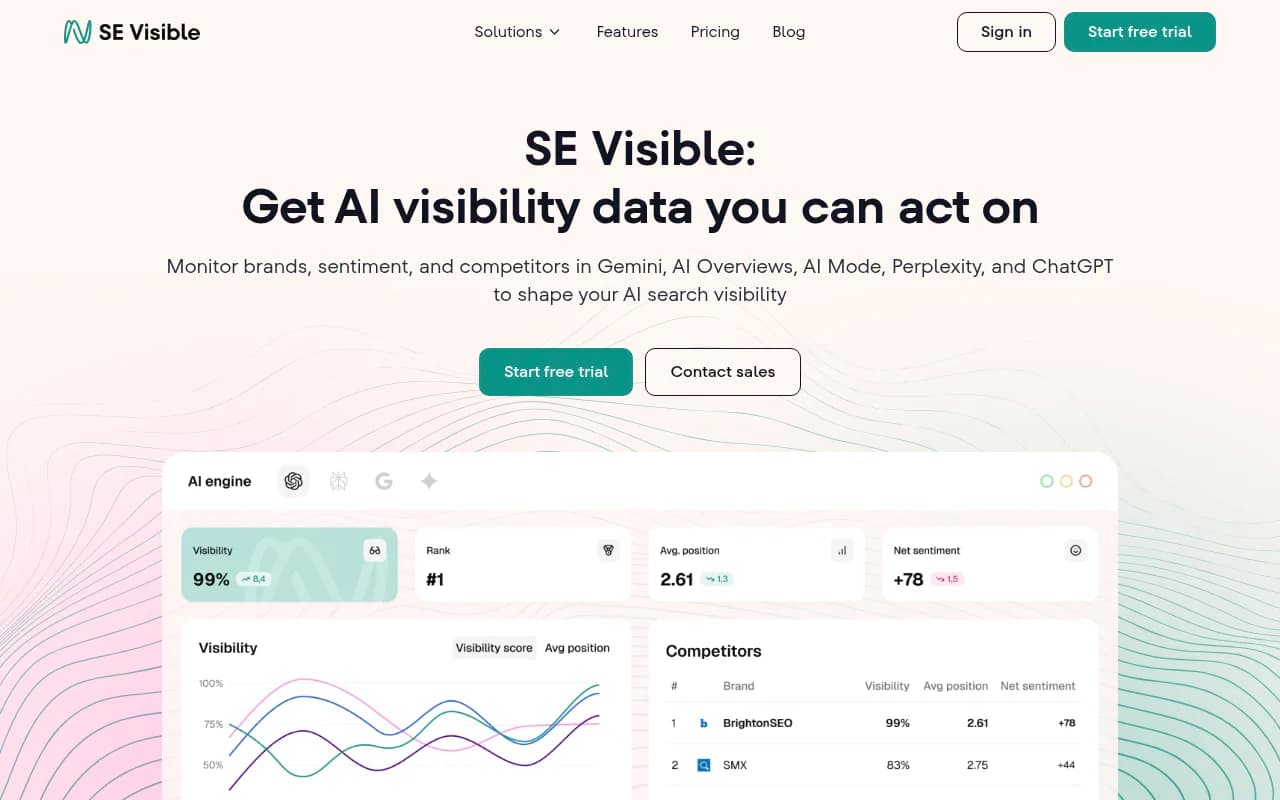
SE Visible (from SE Ranking) tracks AI Overviews, AI Mode, Gemini, ChatGPT, and Perplexity. It's one of the more affordable options at $99/month and does a solid job with competitor intelligence and sentiment scoring. The sentiment angle is actually useful -- knowing whether AI models describe your brand positively or negatively is something most tools ignore.
It's a good fit for marketing leaders and brand specialists who want strategic visibility data without a heavy enterprise price tag. Less suited for teams that need deep content optimization workflows.
Writesonic
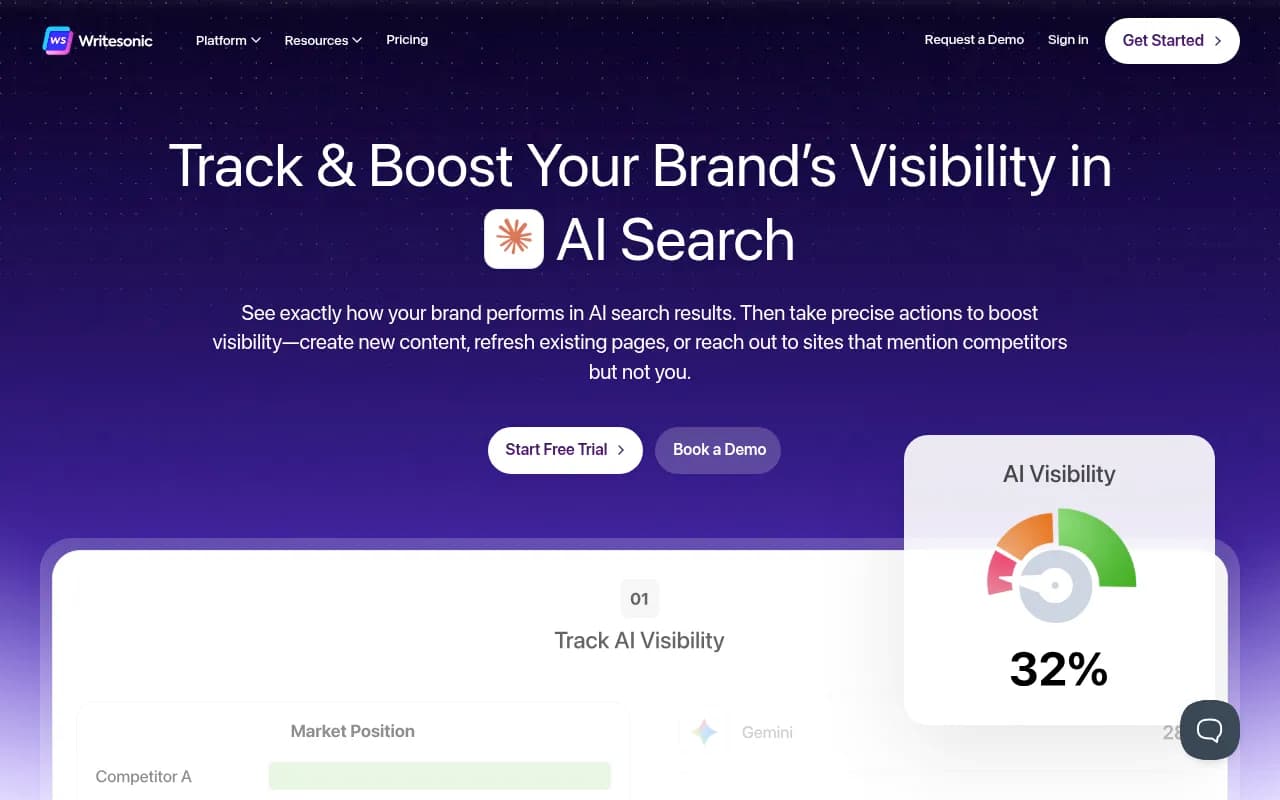
Writesonic has evolved from a content generation tool into a full GEO platform. It now combines AI visibility tracking with citation analysis and in-platform content optimization -- covering ChatGPT, Google AI Mode, AI Overviews, Gemini, Perplexity, and Claude. At $199/month, it sits in the mid-range.
The strength here is the workflow integration: you can see where you're missing citations and generate content to fill those gaps without leaving the platform. It's particularly well-suited to marketing agencies and enterprises that are already using Writesonic for content and want to add AI visibility tracking to the same stack.
Nightwatch
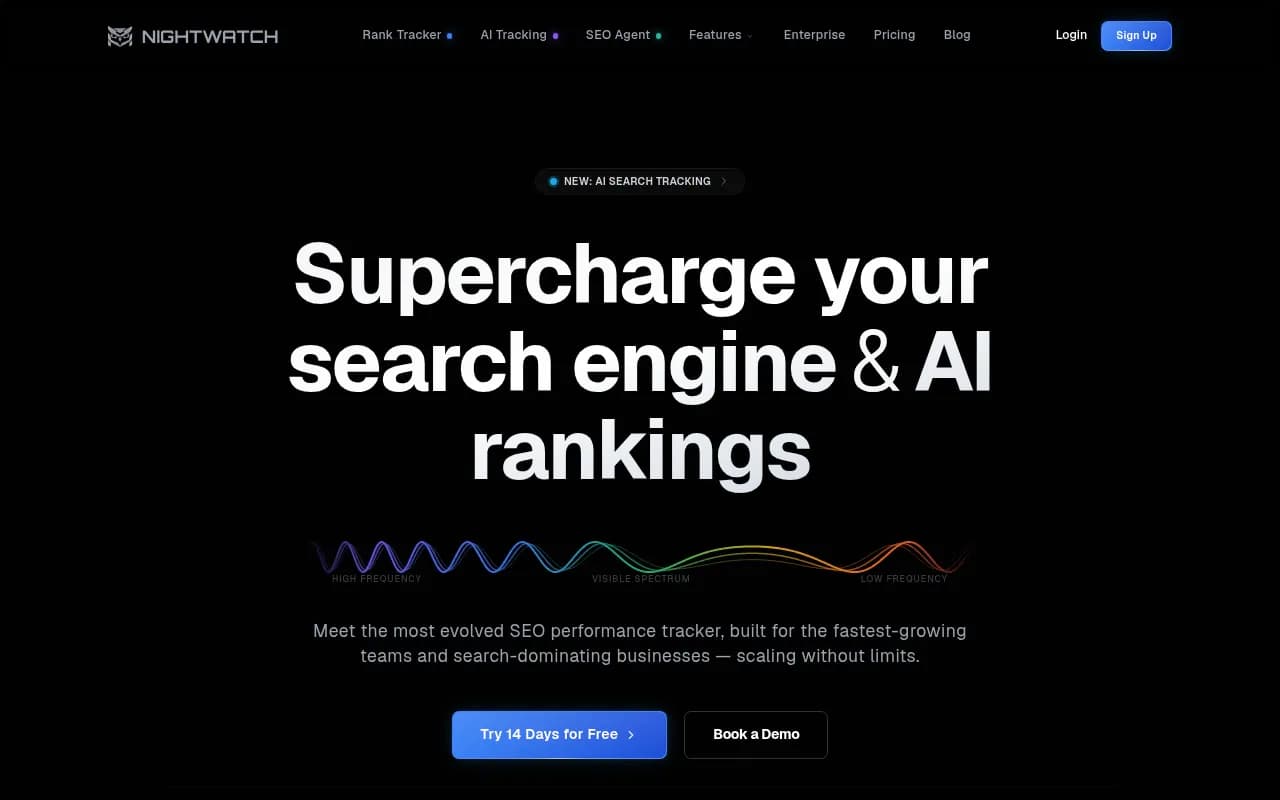
Nightwatch is interesting because it combines classic rank tracking with AI visibility monitoring. It covers ChatGPT, Google AI Overviews, Bing Copilot, Perplexity, and Claude. The base plan starts at $39/month with a $99/month AI add-on, making it one of the more affordable ways to get multi-model coverage.
It's particularly strong for agencies managing multiple clients and local SEO -- the zip-code level tracking is genuinely useful for brands with regional visibility concerns. If you're already using Nightwatch for traditional SEO, adding the AI layer is a natural extension.
Otterly.AI
Otterly.AI is one of the simpler, more affordable options in the market. It's built for teams that want basic AI visibility monitoring without a steep learning curve or a large budget. Coverage is solid for the price point.
The honest caveat: it's monitoring-only. No crawler logs, no visitor analytics, no content generation. For small teams or individuals who just want to know whether they're showing up in AI responses, it's a reasonable starting point. For teams that want to optimize, you'll outgrow it quickly.

Peec AI
Peec AI focuses on multi-language AI visibility tracking, which makes it stand out for international brands. If you're monitoring AI search presence across multiple markets and languages, Peec AI handles that better than most alternatives. It's a monitoring platform, so the same content-gap limitations apply, but the international coverage is genuinely differentiated.

Feature comparison table
| Tool | AI models covered | Content generation | Crawler logs | Reddit/YouTube tracking | ChatGPT Shopping | Starting price |
|---|---|---|---|---|---|---|
| Promptwatch | 10 (ChatGPT, Perplexity, AI Overviews, AI Mode, Claude, Gemini, Grok, DeepSeek, Copilot, Mistral) | Yes | Yes | Yes | Yes | $99/mo |
| Profound | 5+ | No | No | No | No | Higher |
| AthenaHQ | 8+ | No | No | No | No | Mid-range |
| SE Visible | 5 (AIOs, AI Mode, Gemini, ChatGPT, Perplexity) | No | No | No | No | $99/mo |
| Writesonic | 6 (ChatGPT, AI Mode, AI Overviews, Gemini, Perplexity, Claude) | Yes | No | No | No | $199/mo |
| Nightwatch | 5 (ChatGPT, AI Overviews, Copilot, Perplexity, Claude) | No | No | No | No | $39/mo + $99 add-on |
| Otterly.AI | 4-5 | No | No | No | No | Low |
| Peec AI | 4-5 | No | No | No | No | Mid-range |
What most tools get wrong
The AEO tool market has a monitoring problem. Most platforms were built to answer "are we showing up?" -- which is a reasonable first question. But it's not the question that moves the needle.
The more useful questions are: "Which prompts are we missing that competitors win?" and "What content do we need to create to fix that?" Very few tools help you answer those, and even fewer help you act on the answers.
This is why the monitoring-only tools, despite being technically solid, leave marketing teams stuck. You get a dashboard full of data and then... what? You export it, put it in a slide, and someone asks "so what do we do about it?" The tool doesn't help you answer that.
The tools that include content gap analysis and content generation (Promptwatch, Writesonic to a degree) close that loop. The ones that don't leave you to figure out the "so what" on your own.
How to choose the right tool for your situation
The right tool depends less on which AI models it covers (most serious platforms cover the big three: ChatGPT, Perplexity, and Google AI Overviews) and more on what your team needs to do with the data.
If you need to monitor and optimize
Go with Promptwatch. It's the only platform that covers the full loop: find gaps, generate content, track results. The crawler logs and Reddit/YouTube tracking give you signal that monitoring-only tools miss entirely.
If you're an agency managing multiple clients
Nightwatch is worth considering for its multi-client structure and affordable entry point. Promptwatch also has agency and enterprise pricing with multi-site support.
If you're already using Writesonic for content
The integrated GEO workflow in Writesonic makes sense -- you're already in the platform, and adding AI visibility tracking without switching tools has real value.
If you need multi-language coverage
Peec AI is the strongest option for international brands tracking AI visibility across languages and regions.
If you just want to start cheap and validate the channel
Otterly.AI or Nightwatch's base tier let you get visibility data without a large upfront commitment. Useful for proving the channel matters before investing in a full platform.
A few tools worth a closer look
Beyond the main contenders, a few tools in the catalog are worth knowing about depending on your specific use case:
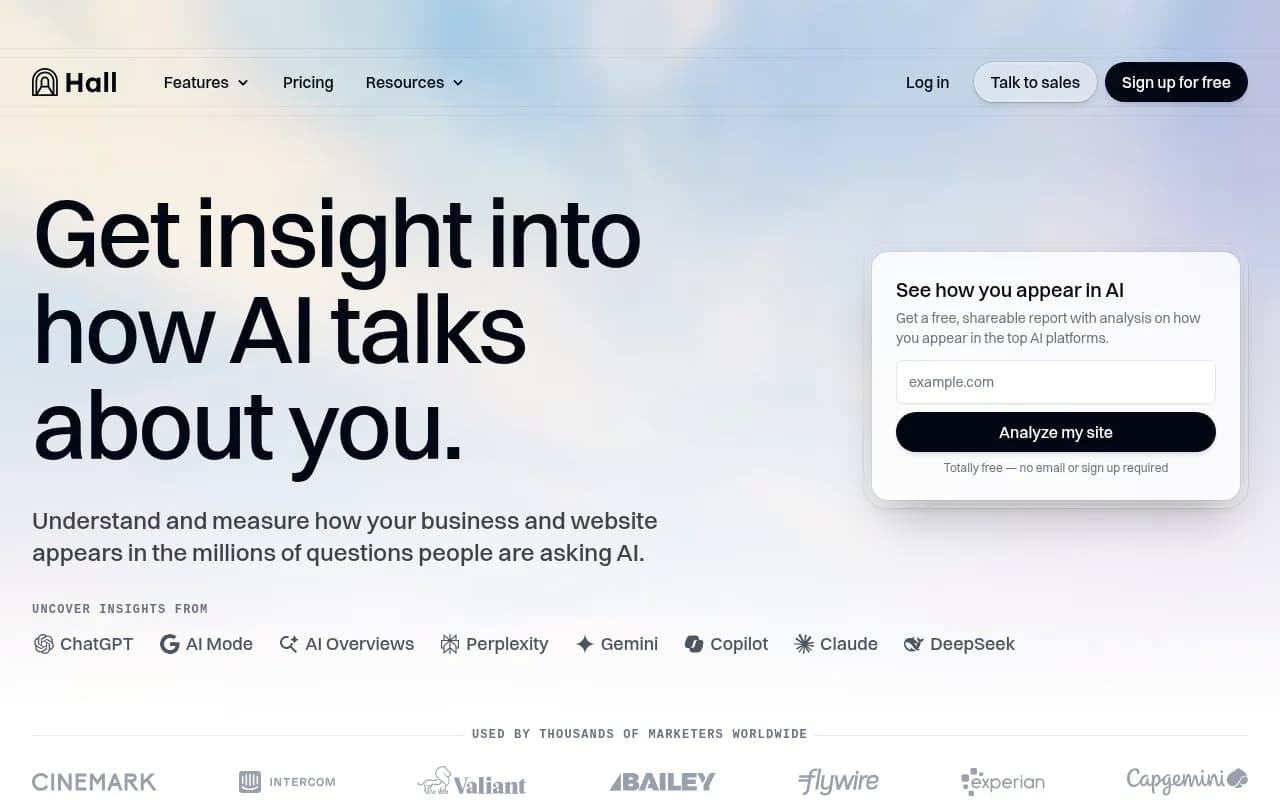
Hall AI monitors real-time AI citations and sends alerts when your brand is mentioned -- useful for reputation-sensitive brands that need to know immediately when something changes.
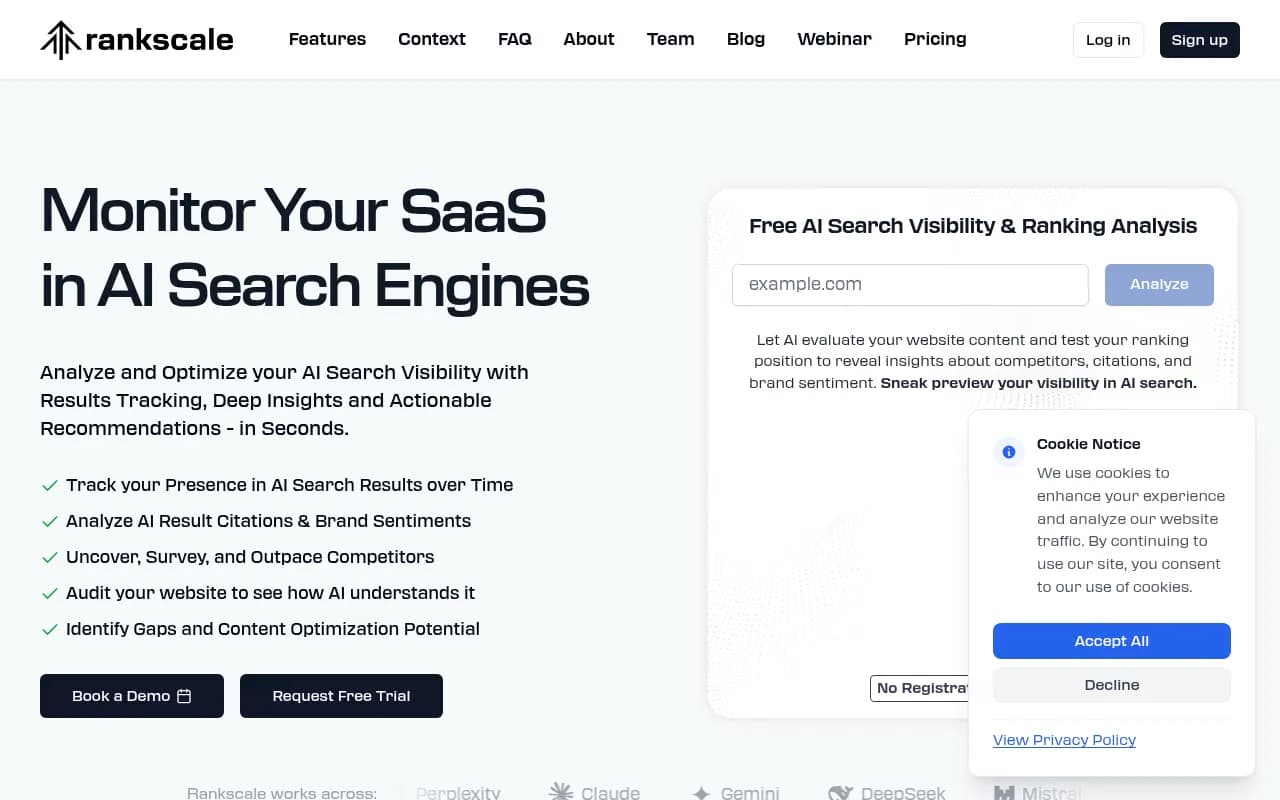
Rankscale focuses on AI search ranking and visibility with a clean interface suited to smaller teams.
Scrunch AI offers AI search visibility monitoring with a focus on modern brand tracking workflows.
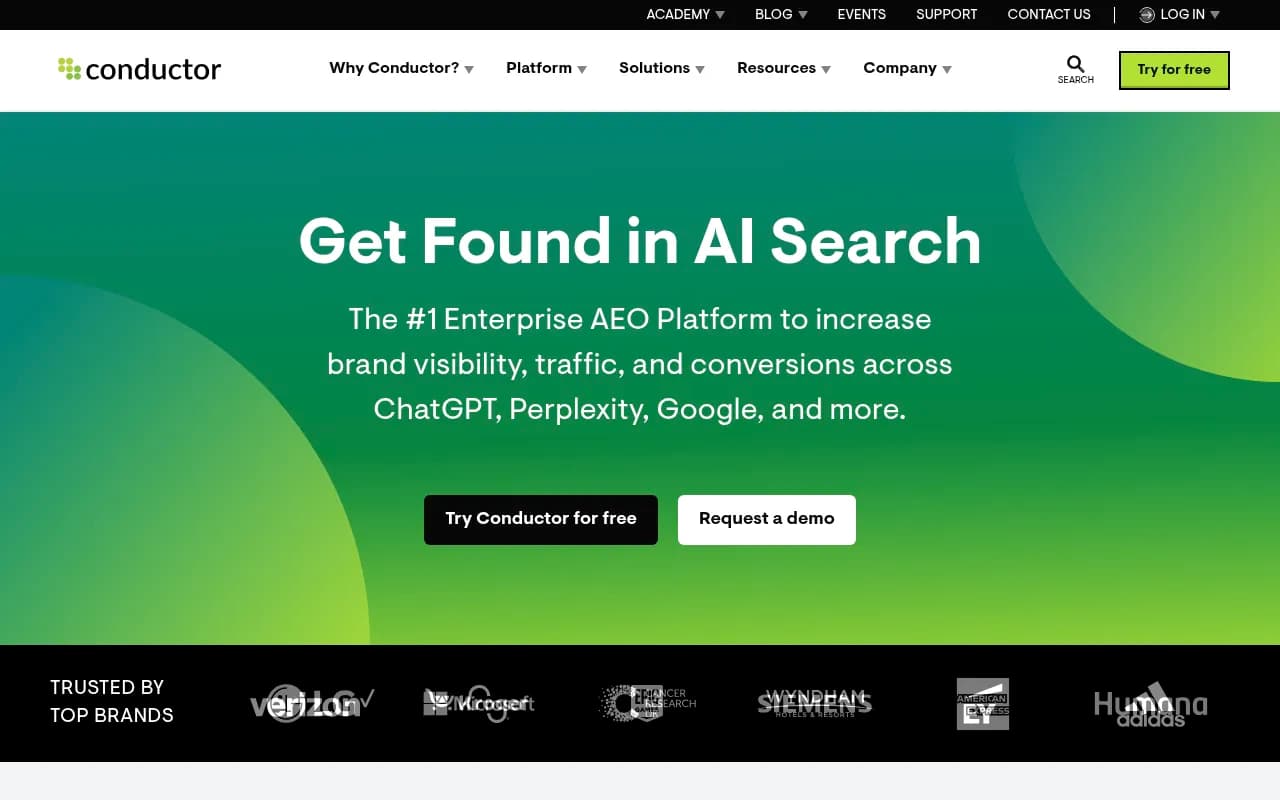
Conductor has persona customization for AI visibility tracking -- useful if you need to simulate how different customer types prompt AI models.
The Reddit reality check
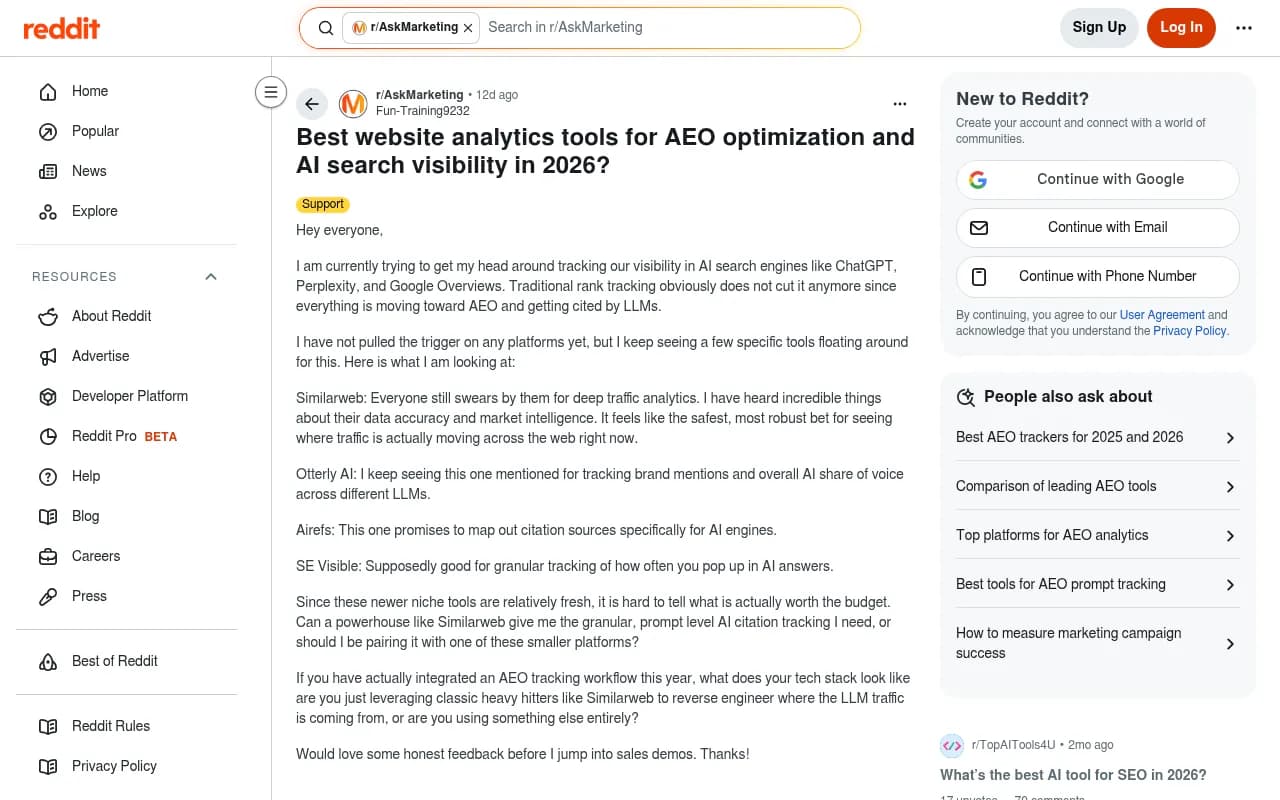
It's worth noting what practitioners are actually saying. A recent thread in r/AskMarketing asked about tracking AI visibility across ChatGPT, Perplexity, and Google Overviews. The consistent theme: people are frustrated that traditional analytics tools (GA4, Search Console) don't capture AI-referred traffic cleanly, and they're looking for tools that connect AI visibility to actual business outcomes -- not just citation counts.
That's a fair frustration. Citation counts are a leading indicator, but they don't tell you whether those citations are driving traffic or revenue. The tools that close this loop -- connecting AI visibility to actual site visits and conversions -- are still relatively rare. Promptwatch does this through a code snippet, Google Search Console integration, or server log analysis. Most other tools leave the attribution question unanswered.
Setting up your AEO tracking stack
Whatever tool you choose, here's a practical setup sequence:
- Start with your most important prompts -- the questions your customers actually ask that lead to purchase decisions. Don't try to track everything at once.
- Run a competitor baseline. Before you optimize anything, know where your competitors stand for those same prompts. This tells you whether you're behind, ahead, or in a category where nobody has AI visibility yet.
- Look at what's being cited. Which pages on your site (if any) are AI models referencing? Which competitor pages are they citing? This tells you what kind of content AI models prefer in your category.
- Identify the gap. Which prompts are competitors winning that you're not? That's your content priority list.
- Create and track. Publish content targeting those gaps, then watch whether your visibility scores improve over the following weeks.
This cycle -- find gaps, create content, measure results -- is the core workflow. The tool you pick should support all five steps, not just the first two.
Bottom line
The AEO tool market in 2026 is mature enough that you don't need to build anything custom or rely on manual tracking. But it's also crowded enough that picking the wrong tool means paying for a dashboard you can't act on.
For most marketing and SEO teams, the decision comes down to this: do you need a monitoring tool, or do you need an optimization platform? If you just need to know whether you're showing up in AI responses, several affordable tools handle that. If you need to understand why you're not showing up and fix it, the options narrow considerably -- and Promptwatch is the clearest choice in that category.
Start with a free trial, run your 10-20 most important prompts, and see what the data actually shows. The gap between where you think you stand in AI search and where you actually stand is usually surprising.