Promptmonitor Review 2026
Monitors brand mentions and visibility across AI search engines with comprehensive tracking features for AI-generated responses.
Summary
- Monitoring-only tool that tracks brand mentions across 8 AI models (ChatGPT, Claude, Gemini, Perplexity, DeepSeek, Grok, AI Overview, AI Mode) but lacks content gap analysis, AI content generation, and optimization features that Promptwatch offers
- Best for: Small businesses and agencies who need basic AI visibility tracking without optimization capabilities
- Pricing: $29/mo (Starter, 25 prompts), $39/mo (Growth, 50 prompts), $129/mo (Pro, 150 prompts) -- significantly cheaper than Promptwatch but with fewer actionable features
- Strengths: Clean interface, daily refresh, source contact extraction, AI bot analytics, GDPR-compliant web analytics built in
- Limitations: No Answer Gap Analysis to find content you're missing, no AI writing agent to create optimized content, no prompt volume/difficulty scoring, no Reddit/YouTube tracking, no ChatGPT Shopping monitoring, no traffic attribution beyond basic analytics

Promptmonitor launched as a GEO (Generative Engine Optimization) monitoring platform for businesses that want to track how AI search engines talk about their brand. The pitch is simple: your customers aren't Googling anymore, they're asking ChatGPT and Claude for recommendations. If AI doesn't mention you, you lose the sale. Promptmonitor shows you where you stand across 8 AI models, which sources AI cites, and how your competitors perform. It's built for marketers, agencies, and SMBs who need visibility into AI search without the complexity of a full optimization suite.
The tool is used by over 1,450 companies including SEO Aesthetic (founded by ex-Google/Microsoft engineer Steve Lee) and Media.ai. It's a Dutch company competing directly with Promptwatch, Otterly.AI, Peec.ai, AthenaHQ, and other GEO platforms. The core difference: Promptmonitor stops at monitoring. It tells you what's happening but doesn't help you fix it.
Core Features
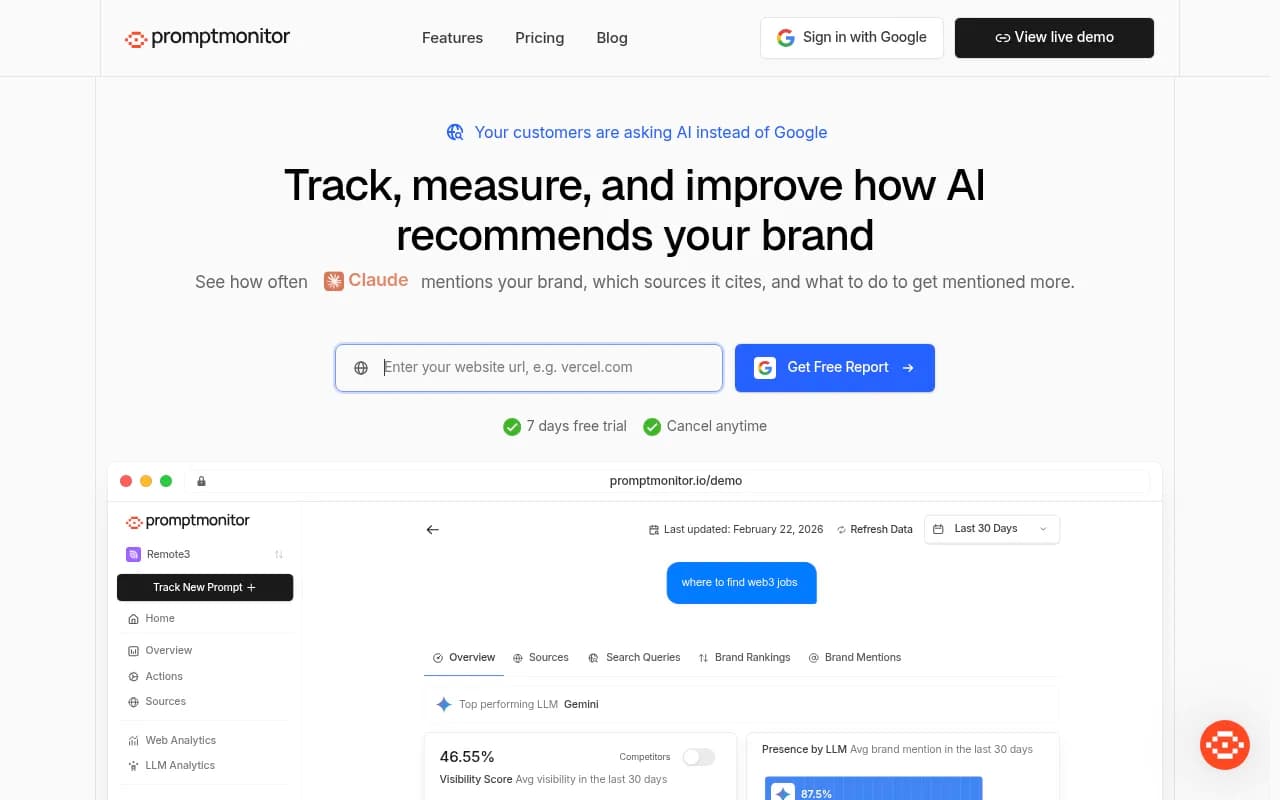
AI Visibility Tracking: Daily monitoring across ChatGPT (OpenAI), Claude (Anthropic), Gemini, Perplexity, DeepSeek, Grok, Google AI Overview, and Google AI Mode. You define prompts (e.g. "best marketing agencies in NYC"), and Promptmonitor queries each model daily to see if your brand gets mentioned. Results are aggregated into a Visibility Score (0-100%) calculated as (Presence Rate × 80%) + (Cross-Model Consistency × 20%). Presence Rate is how often you're mentioned across all responses. Cross-Model Consistency measures how many different AI models cite you. A score of 80-100% is excellent, 60-79% is good, 40-59% is fair, 20-39% is poor, 0-19% is critical. The dashboard shows a timeline chart of your score over 7/30/60/90 days or all time, broken down by model. You can see which model performs best for you (e.g. Gemini 87.5%, Perplexity 44.83%, ChatGPT 20.69% in the demo). This is useful for understanding where you're visible and where you're not, but it doesn't tell you why or what to do about it.
Source Analysis: For every prompt, Promptmonitor shows which websites, articles, Reddit threads, and YouTube videos AI models cited when generating their answers. Each source is listed with its URL, domain favicon, usage count (how many times AI cited it), last seen date, and first identified date. Sources are categorized as "Opportunity" (doesn't mention you), "You" (mentions your brand), "Competitor" (mentions a competitor), "Forum" (Reddit, Quora, etc.), "Blog", "E-commerce", or "Other". The demo shows 27 opportunity sources for the prompt "where to find web3 jobs" -- sites like web3.career, remote3.co, cryptocurrencyjobs.co that AI cites but don't mention the tracked brand. This is where Promptmonitor's value proposition starts to show: you can see exactly which publishers AI trusts, then decide whether to pitch them or outrank them. The tool extracts author emails and social profiles from each source so you can reach out directly. It also pulls SEO metrics (domain rating, backlinks) to help you decide: low authority sites you can outrank with better content, high authority sites you should pitch. This is solid for outreach planning but it's reactive -- you're chasing sources AI already found, not proactively creating content AI will cite.
Competitor Tracking: Add competitor brands to any prompt and see how often AI mentions them vs you. The demo shows a "Brand Rankings" tab with brands like Telegram, LinkedIn, Discord, CryptoJobsList, GitHub, Wellfound, Web3.career, Indeed, CryptoJobs, Glassdoor all scoring 100% visibility for the "where to find web3 jobs" prompt. Your brand (in the demo, Remote3) also scores 100%. This tells you who you're competing against in AI answers and whether you're keeping up. The "Brand Mentions" tab shows the actual text AI wrote about each brand, with sentiment labels (Positive, Neutral, Negative). For example, Gemini wrote "Remote3 specializes in Web3, crypto, blockchain, DeFi, and NFT jobs, listing thousands of new positions monthly" (Positive). ChatGPT wrote "Remote3 Focused on remote Web3 roles" (Neutral). You can read every mention to understand how AI frames your brand vs competitors. This is useful for reputation monitoring but again, it's descriptive, not prescriptive. You see the problem but Promptmonitor doesn't help you solve it.
Search Query Discovery: When AI models answer a prompt, they often search the web with specific queries. Promptmonitor captures those exact search queries so you can see what keywords AI is using to find sources. The demo shows 56 unique queries for "where to find web3 jobs", including "where to find web3 jobs" (27 uses), "web3 job boards" (13 uses), "web3 jobs" (9 uses), "decentralized jobs platforms" (6 uses), "blockchain developer jobs" (5 uses), etc. Each query is tagged with which AI models used it (Perplexity, Gemini, ChatGPT icons). This is valuable for content strategy -- you can create pages targeting these exact queries knowing AI will search for them. But Promptmonitor doesn't tell you which queries have high volume, which are easy to rank for, or which gaps you should prioritize. Promptwatch's Prompt Intelligence feature does this with volume estimates and difficulty scores. Promptmonitor just shows you the raw list.
AI Bot Analytics: Real-time logs of AI crawlers visiting your website. You see which pages ChatGPT, Claude, Perplexity, and other AI bots read, when they visited, and how often they return. This helps you understand if AI models are discovering your content and whether they're encountering errors. The feature requires adding a script to your site (similar to Google Analytics). It's GDPR-compliant, no cookies, no consent popups. This is a strong feature that most competitors (Otterly.AI, Peec.ai, AthenaHQ) don't offer. Promptwatch has AI Crawler Logs with more detail (errors, response codes, indexing status), but Promptmonitor's version is still useful for basic monitoring.
Web Analytics: Built-in, privacy-first web analytics that tracks visitors, page views, traffic sources, and referrals without cookies. You see how many visitors came from AI referrals (ChatGPT, Claude, Perplexity, etc.) vs Google, social, or direct. Promptmonitor claims "people coming from AI referrals are more likely to buy from you than from Google" but doesn't provide data to back this up. The analytics are basic -- no conversion tracking, no funnel analysis, no cohort reports. It's enough to see if AI traffic is growing but not enough to attribute revenue. Promptwatch's AI traffic attribution (code snippet, GSC integration, server log analysis) is more robust and connects visibility to actual revenue.
Geographic Targeting: Track AI responses by country, state, or city. AI gives different answers in different places, so you can set target markets (e.g. US, UK, Germany) and see how your visibility changes by location. Promptmonitor supports over 200 countries. This is useful for local businesses or brands with regional strategies. The demo doesn't show this feature in action, so it's unclear how granular the location targeting is (city-level? zip code?) or whether you can compare multiple locations side-by-side. Promptwatch offers multi-language and multi-region tracking with customizable personas that match how your actual customers prompt.
Contact Extraction: For every source AI cites, Promptmonitor extracts author emails and social profiles so you can pitch publishers to mention your brand. This is a time-saver for outreach campaigns. The demo shows a "Contact information for sources" screenshot but doesn't reveal how accurate the extraction is or what percentage of sources have contact info. If you're running a link-building or PR campaign, this feature is valuable. But it's still manual work -- you have to write the pitch, send the email, follow up. Promptwatch doesn't have this feature, but its Answer Gap Analysis tells you what content to create so you don't need to rely on outreach.
SEO Metrics for Sources: Each source comes with domain rating, backlinks, and content structure (headings, word count, etc.). This helps you decide whether to outreach or outrank. Low authority sites (DR 20-40) you can beat with better content. High authority sites (DR 70+) you should pitch. The demo shows this in a screenshot labeled "SEO metrics and content outline" but doesn't specify which SEO data provider Promptmonitor uses (Ahrefs? Moz? Majestic?). If you're already using Ahrefs or Semrush, this might be redundant. If you're not, it's a nice bonus.
Daily Refresh: All plans include daily data refresh. Your visibility score, brand mentions, sources, and search queries update every 24 hours. This is standard for GEO tools. Promptwatch also refreshes daily. Some competitors (Otterly.AI, Peec.ai) refresh less frequently on lower tiers.
Export to CSV: Download your data (prompts, sources, mentions, queries) as CSV files for custom reporting or analysis. All plans include this. Promptwatch has Looker Studio integration and API access for more advanced workflows.
Team Collaboration: Growth and Pro plans include unlimited team seats. Starter plan includes 1 seat. You can invite team members to view and manage projects. No role-based permissions (admin, editor, viewer) mentioned, so it's unclear if you can restrict access. Promptwatch also offers unlimited seats on higher tiers.
Email Reports: Weekly email reports summarizing your visibility score, top mentions, and new sources. All plans include this. Promptwatch sends similar reports.
Live Demo: Promptmonitor offers a public demo project (https://promptmonitor.io/share/c6975337-08aa-4ea6-8eb3-beb9e73fd074) so you can explore the interface before signing up. The demo tracks the prompt "where to find web3 jobs" and shows real data for Remote3 (a Web3 job board). This is a smart move -- most competitors don't offer live demos. You can see exactly what you're buying.
Who Is It For
Promptmonitor is built for small businesses, agencies, and marketers who need basic AI visibility tracking without the complexity or cost of a full optimization platform. If you're a solo founder, freelancer, or small agency managing 1-5 clients, and your main goal is to understand where you stand in AI search, Promptmonitor is a solid starting point. The $29/mo Starter plan (25 prompts, 1 project) is affordable enough to test the waters. The $39/mo Growth plan (50 prompts, 2 projects) works for small agencies tracking a handful of clients.
It's particularly useful for businesses in competitive niches where AI recommendations matter -- SaaS tools, local services (lawyers, dentists, contractors), e-commerce brands, consultants, and agencies. If potential customers are asking ChatGPT "best X in Y" and your competitors are getting mentioned but you're not, Promptmonitor will show you the gap. The source analysis and contact extraction features are valuable for PR and link-building campaigns. If your strategy is to pitch publishers and earn mentions, Promptmonitor gives you the data to prioritize outreach.
It's NOT for businesses that want to optimize their AI visibility proactively. If you need to know what content you're missing, which prompts to prioritize, or how to create content that AI will cite, Promptmonitor won't help. It shows you the problem but doesn't solve it. Promptwatch's Answer Gap Analysis, AI writing agent, and prompt intelligence features are designed for optimization, not just monitoring. If you're serious about ranking in AI search, you need a platform that helps you take action.
It's also not ideal for enterprises or large agencies managing 10+ clients. The Pro plan caps at 5 projects and 150 prompts for $129/mo. If you need more, you have to contact sales for a custom Agency plan. Pricing isn't transparent beyond the Pro tier, which is frustrating. Promptwatch's Business plan ($579/mo) supports 5 sites and 350 prompts, with clear pricing for higher tiers.
Integrations & Ecosystem
Promptmonitor is a standalone platform with minimal integrations. It doesn't connect to Google Search Console, Ahrefs, Semrush, Slack, Zapier, or other tools in your marketing stack. You can export data to CSV and manually import it into other tools, but there's no native integration. Promptwatch integrates with Looker Studio and offers an API for custom workflows. If you need to build automated reports or connect AI visibility data to your CRM or analytics platform, Promptwatch is the better choice.
Promptmonitor does offer a script you can add to your website to track AI bot visits and web analytics. This is similar to Google Analytics but without cookies. The script is GDPR-compliant and doesn't require consent popups. If you're already using GA4 or another analytics tool, you might not need this. But if you want a simple, privacy-first alternative, it's a nice bonus.
No browser extensions, mobile apps, or desktop apps. Everything is web-based. The interface is clean and responsive, so it works on mobile browsers, but there's no native mobile experience.
Pricing & Value
Promptmonitor's pricing is straightforward and significantly cheaper than most competitors:
- Starter: $29/mo (normally $49/mo, 40% discount). 1 project, 25 prompts, 2,250 responses/month, daily refresh, 8 AI models, web analytics, AI bot analytics, CSV export, 1 team seat, weekly email reports, email + live chat support.
- Growth: $39/mo (normally $66/mo, 40% discount). 2 projects, 50 prompts, 4,500 responses/month, unlimited team seats. Everything else same as Starter.
- Pro: $129/mo (normally $219/mo, 40% discount). 5 projects, 150 prompts, 14,000 responses/month, unlimited team seats. Everything else same as Growth.
- Agency: Custom pricing. Unlimited projects, unlimited team seats, priority support, revenue sharing. Contact sales.
All plans include a 7-day free trial. No credit card required. Cancel anytime. Annual billing discounts are advertised but not specified (likely 20-30% off).
Compared to competitors:
- Promptwatch: $99/mo (Essential, 1 site, 50 prompts), $249/mo (Professional, 2 sites, 150 prompts), $579/mo (Business, 5 sites, 350 prompts). Promptwatch is 3-4x more expensive but includes content gap analysis, AI writing agent, crawler logs, traffic attribution, Reddit/YouTube tracking, ChatGPT Shopping, prompt intelligence, and more. If you need optimization, not just monitoring, Promptwatch is worth the premium.
- Otterly.AI: $49/mo (Starter, 1 brand, 25 keywords), $99/mo (Growth, 3 brands, 100 keywords), $249/mo (Pro, 10 brands, 500 keywords). Otterly is monitoring-only like Promptmonitor but more expensive at every tier.
- Peec.ai: $99/mo (Starter, 1 brand, 50 keywords), $199/mo (Growth, 3 brands, 150 keywords). Also monitoring-only, more expensive than Promptmonitor.
- AthenaHQ: $295/mo (Pro, 1 brand, 100 keywords). Monitoring-focused, very expensive.
- Semrush: AI search monitoring is part of the broader SEO suite, starting at $139.95/mo. Fixed prompts, no customization, no AI traffic attribution.
- Ahrefs Brand Radar: $99/mo (Lite, 1 brand, 50 keywords). Fixed prompts, no AI traffic attribution.
Promptmonitor is the cheapest option in the GEO space. If budget is your primary constraint and you only need basic monitoring, it's a good deal. But you get what you pay for. The lack of optimization features, integrations, and advanced analytics means you'll hit a ceiling quickly. If you're serious about AI visibility, you'll outgrow Promptmonitor and need to upgrade to Promptwatch or another platform.
Strengths & Limitations
Strengths:
- Affordable: $29/mo Starter plan is the cheapest in the GEO space. Good for small businesses testing AI visibility tracking.
- Clean interface: The dashboard is intuitive and easy to navigate. The live demo shows a polished product.
- Source contact extraction: Automatically pulls author emails and social profiles from cited sources. Saves time for outreach campaigns.
- AI bot analytics: Real-time logs of AI crawlers visiting your site. Most competitors don't offer this.
- GDPR-compliant web analytics: Built-in, privacy-first analytics without cookies. No consent popups needed.
- Daily refresh: All plans update data every 24 hours. No waiting for weekly or monthly reports.
- 8 AI models: Tracks ChatGPT, Claude, Gemini, Perplexity, DeepSeek, Grok, AI Overview, AI Mode. Broad coverage.
- Live demo: Public demo project lets you explore the tool before signing up. Rare in this space.
Limitations:
- No content gap analysis: Promptmonitor shows you which sources AI cites but doesn't tell you what content you're missing. Promptwatch's Answer Gap Analysis identifies specific topics, angles, and questions your site lacks.
- No AI content generation: You see the gaps but have to create content manually. Promptwatch's AI writing agent generates articles, listicles, and comparisons grounded in citation data.
- No prompt intelligence: Promptmonitor shows search queries AI uses but doesn't estimate volume or difficulty. Promptwatch's Prompt Intelligence scores each prompt so you can prioritize high-value, winnable opportunities.
- No Reddit/YouTube tracking: Promptmonitor only tracks web sources. Promptwatch surfaces Reddit discussions and YouTube videos that influence AI recommendations.
- No ChatGPT Shopping monitoring: Promptmonitor doesn't track when your brand appears in ChatGPT's product recommendations or shopping carousels. Promptwatch does.
- No traffic attribution: The built-in web analytics show AI referrals but don't connect visibility to revenue. Promptwatch's traffic attribution (code snippet, GSC integration, server log analysis) closes the loop.
- No integrations: No API, no Looker Studio, no Slack, no Zapier. You're stuck exporting CSVs and manually importing data elsewhere.
- Limited prompt capacity: Pro plan caps at 150 prompts. If you need more, you have to contact sales for custom pricing. Promptwatch's Business plan supports 350 prompts with transparent pricing.
- No query fan-outs: Promptmonitor shows search queries AI uses but doesn't map how one prompt branches into sub-queries. Promptwatch's query fan-outs help you understand the full search landscape.
- No page-level tracking: Promptmonitor tracks brand mentions but doesn't show which specific pages AI cites. Promptwatch's page-level tracking tells you exactly which URLs are being cited and how often.
Bottom Line
Promptmonitor is a budget-friendly AI visibility tracker for small businesses and agencies that need basic monitoring without optimization features. At $29-$129/mo, it's 3-4x cheaper than Promptwatch but lacks the content gap analysis, AI writing agent, prompt intelligence, Reddit/YouTube tracking, ChatGPT Shopping monitoring, and traffic attribution that make Promptwatch an optimization platform. If you just want to see where you stand in AI search and which sources AI cites, Promptmonitor is a solid starting point. But if you want to actually improve your AI visibility -- find gaps, create content that ranks, track results -- you need Promptwatch.
Best use case: Small business owner or freelancer tracking 1-2 brands on a tight budget, using source data for manual outreach campaigns. If you're serious about ranking in AI search, start with Promptwatch.
Frequently asked questions
What is Promptmonitor and what does it do?
How much does Promptmonitor cost?
Is Promptmonitor free to use?
Who is Promptmonitor best for?
What AI models does Promptmonitor track?
What are the limitations of Promptmonitor?
How does Promptmonitor compare to Promptwatch?
Does Promptmonitor include analytics features?
Similar and alternative tools to Promptmonitor