Key Takeaways
- Bear AI starts at $100/mo (Basic plan, GPT-5 only, 30 prompts) while Promptmonitor starts at $29/mo (Starter plan) -- Promptmonitor is 3.4x cheaper for entry-level tracking
- Bear AI includes content generation (2 blogs/mo on Basic, more on higher tiers) while Promptmonitor is monitoring-only with no built-in content creation
- Promptmonitor offers a 7-day free trial and has four transparent pricing tiers; Bear AI has no free trial and only shows Basic + Enterprise pricing publicly
- Bear AI positions itself as a "marketing stack for AI agents" with revenue generation focus; Promptmonitor is a straightforward visibility tracker
- Both track ChatGPT, Perplexity, Claude, and Gemini, but neither offers the depth of crawler logs, Reddit/YouTube tracking, or Answer Gap Analysis that platforms like Promptwatch provide
- If you need monitoring + content creation in one tool, Bear AI is the pick. If you just want affordable tracking, Promptmonitor wins on price.
Overview
Bear AI
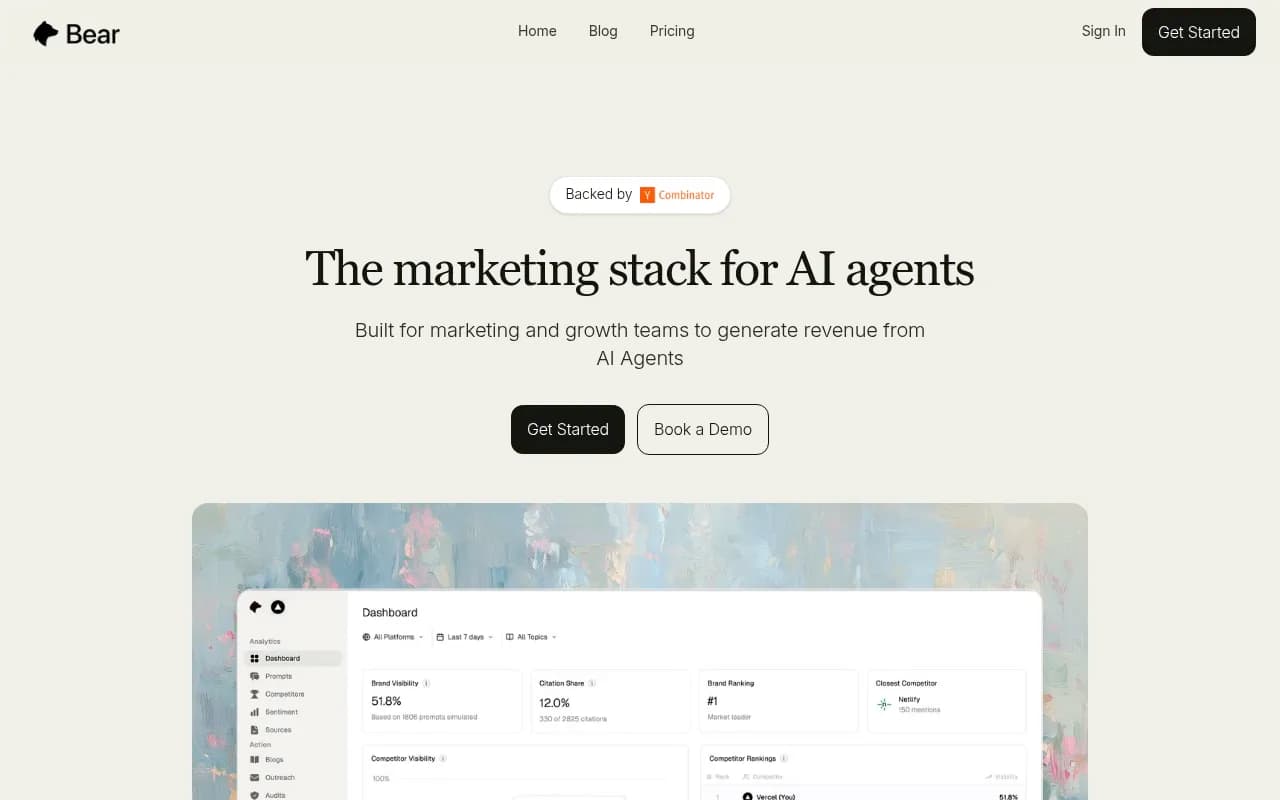
Bear AI calls itself "the marketing stack for AI agents" and targets marketing and growth teams looking to generate revenue from AI search. It's backed by Y Combinator and used by companies like Peerspace, Medal, and Wispr Flow. The platform tracks how AI models like ChatGPT, Claude, Perplexity, and Gemini talk about your brand, then helps you optimize visibility with content recommendations and built-in blog generation. Bear AI's pitch is that it's not just a tracker -- it's a tool to actively improve your AI search presence.
The interface shows trending prompts, visibility scores, and which AI models mention you most often. The Basic plan ($100/mo) covers GPT-5 tracking, 30 prompts, and 2 blog posts per month. Enterprise pricing is custom and unlocks all AI platforms plus unlimited tracking.
Promptmonitor
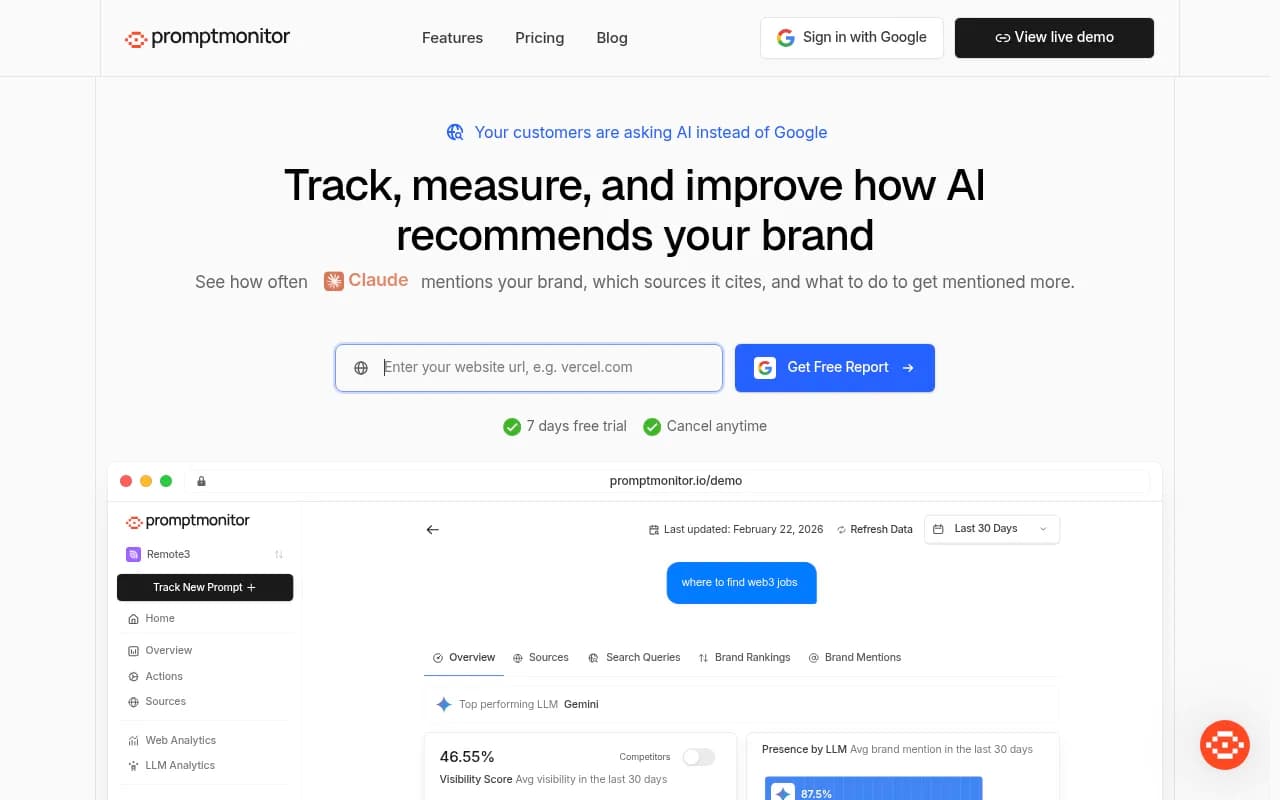
Promptmonitor is a visibility tracking tool that monitors brand mentions across ChatGPT, Perplexity, Claude, Gemini, and other AI models. It shows you when and how often AI engines recommend your brand, which sources they cite, and how your visibility changes over time. The dashboard includes visibility scores, presence by LLM, competitor tracking, and source analysis.
Promptmonitor offers a 7-day free trial and four pricing tiers: Starter ($29/mo), Growth ($39/mo), Pro ($129/mo), and a custom Agency plan. It's positioned as a straightforward monitoring tool -- you track prompts, see the data, and use the insights to guide your content strategy. There's no built-in content generation or optimization engine; it's purely analytics.
Side-by-Side Comparison
| Feature | Bear AI | Promptmonitor |
|---|---|---|
| Starting price | $100/mo (Basic) | $29/mo (Starter) |
| Free trial | No | 7 days |
| AI models tracked | ChatGPT, Claude, Perplexity, Gemini, Google AI Overviews | ChatGPT, Claude, Perplexity, Gemini |
| Content generation | Yes (2-10+ blogs/mo depending on plan) | No |
| Prompt tracking | 30 prompts (Basic), unlimited (Enterprise) | Varies by plan |
| Visibility scoring | Yes | Yes |
| Competitor tracking | Yes | Yes |
| Source analysis | Yes | Yes |
| Web analytics | Yes | Yes |
| LLM analytics | Yes | Yes |
| Public project sharing | Not mentioned | Yes (live demo available) |
| Pricing transparency | Basic + Enterprise only | Four tiers fully disclosed |
Pricing comparison
Bear AI's pricing is less transparent. The website shows a Basic plan at $100/mo (GPT-5 only, 30 prompts, 2 blogs/mo) and an Enterprise plan with custom pricing (all AI platforms, unlimited tracking). There's no middle tier publicly listed, so if you need more than 30 prompts or want to track models beyond GPT-5, you're jumping straight to Enterprise.
Promptmonitor lays out four tiers:
| Plan | Price | Key limits |
|---|---|---|
| Starter | $29/mo | Entry-level tracking |
| Growth | $39/mo | Mid-tier features |
| Pro | $129/mo | Advanced tracking |
| Agency | Custom | White-label, multi-client |
Promptmonitor's Starter plan is $71/mo cheaper than Bear AI's Basic plan. If you're a solo marketer or small team just starting with AI visibility tracking, that's a big difference. Bear AI's value prop is the bundled content generation -- you're paying more, but you're also getting blog posts written for you. Promptmonitor assumes you'll handle content creation separately.
Feature deep-dive
AI model coverage
Bear AI tracks ChatGPT, Claude, Perplexity, Gemini, and Google AI Overviews. The Basic plan only covers GPT-5, which is a significant limitation -- if you want to see how Claude or Perplexity talks about you, you need Enterprise.
Promptmonitor tracks ChatGPT, Claude, Perplexity, and Gemini across all plans. The live demo on their site shows tracking for all four models simultaneously, with presence percentages for each (e.g. Gemini 85.19%, Perplexity 65.52%, ChatGPT 17.24%). This is more flexible than Bear AI's Basic tier, which locks you into a single model.
Neither tool tracks as many models as some competitors -- platforms like Promptwatch monitor 10+ AI engines including Meta AI, DeepSeek, Grok, Mistral, and Copilot. If you need comprehensive cross-model tracking, both Bear AI and Promptmonitor leave gaps.

Visibility scoring and analytics
Both platforms calculate visibility scores based on how often your brand appears in AI responses. Bear AI shows "trending prompts" with volume indicators (e.g. "High-volume") and tracks which AI models mention you most. The dashboard highlights top-performing LLMs and visibility trends over time.
Promptmonitor's visibility score combines presence (whether you're mentioned) and cross-model consistency (how often you're mentioned across different LLMs). The interface shows a 30-day visibility chart, presence by LLM with percentages, and a calendar heatmap indicating which days you were mentioned by which models. This is more granular than Bear AI's public-facing screenshots suggest.
Both tools track competitors, but neither shows detailed competitor heatmaps or side-by-side prompt-level comparisons. You can see that a competitor is mentioned, but not necessarily why or which specific content is driving their visibility.
Content generation and optimization
This is where Bear AI pulls ahead. Every plan includes blog generation: 2 posts/mo on Basic, scaling up on higher tiers. The idea is that Bear AI identifies gaps in your AI visibility, then writes content to fill those gaps. The quality and relevance of these AI-generated blogs isn't clear from the website, but the feature exists.
Promptmonitor has no content generation. It's a monitoring dashboard. You see the data, you interpret it, you go write content yourself (or hire someone to do it). If you want an all-in-one tool that both tracks and creates, Bear AI is the only option here.
That said, monitoring-only tools can integrate with your existing content workflow more easily. Promptmonitor gives you the insights; you plug them into your CMS, your writers, your content calendar. Bear AI's bundled approach is convenient but less flexible if you already have a content team.
Source and citation analysis
Both platforms show which sources AI models cite when they mention your brand. Bear AI's website mentions "see how AI agents are discovering your brand" and tracking "which sources it cites." Promptmonitor has a dedicated "Sources" tab in the dashboard (visible in the live demo) that lists cited URLs.
Neither tool appears to offer Reddit or YouTube tracking -- a gap that matters because Reddit threads and YouTube videos heavily influence AI recommendations. Promptwatch, for example, surfaces Reddit discussions and YouTube content that feed into AI responses, which helps you understand the full picture of what's shaping your visibility.
Prompt discovery and tracking
Bear AI shows "trending prompts" with volume labels (High-volume, etc.) and lets you track up to 30 prompts on the Basic plan, unlimited on Enterprise. The interface suggests it surfaces prompts automatically based on what users are asking AI agents about your brand.
Promptmonitor lets you track custom prompts and shows search query data in the dashboard. The live demo includes a "Search Queries" section and tracks specific prompts like "where to find web3 jobs." It's not clear how many prompts each plan supports, but the Pro plan ($129/mo) likely has higher limits than Starter.
Neither tool offers prompt volume estimates or difficulty scoring -- features that help you prioritize which prompts to target. Promptwatch, for instance, shows estimated search volumes and difficulty scores so you can focus on high-value, winnable prompts instead of guessing.
Web analytics and traffic attribution
Bear AI mentions "analyze traffic from all major LLMs" and claims to help you "boost traffic" from AI agents. The extent of traffic attribution (e.g. tracking which AI-driven visits convert, revenue impact) isn't detailed on the website.
Promptmonitor has a "Web Analytics" tab in the dashboard and an "LLM Analytics" section. The live demo shows these features exist, but the depth of attribution (connecting AI visibility to actual site traffic and conversions) is unclear.
Full traffic attribution -- tracking AI crawler activity, visitor sources, and revenue tied to AI search -- is still rare in this space. Promptwatch offers AI crawler logs and traffic attribution via code snippet, GSC integration, or server log analysis, closing the loop from visibility to revenue. Bear AI and Promptmonitor both hint at analytics but don't show the full picture.
Ease of use and interface
Bear AI's website shows a clean, modern dashboard with AI model logos, trending prompts, and visibility charts. The design feels polished and marketing-team-friendly. The Y Combinator backing and client logos (Peerspace, Medal, Wispr Flow) suggest a product built for fast-moving startups.
Promptmonitor offers a live demo you can click through (promptmonitor.io/demo), which is a big plus for transparency. The interface is straightforward: tabs for Overview, Sources, Search Queries, Brand Rankings, Brand Mentions, Web Analytics, and LLM Analytics. It's functional but less visually slick than Bear AI. The 7-day free trial lets you test it risk-free.
Support and onboarding
Bear AI's website has a "Book a Demo" CTA, suggesting they offer onboarding calls for new users. The Y Combinator pedigree implies a startup that's iterating quickly and responsive to feedback, but formal support details aren't listed.
Promptmonitor's website mentions "7 days free trial" and "Cancel anytime," which suggests a self-service model. There's no mention of dedicated support or onboarding calls. For a $29/mo tool, that's expected -- you sign up, poke around, and figure it out.
Pros and cons
Bear AI pros
- Includes content generation (2+ blogs/mo) so you're not just tracking, you're acting on the data
- Tracks Google AI Overviews in addition to ChatGPT, Claude, Perplexity, Gemini
- Backed by Y Combinator with recognizable client logos
- Positioned as a full "marketing stack for AI agents," not just a tracker
- Trending prompts with volume indicators help prioritize what to optimize for
Bear AI cons
- Basic plan ($100/mo) only tracks GPT-5 -- you need Enterprise for multi-model tracking
- No free trial, so you're committing $100 upfront to test it
- Pricing is opaque (only Basic + Enterprise shown, no middle tier)
- No mention of Reddit/YouTube tracking or AI crawler logs
- Content generation quality is unknown -- could be generic AI filler
Promptmonitor pros
- Much cheaper entry point ($29/mo vs $100/mo)
- 7-day free trial lets you test before paying
- Tracks ChatGPT, Claude, Perplexity, and Gemini across all plans (no single-model lock-in)
- Four transparent pricing tiers with clear upgrade path
- Live demo available so you can see the interface before signing up
- Public project sharing for collaboration or reporting
Promptmonitor cons
- No content generation -- you're on your own for creating optimized content
- Less polished interface compared to Bear AI
- Doesn't track Google AI Overviews or as many models as some competitors
- Limited details on prompt limits per plan
- No mention of AI crawler logs or deep source analysis
Who should pick which tool
Pick Bear AI if:
- You want monitoring + content creation in one tool and don't want to manage a separate content workflow
- You're a small marketing team (2-5 people) with budget for a $100+/mo tool and need to move fast
- You care about Google AI Overviews tracking in addition to ChatGPT/Claude/Perplexity
- You're okay with limited transparency on pricing and features (Enterprise is custom, so you'll need to talk to sales)
- You value the Y Combinator backing and want a tool that's iterating quickly
Pick Promptmonitor if:
- You're budget-conscious and want to start tracking AI visibility for under $30/mo
- You already have a content team or workflow and just need the data/insights
- You want to test the tool risk-free with a 7-day trial before committing
- You need multi-model tracking (ChatGPT, Claude, Perplexity, Gemini) from day one without paying for Enterprise
- You prefer transparent pricing with clear upgrade paths
Consider Promptwatch if:
- You need more than just monitoring -- you want Answer Gap Analysis to see exactly which prompts competitors rank for but you don't, then AI-generated content grounded in 880M+ citations to fill those gaps
- You want AI crawler logs showing which pages ChatGPT, Claude, Perplexity, etc. are actually reading on your site (and errors they encounter)
- You need Reddit and YouTube tracking to understand the full picture of what's influencing AI recommendations
- You want traffic attribution that connects AI visibility to actual revenue (via code snippet, GSC integration, or server logs)
- You're tracking 10+ AI models (ChatGPT, Claude, Perplexity, Gemini, Meta AI, DeepSeek, Grok, Mistral, Copilot, Google AI Overviews) and need comprehensive cross-model insights
Final verdict
Bear AI and Promptmonitor are both solid AI visibility trackers, but they serve different needs.
Promptmonitor wins on price and transparency. At $29/mo with a free trial, it's the obvious choice if you're just starting out or want a no-frills monitoring tool. You get multi-model tracking (ChatGPT, Claude, Perplexity, Gemini) from day one, visibility scoring, and source analysis. The interface is functional, the pricing is clear, and you can test it risk-free. The downside: it's monitoring-only. You see the data, but you're on your own for creating content that improves your visibility.
Bear AI wins if you want an all-in-one tool that both tracks and creates. The $100/mo Basic plan includes 2 blog posts per month, so you're not just seeing where you're invisible -- you're actively generating content to fix it. The catch: Basic only tracks GPT-5, so if you want multi-model insights, you're jumping to Enterprise (custom pricing, likely $500+/mo). The lack of a free trial and opaque pricing make it harder to evaluate.
For most teams, I'd start with Promptmonitor's free trial to see if basic tracking meets your needs. If you realize you need content generation bundled in, then consider Bear AI. If you need deeper optimization features -- Answer Gap Analysis, AI crawler logs, Reddit/YouTube tracking, traffic attribution -- neither tool goes far enough, and you'd be better served by a platform like Promptwatch that's built around the full action loop (find gaps, create content, track results).