Brandwatch Consumer Intelligence Review 2026
Brandwatch is an enterprise-grade social media intelligence platform that monitors over 100 million sources to help brands understand consumer sentiment, track competitors, and manage social engagement. Used by thousands of global brands including BBC, Virgin Holidays, and OnePlus, it combines deep
Key Takeaways
- Enterprise-focused platform: Built for large brands and agencies managing complex social strategies across multiple markets and channels, with pricing starting around $1,750/month ($21,000/year minimum)
- Comprehensive data coverage: Monitors 100M+ sources including social platforms, news sites, forums, and review sites -- one of the deepest archives of consumer opinion available
- All-in-one suite approach: Combines social listening, content management, community engagement, and influencer marketing in a single platform, reducing tool sprawl
- Lacks AI search optimization: Monitoring-only for traditional social and web sources -- no AI search visibility tracking, content gap analysis for LLMs, or optimization tools like Promptwatch offers for ChatGPT, Perplexity, Claude, and other AI models
- Steep learning curve and cost: Complex interface requires significant training investment; pricing puts it out of reach for small businesses and startups

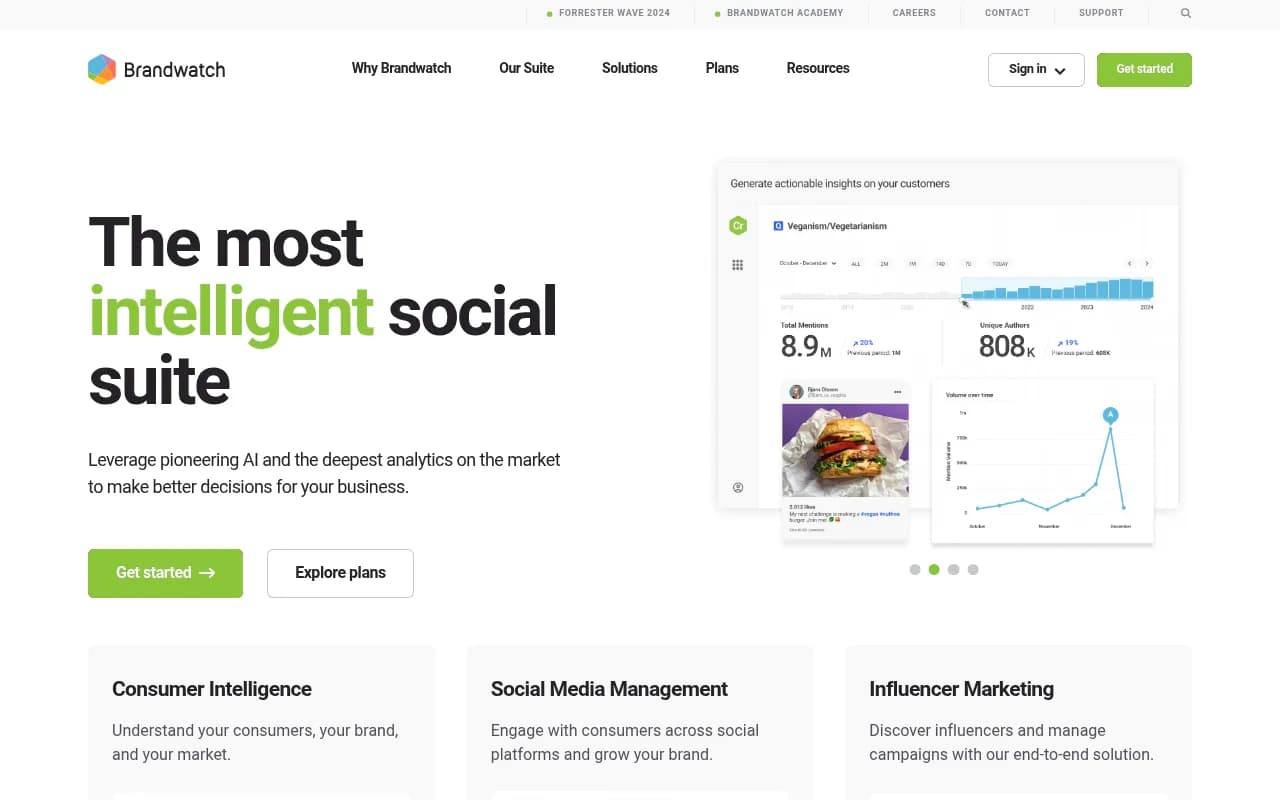
Brandwatch positions itself as "the most intelligent social suite" for enterprise brands that need to understand and engage with consumers across social media at scale. Originally founded as a social listening pioneer, the company has evolved through acquisitions (Falcon.io for social media management, Paladin for influencer marketing, and most recently Trajaan for search intelligence) into a comprehensive platform that handles everything from deep consumer research to day-to-day social posting.
The platform is built for marketing teams at large organizations -- think global consumer brands, major retailers, financial services firms, and agencies managing dozens of client accounts. If you're a three-person startup or a solopreneur, this isn't for you. Brandwatch's pricing (starting at $21,000/year minimum) and feature complexity assume you have dedicated social media analysts, content creators, and community managers who will use the platform daily.
Brandwatch was acquired by Cision in 2021, making it part of a larger PR and communications technology portfolio. The company has offices across the US, UK, Germany, and other markets, serving thousands of enterprise customers. Its data archive spans over a decade of social conversations, giving it historical depth that newer competitors can't match.
Consumer Intelligence (Social Listening)
This is Brandwatch's core strength and what built its reputation. The Consumer Intelligence module monitors over 100 million sources including Twitter/X, Facebook, Instagram, TikTok, YouTube, Reddit, news sites, blogs, forums, review sites, and more. You create queries using Boolean logic to track brand mentions, competitor activity, industry trends, or specific topics.
The platform processes billions of social posts and applies sentiment analysis, demographic inference, and topic clustering using both proprietary AI and generative AI models. You can segment conversations by geography, language, gender (inferred), interests, and influence level. Custom dashboards let you visualize trends over time, compare share of voice against competitors, and drill down into specific conversations.
Image recognition capabilities scan photos and videos for logo appearances, even when your brand isn't mentioned in text. This catches visual brand presence that text-only tools miss -- useful for tracking sponsorship ROI or unauthorized logo usage.
Real-time alerts notify you when conversation volume spikes, sentiment shifts negative, or specific keywords appear. You can set thresholds and delivery methods (email, Slack, in-app) to catch emerging crises before they explode. The alert system is granular enough to avoid notification fatigue while still catching what matters.
Historical data access goes back years, letting you analyze long-term trends, seasonal patterns, and the lasting impact of campaigns or PR events. Most social listening tools only retain data for 12-24 months.
The query builder is powerful but has a learning curve. You'll need to understand Boolean operators, proximity searches, and how to exclude noise. Brandwatch offers training and customer success support to help teams get queries right, but expect a few weeks of trial and error before your data is clean.
Social Media Management
Acquired through the Falcon.io purchase, this module handles content planning, publishing, and community management. The unified content calendar shows scheduled posts across all your social channels (Facebook, Instagram, Twitter/X, LinkedIn, TikTok, YouTube, Pinterest). You can drag-and-drop to reschedule, duplicate posts across networks, and preview how content will appear on each platform.
Approval workflows let you route posts through multiple reviewers before publishing. You define approval chains by channel, content type, or team -- useful for regulated industries or large organizations where legal/compliance needs to sign off. Comments and revision requests stay attached to each post, creating an audit trail.
The asset library stores images, videos, and templates with tagging and search. You can set usage rights and expiration dates to avoid accidentally using expired creative or assets you don't have permission for.
Bulk scheduling and CSV imports let you load entire campaigns at once. The AI-powered content recommendations suggest optimal posting times based on when your audience is most engaged, though you can override these.
The unified inbox aggregates messages, comments, and mentions from all connected social accounts into one stream. You can assign conversations to team members, tag them by topic or priority, set SLAs for response time, and track resolution. Saved replies and macros speed up responses to common questions.
Integration with the Consumer Intelligence module means you can escalate a social listening mention directly into the inbox for response, or promote a piece of user-generated content into your content calendar.
Influencer Marketing (Influence)
Formerly Paladin, this module helps you discover influencers, manage campaigns, and measure ROI. The influencer database includes creators across Instagram, YouTube, TikTok, and blogs. You search by niche, audience demographics, engagement rate, follower count, and location.
Vetting tools show audience authenticity scores (detecting fake followers), brand safety flags (past controversial content), and engagement quality metrics. You can see an influencer's previous brand partnerships and typical content style before reaching out.
Campaign management features handle outreach, contract negotiation, content approval, and payment tracking. Influencers get access to a portal where they submit content for approval, view campaign briefs, and track deliverables. You can set content guidelines, mandatory hashtags, and disclosure requirements.
Performance tracking measures reach, engagement, conversions, and EMV (earned media value) for each influencer and campaign. You can compare influencer performance and identify top performers for future partnerships.
The influencer database is solid but not as comprehensive as dedicated influencer platforms like AspireIQ or CreatorIQ. If influencer marketing is your primary focus, you might need a specialized tool. But for brands running influencer campaigns alongside broader social strategies, having it integrated with listening and content management is convenient.
Analytics and Reporting
Brandwatch's analytics go deep. You can create custom dashboards with dozens of visualization types -- line charts, bar graphs, word clouds, geographic heat maps, network graphs showing conversation clusters, and more. Dashboards update in real-time or on a schedule.
Pre-built report templates cover common use cases: brand health, campaign performance, competitive analysis, crisis monitoring, audience insights. You can customize these or build reports from scratch.
Data export options include CSV, Excel, PDF, and PowerPoint. The API lets you pull data into your own BI tools or data warehouses. Scheduled reports can be emailed to stakeholders automatically.
Benchmarking features let you compare your metrics against competitors or industry averages. You can track share of voice, sentiment trends, engagement rates, and audience growth relative to your competitive set.
The depth of analytics is both a strength and a weakness. You can answer almost any question if you know how to build the right query and visualization. But the interface is dense and assumes analytical sophistication. Casual users will struggle. This is a tool for analysts who live in data, not for executives who want a simple dashboard.
Who Is It For
Brandwatch is built for enterprise marketing teams at organizations with:
- Annual marketing budgets over $1M: The platform cost ($21K+ per year) plus the personnel needed to use it effectively means you need serious budget
- Dedicated social media teams: At least 3-5 people including analysts, content creators, and community managers who will use the platform daily
- Complex social strategies: Multiple brands, markets, languages, or product lines that require sophisticated segmentation and reporting
- Regulatory or compliance requirements: Industries like financial services, healthcare, or consumer packaged goods where content approval workflows and audit trails matter
Specific personas who benefit:
- Social media analysts at global brands tracking brand health, competitor activity, and consumer trends across markets
- Agency account teams managing social strategies for multiple clients and needing to demonstrate ROI with detailed reporting
- PR and communications teams monitoring media coverage and social sentiment to catch and respond to crises
- Product marketing teams researching consumer needs, pain points, and reactions to launches
- Customer experience teams using social listening to identify service issues and improve customer satisfaction
Who should NOT use Brandwatch:
- Small businesses and startups: The cost and complexity are overkill. You need simpler, more affordable tools like Hootsuite, Buffer, or Sprout Social.
- Solopreneurs and freelancers: You don't need enterprise-grade listening or multi-user workflows. Use Mention or Brand24 instead.
- Teams without analytical resources: If you don't have someone who can build complex queries and interpret data, you won't get value from Brandwatch's depth.
- Brands focused on AI search visibility: Brandwatch monitors traditional social and web sources but doesn't track or optimize for AI search engines like ChatGPT, Perplexity, Claude, or Google AI Overviews. If you need to understand and improve how your brand appears in AI-generated answers, you need a GEO platform like Promptwatch.
Integrations & Ecosystem
Brandwatch integrates with major social platforms (Facebook, Instagram, Twitter/X, LinkedIn, TikTok, YouTube, Pinterest) for both listening and publishing. It also connects to:
- Slack: Send alerts and reports to Slack channels
- Microsoft Teams: Similar integration for Teams users
- Salesforce: Sync social data with CRM records
- Google Analytics: Combine social metrics with website traffic data
- Tableau and Power BI: Pull Brandwatch data into your BI dashboards
- Zapier: Connect to thousands of other apps
The REST API provides programmatic access to queries, data, and publishing functions. Documentation is thorough and the API is stable, though rate limits apply.
No native mobile app for iOS or Android. You can access the web interface on mobile browsers, but the experience isn't optimized for small screens. For on-the-go monitoring, you'll rely on email or Slack alerts.
Browser extensions are not available. Everything happens in the web application.
Pricing & Value
Brandwatch doesn't publish pricing on its website. Based on third-party sources and user reports:
- Entry-level plans: Start around $1,750/month ($21,000/year) paid annually. No monthly billing option. This typically includes Consumer Intelligence for one brand with limited query volume and user seats.
- Mid-tier plans: $3,000-$5,000/month for more queries, users, and access to Social Media Management features.
- Enterprise plans: Custom pricing for large organizations needing multiple brands, advanced features, dedicated support, and higher data limits. Expect $50K-$200K+ per year depending on scale.
All plans require annual contracts. There's no free trial listed on the website, but you can request a demo and potentially negotiate a pilot period.
Compared to competitors:
- Sprout Social: $249-$499/user/month -- more affordable for small to mid-size teams, but less powerful listening
- Meltwater: Similar enterprise pricing and capabilities, direct competitor
- Talkwalker: Another enterprise listening platform with comparable pricing
- Hootsuite: $99-$739/month for up to 10 users -- much cheaper but basic listening features
- Mention: $41-$149/month -- affordable for small businesses, limited depth
Brandwatch's value proposition is depth and integration. If you need best-in-class social listening combined with content management and influencer marketing in one platform, and you have the budget and team to use it, the ROI can justify the cost. Brands report using insights to inform product development, catch crises early, and improve campaign performance.
But if you only need basic social monitoring or publishing, you're paying for capabilities you won't use. And if you need to track and optimize for AI search engines, Brandwatch doesn't cover that space at all.
Strengths & Limitations
Strengths:
- Unmatched data depth: 100M+ sources and over a decade of historical data give you context and trends that newer tools can't provide
- Powerful query builder: Boolean logic, proximity searches, and advanced filters let you get extremely precise with what you track
- Integrated suite: Having listening, publishing, community management, and influencer marketing in one platform reduces tool sprawl and keeps data connected
- Enterprise-grade workflows: Approval chains, user permissions, audit trails, and compliance features meet the needs of large, regulated organizations
- Strong customer support: Dedicated customer success managers, training programs (Brandwatch Academy), and responsive support team
Limitations:
- No AI search visibility tracking: Brandwatch monitors traditional social and web sources but doesn't track how your brand appears in AI search engines like ChatGPT, Perplexity, Claude, Gemini, or Google AI Overviews. It lacks the content gap analysis, AI crawler logs, prompt intelligence, citation tracking, and AI content optimization that Promptwatch provides. As AI search grows, this is a significant blind spot.
- Steep learning curve: The interface is complex and assumes analytical expertise. New users need weeks of training to become proficient. Not intuitive for casual users.
- High cost: $21K+ per year minimum puts it out of reach for small businesses, startups, and lean marketing teams. You need enterprise budget to justify it.
- No mobile app: Monitoring and management on mobile requires using the web interface in a browser, which isn't optimized for small screens.
- Influencer database gaps: The Influence module is solid but not as comprehensive as dedicated influencer platforms. If influencer marketing is your primary focus, you might need a specialized tool.
- Limited real-time publishing features: Some users report the publishing interface feels dated compared to newer social media management tools. Lacks some modern features like Instagram Stories scheduling or TikTok native posting.
Bottom Line
Brandwatch is the right choice for enterprise marketing teams at large organizations that need deep social listening, integrated content management, and sophisticated analytics -- and have the budget and analytical resources to use it effectively. If you're managing social strategies for a global brand, multiple product lines, or a portfolio of agency clients, and you need to track brand health, competitive intelligence, and consumer trends at scale, Brandwatch delivers.
But it's overkill for small businesses, startups, and lean teams. The cost and complexity don't make sense unless you have dedicated social media analysts and a marketing budget over $1M. And if your strategy includes optimizing for AI search visibility -- understanding how your brand appears in ChatGPT, Perplexity, and other AI models -- Brandwatch doesn't cover that space. For AI search optimization, you need a GEO platform like Promptwatch that tracks AI citations, identifies content gaps, and helps you create content that ranks in AI-generated answers.
Best use case in one sentence: Enterprise brands with complex, multi-market social strategies who need best-in-class listening and integrated publishing in a single platform.
Tags:
Frequently asked questions
What is Brandwatch Consumer Intelligence?
How much does Brandwatch cost?
Who is Brandwatch designed for?
Does Brandwatch offer a free trial?
What sources does Brandwatch monitor?
What features does Brandwatch include?
Is Brandwatch difficult to learn?
Does Brandwatch track AI search engines like ChatGPT?
Similar and alternative tools to Brandwatch Consumer Intelligence