Visiblie Review 2026
AI visibility tool that tracks how your brand appears in responses from ChatGPT, Perplexity, Gemini, and other LLMs, with competitor benchmarking and share-of-voice reporting.
Key takeaways
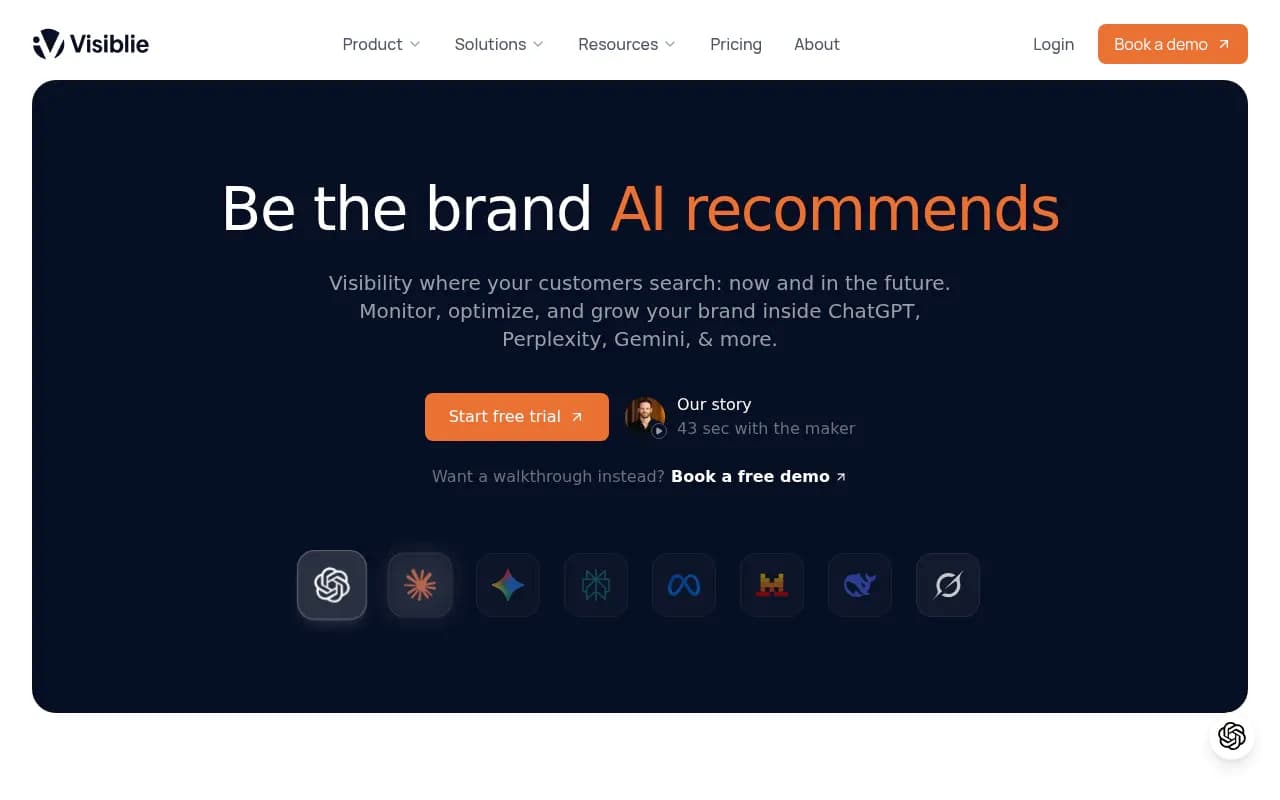
- Visiblie is an AI brand monitoring platform covering ChatGPT, Claude, Gemini, Perplexity, Meta, Mistral, DeepSeek, and Grok from a single dashboard
- Monitoring-only tool -- no content gap analysis, no AI writing agent, no crawler logs, and no traffic attribution, which puts it behind Promptwatch for teams that want to act on what they find, not just observe it
- Useful for brands that want a quick read on where they stand across AI models and how competitors compare
- Includes automated reports with optimization recommendations, though these are surface-level suggestions rather than data-driven content briefs
- Free trial available; paid plans start at an undisclosed EUR price point (Starter, Growth, Enterprise tiers)
- Best suited for small-to-mid-size marketing teams that are just starting to think about AI visibility and want a simple entry point
Visiblie is an AI search visibility platform built for brands that want to know how they're being talked about -- or not talked about -- inside AI assistants. The product monitors brand mentions across the major LLMs: ChatGPT, Claude, Gemini, Perplexity, Meta AI, Mistral, DeepSeek, and Grok. It was built by a small team led by founder Gilles, who appears to be the primary face of the product based on the site's "43 seconds with the maker" intro video and the direct contact email ([email protected]). The company has a remote-first culture and is actively hiring.
The pitch is straightforward: as AI assistants become a primary discovery channel for consumers and B2B buyers, brands need to know whether they're being recommended. Visiblie positions itself as the unified cockpit for that monitoring job. It's a reasonable problem to solve, and the product does cover the basics. But it's worth being clear about what "monitoring" actually means here, because there's a meaningful gap between watching your visibility scores and knowing how to improve them.
The target audience appears to be marketing managers and brand teams at growth-stage companies -- people who've heard about GEO (Generative Engine Optimization) and want a dashboard to show their CMO. Agencies managing multiple client brands could also find value in the multi-model coverage, though the platform's depth at the agency level isn't fully clear from available information.
Key features
Multi-model AI monitoring Visiblie tracks brand mentions across eight AI platforms: ChatGPT, Claude, Gemini, Perplexity, Meta AI, Mistral, DeepSeek, and Grok. That's solid coverage for a tool at this stage. The unified dashboard shows mention counts per model, week-over-week changes, and a composite visibility score (displayed as a 0-100 scale with Poor/Average/Good/Excellent bands). This gives you a quick read on which models are recommending your brand and which are ignoring you.
Visibility score The platform calculates a single visibility score that aggregates your brand's presence across all monitored models. The score changes over time, so you can track progress. The demo UI shows a score of 87/100 with a +12% week-over-week change, which suggests the scoring is sensitive enough to reflect meaningful movement. Whether the underlying methodology is transparent or well-documented isn't clear from the available information.
Competitor intelligence Visiblie lets you monitor how competitors rank in AI responses alongside your own brand. This is one of the more useful features for teams doing competitive analysis -- you can see whether a rival is getting recommended more often than you across specific models. The site describes this as "monitor what your competitors can't see," which is a bit of marketing spin, but the underlying capability (tracking competitor share-of-voice in AI answers) is genuinely useful.
Instant alerts The platform sends notifications when your brand gets mentioned in an AI response. The demo shows a "Mentioned in ChatGPT -- Just now" alert style, suggesting near-real-time monitoring. For PR teams or brand managers who want to know when something changes quickly, this is a practical feature. It's not clear whether alerts are configurable by model, keyword, or sentiment.
Automated reports with recommendations Visiblie generates automated visibility reports delivered to your inbox. These include optimization suggestions like "Add FAQ schema to homepage," "Create comparison pages," "Add structured data markup," and "Update descriptions with AI keywords." The recommendations are sensible as a starting checklist, but they're generic -- there's no indication that they're derived from actual citation data or prompt analysis. A team that's already done basic AEO work will likely find these suggestions too surface-level to act on.
Model rankings view The dashboard shows your brand's ranking position across models (e.g., #1 in ChatGPT, #2 in Perplexity, #3 in Gemini). This is a useful at-a-glance view for understanding where you're strongest and where you're losing ground. It's not entirely clear how "ranking" is defined here -- whether it's based on mention frequency, position in responses, or something else.
Live AI monitoring The site references "live AI monitoring" that watches how AI assistants recommend brands in real-time. The demo shows a simulated ChatGPT conversation asking "What are the best AI visibility tools for brands?" -- suggesting the platform runs prompts against AI models and captures the responses. This is the core data collection mechanism for most tools in this category.
Who is it for
Visiblie fits best for marketing managers at small-to-mid-size companies who are new to AI visibility tracking and want a clean, simple dashboard to get started. Think a 10-50 person SaaS company whose marketing team has noticed that ChatGPT isn't recommending them when users ask about their category, and wants to start measuring the problem. The multi-model coverage and visibility score make it easy to brief leadership without needing to explain the technical details.
It could also work for digital agencies that want to add AI visibility reporting to their client deliverables. The automated reports with recommendations could slot into a monthly reporting workflow without much additional effort. That said, agencies managing clients with serious competitive pressure will likely hit the ceiling of what Visiblie's recommendations can offer fairly quickly.
Who shouldn't use this: brands that are past the "awareness" stage of AI visibility and need to actually do something about it. If you already know you're not being recommended and you need to figure out which content gaps to fill, which prompts to target, or how to get your pages cited by AI crawlers, Visiblie doesn't have the tools for that. There's no content gap analysis, no AI writing agent, no crawler log data, and no traffic attribution. You'll see the problem clearly; you just won't get much help solving it.
Integrations and ecosystem
The website doesn't detail specific third-party integrations. There's no mention of Google Search Console, Slack, Zapier, or any other platform connections. The automated email reports suggest some form of notification delivery, but whether there's a Slack integration or webhook support isn't documented publicly.
There's no mention of an API, which would be a notable gap for agencies or enterprise teams that want to pull data into their own reporting systems. No browser extension or mobile app is referenced either.
The platform does appear to have a web app at app.visiblie.com, accessible via the signup flow. Import/export capabilities aren't described on the marketing site.
Pricing and value
Visiblie offers three tiers -- Starter, Growth, and Enterprise -- with pricing in EUR. The exact numbers aren't publicly listed on the main site (the pricing page search result references "starting at EUR..." but the full amount wasn't captured). A free trial is available without requiring a credit card based on the "Start free trial" CTA.
Without confirmed pricing numbers, it's hard to do a direct comparison. The tiered structure (Starter/Growth/Enterprise) is standard for this category. For reference, comparable tools in the AI visibility monitoring space range from around $49/month at the entry level to $250+ for mid-tier plans with more prompts and models.
The value proposition depends heavily on what you need. For a team that just wants a visibility score and weekly report, Visiblie may be reasonably priced. For a team that needs to actually improve their AI visibility -- not just measure it -- the cost-to-value ratio gets harder to justify when more capable platforms exist.
Strengths and limitations
What Visiblie does well:
- Clean, unified dashboard that covers eight AI models in one view -- that's broad coverage for a tool of this size
- The visibility score with trend tracking gives non-technical stakeholders an easy metric to follow
- Instant alerts for brand mentions are a practical feature for brand monitoring and PR use cases
- The competitor intelligence view is genuinely useful for understanding relative share-of-voice across models
- Low barrier to entry with a free trial and what appears to be a straightforward onboarding experience
Where it falls short:
- No content gap analysis. You can see that you're invisible for certain prompts, but Visiblie doesn't tell you which specific content your site is missing or which topics competitors are winning on. Promptwatch's Answer Gap Analysis does this directly.
- No AI content generation. There's no built-in writing agent to help you create content that gets cited by AI models. The recommendations are generic checklists, not data-driven content briefs.
- No AI crawler logs. Knowing which pages AI crawlers are visiting (or failing to visit) is critical for diagnosing indexing issues. Visiblie doesn't appear to offer this. Promptwatch tracks real-time crawler activity from ChatGPT, Claude, Perplexity, and others.
- No traffic attribution. There's no way to connect AI visibility to actual website traffic or revenue. No GSC integration, no code snippet, no server log analysis. You can't close the loop between visibility scores and business outcomes.
- No prompt volume or difficulty data. Visiblie doesn't appear to show which prompts have high search volume or which are easier to win, so prioritization is guesswork.
- No Reddit or YouTube tracking. These are increasingly important citation sources for AI models, and Visiblie doesn't surface them.
Bottom line
Visiblie is a reasonable starting point for brands that want to understand their AI visibility for the first time. The multi-model dashboard, visibility score, and competitor tracking give you a clear picture of where you stand. But it stops there. For teams that need to move from awareness to action -- identifying content gaps, generating optimized content, tracking crawler behavior, and attributing AI traffic to revenue -- Visiblie's monitoring-only approach will feel limiting quickly.
If you're ready to do more than watch your visibility score, Promptwatch is the stronger option: it covers the same monitoring ground but adds content gap analysis, an AI writing agent, crawler logs, and traffic attribution in a single platform.
Best use case: A marketing team at a growth-stage brand that wants a simple, clean dashboard to track AI mention trends and brief leadership on AI visibility progress.
Frequently asked questions
What is Visiblie?
How much does Visiblie cost?
Which AI models does Visiblie monitor?
Does Visiblie help you improve AI visibility, or just track it?
How does Visiblie compare to Promptwatch?
Is there a free trial for Visiblie?
Similar and alternative tools to Visiblie