Key takeaways
- Peec.ai is a solid AI visibility monitor but lacks ChatGPT Shopping tracking, SKU-level product visibility, and content optimization -- all of which matter for e-commerce brands.
- AI-referred traffic to e-commerce sites grew 393% year over year in Q1 2026 (Adobe), and visitors from ChatGPT convert 42% better than paid search traffic.
- Most Peec.ai alternatives are also monitoring-only tools. The ones worth paying for go further: they show you why you're invisible and help you fix it.
- For e-commerce brands that need the full picture -- shopping carousels, product citations, content gaps, and traffic attribution -- Promptwatch is the only platform that covers all of it in one place.
- Budget-conscious brands can start with Otterly.AI or SE Visible for basic monitoring, then graduate to a more capable platform as AI search traffic grows.
If you're running an e-commerce brand in 2026 and you've been using Peec.ai to track AI visibility, you've probably noticed the gaps. Peec.ai does a decent job of showing you whether your brand name appears in ChatGPT or Perplexity responses. What it doesn't do is tell you whether your products are showing up in ChatGPT's shopping carousels, which specific pages are getting cited, or what content you're missing that would get you cited more.
For a SaaS company or a B2B brand, that might be fine. For an e-commerce brand, it's a real problem.
Adobe's data from Q1 2026 puts this in stark terms: AI-referred traffic grew 393% year over year, and those visitors spend 37% more per visit than people arriving from paid search or email. ChatGPT is now actively recommending products by name, with images and pricing, inside its shopping carousels. If your products aren't appearing there, you're handing high-intent buyers to competitors who are.
This guide breaks down the best Peec.ai alternatives for e-commerce brands specifically -- with a focus on which platforms actually track ChatGPT Shopping, product-level visibility, and the content gaps that determine whether you show up at all.
What Peec.ai does well (and where it stops)
Peec.ai monitors how your brand appears across AI engines including ChatGPT, Perplexity, Claude, and Gemini. It tracks brand mention rates, share of voice, and sentiment across multiple languages, which makes it genuinely useful for brands operating in multiple markets.

The problems for e-commerce brands are structural:
- No ChatGPT Shopping carousel tracking. ChatGPT's product recommendations are a distinct surface from its text responses, and Peec.ai doesn't monitor them.
- No SKU-level or product-level visibility. You can see if your brand name appears, but not whether specific products are being recommended.
- No content gap analysis. Peec.ai shows you where you're invisible but doesn't tell you what content would make you visible.
- No AI crawler logs. You can't see which pages ChatGPT or Perplexity are actually reading on your site, or whether they're hitting errors.
- No built-in content generation. You're on your own to figure out what to write and how to write it.
For a brand that just wants a dashboard showing AI mention trends, Peec.ai works. For an e-commerce brand that wants to actually grow AI-referred revenue, it's a starting point, not a solution.
The e-commerce AI visibility problem in 2026
Here's what makes e-commerce different from other categories when it comes to AI visibility.
When someone asks ChatGPT "what's the best moisturizer for dry skin under $40," the AI doesn't just mention brand names -- it often generates a product carousel with images, prices, and links. That's a completely different surface from the text responses most monitoring tools track. Appearing in a text response is good. Appearing in a shopping carousel is where the actual conversions happen.
Most AI visibility tools were built to track brand mentions in text responses. Very few were designed with product-level tracking in mind, and even fewer monitor shopping carousels specifically.
The second problem is content. AI engines cite specific pages, not brands in the abstract. If ChatGPT recommends a moisturizer, it's pulling from pages that compare moisturizers, review them, or explain ingredients. If your site doesn't have that content, you won't be cited, regardless of how good your product is. Knowing you're invisible is step one. Knowing what to publish to become visible is step two -- and most tools stop at step one.
The best Peec.ai alternatives for e-commerce brands
1. Promptwatch -- best for e-commerce brands that want to act, not just monitor
Promptwatch is the only platform I'd recommend for e-commerce brands that are serious about growing AI-referred revenue, not just tracking it.

The core difference from Peec.ai and most other alternatives is what happens after you see the data. Promptwatch has a full action loop built in:
- Answer Gap Analysis shows you exactly which prompts your competitors are visible for that you're not -- including product-specific queries like "best running shoes under $150" or "top moisturizer for sensitive skin."
- The built-in AI writing agent generates articles, listicles, and comparisons grounded in real citation data. This isn't generic content -- it's engineered to get cited by ChatGPT, Claude, and Perplexity based on analysis of 880M+ citations.
- ChatGPT Shopping tracking monitors when your brand appears in ChatGPT's product recommendation carousels -- a feature most competitors don't have at all.
- AI Crawler Logs show you which pages ChatGPT, Perplexity, and other AI engines are actually reading on your site, how often they return, and whether they're hitting errors.
- Page-level tracking shows exactly which pages are being cited, by which models, and how often. You can connect this to actual revenue through a code snippet, GSC integration, or server log analysis.
Promptwatch monitors 10 AI models: ChatGPT, Perplexity, Google AI Overviews, Google AI Mode, Claude, Gemini, Meta/Llama, DeepSeek, Grok, and Mistral. It also tracks Reddit and YouTube -- two sources that heavily influence AI recommendations but that most tools ignore entirely.
Pricing starts at $99/month for the Essential plan (1 site, 50 prompts, 5 articles). The Professional plan at $249/month adds crawler logs, state/city tracking, and 15 articles per month. Business is $579/month for 5 sites. A free trial is available.
For an e-commerce brand spending real money on AI-referred traffic, the ability to close the loop from "I'm invisible for this query" to "here's the content that will fix it" to "here's the revenue it generated" is worth a lot more than a monitoring dashboard alone.
2. Profound -- best for enterprise e-commerce with deep analytics needs
Profound is one of the more capable platforms in the category, with support for up to 10 LLMs at the enterprise tier and strong analytics for share of voice and citation tracking.

Where Profound shines is data depth. It's genuinely good at showing you how your brand is perceived across AI engines, and its enterprise tier covers more models than most competitors. The limitation for e-commerce brands is that it's primarily a monitoring and analytics tool -- there's no content generation, no ChatGPT Shopping tracking, and no Reddit/YouTube insights. It's also priced at the higher end of the market, which makes it harder to justify for mid-market brands.
If you're a large e-commerce brand with a dedicated analytics team that wants to build custom reports from rich data, Profound is worth evaluating. If you want something that helps you take action, you'll hit its ceiling quickly.
3. Otterly.AI -- best for budget-conscious brands starting out
Otterly.AI is the most affordable serious option in the category, with plans starting around $29/month. It monitors brand mentions across four AI engines and gives you basic share of voice data.

The honest assessment: Otterly.AI is a monitoring tool, not an optimization tool. It won't tell you what content to create, it doesn't track ChatGPT Shopping, and it has no crawler logs or content generation. But if you're an e-commerce brand that just wants to start tracking AI visibility without committing to a larger platform, it's a reasonable starting point.
The risk is that you'll quickly outgrow it. Once you see that you're invisible for key product queries, you'll want to know why and what to do about it -- and Otterly.AI won't help with that.
4. SE Visible (SE Ranking) -- best for brands already using SE Ranking
SE Visible is SE Ranking's AI visibility module, and it's a strong option if you're already paying for SE Ranking's broader SEO platform. It tracks AI mentions across multiple engines and integrates with SE Ranking's existing keyword and rank tracking data.
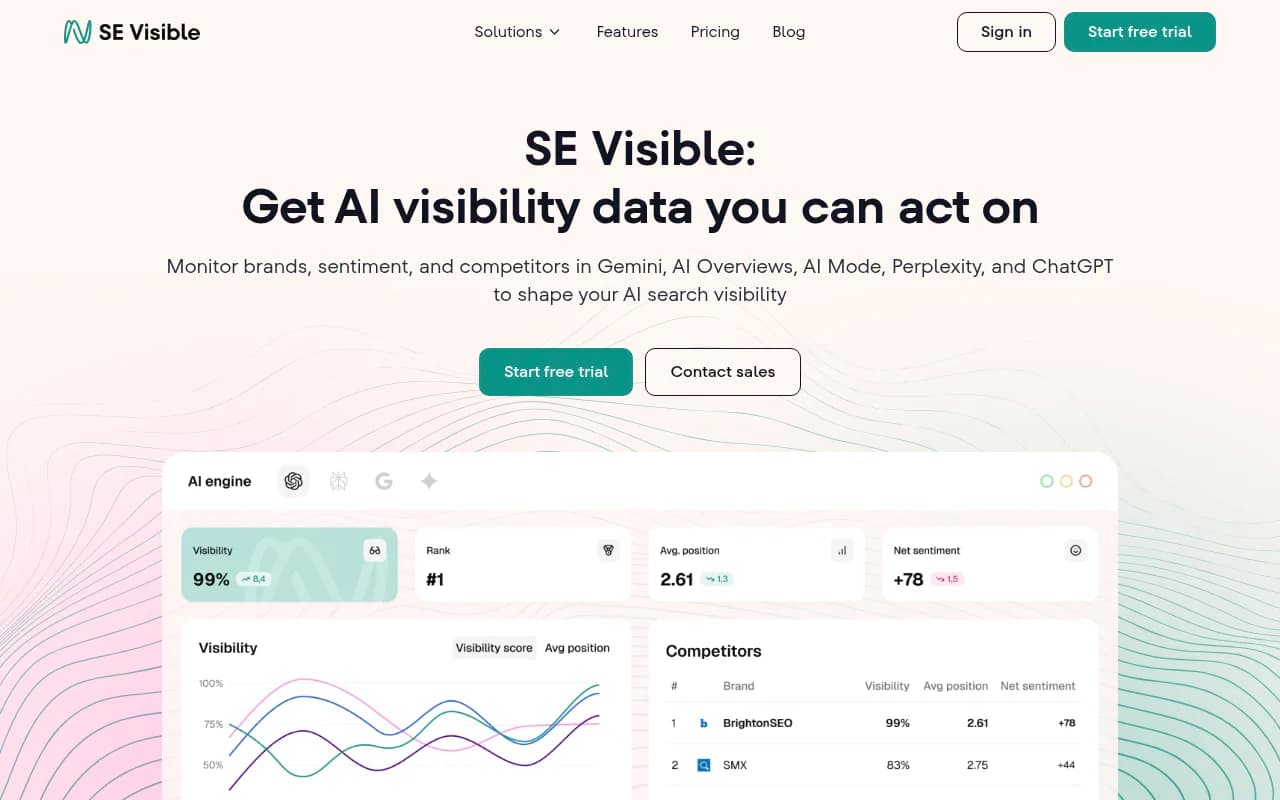
The advantage here is consolidation -- you get AI visibility data alongside traditional SEO data in one place, which makes it easier to see how your organic rankings and AI citations relate to each other. The disadvantage is that SE Visible is still primarily a monitoring tool. No content generation, no ChatGPT Shopping tracking, no crawler logs.
For an e-commerce brand that's already invested in SE Ranking and wants to add AI visibility monitoring without switching platforms, SE Visible makes sense. For a brand starting fresh and prioritizing AI search specifically, there are better options.
5. AthenaHQ -- best for brands that want structured brand perception data
AthenaHQ tracks brand visibility across 8+ AI search engines and is particularly good at showing how AI engines describe your brand -- the attributes, comparisons, and sentiment that appear in responses.

For e-commerce brands, this matters because AI engines don't just recommend products -- they describe them. If ChatGPT consistently describes your brand as "mid-range" when you want to be perceived as "premium," that's a positioning problem you need to know about. AthenaHQ surfaces this kind of data well.
The limitation is the same as most competitors: it's monitoring-focused. You'll know how you're perceived, but the platform won't help you change it. No content generation, no ChatGPT Shopping tracking.
6. Semrush One -- best for brands that want AI visibility alongside traditional SEO
Semrush has added AI visibility tracking to its platform through the AI Toolkit, which lets you monitor brand mentions in AI responses alongside Semrush's existing keyword research, site audit, and rank tracking tools.
The appeal is obvious: if you're already paying for Semrush, adding AI visibility data to your existing workflow is low friction. The limitation is that Semrush uses fixed prompt sets rather than custom prompts, which means you can't track the specific product queries that matter to your category. There's also no AI traffic attribution, no ChatGPT Shopping tracking, and no content generation.
For e-commerce brands that want a rough sense of AI visibility without switching tools, Semrush's AI Toolkit is convenient. For brands that want to actually optimize for AI search, it's not deep enough.
7. Scrunch AI -- best for mid-market brands that want SOC 2 compliance
Scrunch AI is a solid mid-market option with strong compliance credentials (SOC 2 Type II) and support for up to 9 LLMs at the enterprise tier. Its Core plan at $250/month includes 5 user licenses and 125 prompts, which is reasonable for a small team.
Scrunch is a monitoring platform -- it doesn't generate content or track ChatGPT Shopping. But it's well-built, covers more models than most mid-market options, and the compliance credentials matter for brands in regulated categories like health, beauty, or financial products. If your e-commerce brand operates in a category where data security is a real concern, Scrunch is worth a look.
Feature comparison: what each platform actually tracks
| Platform | ChatGPT Shopping | SKU-level tracking | Content generation | AI crawler logs | Reddit/YouTube | Traffic attribution | Starting price |
|---|---|---|---|---|---|---|---|
| Promptwatch | Yes | Yes (page-level) | Yes | Yes | Yes | Yes | $99/mo |
| Profound | No | No | No | No | No | Limited | Custom |
| Otterly.AI | No | No | No | No | No | No | $29/mo |
| SE Visible | No | No | No | No | No | No | Bundled |
| AthenaHQ | No | No | No | No | No | No | Custom |
| Semrush One | No | No | No | No | No | No | Bundled |
| Scrunch AI | No | No | No | No | No | No | $250/mo |
| Peec.ai | No | No | No | No | No | No | €85/mo |
The table makes the gap visible. Most platforms in this category are monitoring dashboards. Promptwatch is the only one that covers ChatGPT Shopping tracking, content generation, crawler logs, and traffic attribution in a single platform.
How to choose the right platform for your e-commerce brand
The right choice depends on where you are in your AI visibility journey.
If you're just starting out and want to understand the basics before committing to a larger platform, Otterly.AI or SE Visible (if you're already on SE Ranking) are reasonable entry points. You'll get basic monitoring data and a sense of where you stand.
If you're a mid-market brand that's already seeing meaningful AI-referred traffic and wants to grow it, Promptwatch is the clear choice. The combination of ChatGPT Shopping tracking, content gap analysis, AI writing, and traffic attribution gives you everything you need to turn visibility data into revenue.
If you're an enterprise brand with a large analytics team and complex reporting needs, Profound or Scrunch AI are worth evaluating -- but be prepared to build your own optimization workflow on top of the data they provide.
If you're already paying for Semrush and just want to add AI visibility monitoring to your existing stack, the AI Toolkit is the path of least resistance. Just don't expect it to replace a dedicated GEO platform.
What to look for specifically in an e-commerce AI visibility tool
Before you sign up for any platform, ask these questions:
Does it track ChatGPT Shopping carousels? This is a distinct surface from text responses and is where product-level conversions happen. Most tools don't track it.
Does it track individual products or just brand names? Brand-level monitoring tells you if you're mentioned. Product-level monitoring tells you if your actual SKUs are being recommended.
Does it show you which pages are being cited? Knowing that "your brand" is mentioned is less useful than knowing that your "best moisturizer for dry skin" comparison page is being cited 47 times per week by Perplexity.
Does it help you create content, or just show you gaps? Seeing that you're invisible for "best running shoes under $150" is useful. Getting a content brief and draft article targeting that query is what actually moves the needle.
Does it connect visibility to revenue? AI visibility data is only valuable if you can tie it to actual traffic and conversions. Look for platforms that offer traffic attribution through a code snippet, GSC integration, or server log analysis.
The bottom line
Peec.ai is a reasonable starting point for AI visibility monitoring, but it was built for brand tracking, not e-commerce optimization. The features that matter most for online retailers -- ChatGPT Shopping tracking, product-level citations, content gap analysis, and revenue attribution -- aren't there.
Most alternatives have the same problem. They show you a dashboard of where you're invisible and leave you to figure out the rest.
The exception is Promptwatch, which covers the full cycle: find the gaps, generate the content, track the results, and connect it to revenue. For e-commerce brands that are serious about AI search in 2026, that's the difference between a monitoring tool and a growth tool.