GetMint Review 2026
Monitor and optimize your brand's presence across AI search engines like ChatGPT, Perplexity, and Google AI Overviews with content creation tools.
Key Takeaways:
- GetMint offers monitoring across major AI models (ChatGPT, Claude, Gemini, Perplexity, Grok, Google AI Overviews) but lacks the depth of Promptwatch -- no AI crawler logs, no traffic attribution, no Reddit/YouTube tracking, and no prompt volume/difficulty scoring
- Strong content distribution network with 150K+ partner media outlets to influence AI sources, a unique differentiator in the GEO space
- Monitoring-focused platform with basic content creation tools, but missing the optimization loop that connects visibility to actual business results
- Best for brands prioritizing external media placement over technical optimization and traffic measurement
- Pricing starts at €99/mo (Starter), €229/mo (Growth), €499/mo (Pro) with project-based scaling

GetMint launched as one of the early platforms addressing Generative Engine Optimization (GEO), the practice of optimizing brand presence in AI-powered search results. The company is based in France and serves over 200 brands including Pretto, Jow, Olyos Group, and JLL. The platform targets marketing teams, agencies, and brands concerned about how AI models like ChatGPT and Perplexity represent them when users ask for product recommendations or industry information.
The core problem GetMint addresses: 1.6 billion people now use AI search monthly, and 50% of consumers rely on AI for purchase decisions. If your brand doesn't appear when someone asks ChatGPT "What's the best project management tool?" or Perplexity "Which CRM should I use?", you're invisible to half your potential market. GetMint positions itself as an end-to-end platform for tracking, improving, and measuring AI visibility.
Core Features Breakdown:
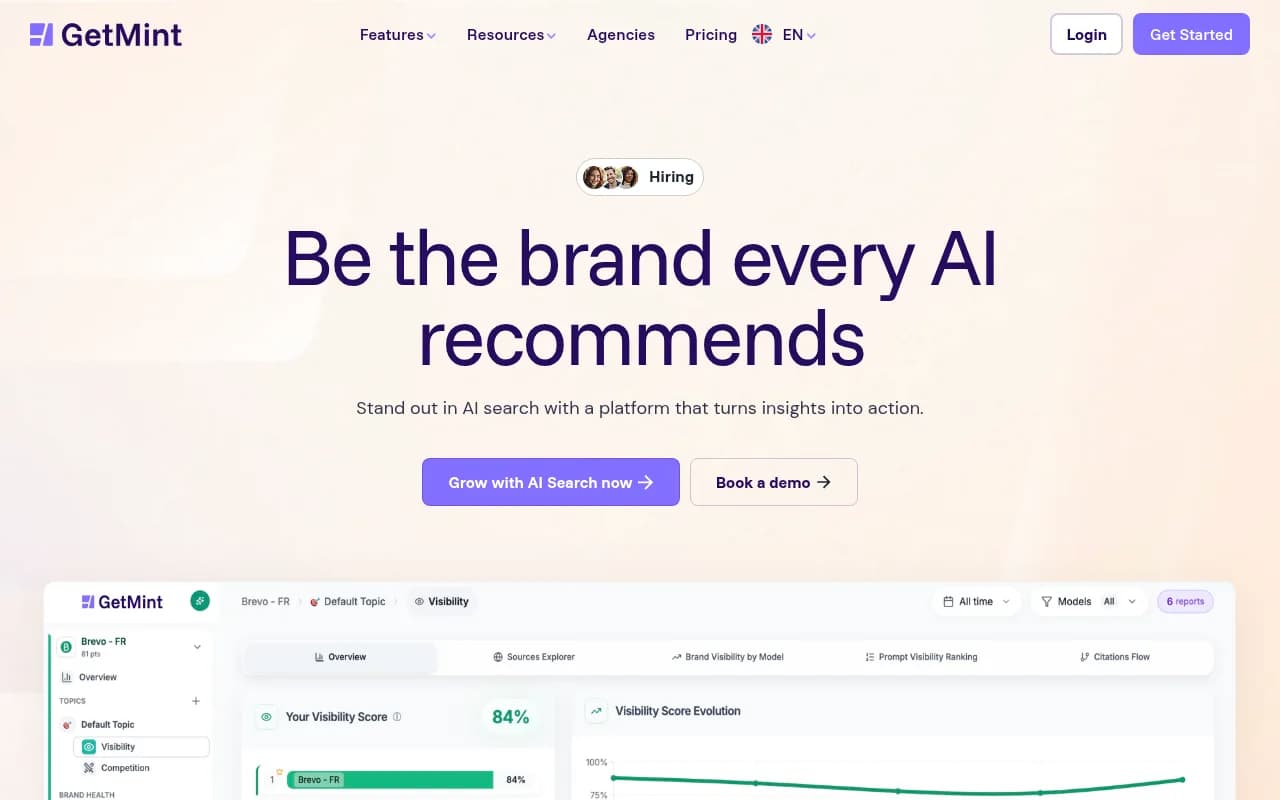
AI Visibility Monitoring tracks how your brand appears across ChatGPT, Claude, Gemini, Perplexity, Grok, and Google AI Overviews. You define core topics and prompts relevant to your business, then GetMint monitors whether your brand gets mentioned, how it's positioned, and which competitors appear alongside you. The dashboard shows visibility scores by market, product, and persona. You can see which AI models favor your brand and which ignore you entirely. This is table-stakes monitoring -- similar to what Otterly.AI, Peec.ai, and AthenaHQ offer. What's missing: GetMint doesn't provide AI crawler logs (you can't see when ChatGPT or Claude actually crawled your site), no traffic attribution to connect visibility to actual visitors, and no prompt volume estimates to prioritize which queries matter most. Promptwatch offers all three, plus page-level citation tracking so you know exactly which URLs are being cited.
Content Gap Analysis identifies where competitors appear in AI answers but you don't. GetMint shows you the prompts where you're invisible and suggests content topics to fill those gaps. This is useful for understanding what's missing, but the analysis is surface-level compared to platforms like Promptwatch that show specific missing content angles, query fan-outs (how one prompt branches into sub-queries), and difficulty scoring to help you prioritize winnable opportunities. GetMint tells you there's a gap; Promptwatch tells you exactly what content to create and why it will work.
Content Creation Tools let you generate AI-optimized articles directly in the platform. You get a certain number of content creation credits per month depending on your plan (Starter: limited, Growth: more credits, Pro: higher volume). The AI writing agent produces articles designed to get cited by AI models, but there's no indication it's trained on citation data or prompt intelligence the way Promptwatch's content generator is (880M+ citations analyzed). The content quality and strategic targeting likely lag behind platforms that build their writing tools on actual AI search data.
Content Distribution Network is GetMint's standout differentiator. The platform connects you to 150K+ partner media outlets where you can publish content that directly influences the sources AI models cite. This is a unique capability -- most GEO platforms (Promptwatch, Otterly.AI, Peec.ai, AthenaHQ, Profound) focus on optimizing your own site and tracking results, but don't offer external publishing. If you want to place thought leadership articles, case studies, or product comparisons on third-party sites that AI models trust, GetMint gives you that distribution channel. The trade-off: you're relying on external placements rather than building authority on your own domain. For brands with weak owned media or new companies needing fast visibility, this is valuable. For established brands with strong domains, optimizing your own content (and tracking how AI crawlers interact with it) is usually more sustainable.
Competitor Benchmarking shows how your visibility compares to competitors across different AI models. You can see who's winning for specific prompts and which brands dominate your category in AI search. This is standard competitive intelligence -- every GEO platform offers some version of it. GetMint's implementation is clean and easy to read, but doesn't go deeper into why competitors are winning (which pages they're getting cited for, what content strategies they're using, how their crawler activity differs from yours).
Multi-Model Coverage includes ChatGPT, Claude, Gemini, Perplexity, Grok, and Google AI Overviews. That's solid but not comprehensive -- Promptwatch monitors 10+ models including Meta AI, DeepSeek, Mistral, and Copilot. If you're targeting a global audience or specific regions where certain AI models dominate, broader coverage matters.
Persona and Market Segmentation lets you track visibility by different user personas (e.g. "enterprise buyer" vs "freelancer") and geographic markets. You can see if your brand appears differently depending on who's asking and where they're located. This is useful for companies with multiple customer segments or international presence. The feature works, but there's no indication GetMint offers the granularity of state/city-level tracking or custom persona prompts that platforms like Promptwatch provide.
Dashboard and Reporting is clean and straightforward. You get visibility scores, trend charts, and prompt-level breakdowns. The interface is modern and easy to navigate -- testimonials mention it's "simple" and "reliable." For agencies managing multiple clients, GetMint offers multi-brand support with unlimited seats on Growth and Pro plans. No mention of Looker Studio integration, API access, or custom reporting capabilities that larger teams or agencies might need for client dashboards.
Who Is It For:
GetMint is built for brands and agencies that want a simple, monitoring-focused GEO platform with a unique content distribution angle. Primary users:
Brand marketing teams at mid-market companies (50-500 employees) who need to understand how AI represents their brand but don't have the resources or technical depth to optimize at the page level. If you're a CMO at a SaaS company or consumer brand and you just want to know "Are we visible in ChatGPT? How do we compare to competitors? What content should we create?", GetMint gives you those answers without overwhelming you with technical details. You won't get AI crawler logs or traffic attribution, but you'll get a clear action list.
Agencies managing multiple clients who need a clean, client-friendly dashboard and the ability to scale across brands. GetMint's unlimited seats and project-based pricing (Growth: €229/mo, Pro: €499/mo) make it easier to onboard clients than platforms with per-seat pricing. The content distribution network is a service you can sell -- "We'll get you placed in 150K+ outlets that influence AI models." The limitation: you're not delivering the deep optimization and traffic measurement that sophisticated clients expect. If a client asks "How much traffic did we get from AI search this month?", GetMint can't answer that.
Startups and newer brands with weak domain authority who need fast visibility in AI search. If your website is new and Google barely ranks you, optimizing your own content won't move the needle quickly. GetMint's external publishing network lets you borrow authority from established media outlets. You're essentially buying your way into AI citations through third-party placements. This works as a short-term tactic but isn't a sustainable long-term strategy -- you're building someone else's domain, not your own.
Who should NOT use GetMint: Companies that need technical depth, traffic attribution, or a true optimization platform. If you're an SEO team at an enterprise company tracking hundreds of keywords and you need to know which pages are being cited, how AI crawlers interact with your site, and how visibility translates to actual traffic and revenue, GetMint doesn't provide those capabilities. Promptwatch is built for that use case -- AI crawler logs show you exactly when and how AI models access your site, traffic attribution connects visibility to visitors, and page-level citation tracking shows which URLs are working. GetMint is monitoring-only; Promptwatch is an optimization platform.
Integrations & Ecosystem:
GetMint mentions "integrations" in its pricing tiers but doesn't specify which tools it connects to. No mention of Google Search Console integration, Slack notifications, Zapier, or API access. The platform appears to be a standalone tool without the ecosystem connectivity that larger teams need. For comparison, Promptwatch integrates with GSC for traffic attribution, offers a full API for custom workflows, and supports Looker Studio for custom reporting.
No browser extensions, mobile apps, or developer tools mentioned. The platform is web-based only.
Pricing & Value:
GetMint uses project-based pricing with unlimited seats:
- Starter: €99/month -- Basic monitoring, limited content creation credits, single brand/project
- Growth: €229/month -- More brands/URLs, higher content creation volume, advanced features
- Pro: €499/month -- Highest limits, priority support, full feature access
All plans include unlimited seats, which is a plus for agencies or larger teams. The pricing is competitive with other GEO platforms (Promptwatch Essential is $99/mo, Professional is $249/mo, Business is $579/mo), but you're getting less functionality. GetMint's pricing reflects its positioning as a simpler, monitoring-focused tool. If you just want dashboards and basic content suggestions, it's reasonable. If you need crawler logs, traffic attribution, Reddit/YouTube tracking, and optimization tools, you're underpaying for a platform that can't deliver those capabilities.
Free trial available -- you can sign up directly from the site to test the platform. No pricing details on the content distribution network (the 150K+ partner outlets) -- that's likely an add-on or included in higher tiers.
Strengths:
- Content distribution network is a genuine differentiator -- 150K+ partner outlets give you external publishing reach that most GEO platforms don't offer
- Clean, simple interface that's easy for non-technical users -- testimonials consistently mention it's straightforward and reliable
- Unlimited seats on Growth and Pro plans make it agency-friendly without per-user pricing penalties
- Multi-model coverage across the major AI search engines (ChatGPT, Claude, Gemini, Perplexity, Grok, Google AI Overviews)
- Trusted by 200+ brands including recognizable names like Pretto, Jow, JLL -- social proof that it works for real companies
Limitations:
- No AI crawler logs -- you can't see when or how AI models access your website, which makes it impossible to diagnose indexing issues or understand discovery patterns. Promptwatch provides real-time crawler logs for ChatGPT, Claude, Perplexity, and other models.
- No traffic attribution -- GetMint can't tell you how many visitors or conversions came from AI search visibility. You're flying blind on ROI. Promptwatch offers traffic attribution via code snippet, GSC integration, or server log analysis.
- No Reddit or YouTube tracking -- AI models heavily cite Reddit discussions and YouTube videos, but GetMint doesn't surface those sources. Promptwatch tracks both.
- No prompt volume or difficulty scoring -- you don't know which prompts are high-value or winnable. Promptwatch provides volume estimates and difficulty scores so you can prioritize.
- No ChatGPT Shopping tracking -- if your brand appears in ChatGPT's product recommendations or shopping carousels, GetMint won't tell you. Promptwatch monitors this.
- Limited content intelligence -- the content creation tools aren't grounded in citation data or prompt analysis the way Promptwatch's AI writing agent is (880M+ citations analyzed).
- No API or advanced integrations -- if you need to build custom workflows or connect to other tools, GetMint doesn't provide that flexibility.
Bottom Line:
GetMint is a solid entry-level GEO platform for brands and agencies that want simple monitoring and a unique content distribution angle. If you're a mid-market brand that just needs to know "Are we visible in ChatGPT?" and "What content should we create?", GetMint gives you those answers without overwhelming you. The 150K+ partner media network is a real differentiator if external placements fit your strategy.
But if you're serious about optimizing AI search visibility -- not just monitoring it -- GetMint falls short. No AI crawler logs means you can't diagnose technical issues. No traffic attribution means you can't measure ROI. No Reddit/YouTube tracking means you're missing major citation sources. No prompt intelligence means you're guessing which opportunities matter. Promptwatch is the stronger choice for teams that want to close the loop from visibility to traffic to revenue. GetMint shows you the problem; Promptwatch helps you fix it.
Frequently asked questions
What is GetMint and what does it do?
How much does GetMint cost?
Which AI search engines does GetMint monitor?
Who should use GetMint?
Does GetMint offer a free plan?
What makes GetMint different from other GEO tools?
Can GetMint help improve my brand's AI search rankings?
What is Generative Engine Optimization or GEO?
Similar and alternative tools to GetMint