Key takeaways
- Most GetMint problems fall into four buckets: login and dashboard issues, delayed or missing tracking data, incomplete model coverage, and billing or support friction.
- Before switching, run through the quick fixes: clear your cache, check the status of your tracked prompts, verify your subscription tier limits, and contact support with a specific request.
- If issues persist for more than a few weeks, or if you've outgrown what GetMint can measure, it's reasonable to switch. Migration is easier than it used to be because most platforms let you export your prompt lists.
- Strong alternatives in 2026 include Promptwatch, Profound, Scrunch, Peec AI, Otterly.AI, AthenaHQ, and Semrush, each suited to different budgets and team sizes.
- If you'd rather outsource the whole AI visibility problem than manage another tool, an agency like 1001 SEO Media can run GEO for you end to end.
First, is GetMint actually down?
Before you tear your hair out, separate "the platform is broken" from "the platform is working but I don't like the results." These get conflated a lot.
GetMint is a real product with real customers, including some big consumer brands, and it does what it says on the tin: it tracks how ChatGPT, Gemini, Perplexity, Claude, and Google AI Overviews mention your brand, flags content gaps, and helps you publish content to close them. It's a legitimate GEO platform.
That said, it's a young company, and young companies have young-company problems. Here's what users typically run into, both with GetMint specifically and with AI visibility platforms in this category generally.
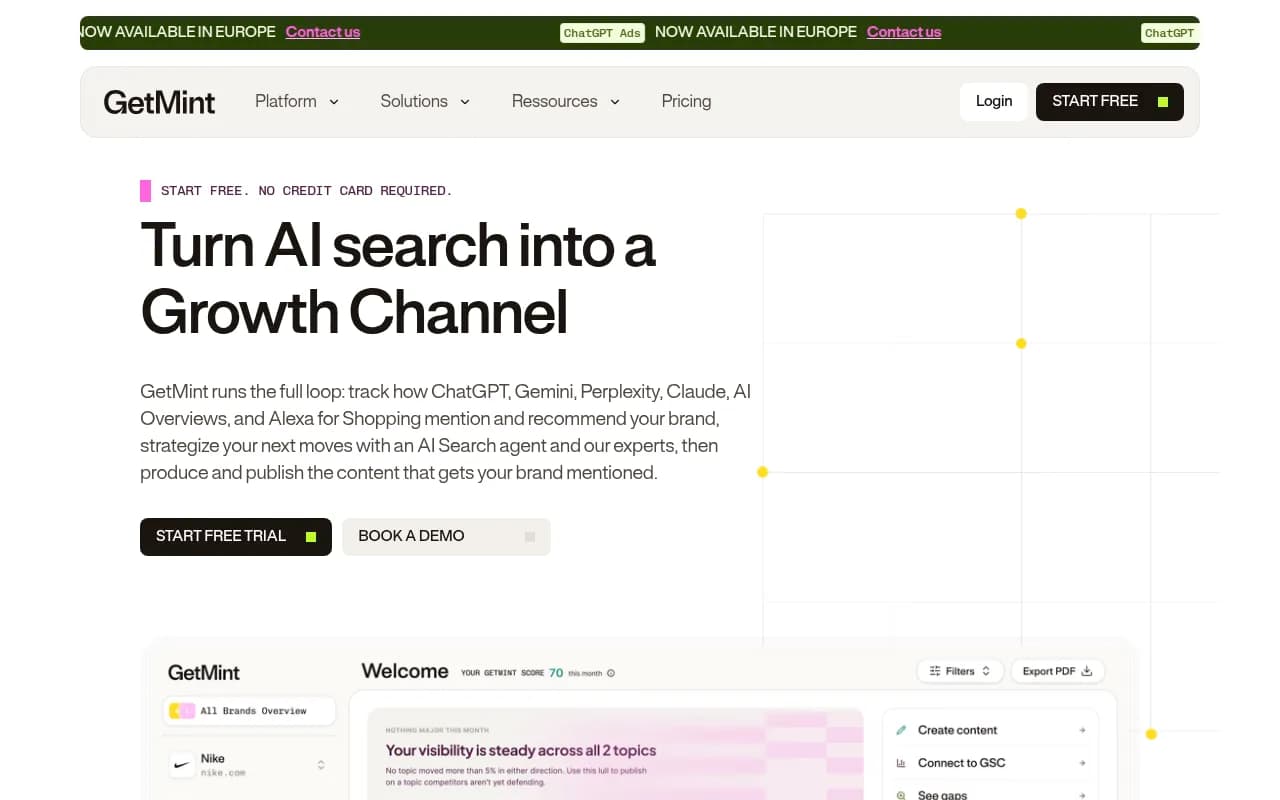
Common problems users run into
1. Dashboard won't load or login loops
The classic. You click "Login," enter credentials, and either nothing happens or you bounce back to the sign-in page. This is almost always a browser session issue, not your account. Framer-built apps (GetMint's site runs on Framer) occasionally serve stale JavaScript, which causes exactly this kind of behavior.
Quick fixes:
- Hard refresh with Ctrl+Shift+R (Cmd+Shift+R on Mac)
- Clear cookies for getmint.ai and app.getmint.ai specifically
- Try an incognito window to rule out a conflicting browser extension
- Try a different browser entirely
- If you use a VPN or corporate proxy, disable it temporarily
2. Tracking data is delayed or missing
This is the most common complaint category across all AI visibility tools, and honestly, it's partly the nature of the beast. These platforms send prompts to live AI models and record what comes back. When a model provider has a bad week, and in 2026 several have had very bad weeks, the data pipeline downstream gets weird too.
One concrete example from outside GetMint: Google's own developer forums have been full of complaints this year about Gemini's reliability, including infinite loading loops and silent quota downgrades. When the model you're tracking is unstable, your tracking data will show gaps no matter which platform you use.
Quick fixes:
- Check whether the missing data affects one model or all of them. One model = provider issue. All models = platform issue.
- Look at whether your prompt count exceeds your plan's limits. Over-limit prompts often silently stop being tracked.
- Give it 24 to 48 hours before assuming data loss. Many platforms backfill.
3. Visibility scores that don't match reality
You ask ChatGPT yourself and your brand shows up, but the dashboard says you're invisible. Or the reverse. This isn't usually a bug. AI models are non-deterministic, meaning the same prompt can return different answers on different days, in different regions, and across different user contexts. A platform checking from US servers while you test from your laptop in Lyon will see different results.
Quick fixes:
- Compare like for like: same prompt, same region, same language
- Run the same prompt a few times in the platform before concluding the score is wrong
- Ask support which model version and interface they query, because API results and chat interface results genuinely differ
4. Billing, plan limits, and support friction
Smaller platforms often have smaller support teams. If you're on a lower tier, response times can stretch to several business days, and plan limits (prompts, refresh frequency, seats) can be stricter than you assumed from the marketing page.
Quick fixes:
- Screenshot your plan limits before you need them, so you're not guessing during an outage
- When you contact support, include your account email, the affected prompts, timestamps, and what you expected vs. what you saw. Vague tickets get slow answers everywhere.
When it's time to switch instead of fixing
Troubleshooting makes sense for a bad afternoon. It stops making sense when:
- The same problems recur for weeks and support can't resolve them
- You've hit plan limits and upgrading within GetMint costs more than an equivalent tier elsewhere
- You need capabilities GetMint doesn't offer, like AI crawler log analysis, Reddit and YouTube citation tracking, or AI traffic attribution to actual conversions
- You're an agency that needs white-label reporting and unlimited client projects
One more honest note: if your frustration is less about the tool and more about not having anyone to own AI visibility strategically, the tool might not be the problem. A GEO-specialist agency like 1001 SEO Media handles the full loop, monitoring, content production, and optimization, without you managing a dashboard at all.
7 platforms to switch to in 2026
Here are seven alternatives worth your shortlist, ranging from full optimization platforms to budget trackers. I've ordered them roughly by how complete their offering is, but the right pick depends on your situation.
1. Profound
Profound is the enterprise name in this space. It tracks brand visibility across the major AI search engines with strong analytics and good reporting for large organizations. If you're a big brand with a real budget and you need something your CFO's team will recognize on an invoice, it's a safe choice. The tradeoffs are price, which runs higher than most competitors, and a monitoring-heavy focus. It tells you where you stand very well; it does less to help you fix what it finds.

2. Promptwatch
Promptwatch sits at the opposite end of the philosophy spectrum from monitoring-only tools: it's built to close the loop. You get prompt tracking with volumes and difficulty scores, citation analytics, and something most competitors lack entirely, real AI crawler logs showing when ChatGPTBot, ClaudeBot, PerplexityBot, and 400+ other bots actually hit your site, what they read, and whether they hit errors. That answers the "why am I not visible" question instead of just confirming you're invisible.
Then it acts: content gap analysis, automated Content Agents that plan, write, and publish GEO-optimized content straight to WordPress, Webflow, or Framer, and Unified Actions, which is essentially a prioritized AI-generated to-do list. It also tracks things most platforms ignore, like Reddit and YouTube citations, ChatGPT Shopping recommendations, and sponsored placements in AI search. The dataset behind it is large, more than 4.5 billion citations and prompts analyzed, and it's used by over 1,840 brands and agencies including Duolingo, Yelp, and Shutterstock. Pricing starts at $95/month with a free tier, which makes it one of the better cost-per-value options in the category.

3. Scrunch
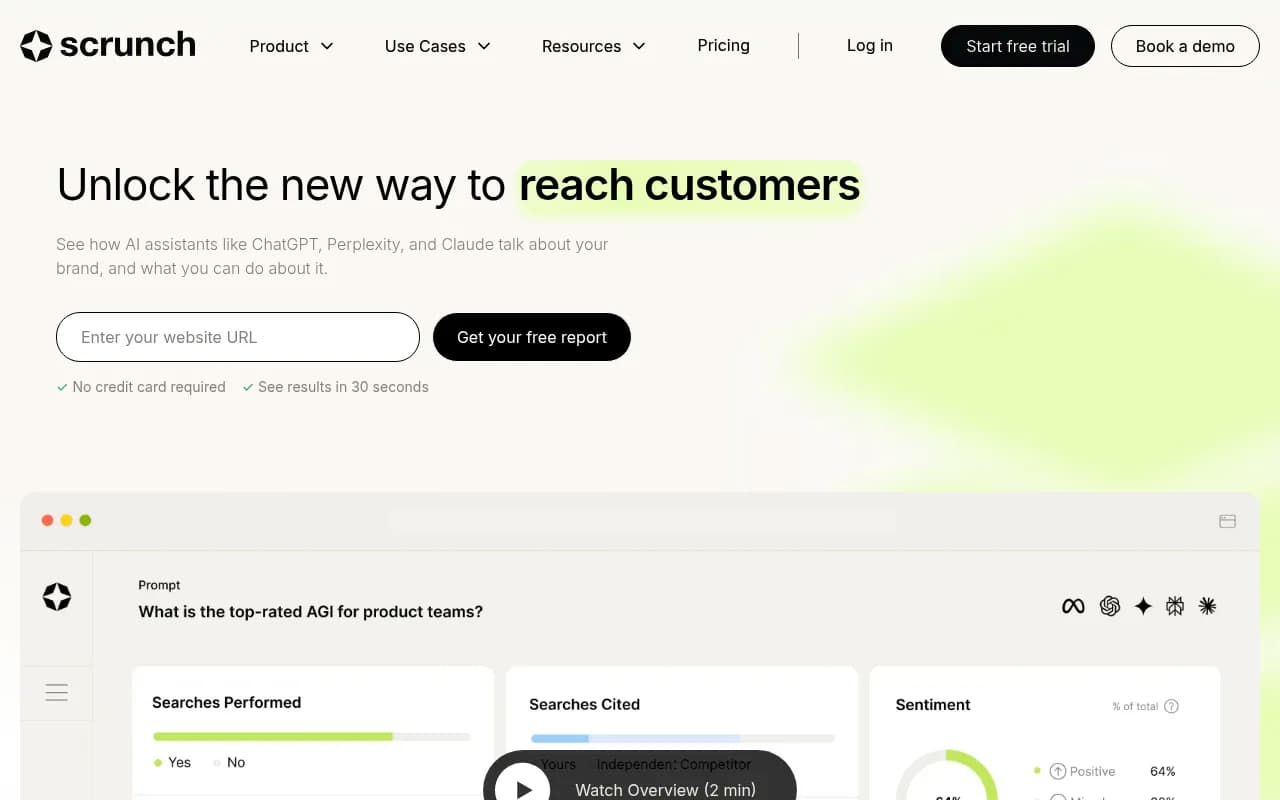
Scrunch approaches AI visibility from an interesting angle: it maps how AI assistants discover and cite sources, then helps you fix the source problems. Its monitoring is solid and its source-level analysis is genuinely useful for understanding why competitors get cited and you don't. Like Profound, it leans monitoring-heavy, and it's pricier than the budget trackers. Good fit if your core question is "where does AI get its information about my industry?"
4. Peec AI
Peec AI is a straightforward, affordable visibility tracker with unusually good multi-language support. If you operate in non-English markets and GetMint's language coverage has been a pain point, Peec is worth a look. It's a tracker first and foremost, so don't expect content generation or crawler analytics, but for the price it does the monitoring job cleanly.

5. Otterly.AI
Otterly.AI is one of the earlier AI visibility monitors and remains one of the simplest. You set prompts, it checks them on a schedule, and you get clean reports. It's affordable and easy to set up, which makes it a good landing spot if GetMint felt overcomplicated or you just need basic monitoring for a small brand. The ceiling is low, though. No crawler logs, no traffic attribution, no content tooling.

6. AthenaHQ
AthenaHQ tracks brand visibility across eight-plus AI search engines with a tidy dashboard and reasonable pricing. It's aimed at teams that want monitoring plus light optimization guidance without enterprise pricing. It's a sensible middle option, more capable than Otterly, less expensive than Profound, though it lacks the deeper execution features like CMS publishing and agentic content workflows.

7. Semrush
If you already pay for Semrush, its AI visibility toolkit deserves a look before you buy anything new. As a traditional SEO suite bolting on AI tracking, it's shallower than dedicated GEO platforms, with fixed prompt sets and no crawler-level data, but the integration with your existing keyword research, rank tracking, and reporting is a real convenience. Best as a stopgap or for teams whose AI visibility needs are still exploratory.
Quick comparison
| Platform | Starts at (monthly) | Crawler logs | Content creation & publishing | Best for |
|---|---|---|---|---|
| GetMint | Free tier, paid plans above that | No | Yes (Content Studio) | Brands wanting tracking plus content in one place |
| Promptwatch | $95 (free tier available) | Yes (400+ bots) | Yes (automated agents, CMS publishing) | Teams that want to fix visibility, not just measure it |
| Profound | Enterprise pricing | No | Limited | Large brands needing enterprise-grade monitoring |
| Scrunch | Mid-to-high pricing | No | Limited | Source-level analysis and monitoring |
| Peec AI | Budget-friendly | No | No | Multi-language monitoring on a budget |
| Otterly.AI | Budget-friendly | No | No | Simple, affordable prompt tracking |
| AthenaHQ | Mid-range | No | Light guidance | Small teams wanting a middle-ground option |
| Semrush | Bundled with SEO suite | No | Via separate tools | Existing Semrush users with basic AI visibility needs |
How to choose without another bad subscription
The AI tool market in 2026 has a real subscription fatigue problem, and GEO tools are some of the worst offenders because every platform demos beautifully and then you discover its limits three weeks in. A few rules that save people money:
- Decide if you need a tracker or an optimizer. If you only need to know whether ChatGPT mentions you, a cheap tracker like Otterly or Peec does the job for a fraction of the price. If you need to move the number, you need execution features: content gap analysis, content production, CMS publishing. Only a couple of platforms on this list actually have that, and Promptwatch is the most complete of them.
- Trial with your real prompts. Every platform offers a trial or free tier. Before committing, load in ten prompts you actually care about and compare the results against what you see manually in ChatGPT and Perplexity. If a platform's data doesn't roughly match your own spot checks, nothing else about it matters.
- Check the crawler question. Ask any vendor: "Can you show me when AI crawlers visit my site and what errors they hit?" If the answer is no, the platform can tell you that you're invisible but can't tell you why. That distinction matters more than any feature comparison table.
- Export before you leave. Whatever you switch from, download your prompt list and historical data first. Most platforms make this possible but not obvious.
And if the real issue is that nobody on your team has time to own AI visibility at all, that's a hiring decision, not a software decision. 1001 SEO Media runs GEO programs for brands that want the outcome without the dashboard management, from monitoring through content production to reporting. Sometimes the tool that's "not working" is just the one nobody has time to use properly.