Scrunch Review 2026
Monitors brand presence across AI platforms with focus on influencer marketing and social media visibility in AI-generated content.
Key Takeaways
• Scrunch monitors brand presence across major AI platforms (ChatGPT, Perplexity, Claude, Gemini) with performance tracking, prompt analytics, and competitor benchmarking • Lacks content generation, answer gap analysis, and Reddit/YouTube tracking that Promptwatch offers -- Scrunch is monitoring-focused, not optimization-focused • Agent Experience Platform (AXP) creates AI-optimized parallel versions of your site to improve how bots interpret your content • Pricing starts at $250/month (Starter plan) -- significantly higher than most GEO platforms • Best for mid-market and enterprise brands with budget for monitoring, but not ideal if you need help creating content that ranks in AI search

What Scrunch Actually Does
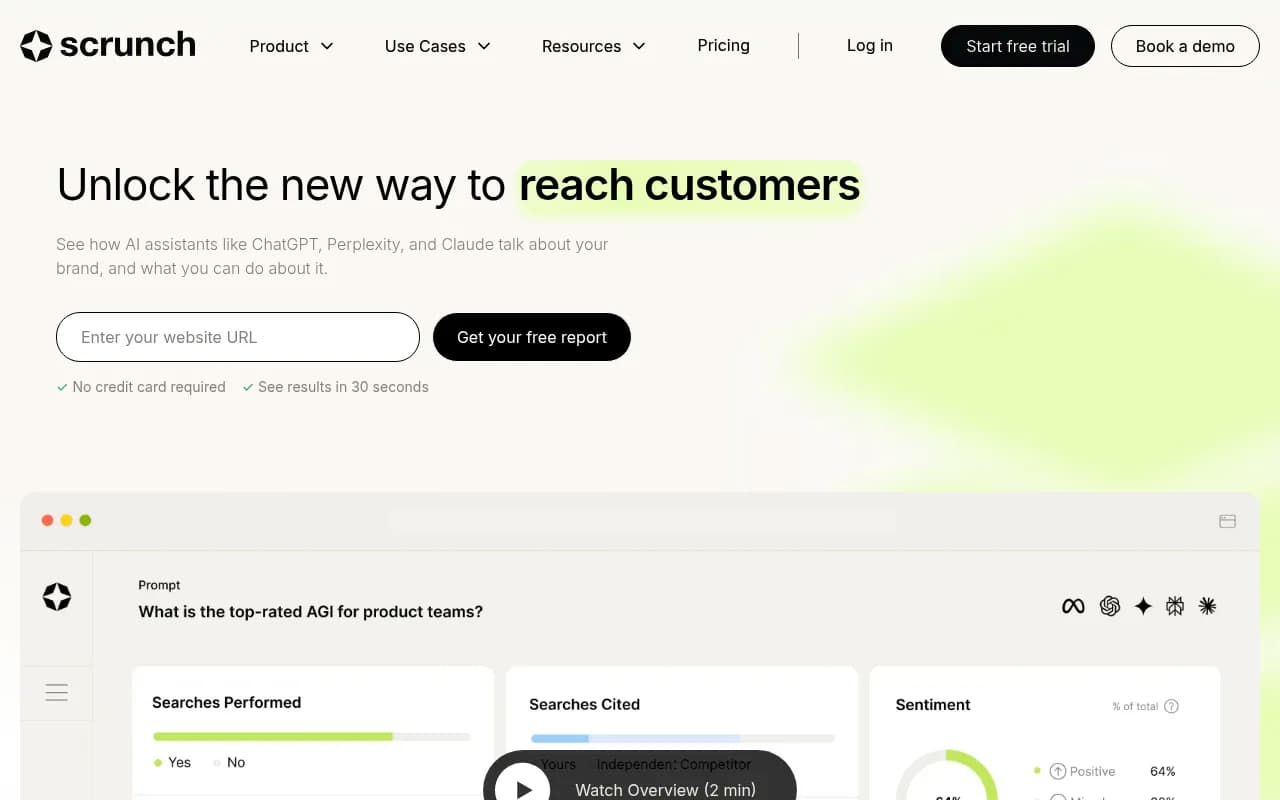
Scrunch positions itself as an "AI Customer Experience Platform" -- a term that sounds vague until you dig into what it actually means. The core idea: AI assistants like ChatGPT and Perplexity are becoming primary research tools for B2B buyers, and Scrunch helps you understand how these AI engines talk about your brand. It's a monitoring and analytics platform first, with some optimization features layered on top.
The company launched in 2024 and has picked up 500+ customers including recognizable names like Lenovo, Clerk, Skims, and Penn State University. They're SOC 2 Type II compliant and clearly targeting mid-market to enterprise customers based on pricing and positioning. The platform covers the major AI models -- ChatGPT, Perplexity, Claude, Gemini -- though the exact list isn't fully detailed on their site.
What sets Scrunch apart from pure monitoring tools is the Agent Experience Platform (AXP), which we'll get to. But the foundation is tracking: you connect your brand, define prompts you care about, and Scrunch shows you where you rank, who's getting cited instead, and how AI bots are crawling your site.
Monitoring Dashboard: What You Actually See
The monitoring side breaks down into three main views:
Performance Tracking shows your brand's visibility score across AI platforms, broken down by competitor, persona, topic, and geography. You can see trends over time -- are you gaining or losing ground? The competitor benchmarking is useful: you're not just tracking your own performance in a vacuum, you're seeing how you stack up against specific rivals for specific prompts. If a competitor suddenly jumps in visibility for "best project management software for remote teams," you'll see it.
Prompt Analytics digs into individual prompts. For any query you're tracking, Scrunch shows you the AI-generated response, which sources got cited, your ranking position, and how that's changed over time. This is table stakes for any GEO platform, but Scrunch's interface is clean and the data is presented clearly. You can filter by AI model, date range, and persona.
AI Traffic Monitoring is where Scrunch differentiates itself from some competitors. You get a real-time feed of AI bot crawl activity on your site -- which pages they're hitting, how often, and whether they're encountering errors. This is similar to what Promptwatch calls "AI Crawler Logs," though Scrunch doesn't provide as much granular detail about specific bot behavior patterns or error diagnostics. Still, knowing that ChatGPT's crawler hit your pricing page 47 times last week but got a 403 error on your case studies page is actionable intel.
The traffic feed also shows trends: are AI bots crawling your site more or less frequently over time? A sudden drop can signal indexing issues or that your content has become less relevant to AI training data.
Insights: The "Why" Layer
Scrunch's Insights module tries to answer the question every monitoring dashboard leaves hanging: "Okay, but what do I do about this?"
Optimization Tips are AI-generated suggestions for improving your visibility. If you're not ranking for a prompt, Scrunch will analyze the top-cited sources and suggest content gaps you could fill, keywords to emphasize, or structural changes to make your content more digestible for AI models. The quality of these tips varies -- sometimes they're genuinely useful ("Add a comparison table to your pricing page"), sometimes they're generic SEO advice repackaged ("Include more relevant keywords").
This is where Scrunch's limitations become clear. Unlike Promptwatch, which has Answer Gap Analysis that shows you exactly which prompts competitors rank for but you don't, and then generates the missing content for you, Scrunch gives you suggestions but leaves the content creation entirely to you. There's no built-in writing agent, no content templates, no way to generate articles grounded in citation data. You're on your own to implement the recommendations.
Citation Analysis surfaces the domains and pages that AI models cite most frequently in your category. If you're in the CRM space and Salesforce's help docs get cited 10x more than anyone else's, that's a signal. You can reverse-engineer what makes those pages citation-worthy. Scrunch doesn't track Reddit threads or YouTube videos the way Promptwatch does, so you're missing a big chunk of the citation landscape -- especially for consumer brands where Reddit discussions heavily influence AI recommendations.
Error Detection flags when AI bots can't access your content. Maybe your robots.txt is blocking them, maybe a page is returning 404s, maybe your site is too slow and bots are timing out. Scrunch surfaces these issues, but again, the diagnostics aren't as deep as dedicated crawler log tools. You get the alert, but figuring out the root cause and fix is mostly on you.
Agent Experience Platform: The Differentiator
This is Scrunch's most interesting feature and the one that justifies the "Customer Experience Platform" branding. The idea: your website is built for humans, but AI bots interpret it differently. They struggle with JavaScript-heavy sites, they don't understand visual hierarchy, they can't parse complex navigation. So Scrunch lets you create a parallel, AI-optimized version of your site that gets served to AI crawlers.
You're essentially building a lightweight, structured data layer on top of your existing site. Instead of forcing ChatGPT to parse your 263KB pricing page with all its scripts and styling, you serve it a 4.5KB plain-text version with the key facts clearly labeled. The example on Scrunch's site shows this dramatically -- the human version is a massive HTML blob, the AI version is clean structured data.
This is clever, but it's also a band-aid. You're maintaining two versions of your content, which is extra work. And it only helps if AI bots actually crawl your site -- if you're not showing up in AI responses at all, AXP doesn't solve that problem. It's an optimization layer for brands that already have some AI visibility and want to maximize it.
The AXP also lets you inject content directly into AI responses. If you want ChatGPT to mention your new product launch or updated pricing, you can feed that information through the AXP and increase the odds it gets picked up. This feels a bit like SEO for AI -- you're optimizing for the algorithm, not necessarily for the end user.
Who This Is Actually For
Scrunch is built for mid-market and enterprise B2B companies with established brands and marketing budgets. The $250/month starting price (more on that below) immediately excludes startups and small businesses. The customer logos -- Lenovo, Penn State, Clerk -- back this up. These are organizations that:
• Already have significant web traffic and content libraries • Care about brand reputation and how they're positioned vs competitors • Have marketing or SEO teams who can act on insights (since Scrunch doesn't generate content for you) • Operate in competitive categories where AI visibility matters (SaaS, tech, education, e-commerce)
Scrunch is less useful for:
• Early-stage startups with limited content and no existing AI visibility -- you need content first, monitoring second • Agencies managing multiple clients -- the pricing model doesn't scale well for agencies (unlike Promptwatch's agency plans) • Brands that need help creating content, not just tracking it -- Scrunch won't write articles or fill content gaps for you • Consumer brands heavily discussed on Reddit or YouTube -- Scrunch doesn't track these channels
Integrations and Ecosystem
Scrunch offers a Data API for enterprises that want to pipe AI visibility metrics into their own dashboards or BI tools. This is table stakes for enterprise software, but worth noting. There's no mention of integrations with Google Search Console, Looker Studio, Slack, or other common marketing tools. The platform seems designed to be a standalone dashboard rather than part of a broader martech stack.
No browser extensions, no mobile app. You're logging into the web app to check your data.
Pricing: The Elephant in the Room
Scrunch's pricing is significantly higher than most GEO platforms:
• Starter: $250/month (billed annually) -- basic monitoring and insights • Growth: $417/month (billed annually) -- adds more prompts, advanced analytics • Enterprise: Custom pricing -- adds RBAC, multi-brand management, API access, dedicated support
For context, Promptwatch starts at $99/month and includes content generation, crawler logs, and traffic attribution at the $249/month tier. Otterly.AI and Peec.ai are in the $99-199/month range. Scrunch is 2-3x more expensive than monitoring-only competitors and doesn't offer the content optimization tools that justify a premium.
The pricing makes sense if you're a large company that values the AXP and enterprise features (SOC 2 compliance, RBAC, multi-brand management). But for most mid-market companies, you're paying a premium for a monitoring tool when cheaper alternatives offer more complete optimization workflows.
There's a 7-day free trial, which is standard. No freemium tier.
What Scrunch Does Well
Clean, intuitive interface: The dashboard is well-designed and easy to navigate. You're not drowning in data or hunting for key metrics.
AI crawler monitoring: The real-time feed of bot activity is genuinely useful and not something every competitor offers at this level of detail.
Agent Experience Platform: The ability to serve AI-optimized content to bots is a smart feature that addresses a real problem. If you have the resources to maintain it, it can improve your citation rate.
Enterprise-ready: SOC 2 compliance, RBAC, multi-brand support, and API access make this a viable option for large organizations with strict security and scalability requirements.
Competitor benchmarking: Seeing how you stack up against specific rivals for specific prompts is more actionable than just tracking your own performance in isolation.
Where Scrunch Falls Short
No content generation: This is the biggest gap. Scrunch tells you what's wrong but doesn't help you fix it. Promptwatch has a built-in AI writing agent that generates articles, listicles, and comparisons grounded in citation data. Scrunch gives you optimization tips and leaves the content creation to you.
No answer gap analysis: You can't see which prompts your competitors rank for but you don't. This is a core feature in Promptwatch that makes optimization actionable -- you know exactly what content you're missing. Scrunch requires you to manually define every prompt you want to track.
No Reddit or YouTube tracking: AI models cite Reddit discussions and YouTube videos constantly, especially for consumer products and "best of" queries. Scrunch doesn't surface these citations, so you're missing a big piece of the puzzle.
No traffic attribution: Scrunch shows you AI bot crawl activity, but it doesn't connect AI visibility to actual website traffic or conversions. Promptwatch offers visitor analytics that show you when someone clicks through from an AI-generated response and what they do on your site. That's the ROI proof that justifies the investment.
Limited prompt intelligence: No volume estimates, no difficulty scores, no query fan-outs showing how one prompt branches into sub-queries. You're guessing which prompts are worth optimizing for.
High price point: At $250/month minimum, Scrunch is expensive for what it offers. You're paying enterprise prices for a monitoring tool that lacks the optimization features of cheaper competitors.
Bottom Line
Scrunch is a well-built monitoring platform with a clever differentiator (the Agent Experience Platform), but it's incomplete as an optimization solution. If you're a mid-market or enterprise brand with budget to spare and you just want visibility into how AI platforms talk about you, Scrunch delivers. The interface is clean, the data is reliable, and the enterprise features are solid.
But if you actually want to improve your AI visibility -- not just track it -- you'll hit a wall. Scrunch doesn't help you create content, doesn't show you which prompts you're missing, doesn't track Reddit or YouTube citations, and doesn't connect AI visibility to traffic or revenue. You're paying $250-417/month for a dashboard that tells you what's wrong but leaves the fixing to you.
For most companies, Promptwatch is the stronger choice. It costs less, covers more AI models, includes content generation and gap analysis, tracks Reddit and YouTube, offers traffic attribution, and actually helps you optimize -- not just monitor. Scrunch makes sense if you're a large enterprise that needs SOC 2 compliance and multi-brand management and you already have a content team to act on insights. For everyone else, you're better off with a platform that closes the loop from insight to action.
Frequently asked questions
What is Scrunch and what does it do?
How much does Scrunch cost?
Does Scrunch offer a free plan?
Who is Scrunch best for?
What AI platforms does Scrunch monitor?
What is Scrunch's Agent Experience Platform (AXP)?
Is Scrunch SOC 2 compliant?
What features does Scrunch lack compared to other GEO platforms?
Similar and alternative tools to Scrunch