Key Takeaways
- Pricing: Rankshift starts at €69/mo (150 prompts/day) vs Scrunch at $250/mo (Starter plan) -- Rankshift is 72% cheaper for entry-level monitoring
- Prompt volume: Rankshift's Starter plan offers 150 prompts/day (4,500/month) vs Scrunch's undisclosed limits -- Rankshift gives you more tracking capacity at lower price points
- Core difference: Scrunch positions itself as an "AI Customer Experience Platform" with agent-specific site optimization, while Rankshift is a pure monitoring and analytics tool focused on visibility tracking
- User access: Rankshift includes unlimited users on all plans, Scrunch pricing doesn't specify user limits (likely tiered)
- Trial period: Rankshift offers 30 days free vs Scrunch's 7 days -- more time to evaluate before committing
- Target audience: Scrunch leans toward agencies and enterprise with higher price points and AXP features, Rankshift targets a broader range from startups to agencies with flexible credit-based pricing
Overview
Scrunch
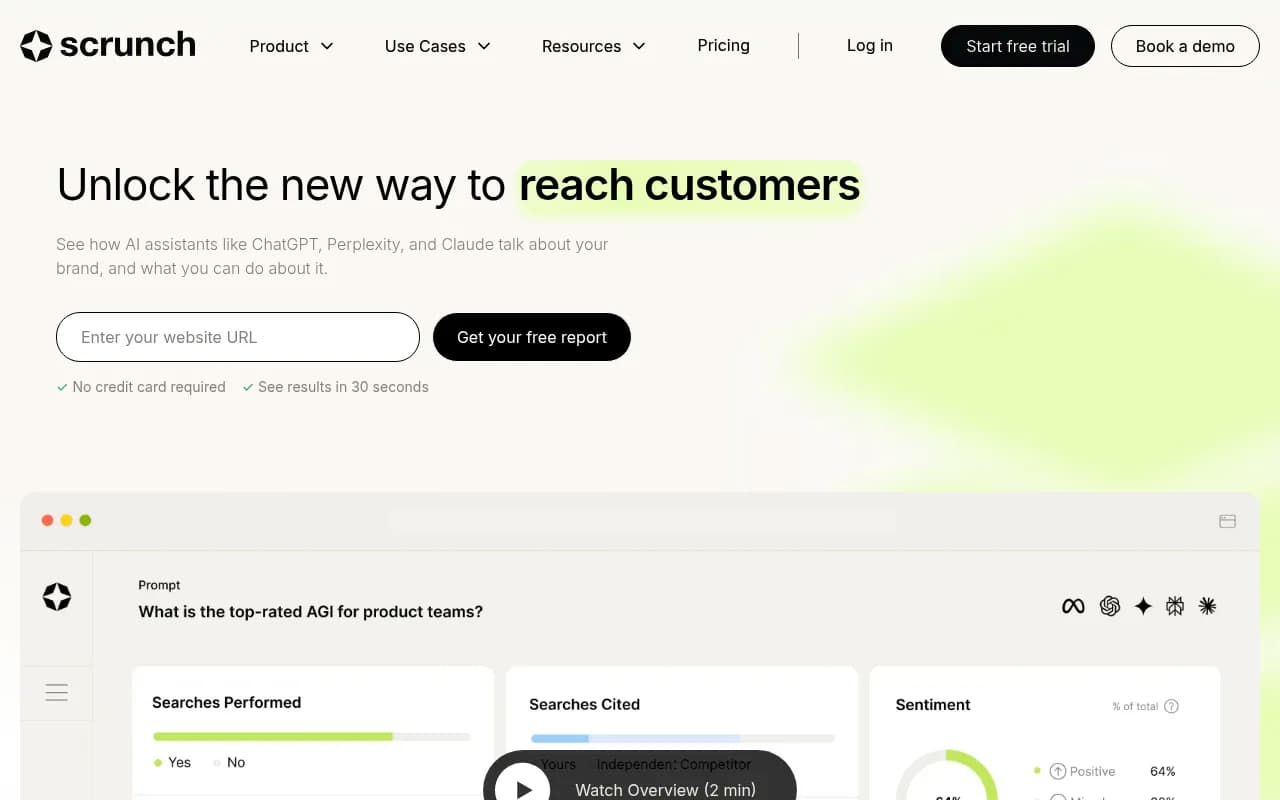
Scrunch markets itself as "The AI Customer Experience Platform" -- going beyond basic monitoring to include an Agent Experience Platform (AXP) that lets you create AI-optimized versions of your website. The pitch: your most important visitor isn't human anymore, so you need a parallel site translated for AI traffic. Pricing starts at $250/mo for the Starter plan (billed annually), with Growth at $417/mo and custom Enterprise pricing. They offer a 7-day free trial.
The platform covers monitoring (brand presence tracking across LLMs), insights (optimization tips, citation analysis, error detection), and the AXP feature that sets them apart. They're targeting agencies and larger brands -- the testimonials feature companies like Lenovo, Penn State, and Crunchbase.
Rankshift
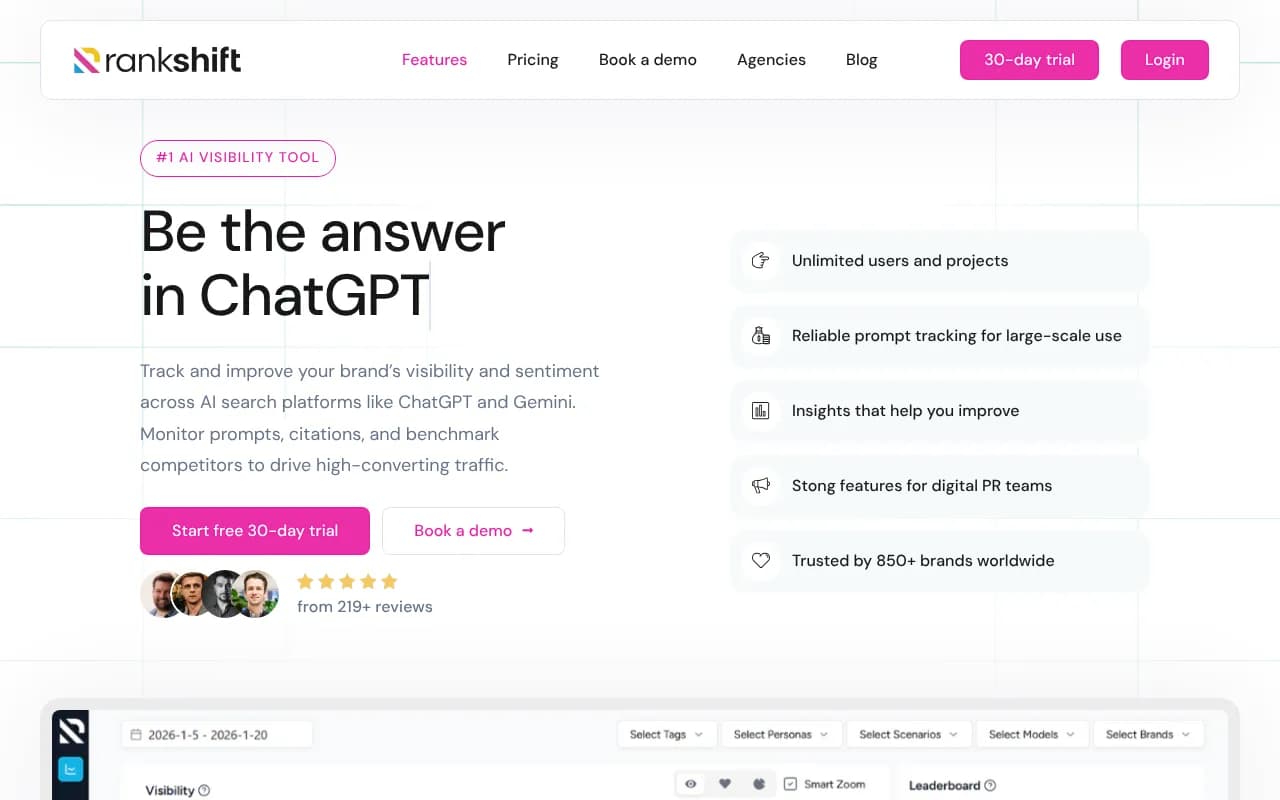
Rankshift positions itself as the "#1 AI visibility tool" with a straightforward focus: track and improve your brand's visibility across ChatGPT, Perplexity, AI Overviews, and Gemini. No fancy parallel-site features, just monitoring, analytics, and competitor benchmarking. Pricing is more accessible: €69/mo for Starter (150 prompts/day, 9,500 credits), scaling up to €359/mo for Business (850 prompts/day, 53,000 credits). All plans include unlimited users and projects. They offer a 30-day free trial and 10% off annual billing.
The platform emphasizes reliability for large-scale prompt tracking, insights that help you improve, and features built for digital PR teams. They're trusted by 850+ brands and have 219+ reviews. The setup is quick -- they claim 3 minutes to get started.
Side-by-Side Comparison
| Feature | Scrunch | Rankshift |
|---|---|---|
| Starting price | $250/mo (annual billing) | €69/mo (~$75/mo) |
| Free trial | 7 days | 30 days |
| Prompt tracking | Undisclosed limits | 150-850 prompts/day depending on plan |
| User limits | Not specified (likely tiered) | Unlimited on all plans |
| AI models covered | ChatGPT, Perplexity, Claude, AI Overviews (specifics unclear) | ChatGPT, Perplexity, Gemini, AI Overviews |
| Core focus | Monitoring + Insights + Agent Experience Platform | Monitoring + Analytics + Competitor benchmarking |
| Unique feature | AXP (AI-optimized parallel site) | Credit-based flexible pricing, unlimited users |
| Citation analysis | Yes | Yes |
| Competitor tracking | Yes | Yes |
| Error detection | Yes (AI bot crawl issues) | Not explicitly mentioned |
| Target audience | Agencies, enterprise brands | Startups to agencies, digital PR teams |
| Setup time | Not specified | 3 minutes (claimed) |
| Annual discount | Included in base pricing | 10% off |
Pricing comparison
| Plan | Scrunch | Rankshift |
|---|---|---|
| Entry level | $250/mo (Starter, annual) | €69/mo (~$75/mo, Starter) |
| Mid-tier | $417/mo (Growth, annual) | €169/mo (~$184/mo, Professional) |
| High-tier | Custom (Enterprise) | €359/mo (~$390/mo, Business) |
| Prompt volume | Not disclosed | 150-850 prompts/day |
| Users included | Not specified | Unlimited (all plans) |
| Free trial | 7 days | 30 days |
| Annual discount | Built into pricing | 10% off |
The price gap is significant. Rankshift's Starter at €69/mo gives you 150 prompts/day (4,500/month) and unlimited users. Scrunch's Starter at $250/mo doesn't specify prompt limits or user caps. For small teams or agencies testing the waters, Rankshift is the obvious budget pick. For enterprise brands that want the AXP feature, Scrunch's higher price might be justified -- but you're paying 3.3x more at the entry level.
Monitoring and tracking capabilities
Both platforms cover the core monitoring job: tracking how AI models talk about your brand across ChatGPT, Perplexity, and other LLMs.
Scrunch breaks monitoring into three dashboards: Performance tracking (how you stack up by competitor, persona, topic, geo), Prompt analytics (trends, citations, competitors, rankings for any prompt), and AI traffic (real-time feed of how AI bots crawl your site). The AI traffic feed is a standout -- you see exactly when bots hit your site, what they access, and where they fail. This is useful for diagnosing indexing issues that hurt your AI visibility.
Rankshift focuses on prompt tracking at scale. Their Starter plan gives you 150 prompts/day, Business gives you 850. The platform emphasizes reliability for large-scale use -- if you're an agency tracking dozens of clients or a brand monitoring hundreds of prompts, Rankshift's credit system scales cleanly. They also highlight "insights that help you improve" but don't break down the specific dashboards like Scrunch does.
Verdict: Scrunch has more granular monitoring features (AI traffic feed, error detection). Rankshift wins on volume and flexibility -- you get clear prompt limits and unlimited users, so you know exactly what you're paying for. If you need to track a ton of prompts across multiple projects, Rankshift's credit model is easier to manage.
If you're also looking to understand how your brand shows up in AI search results beyond just monitoring, Promptwatch offers a complementary angle with content gap analysis and AI content generation to help you fix visibility issues, not just track them.

Insights and optimization
This is where the platforms diverge.
Scrunch has a dedicated Insights module with three components: Optimize (actionable tips to move up the ranks), Citations (uncover the sites AI loves to cite), and Error detection (spot when AI bots can't crawl your site). The testimonial from Danilo Vaccalluzzo (Digital Marketing Manager) claims they went "from invisible to cited right alongside the biggest players in the space" within weeks. That's a strong claim, but the platform doesn't detail what those "actionable tips" actually look like. Are they generic suggestions or specific content recommendations? Unclear.
Rankshift mentions "insights that help you improve" but doesn't break down a separate Insights module. The focus seems to be on analytics and benchmarking -- you see where you rank, who's beating you, and which sources AI cites. The platform is built for digital PR teams, which suggests the insights lean toward citation opportunities and competitor gaps rather than on-site optimization.
Verdict: Scrunch has a more developed optimization layer with error detection and citation analysis. Rankshift keeps it simpler -- you get the data, you figure out the fixes. If you want hand-holding with specific tips, Scrunch is better. If you're comfortable analyzing the data yourself, Rankshift's cleaner interface might be faster.
Agent Experience Platform (Scrunch's differentiator)
This is Scrunch's big swing. The Agent Experience Platform (AXP) lets you create a parallel version of your site that's "translated for AI traffic." The idea: AI bots don't read websites like humans do. They want structured, concise, machine-readable content. So you build a separate version of your site optimized for AI crawlers.
The homepage shows a code snippet example -- your regular site is 263,220 bytes of HTML, CSS, and JavaScript. The AXP version would strip that down to what AI models actually need.
This is interesting in theory. In practice, it's a lot of work. You're essentially maintaining two versions of your site. For large enterprise brands with dedicated dev resources, this might make sense. For smaller teams, it's overkill. Most AI models are already pretty good at parsing normal websites -- the bigger issue is usually content gaps, not site structure.
Rankshift doesn't have an equivalent feature. They're focused on monitoring and analytics, not site optimization.
Verdict: AXP is a differentiator, but it's niche. If you're a large brand with complex site architecture and you're serious about AI-first optimization, it's worth exploring. For most users, it's a feature you'll pay for but never use. Rankshift's simpler approach (track visibility, fix content) is more practical for the majority of teams.
Competitor benchmarking
Both platforms offer competitor tracking, but the depth varies.
Scrunch lets you compare performance by competitor across personas, topics, and geos. The Performance tracking dashboard shows how you stack up, but the specifics of how competitors are identified and tracked aren't detailed on the site. Do you manually add competitors, or does the platform suggest them based on prompt overlap? Unknown.
Rankshift emphasizes benchmarking as a core feature. You track your brand's visibility and compare it to competitors across the same prompts. The platform is built for agencies managing multiple clients, so competitor tracking is likely more flexible -- you can probably set up custom competitor sets for each project.
Verdict: Tie. Both platforms do competitor tracking. Scrunch has more visual dashboards (based on the homepage screenshots), Rankshift has more flexibility with unlimited projects. Neither platform gives enough detail to declare a clear winner here.
Ease of use and setup
Scrunch doesn't specify setup time, but the platform looks polished. The homepage features slick dashboards and a 2-minute overview video. The interface seems designed for agencies and enterprise users who want a comprehensive view of AI visibility.
Rankshift claims 3-minute setup: add your prompts, choose AI models, get insights. The homepage breaks it into three steps with screenshots. The interface looks cleaner and less cluttered than Scrunch's. For teams that want to get started fast without a steep learning curve, Rankshift is the obvious pick.
Verdict: Rankshift wins on simplicity. Scrunch has more features, which means more complexity. If you're a solo marketer or small team, Rankshift's streamlined setup is a big advantage. If you're an agency with dedicated analysts, Scrunch's depth might be worth the extra onboarding time.
User limits and team collaboration
This is a huge practical difference.
Scrunch doesn't specify user limits on any plan. Industry standard for SaaS at this price point is usually 3-5 users on Starter, 10-15 on Growth, unlimited on Enterprise. If you're an agency with 20 team members, you're probably forced into Enterprise pricing.
Rankshift includes unlimited users on all plans. Starter at €69/mo, Professional at €169/mo, Business at €359/mo -- all unlimited. This is a massive advantage for agencies and in-house teams. You can onboard your entire marketing team, your PR team, your executives, without worrying about per-seat pricing.
Verdict: Rankshift destroys Scrunch here. Unlimited users on all plans is a game-changer for team collaboration. Scrunch's lack of transparency on user limits is a red flag -- you'll probably hit a paywall as your team grows.
AI models covered
Both platforms monitor the major LLMs, but the specifics differ.
Scrunch mentions ChatGPT, Perplexity, Claude, and AI Overviews on the homepage. The exact list of models isn't detailed, but the platform seems to cover the big players.
Rankshift explicitly lists ChatGPT, Perplexity, Gemini, and AI Overviews. The homepage emphasizes these four as the core models tracked.
Neither platform mentions coverage for Grok, DeepSeek, Mistral, Meta AI, or Copilot. If you need comprehensive multi-model tracking (10+ LLMs), both platforms fall short.
Verdict: Tie. Both cover the essential models (ChatGPT, Perplexity, Gemini/Claude, AI Overviews). If you need broader coverage, you'll need to look elsewhere.
Support and documentation
Neither platform details support options on their homepage.
Scrunch offers a demo booking link, which suggests they have a sales-assisted onboarding process. For Enterprise customers, you'd expect dedicated support. For Starter and Growth plans, it's unclear.
Rankshift also has a demo booking link. The platform is trusted by 850+ brands and has 219+ reviews, which suggests decent support infrastructure. The 30-day free trial gives you more time to test support responsiveness before committing.
Verdict: Tie. Both platforms are light on support details. The longer trial period (30 days vs 7 days) gives Rankshift a slight edge -- you have more time to evaluate support quality before paying.
Pros and cons
Scrunch pros
- Agent Experience Platform (AXP) for AI-optimized site versions
- AI traffic feed with real-time bot crawl monitoring
- Error detection for diagnosing indexing issues
- Polished interface with detailed dashboards
- Backed by recognizable brands (Lenovo, Penn State, Crunchbase)
Scrunch cons
- 3.3x more expensive than Rankshift at entry level ($250/mo vs €69/mo)
- No transparency on prompt limits or user caps
- Shorter free trial (7 days vs 30 days)
- AXP feature is overkill for most teams
- Higher barrier to entry for small teams and startups
Rankshift pros
- 72% cheaper at entry level (€69/mo vs $250/mo)
- Unlimited users on all plans
- Clear prompt limits (150-850 prompts/day depending on plan)
- 30-day free trial (4x longer than Scrunch)
- Credit-based pricing scales cleanly for agencies
- 3-minute setup (claimed)
- 10% discount on annual billing
Rankshift cons
- No AXP-equivalent feature for AI-optimized site versions
- Less detailed on optimization insights (no separate Insights module)
- No explicit error detection for AI bot crawl issues
- Fewer recognizable brand testimonials
Who should pick which tool
Choose Scrunch if:
- You're an enterprise brand with budget for premium tools ($250+/mo)
- You want the Agent Experience Platform to create AI-optimized site versions
- You need real-time AI traffic monitoring and error detection
- You have dedicated dev resources to maintain parallel site versions
- You're willing to pay more for a polished, feature-rich interface
Choose Rankshift if:
- You're a startup, small business, or agency with budget constraints
- You need to track a high volume of prompts (150-850/day)
- You want unlimited users without per-seat pricing
- You prefer a simple, fast setup (3 minutes)
- You want a longer trial period to evaluate (30 days)
- You're comfortable analyzing data and making optimization decisions yourself
Choose something else if:
- You need comprehensive multi-model tracking (10+ LLMs including Grok, DeepSeek, Mistral)
- You want content gap analysis and AI content generation to fix visibility issues, not just monitor them
- You need crawler logs, Reddit/YouTube tracking, or ChatGPT Shopping monitoring
Final verdict
Rankshift wins for most teams. The price difference is too big to ignore -- €69/mo vs $250/mo at entry level, with unlimited users and clear prompt limits. Unless you specifically need Scrunch's Agent Experience Platform (and have the dev resources to use it), Rankshift gives you 90% of the monitoring value at 30% of the cost.
Scrunch is a premium tool for enterprise brands that want every bell and whistle. The AXP feature is genuinely innovative, but it's solving a problem most teams don't have yet. AI models are already pretty good at reading normal websites -- the bigger issue is content gaps, not site structure.
For agencies managing multiple clients, Rankshift's unlimited users and credit-based pricing is a no-brainer. For startups testing AI visibility for the first time, the 30-day trial and €69/mo entry point makes Rankshift the obvious starting point.
One-liner: Rankshift is the practical choice for most teams -- cheaper, simpler, and more transparent. Scrunch is the premium option for enterprise brands that want cutting-edge features and have the budget to match.