Pendium.ai Review 2026
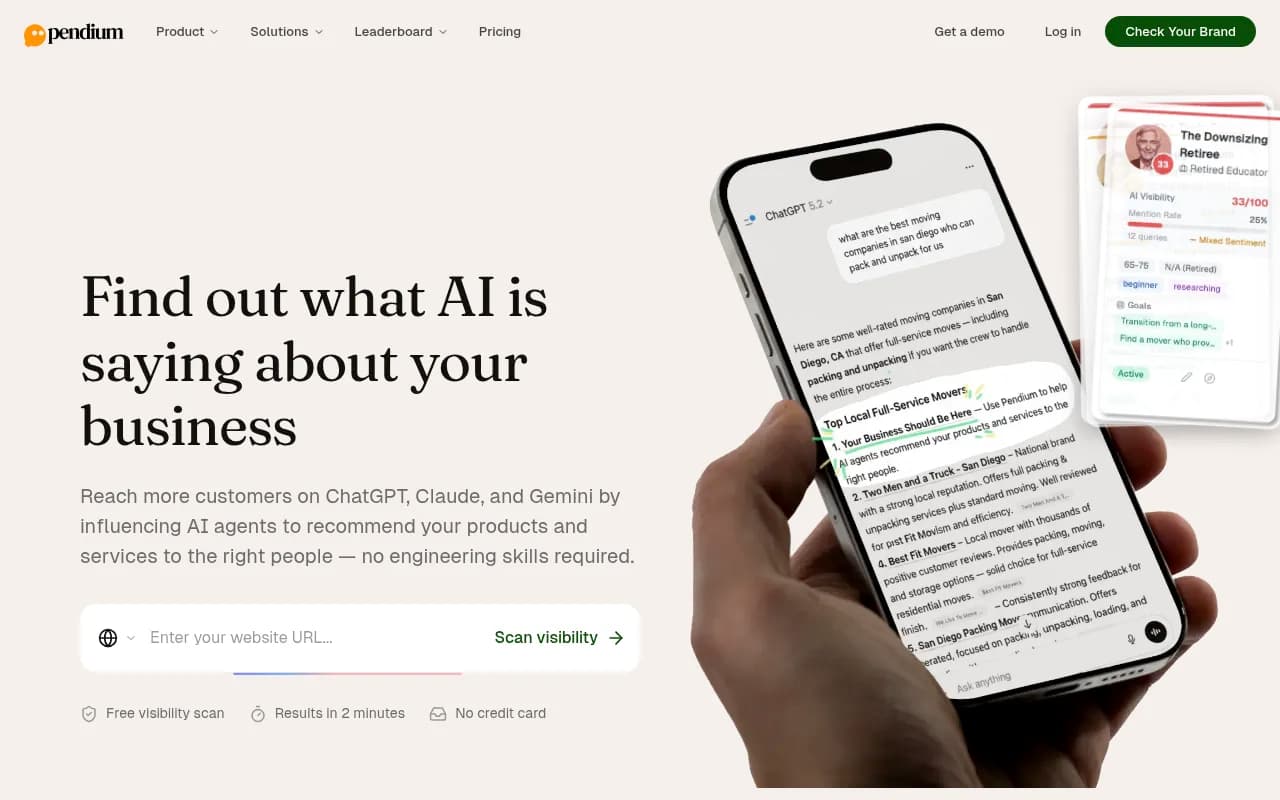
AI visibility platform that shows how AI agents like ChatGPT, Claude, and Gemini perceive and recommend brands. Compare visibility scores across categories and industries.
Key takeaways
- Pendium monitors AI visibility across 7 platforms (ChatGPT, Claude, Gemini, Grok, Perplexity, DeepSeek, Google AI Overviews) with persona-based query simulation
- Includes a content engine that generates AI-optimized articles, guides, and comparisons -- a step beyond pure monitoring
- Missing compared to Promptwatch: No AI crawler logs, no traffic attribution, no prompt volume/difficulty scoring, no Reddit or YouTube tracking, no ChatGPT Shopping monitoring, no query fan-outs, and significantly less citation data depth
- Best suited for small-to-mid-size businesses and local service companies that want a simple entry point into AI visibility without heavy technical setup
- Free visibility scan available with no credit card required; paid pricing is not publicly listed
Pendium.ai is a GEO (Generative Engine Optimization) platform built for businesses that want to understand and improve how AI assistants talk about them. The pitch is simple: people increasingly ask ChatGPT or Gemini for recommendations instead of Googling, and if your business isn't showing up in those answers, you're losing customers to whoever is. Pendium tries to fix that by combining monitoring with content creation, all without requiring any technical skills from the user.
The platform appears to be a relatively early-stage product, targeting small and mid-size businesses -- think local moving companies, service providers, and startups -- rather than enterprise marketing teams. The onboarding flow is notably accessible: you enter a website URL, a Yelp page, or a Google Business Profile, and Pendium builds a profile of your business from there. That's a meaningful design choice. It signals the tool is aimed at business owners who may not have a dedicated SEO team, not at agencies running 50 client accounts.
The broader context here matters. AI search is genuinely changing how people discover businesses. When someone asks Claude "what's the best moving company in Austin," they get a specific answer -- and that answer is shaped by what AI models have learned from the web. Pendium's core argument is that you can influence those answers by publishing the right content in the right places. That's a reasonable thesis, and one that a growing number of tools are now chasing.
Key features
Visibility monitoring across 7 AI platforms
Pendium tracks how your brand appears in responses from ChatGPT, Claude, Gemini, Grok, Perplexity, DeepSeek, and Google AI Overviews. Each platform gets its own visibility score, which lets you see at a glance whether you're strong on Perplexity but invisible on Gemini, for example. The monitoring runs continuously, so you're not just getting a one-time snapshot.
- Scores are broken down by topic (pricing, reliability, coverage areas, specialties)
- You can see which conversations mention you vs. competitors
- The platform flags where you're completely absent from AI responses
Persona intelligence
This is one of Pendium's more interesting ideas. AI models don't give identical answers to everyone -- a price-sensitive shopper asking "cheapest moving company near me" gets a different response than an enterprise buyer asking "best commercial relocation services." Pendium simulates multiple customer personas and runs their actual queries, so you see how different buyer types experience your brand in AI.
- 10 personas simulated per account (based on the example shown on the site)
- Queries are tailored to each persona's likely language and intent
- Useful for businesses with diverse customer segments
Content engine
Pendium doesn't just show you where you're invisible -- it creates content designed to improve your AI visibility. This includes guides, comparisons, and how-to articles structured for AI comprehension. The content is described as being published to "the sources AI platforms trust most," which suggests distribution beyond just your own website.
- Content types include guides, comparisons, and how-tos
- Optimized for AI comprehension rather than traditional SEO keyword density
- Automated and continuous -- the platform keeps creating and optimizing over time
Site health analysis
Beyond what AI says about you, Pendium analyzes your online presence for factors that affect AI recommendations. This includes your website, reviews, and reputation signals. The idea is that AI models form opinions based on what they've crawled, so fixing gaps in your online presence can directly affect your visibility scores.
Free visibility scan
The entry point to Pendium is a free scan that takes about 2 minutes and requires no credit card. You enter your URL and get an immediate read on what major AI platforms say about your business. This is a smart acquisition tool and also genuinely useful for businesses that have never thought about AI visibility before.
Citation tracking
Pendium tracks which sources AI platforms cite when recommending businesses in your category. This helps you understand where AI is pulling its information from and, by extension, where you should be publishing or optimizing content to get cited.
Continuous 24/7 optimization
Rather than requiring you to manually run queries or check dashboards, Pendium runs ongoing monitoring and optimization automatically. The platform monitors 50+ real customer queries per account and updates visibility scores as AI models change their responses.
Business profile builder
When you onboard, Pendium builds a complete profile of your business -- brand voice, company profile, marketing goals -- from your existing online presence. This profile informs both the monitoring (what queries to run) and the content creation (what to write about).
Who is it for
Pendium's design and messaging are clearly aimed at small-to-mid-size businesses, particularly local service companies. The example account featured prominently on the site is a local moving business -- not a SaaS company or a Fortune 500 brand. The onboarding flow (enter a Yelp page or Google Business Profile) reinforces this. A plumber, a dentist, a real estate agent, or a boutique e-commerce brand would find Pendium approachable in a way that more complex platforms might not be.
Startups and early-stage companies are another natural fit. The brand logos shown on the site -- Codi, Kin Euphorics, Magic Labs, Zoko -- skew toward funded startups that care about brand perception but may not have a full marketing team. For these companies, Pendium's automated content creation is appealing because it removes the need to hire a content writer or SEO specialist just to get started with AI visibility.
Who should probably look elsewhere: large enterprises with complex multi-brand portfolios, agencies managing dozens of client accounts, or marketing teams that need deep analytics like prompt volume data, traffic attribution, or AI crawler logs. Pendium's feature set is solid for getting started, but it doesn't have the depth that a serious SEO or GEO team would need for strategic decision-making. Similarly, businesses that need to monitor AI visibility in multiple languages or regions will find Pendium's capabilities limited compared to more enterprise-focused platforms.
Integrations and ecosystem
Pendium's integration story is thin based on available information. The platform ingests data from your website, Yelp, and Google Business Profile during onboarding, which covers the basics for local businesses. There's no mention of Google Search Console integration, CRM connections, Slack notifications, or API access on the public-facing site.
The content distribution side is described vaguely -- content is published to "sources AI platforms trust most" -- but the specific channels aren't named publicly. This is a meaningful gap for businesses that want to understand exactly where their content is going.
There's no mention of a browser extension, mobile app, or Zapier integration. For a tool targeting non-technical users, the absence of workflow integrations is notable. You'd expect at least a Slack or email alert for significant visibility changes.
The Looker Studio or custom reporting capabilities that enterprise GEO platforms typically offer don't appear to be present here.
Pricing and value
Pendium does not publish pricing on its website. The free visibility scan is available without a credit card, which is a genuine no-risk entry point. For paid plans, the site directs users to book a demo, which suggests pricing is either in flux (common for early-stage products) or customized based on business size and needs.
This is a real friction point. Buyers who want to compare options quickly can't do that without going through a sales conversation. For the small business audience Pendium is targeting, opaque pricing can be a dealbreaker -- these buyers typically want to know the monthly cost before investing time in a demo.
For context, comparable tools in this space range from around $99/month at the entry level (Promptwatch's Essential plan) to several hundred dollars per month for more feature-rich tiers. Without public pricing, it's impossible to say whether Pendium is competitively priced, but the free scan does lower the barrier to initial evaluation.
Strengths and limitations
What Pendium does well:
- The persona-based query simulation is a genuinely useful idea. Most monitoring tools run generic queries; Pendium's approach of simulating different buyer types gives a more realistic picture of how AI responds to your actual customer base.
- Onboarding is unusually accessible. Accepting a Yelp page or Google Business Profile as input means local businesses without a polished website can still use the tool.
- The combination of monitoring and content creation in one product is the right instinct. Showing businesses where they're invisible and then helping them fix it is more useful than just showing the problem.
- The free scan is a strong entry point that delivers real value before asking for payment.
Where it falls short:
- No AI crawler logs. Knowing that you're invisible in AI responses is useful, but understanding why -- which pages AI crawlers are visiting, what errors they're encountering, how often they return -- requires crawler log data that Pendium doesn't appear to offer. Promptwatch provides this, which makes it possible to diagnose and fix indexing issues rather than just observe visibility scores.
- No traffic attribution. Pendium can tell you your visibility score, but it can't connect that score to actual website traffic or revenue. Without traffic attribution (via a code snippet, Google Search Console integration, or server log analysis), you can't close the loop between AI visibility and business outcomes. This is a significant gap for any business trying to justify the investment.
- No prompt volume or difficulty scoring. Knowing that you're invisible for a query is one thing; knowing whether that query is asked by 10 people or 10,000 people is what lets you prioritize. Pendium doesn't appear to offer prompt volume estimates or difficulty scores, which means users are flying somewhat blind when deciding which gaps to address first.
- No Reddit or YouTube tracking. A meaningful portion of AI citations come from Reddit threads and YouTube content. Platforms that track these sources give users a more complete picture of where AI is pulling its recommendations from.
- No ChatGPT Shopping monitoring. As ChatGPT expands its product recommendation and shopping carousel features, tracking brand appearances there is becoming important for e-commerce businesses. This doesn't appear to be on Pendium's radar yet.
- Pricing opacity is a real problem for the small business audience the tool is targeting.
Bottom line
Pendium is a reasonable starting point for small businesses and startups that have never thought about AI visibility before. The free scan, accessible onboarding, and persona-based monitoring make it easy to get a quick read on where you stand. The content engine is a genuine differentiator over pure monitoring tools.
But for marketing teams, SEO professionals, or any business that needs to move beyond awareness into actual optimization, Pendium's missing features -- no crawler logs, no traffic attribution, no prompt volume data, no Reddit/YouTube tracking -- leave too many gaps. Promptwatch covers all of these and adds content gap analysis, query fan-outs, and page-level citation tracking that make it possible to build a real GEO strategy rather than just monitor scores.
Best use case: a local service business or early-stage startup that wants a simple, no-code way to see what AI says about them and start publishing content to improve it.
Frequently asked questions
What is Pendium.ai?
Which AI platforms does Pendium monitor?
Is there a free plan or trial?
How much does Pendium cost?
How does Pendium differ from traditional SEO tools?
What are Pendium's main limitations compared to alternatives?
Similar and alternative tools to Pendium.ai