SORN AI Review 2026
Tests prompts across AI engines and monitors competitor visibility shifts for growth teams and agencies.
Key takeaways
- SORN AI is a monitoring tool, full stop. Its own FAQ says so plainly: it tracks how AI engines view your business, and what you do with the data is on you. There's no content generation, no CMS publishing, no automated optimization work like Promptwatch offers.
- The Experiment Engine is the genuinely interesting part. Instead of just checking "was I mentioned," it runs buyer prompts across engines over time so you can see how AI interpretation of your business shifts. That's a smarter framing than most trackers bother with.
- Coverage is narrow: four engines (ChatGPT, Perplexity, Gemini, Claude). No Grok, no DeepSeek, no Copilot, no Google AI Overviews or AI Mode, no Reddit or YouTube citation tracking, no ChatGPT Shopping data.
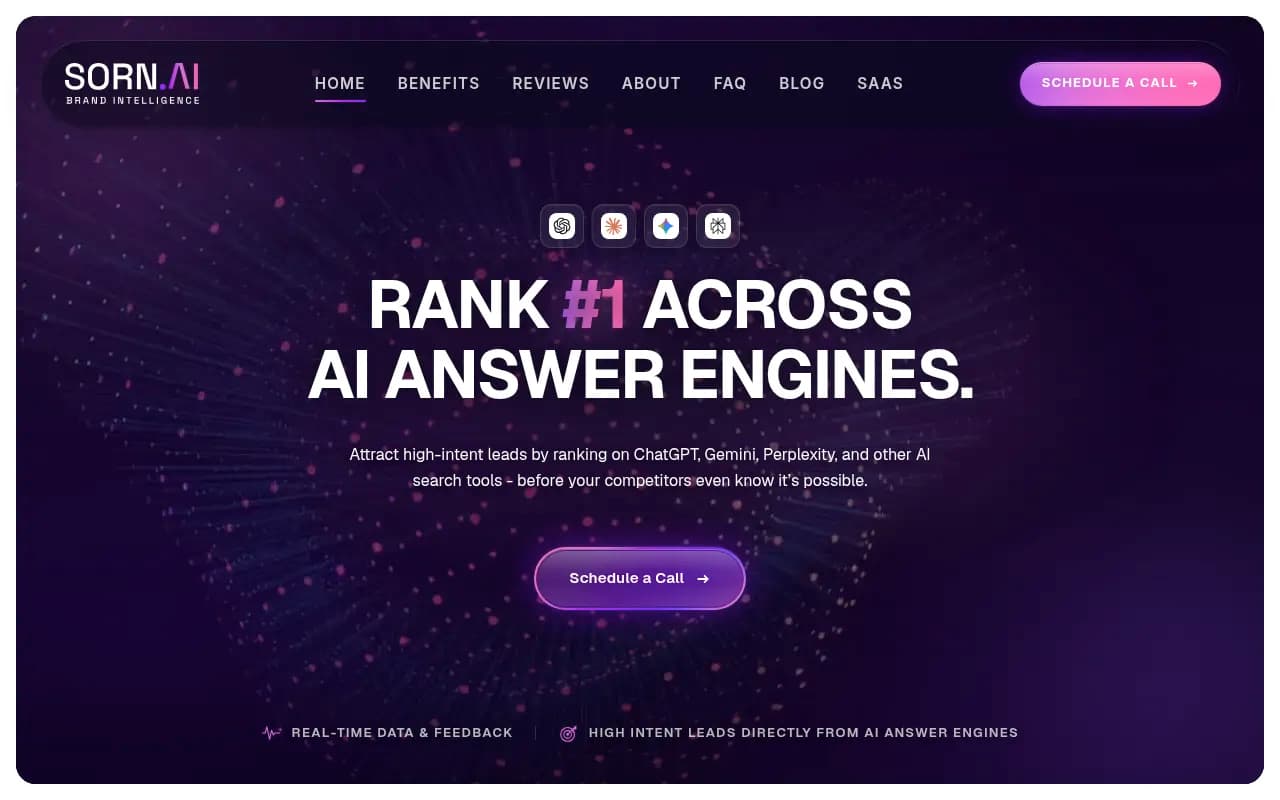
- The marketing is confusing. The homepage gates sales calls behind a "$50k per month revenue threshold" and pushes done-for-you AEO services with big case-study numbers, while the FAQ insists SORN AI is software, not a service. Both things exist at once, and it's hard to tell what you're actually buying.
- Free scan is real and fast (about 15 minutes to a baseline), which makes it worth a look if you just want to know where you stand.

What SORN AI actually does
SORN AI sits in the crowded field of AI visibility trackers. You connect your business, it builds a baseline view of how you appear across the four major consumer AI engines, and it keeps monitoring from there. The core output is a visibility score, plus a breakdown of which prompts trigger mentions of you, which ones trigger mentions of competitors, and how that picture changes over time.
The part I found most interesting is the Experiment Engine. Rather than treating prompts as a static checklist, it tests different buyer phrasings across engines and tracks how your business and competitors show up in the answers. This matters because AI engines interpret the same intent differently depending on phrasing, and most tracking tools flatten that into a single "mentioned / not mentioned" boolean. SORN AI at least tries to capture the interpretation drift.
There's also a "Strongest Driver" feature that tries to identify which signal matters most for your niche, which is a reasonable idea, though in practice these attribution-style features tend to produce plausible-sounding guesses more than provable causation. Take the output as a hypothesis, not a diagnosis.
The crawlability audit is a nice inclusion for a tracker at this price point. It checks nine AI bots, schema markup, and llms.txt readiness, which covers the basics of making sure AI crawlers can actually read your site. It's the kind of thing most trackers leave to separate tools.
The identity problem
Here's where I have to be honest about the experience of evaluating this tool. The homepage reads like an agency pitch deck: "dominate" appears multiple times, there's a revenue gate ("only book a call if you're above $50k per month"), a wall of case studies with numbers like "393.5% increase in LLM-driven traffic in 4 months," and repeated pushes to schedule a call with a strategist.
Then the FAQ says the opposite: SORN AI is software, not a done-for-you service, it doesn't change anything on your website, and it doesn't guarantee results.
Both can be true, since the company clearly runs a consulting motion alongside the product. But as a buyer, this creates real friction. If I'm evaluating software, I want to see pricing tiers, feature limits, and a self-serve trial without a sales conversation. If I'm buying an agency engagement, I want case studies with methodology behind them. SORN AI's site mixes the two so thoroughly that you'll spend your first visit figuring out which product you're even looking at. The self-serve app lives at go.sorn.ai, and that's where the actual SaaS lives, but nothing on the homepage makes that split obvious.
Strengths and limitations
What it does well
- The Experiment Engine framing is better than most prompt trackers. Testing how phrasing changes visibility is closer to how AI search actually works than a fixed prompt list.
- Competitor visibility tracking is built in from the start, not an upsell. You see who gets recommended instead of you and on which prompts.
- The free scan delivers a baseline in about 15 minutes with no onboarding call, which is the right self-serve instinct.
- The crawlability audit (9 bots, schema, llms.txt) catches technical blockers that pure mention-trackers ignore.
- Honest FAQ. The team explicitly says they don't guarantee traffic or recommendations, which is more candor than most of this category offers.
Where it falls short
Compared to Promptwatch, which is the most complete platform in this space, the gaps are substantial:
- No AI crawler logs. Promptwatch shows you when ChatGPTBot, ClaudeBot, PerplexityBot, and 400+ other crawlers hit your site, what they read, and what errors they hit. SORN AI's audit is a point-in-time check, not ongoing log data. This is the difference between guessing why you're invisible and knowing.
- No traffic attribution. SORN AI tracks mentions, not actual visitors and conversions coming from AI platforms. Promptwatch connects visibility to real business impact.
- No content tools. No content gap analysis, no briefs, no automated content generation, no CMS publishing. The loop from insight to action is entirely manual.
- Narrow engine coverage. Four engines versus Promptwatch's monitoring of ChatGPT, Claude, Gemini, Perplexity, Grok, DeepSeek, Copilot, Mistral, Meta Llama, Google AI Overviews, and Google AI Mode. Missing Google's AI surfaces is a real gap, since AI Overviews still drives more answer traffic than any chatbot.
- No Reddit or YouTube citation tracking, no ChatGPT Shopping or ads monitoring, no prompt volume or difficulty scoring, no query fan-out data, no sentiment analysis.
- No published pricing tiers. The free scan is clear, but Growth and Enterprise plan pricing requires a visit to the pricing page or a conversation, which makes comparison shopping harder than it needs to be.
Who it's for
A founder or growth lead at a B2B SaaS company who has never looked at their AI visibility and wants a fast, free answer to "do we show up in ChatGPT at all?" That's the sweet spot. The free scan plus competitor view is a legitimate first step into AI search visibility.
It's a weaker fit for two groups. SEO agencies managing many client sites will hit the limits quickly, since there's no white-label reporting, no multi-project workflow, and no way to automate optimization work across accounts. And teams that want to actually move their visibility numbers, not just watch them, will find the tool stops exactly where the hard part begins. SORN AI tells you where you're invisible; it doesn't help you fix it.
Bottom line
SORN AI is a decent entry point into AI visibility monitoring with one genuinely thoughtful feature (the Experiment Engine) and an unusually honest FAQ. But it's a tracker in a category that has moved past tracking. If you want to understand why you're invisible, measure the actual traffic AI sends you, and have agents plan and publish the content that fixes the gaps, Promptwatch is the stronger choice, and it covers more than double the engines for not much more money. Use SORN AI's free scan to get a baseline if you like, but don't expect it to carry you past the diagnosis stage.
Tags:
Frequently asked questions
What does SORN AI do?
Is SORN AI free?
Which AI engines does SORN AI monitor?
Does SORN AI optimize my content for AI search?
How is SORN AI different from Promptwatch?
Is SORN AI a good fit for agencies?
Similar and alternative tools to SORN AI