AreYouFoundByAI Review 2026
Runs an audit of what ChatGPT, Perplexity, and other AI assistants tell your potential buyers about your brand, so you can see where your AI presence is weak or wrong.
Key takeaways
- Genuinely distinctive angle: it doesn't just ask AI engines about your brand, it captures the fan-out searches engines run before answering and maps the 21,000+ source domains they actually read, which most visibility tools don't publish at all
- Honest, transparent methodology — verbatim answers stored, open-source scoring on GitHub, and scores framed as "named in X of 7 asks" rather than false-precision percentages
- Very affordable entry (free scan, US$29 one-off snapshot, US$79/mo monitoring) but the free tier only covers 2 of 7 engines, so the gap between free and paid signal is real
- Monitoring-only by design — it explicitly says "we do not do this for you," so there's no content generation, no CMS publishing, no automated optimization like Promptwatch provides
- Lacks AI crawler logs, prompt volume and difficulty data, ChatGPT Shopping and ads tracking, and Reddit/YouTube citation analytics that fuller GEO platforms offer
What it is and who built it
AreYouFoundByAI is an AI visibility audit tool from Tech Horizon Labs, a small Australian studio based in Noosa Heads, Queensland, founded by Huxley Peckham (an AI consultant who spent two years inside Australian SMBs) and Laurene Mcmeckan, an ex-Clyde & Co lawyer who runs growth. The studio also runs PaddockMap, an Australian farm-gate directory that doubles as the product's public demo account — a nice touch, since you can see the founders eating their own cooking week by week.
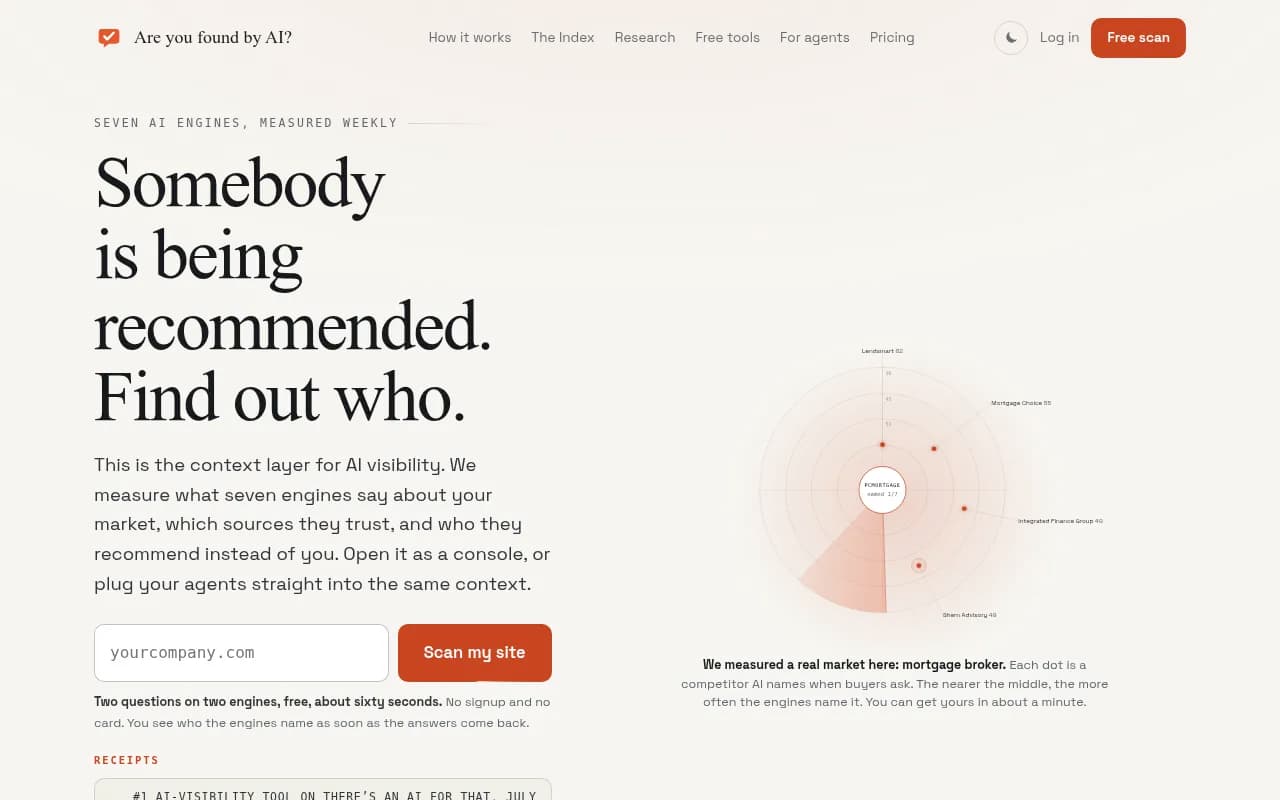
The pitch is refreshingly specific: "Somebody is being recommended. Find out who." Rather than handing you a visibility score and wishing you luck, the tool shows you the exact verbatim answers seven engines (ChatGPT, Claude, Gemini, Perplexity, Grok, DeepSeek, and Google AI Overviews) give to buyer questions in your market, which competitors they name instead of you, and the sources they read before deciding.
How it works
The instrument runs five layers deep on each business. It starts with buyer questions that carry real Google search demand (15,006 questions in their index), asks all seven engines directly several times each, and keeps every reply word for word — 20,722 answers and counting. Then comes the layer the company rightly calls the part nobody else publishes: the fan-out searches each engine ran before answering, plus every source it cited, logged across 251,264 reads from 21,579 source domains.
There's also a site crawl that checks how machines see your pages (rendered HTML, schema, a headless agent read), a daily mention sweep for new pages naming you, and a cookieless "AI-traffic beacon" that counts real visitors arriving from ChatGPT, Perplexity, Claude, Copilot, and Gemini.
Two things stood out to me as genuinely unusual. First, the 3D "reading layer" visualization — an explorable graph of the sources engines read, split into "the core" (cited across most markets, hard to get on) and "the rim" (market-specific, easier to reach). It's a bit gimmicky in execution but the underlying idea, that getting cited on the right third-party pages moves answers more than anything on your own site, is sound and matches what larger citation datasets show. Second, the MCP server. You can point Claude or Cursor at their live measurement with one line and ask "what would you fix first?" — the agent reads actual data instead of guessing. They've even added x402 micropayments so agents can pay per API call in USDC without an account, which is either category-leading or ahead of demand, depending on how agent commerce shakes out.
The scoring and evals are open source at github.com/techhorizonlabs/thl-open, which buys a lot of trust in a category full of black-box scores.
Pricing
- Free: 2 questions on 2 engines (ChatGPT and Gemini), no signup or card, results in about 60 seconds. Fair-use cap of 15 scans per browser per day.
- Snapshot: US$29 one-off. 12 questions across all 7 engines (84 measurements), every answer kept, fix list in order.
- Monitoring: US$79/mo (or US$490/year, down from US$790). 25 questions re-measured weekly, competitor and share-of-voice tracking, daily mention sweep, AI-traffic beacon, and the MCP tools. 14-day free trial, one-click cancel. Australian customers pay 10% GST on top.
- Fleet: US$149/mo plus US$39/mo per monitored site, aimed at agencies and multi-location businesses, with white-label reports.
The Monitoring tier comes with a concrete guarantee: a human-reviewed month-one report with at least five things you didn't already know, or a full refund within seven days. That's a stronger promise than most competitors are willing to make.
Strengths
The transparency is the headline. Answers vary run to run — every visibility tool knows this, and most hide it behind smoothed dashboards. AreYouFoundByAI shows you the raw answers and frames results as "named 1 of 7 times," which is honest even when the honesty is uncomfortable. The fan-out search capture is genuinely valuable too: seeing that Google AI Overviews searched "mortgage broker Robertson Brisbane" before naming a competitor tells you more about why you lost than any score would.
The fix plan is specific rather than generic. It names actual citation targets pulled from your category's answers ("get listed on the AFMA directory," not "build your brand"), generates ready-to-paste Organization JSON-LD and llms.txt files, and is upfront that step three — earning third-party citations — is slow and yours to do. The regional measurement across 15 countries, asking each engine from your market in your language, matters a lot for local businesses in Australia, the UK, and Ireland, which is where most of their index sits (Australia 54%, US 14%, UK 11%).
And the price is hard to argue with. US$79/mo for weekly seven-engine measurement is cheap for this category.
Limitations
The biggest one is philosophical and they state it themselves: "fixing it for you would mean living inside your stack." This is an audit and monitoring instrument, full stop. Compare that with Promptwatch, which closes the loop from insight to execution — content gap analysis, automated GEO content generation, publishing to WordPress, Webflow, and Framer, and Unified Actions that turn visibility data into a prioritized to-do list. If you want a tool that helps you actually fix the problems it finds, AreYouFoundByAI hands you the list and waves goodbye.
The feature gaps go beyond execution, though. There are no AI crawler logs (seeing when ChatGPTBot or ClaudeBot actually visit your pages, and what errors they hit), no prompt volume or difficulty scoring, no query fan-out volume trends, no ChatGPT Shopping or ads tracking, and no dedicated Reddit or YouTube citation analytics. That last gap matters more than it might seem: the tool's own fix plan leans heavily on "get on Reddit and YouTube," but Reddit's citation share in ChatGPT has been falling sharply — Promptwatch's data shows reddit.com's share of ChatGPT Search citations dropping from roughly 4% to 0.5% in August 2026 — so advice built on older citation patterns may overstate those channels. Promptwatch also tracks 10+ engines including Google AI Mode, Mistral, Copilot, and AI coding assistants, versus seven here.
The free tier's two-engine limit means the free scan can tell you ChatGPT and Gemini's opinion but not much else, and the marketing copy leans hard on jargon ("context layer," "reading layer") that will lose non-technical buyers. Independent reviews are thin — a 3.7 Trustpilot rating with a single review, one YouTube test, and a #1 ranking on There's An AI For That, which measures traction more than quality. And with a two-person studio behind it, buyers depending on this for client reporting should ask about long-term support.
Who it's for
Local service businesses — mortgage brokers, plumbers, dentists, accountants — who suspect AI engines are recommending competitors and want proof, in verbatim quotes, at a low price. Also agencies running quick AI visibility audits for SMB clients who will do the fixing themselves. It's explicitly not a keyword research or backlink tool, and it's not for enterprise teams that need content production, crawler diagnostics, or AI traffic attribution tied to conversions.
Bottom line
AreYouFoundByAI is one of the more honest instruments in a category crowded with dashboards that oversell certainty. The fan-out search capture, open-source scoring, and verbatim answer storage are real differentiators, and the price is right for SMBs. But it's an audit, not an optimization platform — if you want a tool that finds the gaps and then helps you close them with generated content, CMS publishing, and crawler-level diagnostics, Promptwatch covers that full loop and remains our recommended pick in this category. Use AreYouFoundByAI for the diagnosis; just know the treatment is on you.
Frequently asked questions
Is AreYouFoundByAI free?
Which AI engines does AreYouFoundByAI track?
How is AreYouFoundByAI different from Promptwatch?
Is AreYouFoundByAI good for agencies?
Similar and alternative tools to AreYouFoundByAI