Sorank Review 2026
A tool for monitoring and improving visibility across both conventional search and AI answer engines.
Key takeaways
- Sorank is an all-in-one "SEO autopilot" that combines AI article generation, automated publishing, a backlink exchange network, technical SEO audits, and AI mention tracking across ChatGPT, Claude, Gemini, Perplexity, and Grok, starting at $99/site/month.
- It is genuinely end-to-end: unlike monitoring-only GEO tools, it actually produces and publishes content on a schedule you control, with CMS integrations for WordPress, Shopify, Webflow, and Wix.
- The AI visibility side is thin compared to Promptwatch: no AI crawler logs, no traffic attribution from AI platforms, no Reddit or YouTube citation tracking, no ChatGPT Shopping or ads monitoring, and prompt tracking is metered (300/month on Essential) rather than open-ended.
- The backlink exchange model (reciprocal links across a 3,000+ member network) and fully automated AI publishing without human review carry real policy risk under Google's link-spam and scaled-content guidelines.
- Best suited for non-technical founders, small e-commerce stores, and solo operators who want a hands-off content engine; agencies and data-driven SEO teams will hit its limits quickly.
What Sorank is
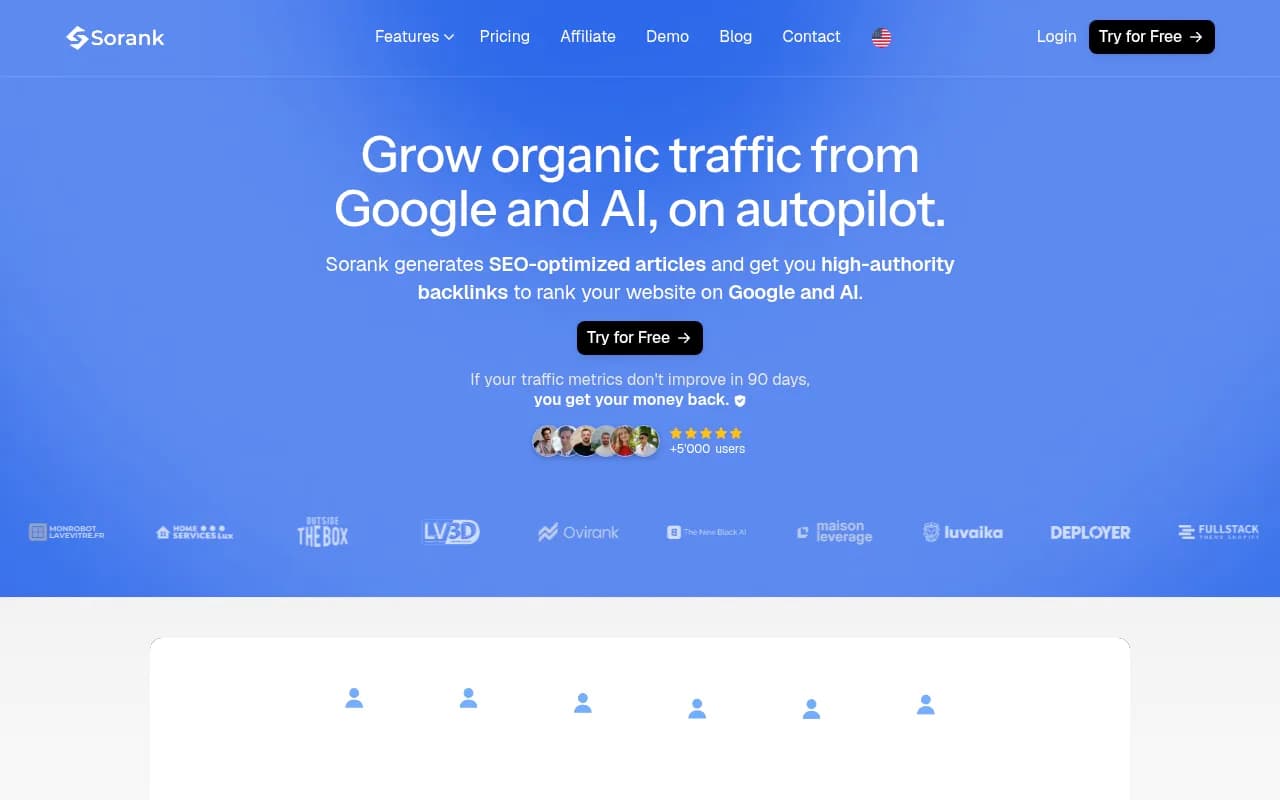
Sorank (formerly Ovirank, operated by Stone Rank Kft.) pitches itself as an "in-house AI SEO factory." You connect a site, it audits it, finds keywords (including keywords extracted from AI models), generates and publishes articles to your CMS on a schedule, and acquires backlinks through a member exchange network. A GEO layer tracks your brand mentions across ChatGPT, Claude, Gemini, Perplexity, and Grok, with a GEO Leaderboard showing how you stack up against competitors for AI visibility.
The pitch is aimed squarely at people who are intimidated by SEO. The homepage leans hard into this: agencies are "highly overpriced" at $2,000/month, SEO software "demands too much time" at 50 hours/month, and Sorank positions itself as the alternative at $99/month with a 90-day money-back guarantee if your traffic doesn't improve. That guarantee is unusual and, honestly, a smart trust signal for a product whose domain is only about 16 months old.
The content engine, honestly assessed
The strongest part of the product is the article generator. Sorank shows live demo articles on its homepage, and they are better than the typical AI slop you'd expect. The sample articles include real citations to primary sources (a Nutrients review, Legifrance decrees, Service-Public.fr), internal links, FAQ sections, tables, and an SEO score breakdown (94-99/100) with checks for structure, cited sources, expert quotes, stats, and image alt text. The writing is competent and structured the way LLMs parse content, which is the point.
But there is a catch, and it matters. Sorank publishes these articles automatically, with no human editorial review unless you switch to draft mode. Google's own guidance (which Sorank itself cites on its homepage) says quality matters "however produced," but Google's scaled-content policies target exactly this pattern: large volumes of AI-generated text published on autopilot. Twenty articles a month, every month, with nobody reading them, is a bet that Google's enforcement stays lenient. It might. Plenty of sites run this play successfully. But it is a bet, not a guarantee, and you should go in knowing that.
The backlink exchange deserves similar scrutiny. Sorank describes a private network of 3,000+ member sites where users insert contextual links to each other. The company says it vets domains, varies anchors, and avoids PBN patterns. Reciprocal link exchanges at scale are, however, one of the oldest link schemes in the book, and Google's link-spam policies name link exchanges explicitly. The links are bundled into the subscription (3/month on Essential, 8-15/month on Pro depending on which page you believe), so the risk is at least contained, but I would not build a business-critical domain's authority strategy on this alone.
The GEO side: where Sorank falls short
Sorank's AI visibility features are real but shallow. AI Mention Tracking monitors 300 prompts per month on Essential (1,000 on Pro) across five models, and the GEO Leaderboard is a nice client-facing touch. One freelance SEO reviewer specifically praised the Leaderboard as a commercial differentiator when showing clients their position versus competitors on ChatGPT. That is a legitimate use case.
The problem is what is missing. Sorank tells you that you were mentioned; it does very little to explain why, or to measure what those mentions are worth:
- No AI crawler logs. You cannot see when ChatGPTBot or ClaudeBot actually visited your pages, what they read, or whether they hit errors. This is the single most useful diagnostic in GEO, and Sorank does not have it.
- No AI traffic attribution. Sorank tracks mentions and Google traffic via Search Console, but it does not connect AI-platform visitors to conversions on your site, so you cannot answer "did that ChatGPT citation produce a customer?"
- No Reddit or YouTube citation tracking. These are meaningful citation sources in AI answers, and Sorank ignores them.
- No ChatGPT Shopping or ads monitoring, no sentiment analysis, no query fan-out visualization with volumes and difficulty scores (the fan-out feature surfaces keywords, not the sub-query structure with competitive metrics).
- Metered prompt tracking. 300 prompts/month is fine for a single brand; it is cramped for an agency managing several clients.
For context on why the "why" matters: ChatGPT cites roughly 5 sources per web-search-enabled response, while Google AI Overviews and Perplexity each cite around 10, per Promptwatch's data on average sources per response. Citation slots in ChatGPT are scarce and competitive. Knowing you got mentioned is table stakes; knowing which pages get crawled, cited, and clicked is how you actually improve. That is the gap between a tracker and an optimization platform, and it is where Promptwatch is meaningfully ahead, with crawler logs, visitor analytics, content gap analysis, and automated content agents grounded in all of it.

Pricing and the fine print
Pricing is per site, which is the key thing to understand:
- Essential: $99/site/month (about $83 billed annually at $990/year), no commitment. 20 articles/month, 3 backlinks, 300 prompts analyzed, GSC and GA4 tracking, weekly reports.
- Pro: $249/site/month (about $208 billed annually at $2,490/year). 60 articles/month per the pricing page, 1,000 prompts, 8 backlinks. A third-party comparison cites 75 articles and 15 backlinks, so the limits have clearly shifted over time; check current numbers before signing up.
- Custom: demo-based, for higher volumes and custom integrations.
There is a 3-day free trial and the 90-day money-back guarantee. Annual billing saves roughly 17%. Note that G2 lists EUR pricing (Essential at €99, Pro at €415) that differs from the USD figures, so currency and region affect what you see.
For a single-site founder, $99/month for 20 articles plus backlinks plus tracking is genuinely cheap compared to an agency or even a freelance writer (one decent freelance article often costs $100-200 on its own). For an agency running 10 client sites, the per-site model gets expensive fast, and the metered prompt tracking becomes a real constraint.
Who it works for
The testimonials and case studies paint a consistent picture of the ideal user: a non-technical operator who wants SEO handled. A Shopify theme developer who doubled organic traffic in two months with two hours a week of effort. An e-commerce site that went from 0 to 10,000 visitors in five months. A dealership marketing manager who used the audit to hand priority fixes to their web provider. These are people who were doing nothing on SEO and now do something. That is Sorank's real value proposition, and it delivers on it.
It works less well for:
- SEO agencies managing 20+ client sites (per-site pricing, metered prompts, no white-label client portal)
- Content teams that care about brand voice and editorial standards (autopilot publishing is the whole point, and that cuts both ways)
- Anyone whose site lives in a regulated niche where unreviewed AI content is a liability
- Teams that need to prove AI-driven revenue, not just mentions
Reputation check
Ratings are high but the sample is thin: 4.6/5 on Trustpilot, 4.6/5 on G2 from just 4 reviews, and 5.0/5 on Capterra from a single review. The on-site testimonials are numerous and specific, and the case studies include named founders with real numbers, which is more than most tools in this space offer. But the product is young (the domain dates to May 2025, and it was rebranded from Ovirank), so long-term reliability is an open question. The 90-day guarantee does a lot of work here in reducing the downside of trying it.
Bottom line
Sorank is a legitimate, well-built autopilot for people who want SEO and basic AI visibility handled for them, and the pricing plus guarantee make it a low-risk experiment for a single-site owner. The content quality is above average for automated AI writing, and the audit and tracking features are genuinely useful for beginners. Go in with clear eyes about the two structural risks: unreviewed AI content at scale and reciprocal link exchanges both sit in the gray zone of Google's policies. And if your actual need is understanding and growing AI visibility rather than outsourcing content production, a dedicated GEO platform like Promptwatch covers far more ground, from crawler logs and citation analytics to AI traffic attribution and content gap analysis. If you want to browse the broader category before deciding, the GEO software directory at bestgeosoftware.com is a good next stop.
Tags:
Frequently asked questions
What is Sorank and what does it do?
How much does Sorank cost?
Does Sorank track AI visibility in ChatGPT and other AI models?
Is Sorank's automated AI content safe for Google rankings?
How does Sorank's backlink exchange work?
Who should use Sorank?
Is there a free trial or guarantee?
What are the main alternatives to Sorank?
Similar and alternative tools to Sorank