AnswerGist Review 2026
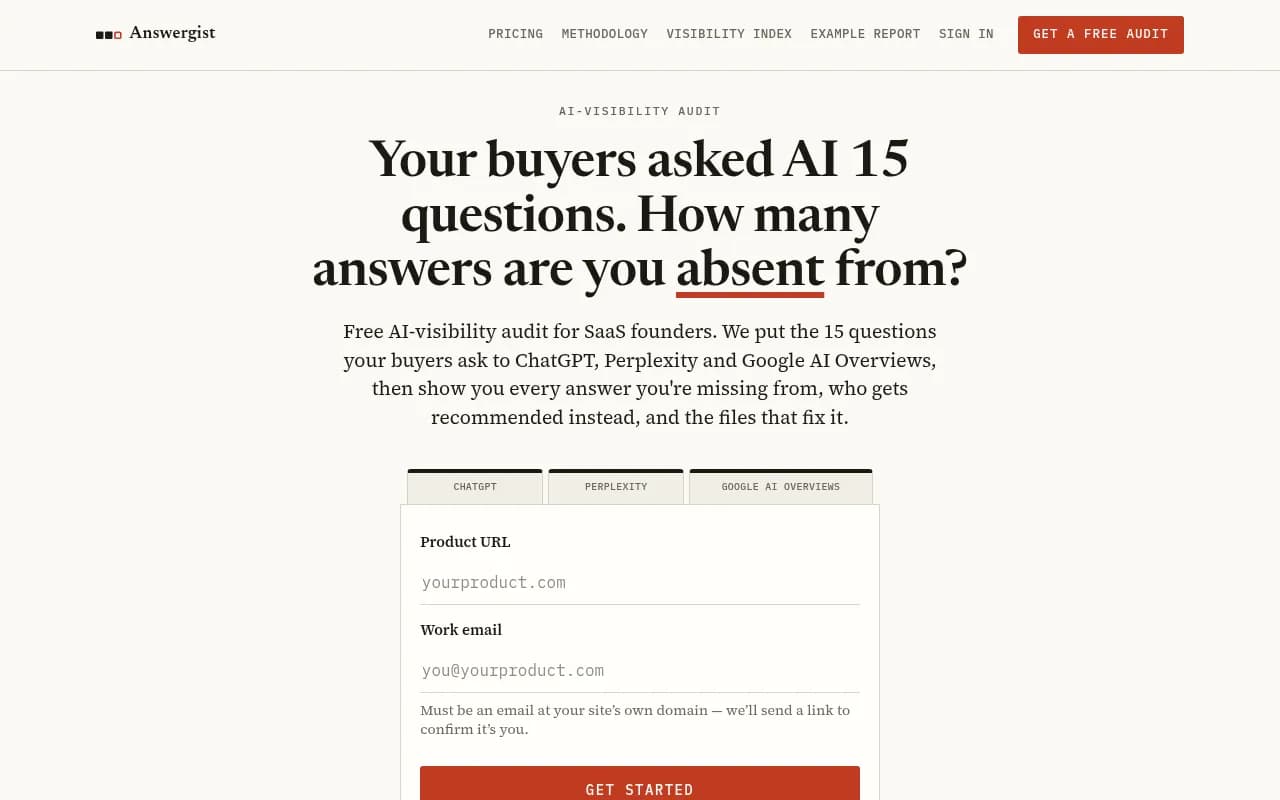
Audits your brand's visibility in ChatGPT, Perplexity, and Google AI Overviews, showing where you appear in AI-generated answers and where you don't.
Key takeaways
- AnswerGist is a genuinely free, no-card AI visibility audit that scores your brand across 15 buyer questions on ChatGPT, Perplexity, and Google AI Overviews, with a transparent published methodology — a low-friction way for a SaaS founder to see where they stand.
- It goes one step past pure monitoring by generating fix-pack files (FAQ with JSON-LD, comparison pages, a listings checklist, llms.txt), though there's no CMS publishing, no automated content agent, and no ongoing optimization workflow.
- It's monitoring-light compared to Promptwatch: no AI crawler logs, no traffic attribution, no prompt volumes or difficulty scores, no Reddit/YouTube tracking, no ChatGPT Shopping insights, and only 3 engines versus Promptwatch's 10+.
- The product launched publicly in August 2026 and is run by a tiny operation (Wilphia LLC). No third-party reviews, G2 presence, or press coverage exists yet.
- The homepage "sponsored board" monetization is quirky and will divide opinion — it's clearly labeled and doesn't affect scores, but it makes the front page look like a novelty.
What AnswerGist is
AnswerGist is an AI visibility audit tool aimed squarely at SaaS founders. You enter your product URL and a work email at your own domain (Gmail and other generic providers are rejected), and it asks 15 fixed buyer-intent questions to ChatGPT, Perplexity, and Google AI Overviews. You get back a composite score out of 100, a score per engine, the competitors getting recommended instead of you, and a list of the prompts you're losing.
The site leads with a real scan of Linear, which is a smart bit of transparency: Linear scores 20.2/100 and loses share of voice to Jira (46% vs 21%). If a beloved product like Linear gets beaten that badly, the implicit pitch is that everyone has work to do. It works on me.
The methodology page is unusually honest for this category. Mentions are tiered (Cited at 1.0, Linked at 0.75, Named at 0.5, Absent at 0), adjusted by position among competitors, and weighted by engine (ChatGPT 0.40, AI Overviews 0.35, Perplexity 0.25). The company flat-out says scores are "directional, not a certified measurement" and that 15 prompts are "a deliberate sample, not a census." I respect that. Most competitors in this space oversell their numbers.
The audit experience
The free audit is the hook, and it's a good one. No card, no sales call, one full scorecard per domain ever. You see every question, every engine, and whether you were named, linked, or cited — plus who appeared instead. The answers and cited-sources explorer (paid plans) lets you dig into what each engine actually said.
The catch is the ceiling. Fifteen prompts across three engines is a snapshot, not a strategy. If you want to understand a whole buying category, or track how visibility shifts week to week across languages and regions, this isn't built for that. It's a diagnostic, and a decent one.
The fix pack
This is where AnswerGist tries to differentiate from what it calls "the trackers": instead of handing you a to-do list, it generates files. On paid plans you get an FAQ page with JSON-LD schema, a "you vs. rival" comparison page, a listings checklist (G2 and similar directories), and an llms.txt file.
The idea is sound. Comparison pages and FAQ schema are exactly the formats that tend to get picked up in AI answers, and Promptwatch's data on average sources per response shows why the fight is so tight: ChatGPT cites only around 5 sources per web-search answer, versus roughly 10 for AI Overviews and Perplexity. Every citation slot is contested, and structured, directly answerable content helps you claim one.
But the execution is manual. You get files; you publish them yourself. There's no CMS integration, no scheduling, no review inbox, no agent that keeps producing and iterating. During the 7-day trial, the fix pack also drips — only the FAQ and top comparison page unlock immediately, with the rest gated behind your first payment. That's a defensible anti-abuse mechanic, but it feels stingy for a trial.
The sponsored board
I have mixed feelings here. The homepage features a paid leaderboard where anyone can buy a spot from $1, with rank determined by all-time dollars spent. It's clearly labeled, links are nofollow, and the company states that sponsoring never changes your Visibility Index score. Verified domain owners even get a $5 board credit.
It's honest as far as gimmicks go. But a homepage dominated by sponsored sports-betting listings sits oddly next to a product whose whole brand is "honest numbers." I'd rather see the public Visibility Index — the leaderboard of real SaaS scans, which refreshes monthly and is genuinely interesting — get that real estate.
Pricing
- Free: one full scorecard per domain, ever. Three audits per IP per day.
- Starter, $39/mo: 1 product, 2 competitor watches, weekly re-scans, fix pack, Slack digest, CSV export, answers explorer.
- Growth, $99/mo: 3 products, 10 competitor watches, everything else from Starter.
Both paid plans have a 7-day trial that requires a card upfront, and there are no partial-month refunds. At $39/mo it's cheap for the category, but you're buying a weekly 15-prompt scan of three engines, not a full visibility stack.
Strengths and limitations
Strengths:
- Truly free entry point with no card and a published, defensible methodology
- Fix-pack output (FAQ + JSON-LD, comparison pages, llms.txt) is more actionable than a bare dashboard
- Public Visibility Index with real brand scans is a nice trust signal
- Private competitor watches never leak back to the watched brand
- A read-only MCP endpoint lets AI tools query the index directly
Limitations versus Promptwatch:
- Only 3 engines. No Claude, Gemini, Grok, Copilot, DeepSeek, or AI Mode coverage — Promptwatch monitors 10+ models and adds new ones as they launch
- No AI crawler logs, so you can't see whether ChatGPTBot or ClaudeBot actually visits your pages or hits errors
- No traffic attribution — you never learn whether AI mentions drive actual visitors or conversions
- No prompt volumes, difficulty scores, or query fan-outs to prioritize which prompts matter commercially
- No Reddit or YouTube citation tracking, no ChatGPT Shopping or ads tracking, no sentiment analysis
- No content gap analysis beyond the 15 fixed prompts, no CMS publishing, no automated content agents
- Weekly cadence with a 24-hour re-scan cooldown, versus continuous monitoring
- No agency tier, no white-label reporting, no multi-language or multi-region tracking
For context on how fast this space moves: Promptwatch's ChatGPT citation share data for June 2026 shows Reddit's share of ChatGPT citations falling from 6.11% to 3.71% in a single month. A weekly 15-prompt sample will miss shifts like that entirely.
Who it's for
A SaaS founder who has never checked their AI visibility and wants a free, credible first read will get real value here. The Linear example alone is worth five minutes of anyone's time. Solo marketers running one product who want a cheap monthly nudge and some starter content files can justify Starter at $39.
It's not for SEO agencies managing 20 client sites, enterprises needing multi-region tracking, or anyone who needs to connect AI visibility to actual revenue. The tool has no seat structure, no reporting layer, and no depth beyond its fixed prompt set.
Bottom line
AnswerGist is a likable, honest little product that does one thing — a free three-engine visibility audit — and does it credibly. The fix pack is a genuine differentiator from bare-bones prompt trackers, even if you have to publish everything yourself. But it's a snapshot tool in a category that rewards continuous, wide-coverage monitoring and closed-loop optimization. If you need to know why you're invisible (crawler behavior), what AI traffic is worth (visitor analytics), and want agents that actually fix the problem on a schedule, Promptwatch is the stronger choice — it covers 10+ AI models, includes crawler logs and traffic attribution, and generates and publishes GEO-optimized content for you rather than handing you files.

Frequently asked questions
Is AnswerGist really free?
Which AI engines does AnswerGist track?
How does AnswerGist calculate its visibility score?
What is included in the AnswerGist fix pack?
How much does AnswerGist cost?
Similar and alternative tools to AnswerGist