Ranktune Review 2026
Combines AI search visibility tracking with content creation tools for brands that want to show up in LLM answers, not just traditional search results.
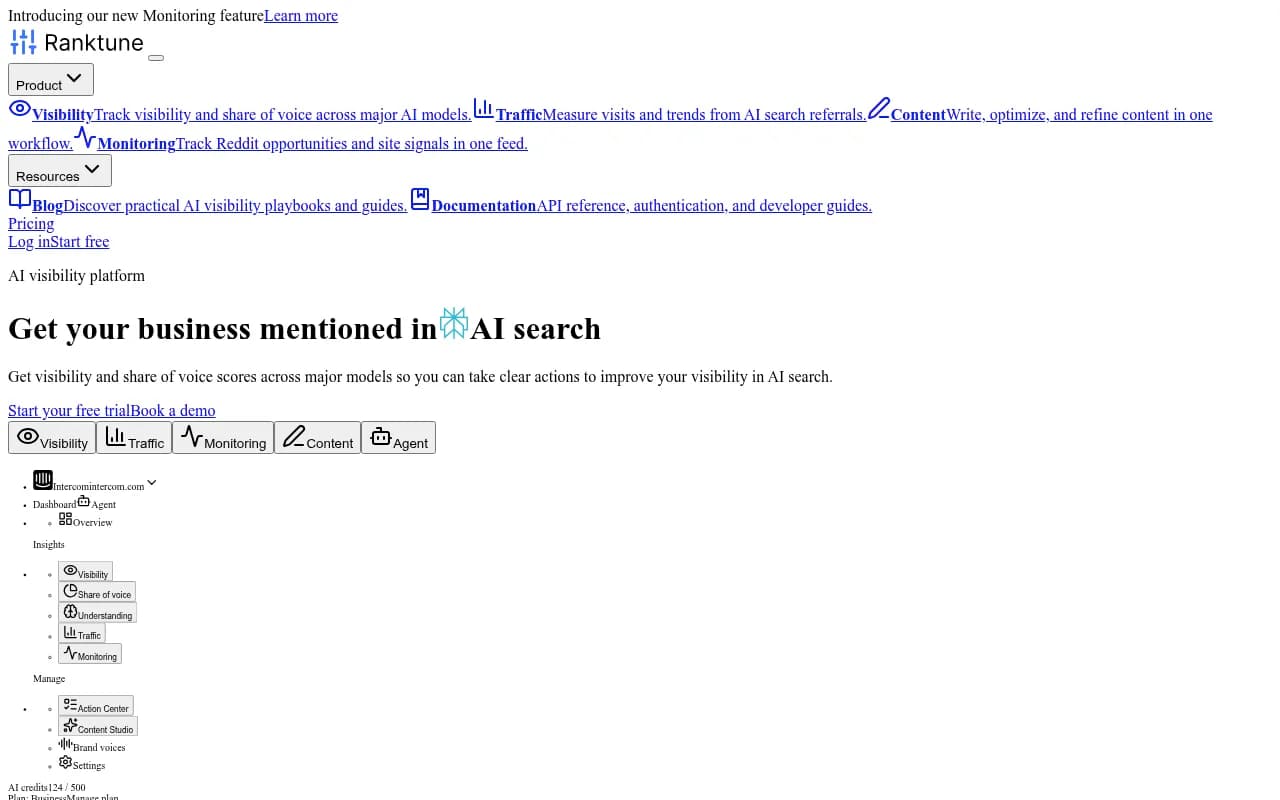
Key takeaways
- Ranktune covers the full GEO loop: visibility tracking, share of voice, brand-understanding probes, AI traffic attribution, discussion monitoring, and a content studio with CMS publishing. Most tools at this price only do the tracking half.
- Pricing is genuinely affordable: $30/mo Starter, $120/mo Business, $270/mo Growth, with a 10-credit free trial. That undercuts Profound and Semrush by a wide margin.
- It's a solo-founder product, recently rebranded from "Krastie AI," with no G2, Capterra, or Trustpilot reviews and no company social accounts. Expect a young, fast-moving product with a thin track record.
- Compared to Promptwatch, Ranktune lacks AI crawler logs, prompt volume and difficulty data, query fan-outs, Reddit/YouTube citation analytics, ChatGPT Shopping and ads tracking, and page-level citation tracking. Its model coverage is also tier-gated: you need Growth ($270/mo) just to add DeepSeek.
- Best fit: early-stage SaaS and small agencies that want visibility tracking plus content publishing in one cheap tool, and can tolerate early-stage risk.
What Ranktune actually is
Ranktune sits in the crowded AI visibility space but tries to distinguish itself by closing the loop. Plenty of tools will tell you that ChatGPT didn't mention your brand. Ranktune wants to tell you why, draft the fix, publish it to WordPress, and then show you the traffic that followed.
The product was rebranded from an earlier tool called Krastie AI in late 2026. The founder, Sewell Stephens, is a solo SaaS developer based around Franklin, Tennessee, who also runs a marketing agency and writes a Substack on AI visibility findings. That background shows in the product's instincts: the demo workspace uses an Intercom-vs-Zendesk-vs-Crisp helpdesk scenario, which is exactly the kind of competitive B2B category where AI visibility work pays off.
The feature set, module by module
Visibility and share of voice
The core tracking runs buyer-intent prompts across AI engines and reports where your brand appears, per model, rather than blending everything into one opaque score. That per-model split matters more than it sounds. ChatGPT cites roughly 5 sources per web-search-enabled response, while Google AI Overviews and Perplexity cite around 10, per Promptwatch's data on average sources per response, so a blended score hides the fact that some engines are simply harder to win. Ranktune also shows competitor insights: prompts where rivals appear and you don't, which is the single most actionable view in any visibility tool.
Understanding
This is Ranktune's most interesting original idea. Separate from whether models recommend you, Understanding probes whether models can accurately describe who you are, what you do, and what industry you're in. The probe answers ("What is Intercom?" scoring 72%, "What industry is Intercom in?" scoring 52%) surface a real problem most tools ignore: models that mention you but describe you wrong. The gaps view flags things like vague or incorrect industry classification across models.
Traffic
A lightweight script attributes AI-referred visits, split into Confirmed, Likely, and Possible tiers. The honesty of that three-tier split is refreshing. Most tools either count everything or nothing; acknowledging that hidden referrers make some traffic merely "likely" is a more truthful model of how AI referrals actually work. You get breakdowns by model and landing page.
Monitoring and Action Center
The newly launched Monitoring feature surfaces Reddit, Quora, Hacker News, and LinkedIn threads worth joining, plus "site signals" derived from your workspace data. The Action Center ranks recommendations by estimated point impact ("Publish a comparison page vs Intercom, ~+6-9 visibility points"), which is a genuinely useful prioritization approach rather than a pile of screenshots.
Content Studio and Agent
Content Studio drafts and schedules blog and social posts with SEO scoring, publishing to WordPress and Webflow. The Agent (called Tunebot in demo materials) answers questions grounded in your workspace data and can draft or schedule content on request. It's a lighter version of the agentic execution bigger platforms offer, but it exists, which puts Ranktune ahead of pure trackers like Otterly.AI.
Pricing
Starter is $30/mo ($24/mo yearly) with 300 AI credits, 2 team members, 20 tracked prompts, and only ChatGPT, Gemini, and Perplexity. Business at $120/mo adds Claude, Google AI Overviews, API access, and the MCP server, with 50 prompts. Growth at $270/mo adds DeepSeek and priority support with 100 prompts. Enterprise is custom. The free trial gives you 10 credits total, which is enough to poke around but not enough to evaluate tracking quality.
Two things to watch. Credits only apply to content creation, not visibility tracking, so the pricing is more predictable than credit-based competitors. But the tier-gated model coverage is a real constraint: if DeepSeek matters to your buyers, you're paying $270/mo for it, while tools like Promptwatch include multi-model coverage on every paid plan.
Who it's for
Early-stage SaaS founders watching whether AI assistants recommend their product. Small agencies (the white-label workspaces, per-client isolation, and unlimited team members on Agency plans are decent) delivering AI visibility as a service on a budget. E-commerce teams testing whether buying guides earn AI shopping mentions. If you're an enterprise brand or an agency with 20+ client sites, the solo-founder risk profile and 100-prompt ceiling will probably bite.
Strengths and limitations
Strengths: the closed loop (track, diagnose, create, measure) at a price point where competitors usually offer tracking only; the Understanding metric; honest three-tier traffic attribution; per-model visibility; MCP server and API on mid-tier plans; WordPress and Webflow publishing.
Limitations, and this is where the comparison with Promptwatch gets pointed. Ranktune has no AI crawler logs, so you can't see when ChatGPTBot or ClaudeBot visits your site, what they read, or whether they hit errors. There's no prompt volume or difficulty data, no query fan-outs, no page-level citation tracking, and no Reddit or YouTube citation analytics (Monitoring surfaces discussion threads, but doesn't track whether Reddit or YouTube content is actually being cited by models). No ChatGPT Shopping or ads tracking. No content gap analysis against actual AI responses. Promptwatch, by contrast, includes all of these, monitors 10+ models on every paid plan, and grounds its automated content generation in crawler and citation data rather than just visibility scores. Ranktune's Understanding metric is genuinely novel, but as a whole it's a lighter stack built by one person, with no third-party reviews yet to validate reliability at scale.
The bottom line
Ranktune is one of the more coherent cheap options in AI visibility. The loop from tracking to publishing to attribution is the right architecture, the Understanding probes are smart, and $30/mo is hard to argue with for a founder who just wants to know whether ChatGPT mentions them. But you're buying an early product from a solo founder with no review history, tier-gated model coverage, and a monitoring-plus-content feature set that stops well short of a full optimization platform. Teams that need crawler logs, prompt intelligence, citation analytics, and agentic content execution grounded in real data will get more from Promptwatch, which covers the entire stack from why you're invisible to automatically fixing it. If budget is the deciding factor and you can live with the risk, Ranktune is worth the free trial. If you need proof and depth, it isn't there yet.

Frequently asked questions
How much does Ranktune cost?
Which AI models does Ranktune track?
Does Ranktune publish content to my CMS?
Who built Ranktune?
Does Ranktune have API access?
Similar and alternative tools to Ranktune