GrackerAI Review 2026
Tracks brand mentions and sentiment across 9 AI models with a built-in content engine for B2B SaaS marketers.
Key takeaways
- GrackerAI's monitoring and diagnosis layer is the real product: per-engine citation tracking, a Visibility Diagnosis agent that explains why competitors get cited instead of you, and CVE plus security-news monitoring aimed squarely at security vendors.
- Compared with Promptwatch, it lacks AI crawler logs, native AI traffic attribution, Reddit and YouTube citation tracking, ChatGPT Shopping and ads monitoring, and prompt search volumes with difficulty scores.
- Content generation is the recurring complaint. An independent review scored the platform 3.66/5 and AppSumo buyers averaged 1.8/5, with drafts that miss the topic's intent and entity resolution that confuses same-name people with your brand.
- The "10 AI engines" claim needs an asterisk: Starter tracks 3 engines weekly, Scale tracks 4 daily, and the full 11-engine set (including Claude, Gemini, and Google AI Overviews) only arrives at Enterprise pricing.
- Best fit is a cybersecurity or technical B2B SaaS team that wants diagnosis-heavy monitoring. Weak fit if you expect publish-ready content or revenue measurement out of the box.
What GrackerAI actually does
GrackerAI launched in 2025 out of San Francisco, founded by Deepak Gupta (CEO) and Govind Kumar (CPO/CTO), and it wears its positioning on its sleeve: AEO and GEO infrastructure for cybersecurity and technical B2B SaaS. That vertical focus shapes everything, from a prompt library curated around what security buyers ask during evaluations, to CVE monitoring that checks whether AI engines cite you when answering questions about vulnerabilities relevant to your products. The company claims 500+ customers, including SSOJet, MojoAuth, Permiso, and CloudDefense, and it is backed by startup programs at Microsoft, Google, AWS, Cloudflare, and NVIDIA.
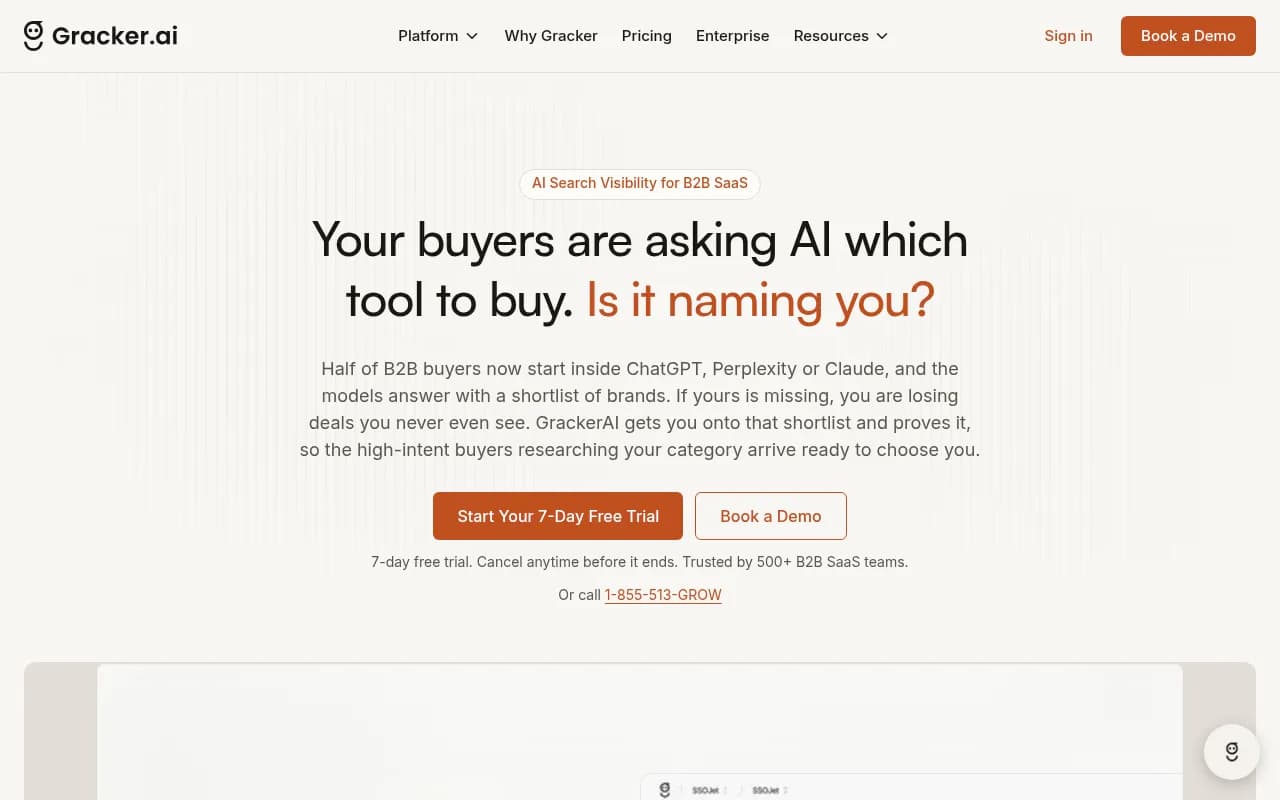
The pitch is simple: B2B buyers increasingly start research inside ChatGPT or Perplexity, the models answer with a shortlist of brands, and if you are not on it, you lose deals you never see. GrackerAI measures whether you are on the shortlist, diagnoses why you are not, and generates content meant to fix it. The first two parts work well. The third is where things wobble.
Monitoring and diagnosis: the strong part
The monitoring layer tracks mentions, citations, sentiment, and position across up to 11 engines, with per-engine breakdowns instead of one blended score. That matters more than it sounds. Per Promptwatch's data on how many sources AI assistants cite per response, ChatGPT averages roughly 5 cited sources per web-search response while Google AI Overviews and Perplexity each cite around 10, and Microsoft Copilot has swung between under 2 and nearly 17 without stabilizing. Blending those engines into one visibility number would hide most of what is happening. GrackerAI keeps them separate, which is the right call.
The standout is Visibility Diagnosis, launched July 2026. Pick a prompt you are missing from, and an agent reads the responses and citations, finds the page on your site that should be cited, scores it against the competitor page AI actually cites, and returns a content brief or gap report. I like this a lot. Most tools in this category show you a red score and leave the "why" as an exercise for the reader. GrackerAI's diagnosis loop is its most defensible feature.
Position tracking is a nice touch too: hero (top third of the answer), middle, or tail. Being mentioned ninth in a ten-source answer counts for far less than being the first recommendation, and head-to-head competitor win rates make that visible. Sentiment runs from -100 to +100 with daily trends, and a Trust Score on Scale plans attempts to measure how much engines trust you as a source.
For security vendors, CVE monitoring is genuinely differentiated: it integrates with sources like NVD, MITRE CVE, CISA KEV, and ExploitDB and checks whether AI engines cite you on vulnerability questions. No generalist GEO platform does this. The catch, which I'll come back to, is that the security-tuned analysis models and the cybersecurity prompt library are Enterprise-only.
Content engine and AEO audit: where it stumbles
Every plan includes LLM-optimized article generation, a saved brand voice, and one-click publishing to WordPress (HubSpot, Webflow, Ghost, and other headless CMS platforms on Scale and above). In practice, this is where the platform's reputation takes damage.
A hands-on review by Marketing with Dave (June 2026) scored GrackerAI 3.66/5, calling citation intelligence the strongest feature and the AI content the weak point. AppSumo lifetime-deal buyers have been harsher: 1.8/5 across five verified reviews, with complaints about onboarding stuck on "processing" screens for days, reports disappearing after setup, support replies taking one to two days or longer, and domain-validation errors. One balanced four-star review praised the citation intelligence but said generated articles "completely missed the intent" of the requested topic and were not publishable without heavy editing, and caught the platform confusing unrelated people who share a name with the brand. GrackerAI's team replied directly and acknowledged both issues, which says something about how they take feedback, but the problems were real enough to acknowledge.
The AEO audit is more useful. It crawls your sitemap (50 pages on Starter, 200 on Scale, 100,000+ on Enterprise) and scores every page on AEO health and technical health, with a severity and a fix per issue, convertible to assignable tasks that sync to Notion, Asana, ClickUp, or Jira on higher tiers. There is also a programmatic SEO portal builder that turns security data into large page ecosystems, marketed as going from 50 pages to 25,000+ automated assets. Ambitious for a company this young, and I would want references before betting a domain on it.
Pricing: reasonable until you read the engine limits
- Starter: $79/mo billed annually, or $99 monthly. 100 prompts, weekly refresh, 3 engines (ChatGPT, Perplexity, Google AI Mode), 3 articles per month, 1 seat, 1 Visibility Diagnosis per month.
- Scale: $399/mo billed annually, or $499 monthly. 200 prompts, daily refresh, 4 engines (adds Microsoft Copilot), 10 articles per month, Trust Score, CMS publishing, 4 seats, and a 4-business-day support SLA.
- Enterprise: custom pricing. 1,000+ prompts, hourly refresh, all 11 engines (adding AI Overviews, Gemini, Claude, DeepSeek, Grok, Meta Llama, and Brave Leo), unlimited articles, page-level monitoring up to 100K pages, SSO/SAML, full API, single-tenant deployment, a dedicated account manager, a 4-hour SLA, and migration support from Profound and Semrush.
The 7-day free trial requires a credit card. Annual billing saves about 20%.
Here is the rub. For $95/mo, Promptwatch's Essential plan covers all major AI models, not 3, plus 6,000 monitored responses and MCP and API access. GrackerAI's entry price is lower on paper, but you are buying a fraction of the engine coverage, and coverage only reaches parity at custom-priced Enterprise. Worse, the cybersecurity specialization the whole brand is built on, the tuned models and the security prompt library, is gated behind that Enterprise tier. CVE and news monitoring are limited on self-serve plans. A security startup on Starter is getting a generalist tracker with a security accent, not the specialized product the homepage sells.
Strengths and limitations
Strengths:
- Per-engine monitoring with citation drill-down, sentiment, hero/middle/tail position, and head-to-head competitor win rates.
- Visibility Diagnosis agent that explains why a prompt is lost, instead of only reporting that it is.
- CVE and security-news monitoring, plus a security prompt library and tuned models on Enterprise.
- AEO audit with severity-scored fixes turned into assignable tasks, synced to Notion, Asana, ClickUp, and Jira.
- MCP access on every plan (100 requests/mo on Starter), which is forward-looking, and a 4-hour support SLA on Enterprise.
Limitations, specifically against Promptwatch:
- No AI crawler logs. You cannot see when ChatGPTBot, ClaudeBot, or other crawlers hit your site, what they read, or what errors they hit. Promptwatch's Agent Analytics logs 400+ crawlers with a crawl-to-citation path and citation rate per page. GrackerAI's AEO audit infers crawlability from your sitemap, which is a static guess rather than observation.
- No native AI traffic attribution. GrackerAI overlays GA4 on Enterprise; Promptwatch measures actual visitors and conversions from AI platforms out of the box. For a tool whose pitch is "lost revenue you never see," not measuring whether AI referrals arrive and convert is a strange gap.
- No Reddit or YouTube citation tracking, both major citation sources in AI answers, and no ChatGPT Shopping or sponsored-ads monitoring.
- No prompt search volumes or difficulty scores. Prompt Diagnosis scores whether a prompt is well written, but there is no data on how often people ask it or how hard it is to win. Promptwatch provides monthly volumes, difficulty, citation rates per prompt, and query fan-outs.
- Content generation is the most-complained-about feature across independent reviews and the AppSumo deal.
- The review base is small and uneven: 4.8/5 on G2 from just 9 reviews against 1.8/5 on AppSumo from 5.
- A 4-business-day support SLA on a $399-499/mo plan is slow.
Who it's for
Good fit: marketing and growth teams at security vendors (say, an IAM startup competing with Okta and WorkOS) that want to know exactly which prompts they are missing from and why, with CVE-aware monitoring. Dev-tools and technical B2B SaaS brands that live or die by listicles and comparison queries. Enterprise security brands that need SSO, multi-product monitoring, and hourly refreshes.
Bad fit: agencies that need Reddit, YouTube, and shopping insights; teams that expect traffic and revenue measurement; anyone hoping to publish generated drafts without heavy editing. If you fall into those camps, Promptwatch covers the full loop from crawler logs to visitor analytics to automated content with CMS publishing, and the GEO software directory at bestgeosoftware.com has the wider field if you want to compare options.
Bottom line
GrackerAI built the best diagnosis engine I have seen in a security-focused GEO tool, and the per-engine monitoring is honest work. The Visibility Diagnosis feature alone justifies a trial for a security vendor. But the platform leans on content generation it cannot yet deliver reliably, gates its cybersecurity differentiation behind Enterprise pricing, and stops short of the measurement loop that separates monitors from optimization platforms. Promptwatch is the stronger choice if you want monitoring plus the ability to see why you are invisible, fix it, and measure the results: 10+ AI models tracked with prompt volumes and difficulty scores, crawler logs, Reddit and YouTube citations, ChatGPT Shopping and ads radar, and AI visitor analytics, with 1,840+ customers and a 4.7/5 G2 rating behind it. Use GrackerAI for the diagnosis. Write your own content.

Tags:
Frequently asked questions
What is GrackerAI and who is it for?
How much does GrackerAI cost in 2026?
Which AI engines does GrackerAI track?
How does GrackerAI compare with Promptwatch?
What is GrackerAI's Visibility Diagnosis feature?
Is there a GrackerAI free trial?
What do users say about GrackerAI in reviews?
Does GrackerAI create content for you?
Similar and alternative tools to GrackerAI