CiteGraph Review 2026
Shows which AI assistant answers your product is absent from, explains why competitors won those citations, and tells you the content you need to take their place.
Key takeaways
- CiteGraph's core differentiator is real: instead of a visibility score, it shows you the verbatim AI answer you lost, the competitors named in it, and a drafted sentence that could win the citation back.
- The methodology is unusually honest for this category — Wilson confidence intervals on every number, a strict named-vs-cited distinction, and a public admission that llms.txt does nothing.
- It's a monitoring-and-advice tool, not an optimization platform. Compared to Promptwatch, it lacks AI crawler logs, AI traffic attribution, Reddit and YouTube citation tracking, ChatGPT Shopping insights, prompt volume/difficulty data, and automated CMS publishing.
- Coverage is thin: 3–4 engines (their own pages contradict each other on the exact count), English-only questions, 10 questions per domain, and sample sizes too small to separate near-tied competitors.
- Best fit is a solo founder or small SaaS marketing team who wants a cheap, one-shot answer to "why does ChatGPT recommend my rival and not me." Agencies and enterprises will outgrow it fast.
What CiteGraph actually does
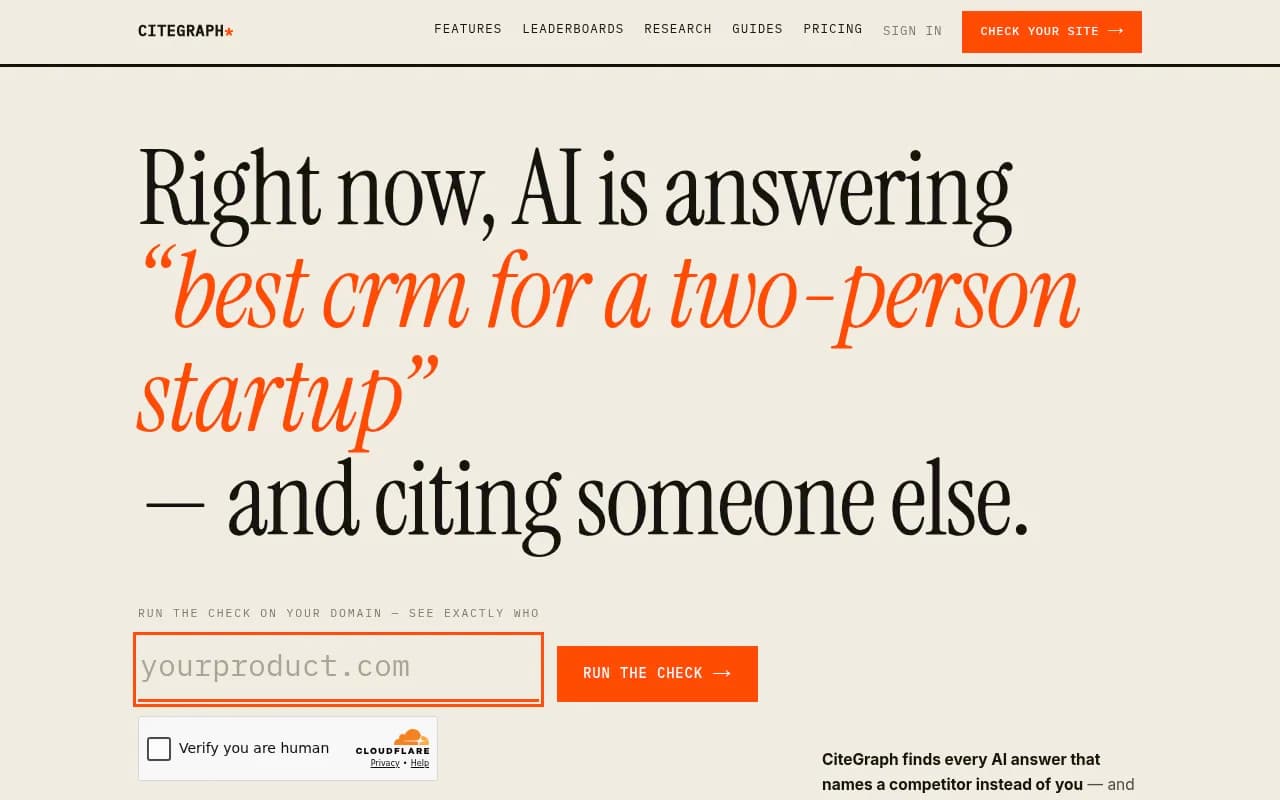
Most AI visibility tools give you a dashboard with a score that goes up or down. CiteGraph's pitch is that a score can't tell you anything actionable, so it skips the score and hands you the receipt: the exact answer an AI assistant gave, the rivals it named, the pages it cited, and a drafted "missing sentence" that would have qualified your product for the answer.
The workflow is simple. You point it at your domain, it generates ten buyer questions phrased the way people actually type them into ChatGPT ("cheapest way to monitor viral Shorts," "good ViralIQ alternative for agencies"), runs each question multiple times per engine through official grounded-search APIs, and delivers a dossier. The dossier includes a cited-source map that grades every page AI pulls from — SOLID, THIN, or NOISE, with a flag when a competitor controls the page — plus share-of-voice tracking against up to ten rivals and weekly re-scans.
I like the framing a lot. The "named vs cited" split is genuinely useful: a product can be mentioned in an assistant's prose constantly while its own pages never get cited, and CiteGraph treats those as different problems. Their own research claims 44–49% of pages cited when recommending a product belong to somebody else, which roughly matches what Promptwatch's citation-type data shows about how heavily AI answers lean on third-party listicles, comparison pages, and review sites rather than homepages. The battleground is rarely your own site, and CiteGraph is built around that insight.
What it gets right
The transparency is the standout. Three things I rarely see in this space:
-
Error bars on everything. Every rate is published with a Wilson 95% confidence interval, and a week-over-week change only counts as movement if it exceeds the combined margin. Given how noisy LLM answers are run to run, this is the correct way to do it, and most competitors don't bother.
-
It publishes its own last-place ranking. CiteGraph maintains public leaderboards for which tools get recommended by AI assistants, and in the AI-visibility-tools category it names itself in 0% of sampled answers — behind Otterly, Peec AI, Profound, Semrush, even Scrunch. They published it anyway. That's either admirable honesty or a clever marketing hook, and honestly it's probably both.
-
It refuses llms.txt theater. They tested llms.txt files, found no measurable effect on citation rates, and say so publicly while competitors keep selling generators for them. Promptwatch's own data on markdown in AI search backs this up — markdown files make up a vanishingly small share of actual citations.
The drafted fixes are also more disciplined than I expected. Artifacts are judged by a second model, unknown facts are marked [FILL IN] rather than invented, and the tool explicitly won't post on your behalf or fabricate reviews. The "plays" (outflank the comparison page, answer the Reddit thread, publish and pitch the missing sentence) are the kind of advice a competent GEO consultant would give you.
Where it falls short
This is a narrow tool, and the gaps matter depending on who you are.
No crawler data. CiteGraph can tell you that you lost an answer, but it can't tell you whether ChatGPTBot or ClaudeBot even visited the page you wanted cited, whether they hit errors, or what your crawl-to-citation rate is. Promptwatch's Agent Analytics logs 400+ AI crawlers in real time, which is the only way to diagnose the "why" behind a visibility problem at the infrastructure level. CiteGraph's "why" stops at the content layer.
No traffic or revenue attribution. There's no visitor analytics tying AI platforms to actual clicks and conversions on your site. You know your mention rate moved; you don't know if it moved revenue. For a CMO trying to justify budget, that's a big hole.
No execution loop. The drafted sentences and plays are handed to you, but nothing publishes anywhere. Promptwatch's Content Agents plan, write, and push GEO-optimized content straight to Webflow, Framer, or WordPress on a schedule. CiteGraph ends at "here's what to write."
Coverage gaps. No dedicated Reddit or YouTube citation tracking, no ChatGPT Shopping or ads monitoring, no prompt volume or difficulty scoring, no query fan-out analysis, no sentiment tracking, no multi-language or multi-region monitoring (questions are English-only). Engine coverage is 3–4 — their pricing table says four engines, their methodology page says three, and either way it's a fraction of the 10+ models Promptwatch tracks, including Google AI Overviews, AI Mode, Grok, and DeepSeek.
Small samples, by design. Ten questions, three to five runs, ~90–120 sampled answers per scan. The tool itself warns this can't resolve two competitors a point apart. That's honest, but it also means the share-of-voice numbers for close rivals are mush.
No free tier and indie risk. One free scan per account, ever, then $12/scan or a subscription. Fair enough — every scan spends real API money — but there's no ongoing way to try before committing. And this is clearly a bootstrapped solo project: no third-party reviews exist anywhere yet, distribution is paid directory placements, and the name collides with an unrelated open-source academic citation-graph visualizer that owns the GitHub search results. If the founder pivots, your tracking history goes with him.
Pricing
Cheap for the category, which is the point. First scan free. Pay-as-you-go at $12/scan (first purchase gets you two). Starter $29/mo for 2 domains, 6 rivals, 1 seat. Growth $69/mo adds fact sheets, CSV export, 5 seats, 10 rivals. Scale $149/mo gets 6 domains, unlimited seats, priority scans, and a white-label dossier link for agencies. Compare that to Profound at $99/mo billed yearly, or Otterly's ladder running to $489/mo, and CiteGraph is undercutting everyone. The trade is depth: you're buying a few dozen sampled answers a week, not a platform.
Who it's for
A solo SaaS founder who just saw ChatGPT recommend a competitor and wants to know exactly why, in plain English, for the price of lunch. A small marketing team that needs a one-shot diagnostic before committing to a real GEO program. Someone who values statistical honesty over dashboard theater.
It's a poor fit for agencies managing 20+ client sites (6 domains max, unlimited seats only at the top tier, no white-label reporting infrastructure), enterprises needing SSO and multi-region coverage, or anyone who wants the tool to actually produce and publish the fixes rather than describe them.
Bottom line
CiteGraph is the most intellectually honest tool in the AI visibility space I've come across, and its "show the lost answer, not the score" framing is genuinely better than what most trackers offer. The error bars, the named-vs-cited distinction, and the refusal to sell llms.txt snake oil all earn it real credibility. But it's a diagnostic, not a treatment — monitoring plus advice, with no crawler logs, no traffic attribution, no Reddit/YouTube tracking, and no content execution. If you want a cheap, candid answer to why you're losing AI answers, run the free scan. If you want to systematically win those answers over time — with crawler analytics, AI traffic measurement, and agents that write and publish the fixes — Promptwatch is the stronger choice, and it's the platform you'll still be using in a year.

Tags:
Frequently asked questions
What does CiteGraph do?
How much does CiteGraph cost?
Which AI engines does CiteGraph track?
Is CiteGraph a good Promptwatch alternative?
Similar and alternative tools to CiteGraph