CrowdReply Review 2026
Outreach service that gets your brand added to the pages ChatGPT, Gemini and Perplexity already cite for relevant queries.
Key takeaways
- CrowdReply combines AI visibility tracking with something most competitors don't offer at all: done-for-you engagement. Its Engagement Engine posts comments and mentions on Reddit through accounts CrowdReply owns, and its new Citation Outreach service pitches the exact pages ChatGPT and Perplexity already cite for your prompts.
- The engagement side is Reddit-only today (Quora and Facebook are still listed as "coming soon"), and it's a pay-per-comment model, so costs scale with activity rather than being flat.
- Compared with Promptwatch, it lacks AI crawler logs, visitor analytics that tie AI traffic to conversions, content gap analysis with CMS publishing, ChatGPT Shopping and Ads Radar, prompt volume and difficulty scoring, and YouTube citation tracking. It's a monitoring-plus-outreach service, not a full optimization platform.
- Independent evidence is thin. G2 shows 4.6/5 but from only 17 reviews, and there's a June 2026 one-star review alleging removed comments and refused refunds. A third-party test found comments sometimes get deleted within weeks.
- Best suited to e-commerce and startup marketers who want offsite mentions handled for them, and who accept the platform risk that comes with posting on accounts they don't own.
What CrowdReply actually is
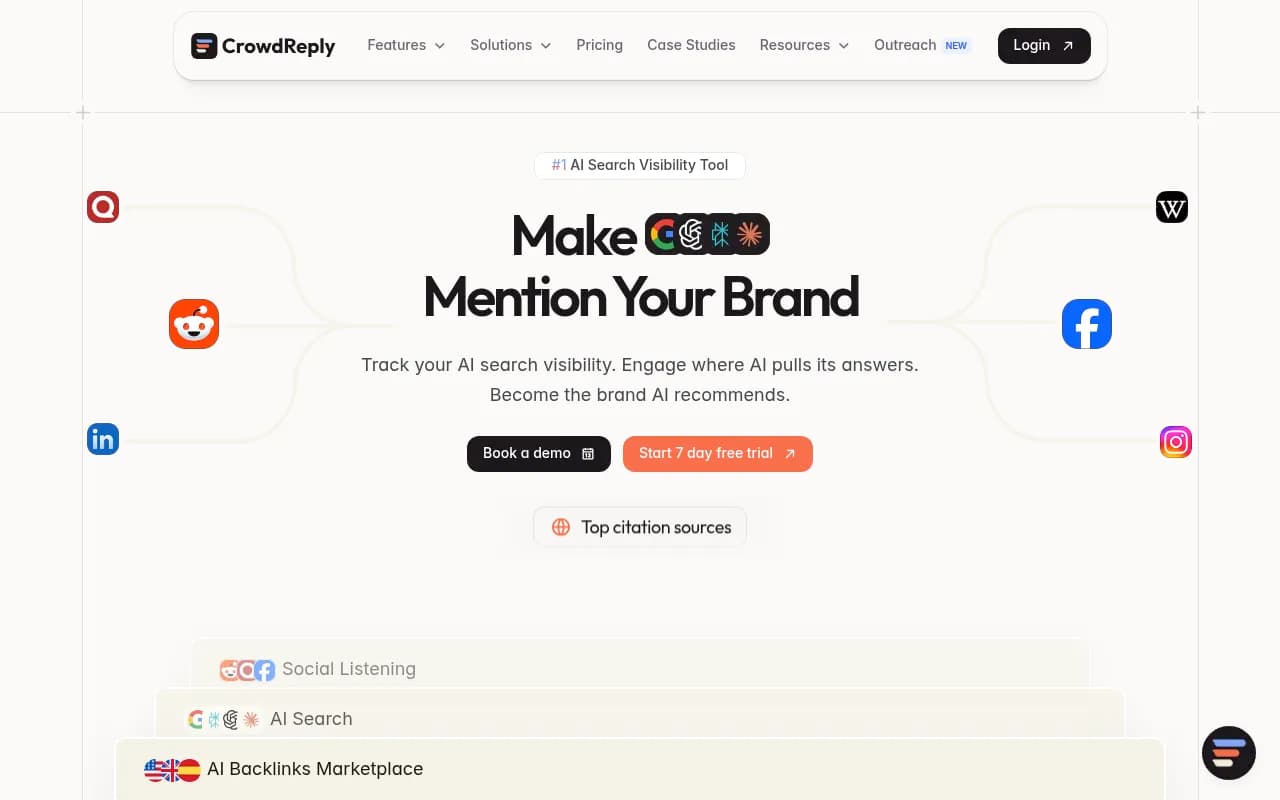
CrowdReply started life in May 2025 as a Reddit marketing service, and honestly, that DNA still shows. The 2026 rebrand ("CrowdReply 2.0," launched on Product Hunt in March) wraps the original service in an AI search visibility platform: you get prompt tracking across ChatGPT, Gemini, Perplexity, Claude, Google AI Overviews, Google AI Mode, Microsoft Copilot, and Grok, plus competitor benchmarking, sentiment analysis, and a chat-style "SuperAgent" that answers questions about your own data.
The pitch is coherent. AI models pull buying recommendations from community threads, review sites, and editorial content. CrowdReply finds those threads, tells you where you're missing, and then, unlike most visibility tools, actually gets you into the conversation. The company claims $5M ARR bootstrapped and 5,000+ brands, though I'd treat the homepage stats ("+47% increased LLM visibility," a 4.9 rating with no linked source) with some skepticism, since no methodology is published.
The three pillars
Visibility tracking. Daily prompt refresh, historical trends, competitor share of voice, and per-model rank trackers. On the Starter plan you pick 2 AI models; Growth gets 4; Enterprise gets all 7. Reporting is exportable and shareable, which agencies will appreciate. MCP and API access are included on every tier, which is more generous than most tools at this price.
The Engagement Engine. This is the differentiator. CrowdReply surfaces Reddit threads filtered by relevance and "AI citation potential," then either you write the reply or AI drafts it, and CrowdReply posts it through its own network of persona-based accounts. You pay per action: $10 per comment on Starter, dropping to $7 on Enterprise, with premiums for comments containing links and for full posts. The obvious caveat: you're building on land you don't own. The karma, the account history, the community relationships all belong to CrowdReply. Stop paying and nothing transfers.
Citation Outreach and the backlinks marketplace. The newest (and, to me, most interesting) piece. Citation Outreach finds pages that AI engines already cite for your tracked prompts, then handles contact finding, pitching, and negotiation to get your brand mentioned on those pages. You only pay when a mention goes live. The separate backlinks marketplace offers placements across 40,000+ vetted publishers with authority and traffic data shown upfront, plus a 12-month replacement policy.
Pricing
Starter is $79/mo (1 brand, 20 prompts, 2 models, $600 in annual engagement credits). Growth is $239/mo (3 brands, 75 prompts, 4 models, $2,400 in credits). Enterprise starts at $399/mo (10 brands, 200 prompts, all models, $3,600 in credits). Annual billing saves 20%. Note that pricing has moved a lot recently: an August 2026 review quoted $99/$299/$499, so the current page reflects a price cut and a credit boost. Check the live page before budgeting.
The credit math matters more than the sticker price. At roughly $8-10 per comment, a Growth plan's $2,400 in annual credits buys around 240-300 comments a year. That's fine for a focused campaign, tight for an agency running always-on engagement across a dozen clients.
Strengths
- The only tool in this category that pairs monitoring with hands-on offsite work. If your team has no bandwidth for community engagement, that's genuinely valuable.
- Citation Outreach's pay-on-publish model is fair, and the idea of targeting pages AI already cites is strategically sound.
- MCP and API on all tiers, Slack and email alerts, and multi-brand tracking at reasonable prices.
- The Reddit-first instinct is backed by real data: Promptwatch's social media citation research shows ChatGPT is a heavy Reddit citer, with Reddit accounting for a far larger share of its citations than any other social platform.
Limitations
- Reddit-only engagement, and Reddit's stock is falling. Promptwatch Data documented reddit.com's share of ChatGPT Search citations collapsing from roughly 4% to 0.5% on August 14, 2026, with Google's AI surfaces declining more gradually. A strategy built almost entirely on Reddit comments is exposed to exactly this kind of platform-level shift. Meanwhile AI Overviews, Grok, and Perplexity lean more on YouTube, which CrowdReply doesn't engage on or track.
- No measurement of real business impact. There's no visitor analytics tying AI-driven traffic to conversions, and no AI crawler logs showing whether ChatGPTBot or ClaudeBot even read your pages. Promptwatch offers both; CrowdReply stops at mentions and rankings.
- No content optimization loop. No content gap analysis, no briefs, no automated publishing to your own CMS. If your problem is that your site's pages aren't citable, CrowdReply can't fix that.
- No prompt volumes, difficulty scores, or query fan-out data, so prioritizing which prompts to fight for is mostly guesswork.
- Delivery risk on the engagement side. A documented third-party test found 8 of 9 ordered comments deleted within a month, and a June 2026 G2 review makes serious allegations about removed comments and refused refunds. CrowdReply does refund credits for removed comments, but the pattern is worth knowing about before you commit.
- Small independent review base (17 G2 reviews), and the brand's own search results are dominated by surfaces it controls.
Who it's for
E-commerce and DTC brands chasing "best X" recommendations, and startups that want Reddit presence without hiring a community manager. Also GEO agencies that want to resell offsite engagement alongside tracking. It's a weaker fit for SEO teams who need to fix their own site's citability, or for anyone who needs to prove AI-driven revenue to a CFO.
The bottom line
CrowdReply is doing something most visibility tools won't: rolling up its sleeves and getting your brand into the conversations AI cites. The Citation Outreach feature in particular is a smart, results-priced model. But the platform is monitoring plus outsourced Reddit work, not end-to-end optimization, and its Reddit-centric bet looks shakier after ChatGPT's August 2026 citation pullback from Reddit. If you want to understand why you're invisible, fix your own content, and measure the revenue AI traffic actually drives, Promptwatch covers that full loop with crawler logs, visitor analytics, content agents, and CMS publishing. CrowdReply works best as a complement to that kind of platform, or as a standalone play for brands that purely want offsite mentions handled for them.

Frequently asked questions
What is CrowdReply?
How does CrowdReply work?
Who is CrowdReply for?
How much does CrowdReply cost?
Is CrowdReply free to use?
What makes CrowdReply different from traditional SEO or link-building services?
Can CrowdReply help my brand get mentioned by ChatGPT?
Does CrowdReply work with Perplexity and Gemini as well as ChatGPT?
What is generative engine optimization (GEO) and how does CrowdReply relate to it?
Do I need technical SEO knowledge to use CrowdReply?
Similar and alternative tools to CrowdReply