Mentionable Review 2026
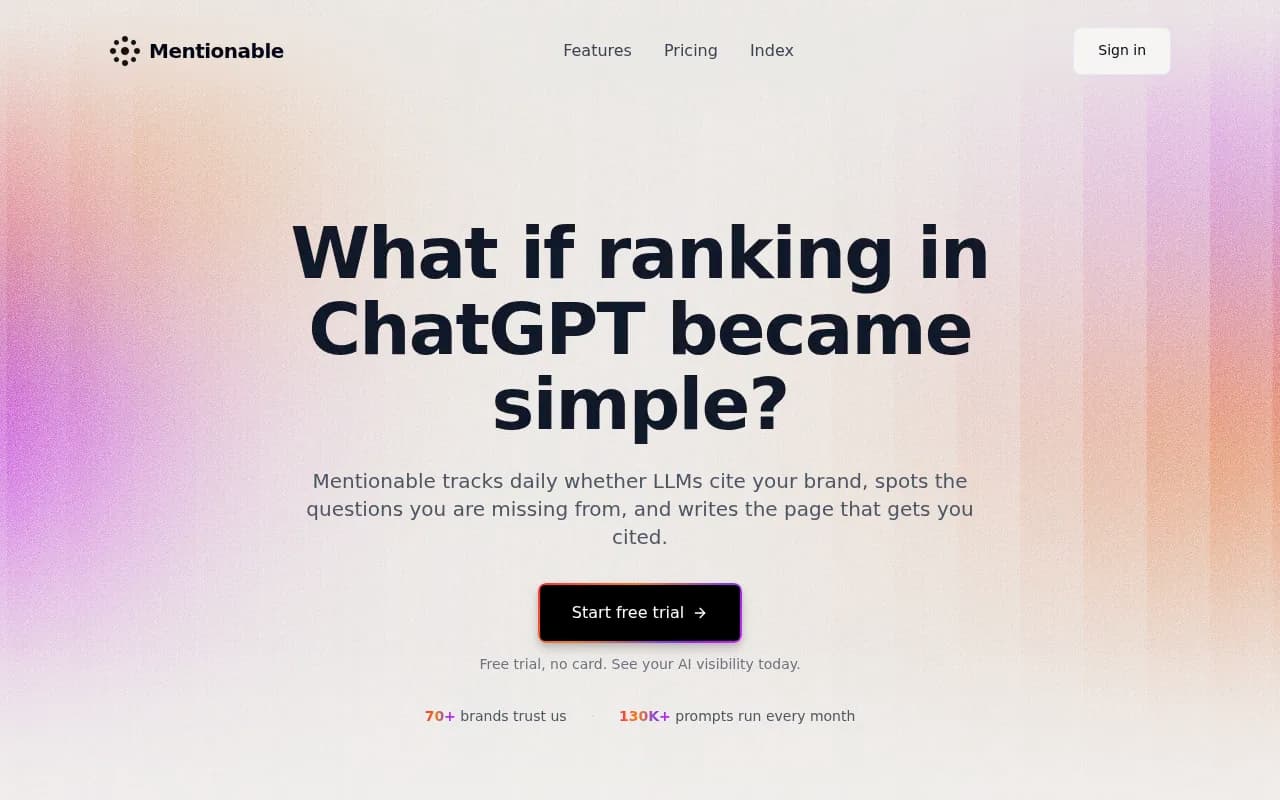
Tracks brand mentions daily across Google AI Mode, AI Overview, Perplexity, ChatGPT, Claude, Gemini and Copilot, with a public MCP server.
Key takeaways
- Mentionable is a genuinely well-designed AI visibility tracker with a smart angle: it doesn't just show where you're invisible, it drafts the page meant to fix it, in the format of the pages AI engines already cite.
- The public MCP server (30 tools, works with Claude Desktop, Cursor, Claude Code and n8n) is the standout feature for teams whose workflow already runs through AI agents rather than dashboards.
- Monitoring-only gaps vs Promptwatch: no AI crawler logs, no first-party visitor analytics (GA4 estimates only), no ChatGPT Shopping or Ads tracking, no YouTube citation tracking, no CMS publishing, and scan frequency is throttled by credits rather than truly daily on lower tiers.
- It's a bootstrapped, solo-founder product launched in January 2026. Fast-moving and cheap, but agencies building client services on it should weigh the single-developer risk.
- Best for: solo founders, consultants and small GEO agencies, especially in the French/European market, who want gap analysis and content drafting at a lower price point than enterprise platforms.
What Mentionable actually does
Mentionable sits in the GEO/AEO tracking category: it runs your market's prompts through seven AI engines (ChatGPT, Claude, Gemini, Perplexity, Copilot, Google AI Mode, Google AI Overviews) and tells you where your brand gets cited, where it doesn't, and who's being recommended in your place.
The onboarding is refreshingly simple. You enter a homepage URL, the tool detects your brand name and aliases, and auto-generates 15-20 suggested prompts to track. First data lands within an hour. For anyone intimidated by GEO, this removes the blank-page problem.
Three things stood out to me during testing:
Fan-out query capture. Before an AI answers "best CRM for startups," it silently runs follow-up queries like "CRM with a free plan?" or "Notion vs HubSpot for CRM." Mentionable captures these and hands you the real topic map you need to exist on. This is one of the more valuable analytical features in the category, and Promptwatch's own data on ChatGPT query fan-outs shows how much search behavior hides in these sub-queries, so it's the right thing to build on.
Source and backlink intelligence. The tool tracks which domains AI engines cite most in your niche, then goes a step further: it ranks domains by an impact score with estimated market prices next to them (g2.com at €240, saashub.com at €120, and so on). Turning citation data into a shortlist of link-building targets is a genuinely practical move. Most trackers stop at the data.
AI page generation. For every prompt where no engine cites you, Mentionable reads the pages that do get cited and drafts your version of that page, matching the structure and markup of what the engines already reward. Data points only you know (pricing, customer numbers) get flagged for you to fill in. You publish it, paste the URL back, and the next scan checks whether it worked. It's a closed loop, at least in theory. The drafts are a starting point, not publish-ready copy, but as a content-brief generator it saves real hours.
The MCP server is the real differentiator
Mentionable ships a public MCP server with 30 tools (20 read, 10 write) covering projects, prompts, sources, fan-outs, competitors, Reddit signals, page audits and white-label audits. It works with Claude Desktop, Cursor, Claude Code, n8n, and anything else that speaks MCP.
This is where the product's positioning gets interesting. Instead of being a dashboard you visit, it becomes a data layer your AI agents query directly: automated monthly reporting, Slack citation-watcher bots, content briefs generated from live fan-out data. There's even an open-source playbook repo on GitHub with Claude Code slash commands for content production and outreach workflows.
If your team already lives in Cursor or Claude Code, this is a compelling architecture. If you prefer a full dashboard with charts and a conversational analyst over your data, you'll find it thinner.
Pricing
Three plans, billed monthly excl. tax, with a 7-day free trial and no credit card:
- Growth: €79/mo — 1 project, up to 115 prompts, 1,500 scan credits/month, all 7 engines, unlimited team members.
- Pro: €149/mo — 3 projects, up to 231 prompts, 3,000 credits, adds MCP integration and priority support.
- Agency: €299/mo — unlimited client projects, up to 385 prompts, 5,000 credits, white-label reports, shareable client audits, MCP.
All seven engines are included on every tier with no per-LLM add-ons, which is a fair jab at competitors like Otterly that charge extra for Gemini coverage. Reddit engagement, page audits and generated pages are credit-based extras.
The catch is the credit system. Scans aren't truly daily unless your budget allows it; a Pro-tier configuration can work out to roughly 3 scans per week. The homepage says "daily" tracking, so read the fine print and size your prompt list to your credit allotment.
Strengths and limitations
Strengths:
- Fan-out query capture and source/backlink impact scoring are genuinely useful, not decorative.
- AI page drafting closes the loop from insight to action, which most trackers never attempt.
- MCP server with 30 tools is ahead of most competitors on agent integration.
- All 7 engines on every plan, no per-LLM upsells.
- Aggressive pricing: €79 entry point undercuts most serious platforms.
- Solo founder ships fast and documents everything publicly; support is direct and responsive.
Limitations, especially vs Promptwatch:
- No AI crawler logs. You can't see when ChatGPTBot or ClaudeBot visit your site, what they read, or whether they hit errors, which is often the actual explanation for poor visibility.
- No first-party visitor analytics. GA4 correlation is an estimate; there's no direct tracking of AI-driven traffic and conversions to your site.
- No ChatGPT Shopping or Ads Radar, no YouTube citation tracking, no sentiment analysis.
- Page generation drafts copy but doesn't publish to your CMS; you review, copy, paste, and report the URL back manually.
- No prompt volume or difficulty scoring, and no multi-language/multi-region tracking comparable to Promptwatch's country- and city-level monitoring.
- Single-developer risk. Salesdorado's review scored maturity at 3.7/5, noting the product evolves faster than its own website documents. For an agency betting client deliverables on this, that matters.
- The customer base skews heavily French (Developr, UpByWeb, ID Interactive testimonials), which is fine, but English-market support maturity is unproven.
Who it's for
A solo founder or in-house marketer who wants to understand AI visibility without a €500/month enterprise contract will get real value here. Small GEO agencies running a handful of French or European clients will like the Agency tier's white-label audits and unlimited projects. Teams already building workflows in Claude Code or n8n should try the MCP server specifically; it's the feature that justifies the Pro plan.
Larger brands, multi-market teams, and agencies that need crawler diagnostics, real traffic attribution, and automated content publishing should look at fuller platforms. For that use case, Promptwatch is the stronger option: it pairs monitoring with AI crawler logs, visitor analytics, Reddit and YouTube citation tracking, ChatGPT Shopping and Ads Radar, prompt volumes and difficulty scores, and Content Agents that plan, write and publish to your CMS automatically, across 10+ AI models.

Bottom line
Mentionable is one of the more thoughtful entries in the crowded AI visibility tracker space. The fan-out capture, backlink impact scoring, and MCP-first architecture show a builder who understands the workflow problem, not just the data problem. At €79/month with all seven engines included, it's easy to recommend for individuals and small agencies getting serious about GEO.
But it's a young, one-person product with credit-throttled scanning and no crawler logs, traffic attribution, or automated publishing. If you need monitoring plus the machinery to actually fix visibility gaps at scale, Promptwatch covers the full end-to-end stack Mentionable only partially addresses. Try Mentionable's free trial if the MCP angle fits your stack; compare it against Promptwatch before committing to an annual plan.
Tags:
Frequently asked questions
How much does Mentionable cost?
Which AI engines does Mentionable track?
Does Mentionable offer a free plan?
Does Mentionable generate content to fix visibility gaps?
What is Mentionable's MCP server?
How does Mentionable compare to Promptwatch?
Similar and alternative tools to Mentionable