Key takeaways
- The $250 to $600 band is where tools stop being simple prompt trackers and start adding crawler logs, traffic attribution, and content workflows. Prices vary a lot for similar-looking plans.
- Judge tools by cost per response and by which engines are really included, not by the headline prompt count.
- API access, extra models, and per-domain fees are where mid-market bills grow. Check them before you sign.
- Older roundups are stale. Profound's $99 Starter, for example, was pulled from its public pricing page in September/October 2026.
- Verify every number on the vendor's own pricing page. Several comparison sources are written by vendors who rank themselves first.
Why the $250 to $600 band matters
Entry-level GEO tools cost $30 to $100 a month and mostly tell you whether your brand was mentioned. Enterprise tools are quote-only and can run into five figures. The middle is where most marketing teams with real budgets actually land.
At this level you should expect more than a dashboard. You are paying for broader engine coverage, enough prompts to represent several topics and markets, some way to connect AI visibility to traffic, and ideally a path from "we're invisible here" to "here is the fix."
I'll be upfront about one limit. I did not pull prices from each vendor's pricing page directly. The numbers below come from vendor comparison pages and third-party roundups, some dated August to October 2026. Treat them as a map, then confirm before buying.
What the market looks like right now
Here is a snapshot of plans at or near the band, as reported in late 2026.
| Tool | Plan | Reported price | What's reported |
|---|---|---|---|
| Promptwatch | Professional | $245/mo | Crawler logs, automated content features, all models |
| Promptwatch | Business | $579/mo | City targeting, ChatGPT Shopping, Ads Radar, Content Agent |
| Scrunch | Core | $250/mo | 125 prompts, about 4 engines, credits consumed per engine |
| AthenaHQ | Starter | $295/mo | Credit-based, about 3,600 responses, API is an add-on |
| Peec AI | Pro / Advanced | $245 / $495 | Extra models cost $35/mo each on lower tiers |
| Ahrefs Brand Radar | Lite + Brand Radar | about $328/mo | About 2,500 responses |
| Searchable | Scale | $400/mo | API requires this tier |
| Goodie AI | Core | $399/mo | Billed quarterly or annually |
| ReachLLM | Pro | $399/mo | Agency-oriented |
A few tools sit just below or above. Otterly's Lite plan is $29 for 15 prompts, and its API and MCP access starts at $189. Semrush's AI Visibility Toolkit is $99 per domain for 25 prompts, plus $60 a month per extra 50 prompts. Evertune Pro is $800. Brandlight publishes no pricing, and enterprise tiers reportedly reach about $25K a month.
Use cost per response, not cost per prompt
Prompt counts are the number vendors like to advertise, and they are the easiest to game. A prompt tracked on one engine once a day is very different from a prompt tracked on six engines in three countries.
Per-response cost is a fairer lens. From the Promptwatch comparison table (August 2026, so a vendor source), the reported figures are:
| Plan | Price | Approx. cost per response |
|---|---|---|
| Scrunch Core | $250 | about $0.017 (estimated about 15,000 responses) |
| AthenaHQ Starter | $295 | about $0.082 (about 3,600 responses) |
| Ahrefs (Lite + Brand Radar) | about $328 | about $0.131 (about 2,500 responses) |
| Promptwatch Essential (for reference) | $95 | about $0.016 (6,000 responses) |
The pattern is that entry-level tools run roughly $0.01 to $0.04 per response, while mid-market tools with more features can cost two to eight times as much. That is not automatically a bad deal. If you are paying for crawler logs, visitor analytics, and content tooling, the per-response number is only part of the story. But if two tools cover the same engines and one costs five times more per response, you should be able to say what the extra money buys.
One more point on how to read volumes. Promptwatch Data's ChatGPT query fanout report shows fanouts per response fell from about 2.15 in early December 2025 to 1.84 by early March 2026, then returned at 1.0 in April. More prompts do not mean proportionally more searches behind each answer, so judge tracking by prompts and responses you can actually use. You can read the underlying numbers in Promptwatch's ChatGPT query fanout report.
What each tier of spend tends to include
Around $250
This is the first real step up from basic trackers. You usually get a few hundred prompts at most, four to six engines, competitor benchmarking, and maybe an API. It is enough for one brand, one or two markets, and a focused topic set.
Promptwatch Professional at $245 is in this range, with crawler logs and content features on top of tracking. Scrunch Core at $250 is the other obvious reference point.

Scrunch's Core plan covers ChatGPT, Perplexity, AI Overviews, and Copilot. Gemini, Claude, AI Mode, and Grok are reported as Enterprise-only, per Straight North. That is a meaningful gap if your buyers use Gemini or AI Mode.
Around $300 to $400
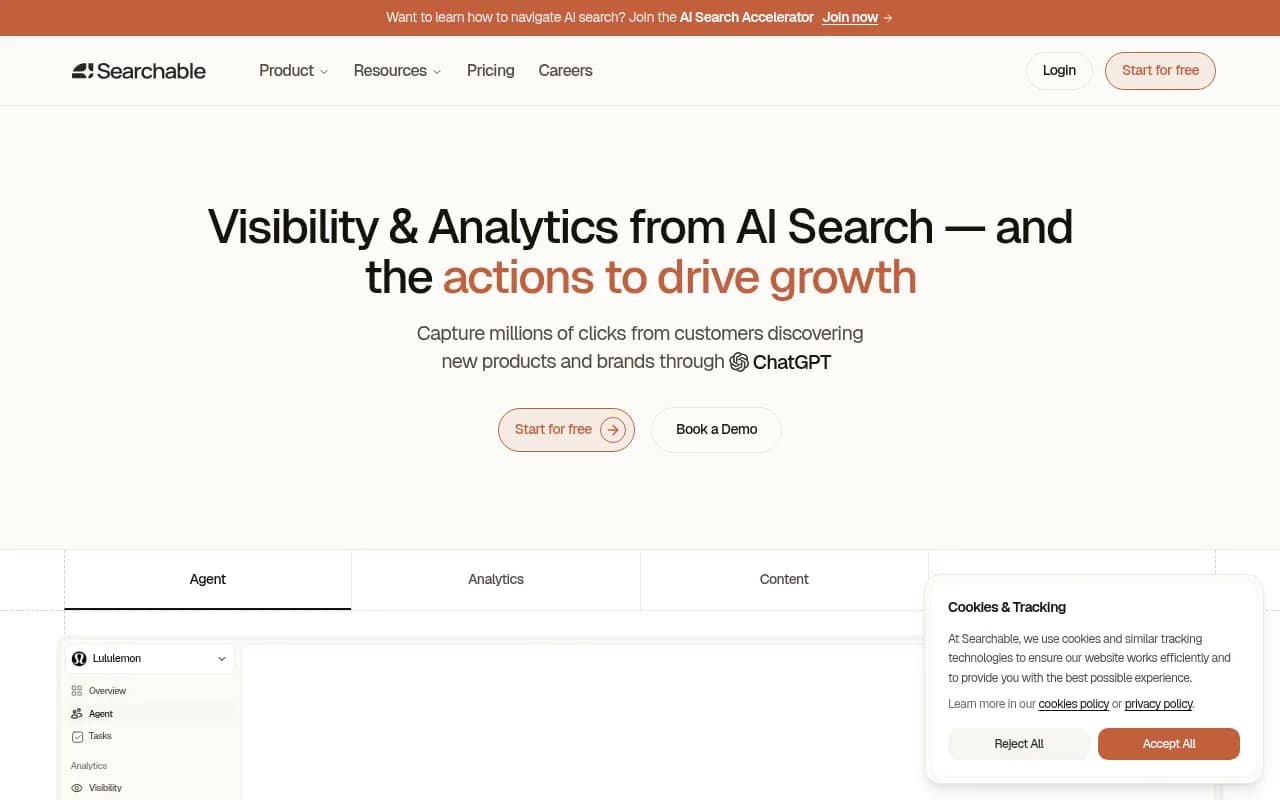
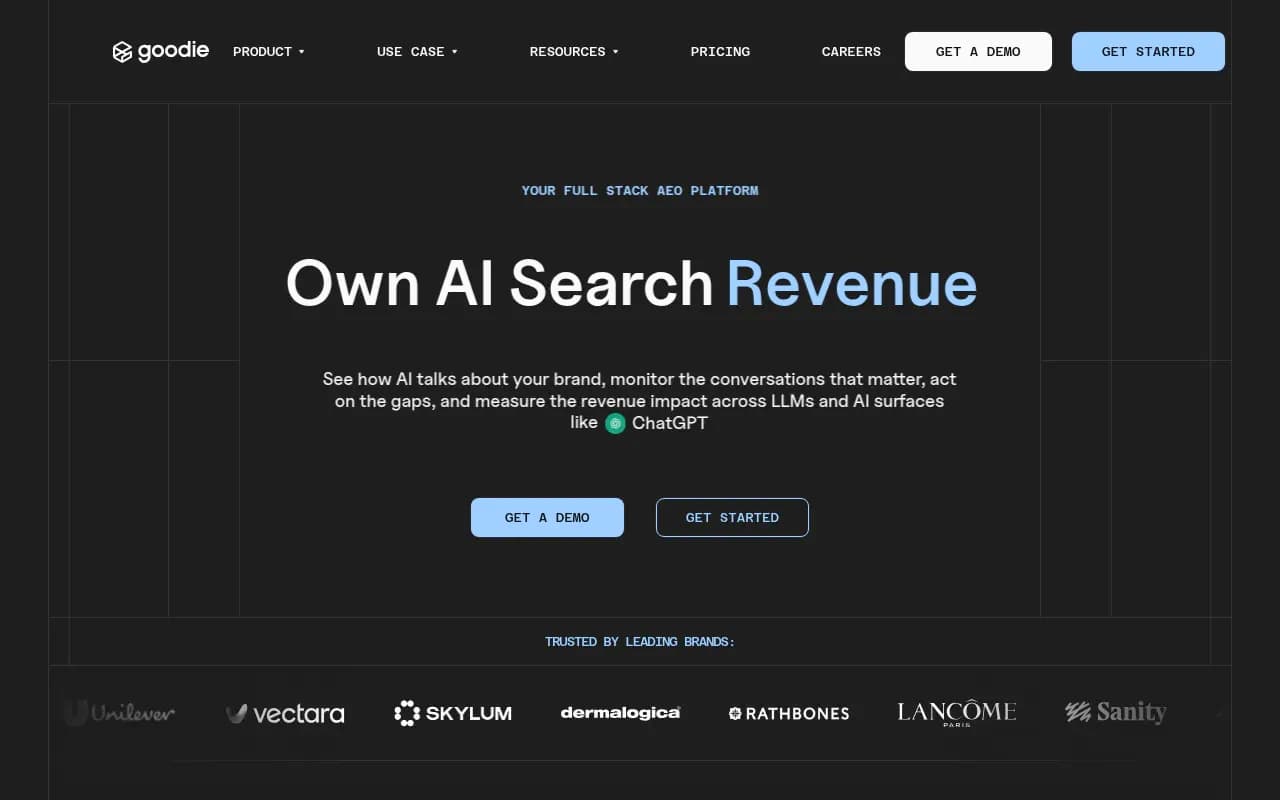
This is where credit systems and add-ons show up. AthenaHQ at $295 is credit-based. Peec's Advanced plan at $495 sits higher. Searchable's $400 Scale plan unlocks the API. Goodie AI and ReachLLM both reportedly list $399 plans.


At this tier, the question is less "how many prompts" and more "what happens when I need one more engine, one more region, or API access."
Up to about $600
This top end of the band is where the more complete platforms live. Promptwatch Business at $579 adds city and state targeting, local GEO/SEO targeting at exact coordinates, ChatGPT Shopping insights, Ads Radar, the automated Content Agent, and 100M crawler logs. It also adds an audit log, which matters for security reviews.
Once you reach this level, you are no longer comparing trackers. You are comparing whether the tool can close the loop: find a gap, produce content, publish it, and report whether it got crawled and cited.
Where the bill quietly grows
The sticker price is rarely the whole price. These are the traps I would check first.
- Per-engine credits. Scrunch consumes prompt credits per engine, so tracking the same prompt on four engines costs four credits. Qwairy's premium models cost 2 to 20 credits.
- Extra model fees. Peec charges $35 a month for each additional model on its lower plans. Searchable charges extra for Claude, Copilot, and Grok.
- API and MCP gating. Otterly requires $189 or more. Peec and Profound gate API to Enterprise. AthenaHQ sells it as an add-on. Searchable needs the $400 Scale plan.
- Per-domain and per-seat fees. Semrush charges per domain, and Profound's agency pricing is $399 per client workspace.
- Quote-only tiers. Profound, Brandlight, and Bluefish do not publish enterprise prices.
If you manage multiple brands or clients, per-domain and per-workspace pricing can matter more than the base plan. A $99 plan times six domains is no longer cheap.
Beware stale pricing
This one catches people. Profound's $99 Starter was removed from its public pricing page in September/October 2026, according to an IndustryLens report dated 12 October 2026. What remains is a free trial and custom Enterprise pricing, plus an agency Growth plan reported at $399 per client workspace. Some roundups, including Straight North and ReachLLM, still list the $99 Starter. They look out of date.

Other recent shifts reported in October 2026: AthenaHQ added a free tier, and Mentionable lists six engines at EUR 79, EUR 149, and EUR 299. Euro prices also confuse comparisons. Peec is listed in euros in some sources and in dollars in others.
The rule is simple. If a comparison article is more than a few weeks old, assume at least one price in it has changed.
Monitoring versus doing something about it
This is the biggest dividing line in the band. Most tools answer "was my brand mentioned?" A smaller group helps you act on the answer.
What acting looks like in practice:
- Crawler logs that show whether AI bots can actually read your pages
- Visitor analytics that tie AI referrals to conversions
- Content gap analysis against the prompts AI answers
- Content generation and CMS publishing
- A prioritized to-do list rather than a chart
Promptwatch positions itself on this side, and I will flag that this is its own claim: that most tools measure but do not ship fixes. It does match what the plan structures show. Its Professional and Business tiers include crawler logs and content tooling, while many comparable trackers in the band stop at monitoring. If you only need reporting for a quarterly deck, that extra capability is wasted money. If you have a content team that can act on gaps, it is where the value is.
A useful sanity check on whether monitoring alone is enough: Promptwatch Data shows that Google AI Overviews cites about 10 sources per answer, roughly double ChatGPT's 5, and Perplexity sits at about 10 as well (average sources per response). Each engine behaves differently, so a tool that only samples a few engines can mislead you about where you stand.
How to decide what to buy
Start with the engines your buyers use
List the engines that matter to your audience. If Gemini and AI Mode are on that list, a plan that locks them behind Enterprise is not a $250 plan for you.
Count responses, not just prompts
Ask each vendor three questions. How many responses per month are included? Does one prompt cost one credit or one per engine? What happens at the limit, a hard stop or overage fees?
Price the add-ons you will need
API, MCP, extra models, extra seats, extra domains. Add them to the sticker price and compare the real totals.
Decide whether you need action tooling
If your team has no capacity to write and publish, monitoring tools leave you with a report and no progress. If you do have capacity, you may only need a cheaper tracker plus your existing content stack.
Consider free starting points
Straight North suggests Google Search Console, Bing Webmaster Tools, and GA4 as a free baseline. That is sensible advice before you commit $250 or more a month. Promptwatch also offers a free Explore plan (1 project, 10 prompts, ChatGPT only) and a 7-day free trial on its paid monthly plans, and several other tools in this space have free tiers.
Quick picks by situation
| Situation | What to look for | Candidates to check |
|---|---|---|
| One brand, wants tracking plus fixes | Crawler logs, content tooling, all engines | Promptwatch Professional or Business |
| Mainly wants mid-market prompt tracking | Solid engine coverage, clear limits | Peec AI, Scrunch Core |
| Already lives in an SEO suite | Bolt-on convenience, fixed prompt sets | Ahrefs Brand Radar, Semrush |
| Needs API for BI pipelines | API included, not gated | Check Searchable Scale, Promptwatch Essential and up |
| Multi-location or local brand | City-level targeting | Promptwatch Business |
| Agency with many clients | Per-workspace pricing, white-label | Promptwatch Agency plans, Profound Growth |
Gaps in what I could verify
No expert commentary I found says how many prompts a mid-market brand actually needs. I also could not confirm prompt and model counts for Peec Pro and Advanced, Promptwatch Professional and Business, or AthenaHQ's credit limits across its 11 advertised models. Ask vendors for these in writing.
For wider comparisons, the GEO software directory at bestgeosoftware.com and the AI rank tracking directory at ai-rank-tools.com list many more options than fit in this band.
Bottom line
Spending $250 to $600 a month on GEO tooling can buy either a better tracker or a platform that helps you fix what it finds. Work out which one you need, count responses instead of prompts, add up the API and model fees, and check prices on the vendor's own page. If a roundup still lists Profound at $99, close the tab.