Key takeaways
- Perplexity is the better first-pass finder for marketing research. It searches by default and returns about 10 citations per answer. ChatGPT averages about 5 when search is triggered.
- ChatGPT's citations lean toward vendor-owned pages. Product and landing pages make up about 39% of what it cites, so competitor claims need checking.
- For voice-of-customer research, ChatGPT is now a weak source. Social platforms are 0.46% of its citations, while Perplexity still surfaces some Reddit and LinkedIn material.
- Headline accuracy numbers (92% vs 87%) come from secondhand claims on one aggregator page. Treat them as directional, not proof.
- The practical answer is both: Perplexity to find and verify sources, ChatGPT to reason over what you collected.
What this comparison covers
Most Perplexity vs ChatGPT articles score the two on speed, writing, or coding. That is not what a marketer doing research needs. If you are sizing a market, profiling a competitor, or pulling together a messaging brief, the question is narrower: where did this claim come from, and would I put it in front of a client?
So this guide looks at source quality. How many sources each tool gives you, what kinds of pages they are, whether they are independent or self-promotional, and how fresh they are. I lean on Promptwatch's first-party citation data wherever it exists, and I flag the third-party numbers that I could not trace back to a primary source.
One framing note. Some reviewers say ChatGPT does not search by default and sometimes answers from training data. That is a fair complaint about the workflow, but the citation data below only covers responses where search was triggered. So every head-to-head comparison here is really "when search is on." For research, turn it on explicitly or say so in the prompt.
The quick comparison
| Factor | Perplexity Pro | ChatGPT Search |
|---|---|---|
| Searches by default | Yes, every query | Not always; you may need to ask or click search |
| Sources per answer | About 10, very stable | About 5 on average, drifts with model updates |
| Citation style | Inline links on every answer | Cited when browsing, less consistent in default mode |
| Social and forum sources | 2.7% of citations | 0.46% of citations |
| Source mix | Broader spread | Leans to product and landing pages |
| Reasoning over findings | Good for synthesis, shallower on multi-step logic | Stronger for analysis, drafting, and restructuring |
| Pricing (consumer) | Pro $20/mo, Max $200/mo | Plus $20/mo, Pro $200/mo |
Pricing is from Fabric's comparison page and changes often, so confirm on each vendor's site before buying.
How many sources you actually get
This is the most concrete difference, and it comes from Promptwatch Data's average sources per response report. That report is dated September 2025 and has no explicit 2026 range, so read the figures as approximate.
- Perplexity cites almost exactly 10 sources per answer, day after day, with barely a decimal of movement. Promptwatch reads that as a deliberate retrieval design.
- ChatGPT cites about 5 sources per web-search answer, and the number drifts as models and retrieval change.
- Google AI Overviews sits near 10 as well.
For a researcher, a fixed 10 is useful. You know roughly what you will get, and you can scan ten links for a contradiction in a few minutes. Five sources from ChatGPT is fine for a quick answer, but it gives you less to triangulate with.
There is a wrinkle. A separate Promptwatch report on unique domains per ChatGPT response (Sep 28 to Oct 4, 2026) found that 47.6% of ChatGPT responses with citations cite 10 or more different domains, and 66.1% cite at least 8. That looks like it contradicts the average of 5. It does not. The first report counts citations in web-search answers on average. The second counts distinct domains in responses that have at least one citation, and it is a newer window. The practical read: ChatGPT's source count varies a lot by prompt type. Organic, no-brand prompts see 10 or more domains in 52.5% of responses. Brand-specific prompts drop to 21.3%, with 5 domains the most common count.
That matters for marketing research. If you ask ChatGPT about a specific company, expect a narrow source pool. If you ask a broad category question, expect a wider one.
What kind of pages each tool cites
Source count is half the story. The other half is whose voice the sources carry.
Promptwatch's content type report (Sep 28 to Oct 4, 2026) breaks down what ChatGPT cites:
| Content type | Share of ChatGPT citations |
|---|---|
| Product pages | 22.4% |
| Landing pages | 16.8% |
| Listicles | 13.6% |
| How-tos | 8.7% |
| Documentation | 7.5% |
| General articles | 6.1% |
| Comparisons | 5.9% |
| News | 5.7% |
| FAQ pages | 3.3% |
| Reviews | 1.7% |
Product and landing pages together are about 39% of citations. These are pages a company wrote about what it sells. Editorial formats combined come to roughly 43%.
On commercial prompts the skew gets stronger: product pages hit 26.0% and landing pages 20.6%. On branded prompts, product pages are 23.3% and landing pages 22.8%.
Why this matters for competitor research
If you ask ChatGPT "how does Competitor X compare on pricing and features," a large share of the evidence it pulls may be written by Competitor X or its rivals. Those pages are not lies, but they are marketing. Claims like "the fastest" or "trusted by thousands" arrive in your notes looking like findings.
My habit: when ChatGPT gives me a competitive claim, I check whether the cited page is the vendor's own. If it is, I label it "vendor-stated" in my notes and look for a third-party source, such as a review site, analyst note, or independent test.
I do not have a matching content-type breakdown for Perplexity, so I will not pretend to. What I can say is that its fixed 10-source pattern gives you more room to find the independent source among the vendor ones.
Community and voice-of-customer evidence
This is where the two tools diverge most sharply in 2026.
Promptwatch's social media citations report (Sep 28 to Oct 4, 2026):
| Engine | Social platforms as share of citations | Notes |
|---|---|---|
| ChatGPT | 0.46% | Reddit 0.09%, LinkedIn about 0.3% |
| Perplexity | 2.7% | LinkedIn and Reddit 0.86% each, YouTube 0.79% |
| Google AI Overviews | 12.2% | YouTube 4.28%, Facebook 2.38%, Reddit 2.15% |
ChatGPT's Reddit citations collapsed from roughly 4% to 0.5% on August 14, 2026. If your research workflow used to rely on ChatGPT surfacing real customer complaints and Reddit threads, that workflow quietly broke.
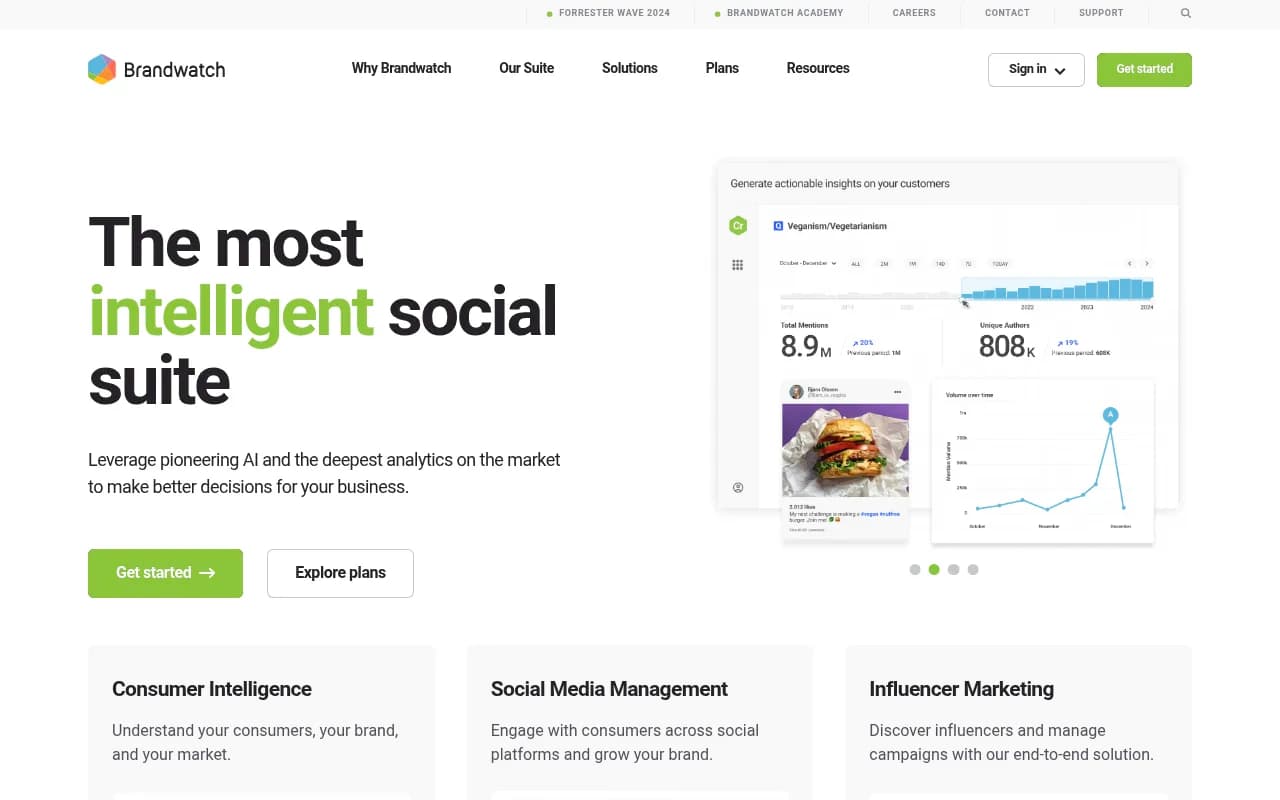
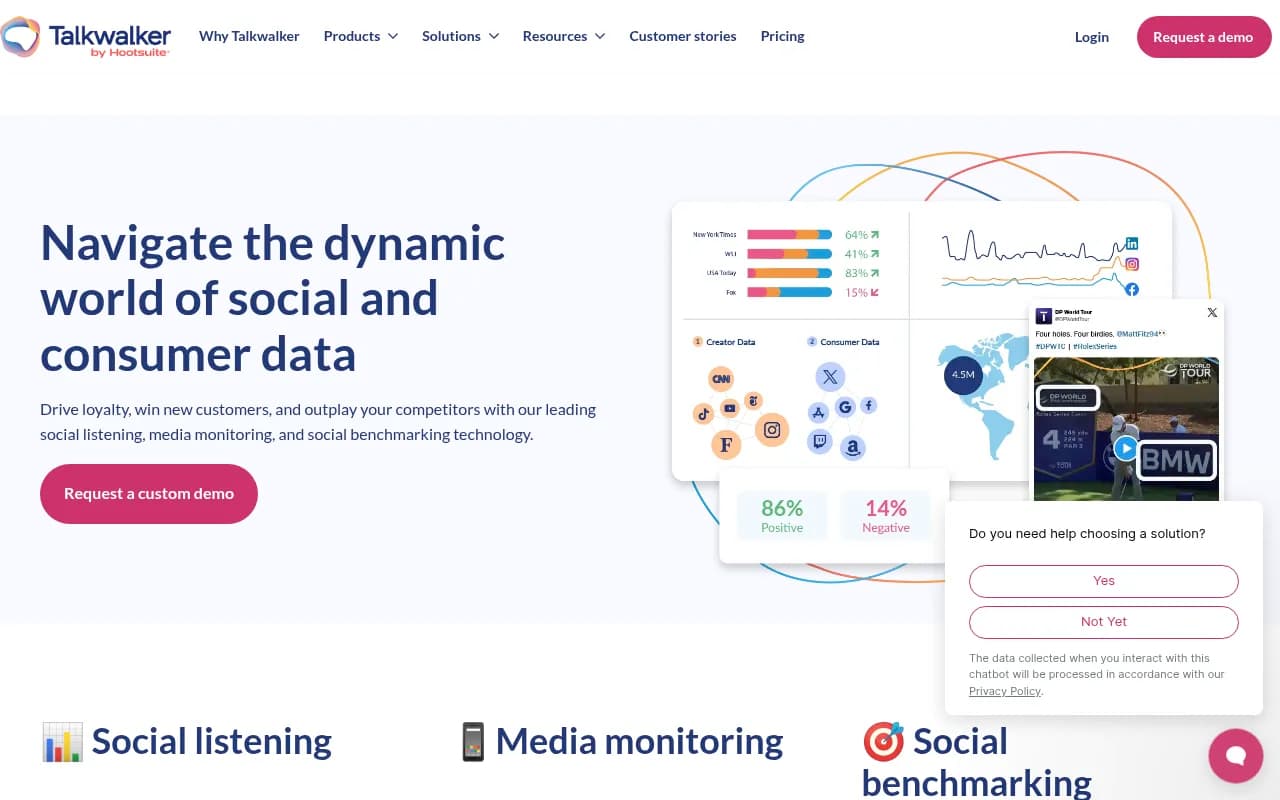
Perplexity is better here, but 2.7% is still small. Neither tool is a substitute for searching Reddit, review sites, and LinkedIn directly when you need the language customers actually use. If you want a tool built for that, social listening platforms such as Brandwatch Consumer Intelligence or Talkwalker are the purpose-built route.
Brandwatch Consumer Intelligence
About the accuracy numbers
You will see a statistic repeated across comparison articles: Perplexity at 92% factual accuracy versus ChatGPT at 87%, and a second audit putting it at 91.3% versus 84.7%. These appear on a single aggregator page (tech-insider.org) attributed to LMSYS and Scale AI. I could not find a primary source for either. That page is also internally inconsistent on dates: it is stamped April 2026 but references September and October 2026 data.
The better-sourced number is from Zapier's editorial team. In a 100-query test, Perplexity's citations were verifiable and accurate 89% of the time. The aggregator page pairs that with a 76% figure for ChatGPT, but I did not verify the ChatGPT number.
My take: the direction is consistent across most sources, with Perplexity ahead on cited research. Zapier, nexos.ai, Coursiv, and Fabric all say roughly the same thing. But do not put "92% vs 87%" in a client deck. Run your own 20-query test instead (a method is below).
For what it is worth, one independent writer ran 100 real searches and reported Perplexity winning 61, mostly on research, synthesis, and complex comparisons. That was Perplexity against Google, not ChatGPT, and it is one person's test. It is a data point, not a verdict.
Freshness: how long do cited sources stay useful
Marketing research ages fast. Promptwatch's content half-life report tracked every page ChatGPT cited on July 6, 2026 for 90 days. Landing pages and docs stayed cited longest, while news lost half its pages within 36 days.
The implication is that ChatGPT's cited pool is itself unstable for anything news-driven. If you ran a market-trends query in July and saved the sources, a good portion of that list may no longer be what ChatGPT would cite today. Re-run time-sensitive queries instead of reusing old outputs, and save the URLs, not just the summaries.
ChatGPT's retrieval behaviour has also shifted more than once. Average citations per response dropped around the GPT-5.3 rollout on March 4, 2026, and on August 8 ChatGPT began using the site: operator at scale, jumping from about 0.4% to about 17% of fan-out queries. A prompt that returned one kind of evidence in spring may return another now. Perplexity's flat 10 looks steadier, though I would still spot-check.
A workflow that uses both
The Fabric comparison puts it neatly: use Perplexity to find sources and ChatGPT to think about what you found. After testing both approaches, I mostly agree, with a few additions.
- Start in Perplexity. Ask the research question, and use its source scoping if you need academic or specific domains. Collect the ten citations.
- Open the sources, not the summary. Skim at least the three most important ones. Summaries compress and sometimes misattribute.
- Tag each source: vendor-owned, independent editorial, community, or data/report. This takes two minutes and prevents most embarrassing errors.
- Move to ChatGPT for analysis. Paste in the facts you verified and ask it to find gaps, build a comparison matrix, or draft the brief. It is stronger at reasoning and writing than at being a search engine.
- Run the same query in ChatGPT with search explicitly on. Compare the overlap. Sources that appear in both are your safer bets. Sources that appear in only one deserve a second look.
- Go outside both for customer language. Search Reddit, G2, and LinkedIn directly.
A simple 20-query test
Before you trust either tool for a client project, build a mini benchmark from your own work.
- Pick 20 questions you already know the answer to, split across your industry, a competitor, and a stat you can verify.
- Run each in both tools with search on.
- For each answer, check three things: is the claim correct, does the cited page actually say it, and is the source independent?
- Score it. Ten minutes of tallying beats any leaderboard.
Which one for which task
| Task | Better pick | Why |
|---|---|---|
| Fast fact-finding with links | Perplexity Pro | Searches by default, about 10 citations |
| Triangulating a claim across sources | Perplexity Pro | Larger, steadier source pool |
| Competitor positioning research | Both, with checks | ChatGPT leans on vendor pages; verify independence |
| Voice-of-customer language | Neither alone | Social is 0.46% (ChatGPT) and 2.7% (Perplexity) of citations |
| Turning findings into a brief | ChatGPT | Better reasoning and drafting |
| News and trend tracking | Perplexity, re-run often | News citations decay fast in ChatGPT |
| Messy multi-step analysis | ChatGPT | Stronger on complex logic |
Beyond the chatbots: tools for tracking what AI says about you
There is a second marketing use of this whole topic. Instead of using Perplexity and ChatGPT to research the market, you may need to know how they describe your brand, and which sources they pull from when they do. That is a monitoring problem, not a research one.
Tools like Promptwatch track how brands show up in ChatGPT, Perplexity, Google AI Overviews and other engines, including which pages get cited. It is also useful for the source-quality question in this guide, because you can see which domains an engine leans on for your category.

If you are comparing options, the GEO software directory at bestgeosoftware.com lists a wide range of trackers. Profound and Peec AI are two other names that come up often.


Common mistakes
- Treating a citation as proof. A link next to a sentence does not mean the page supports the sentence. Open it.
- Quoting accuracy percentages you cannot trace. If the stat has no primary source, leave it out.
- Reusing old outputs. Citation pools shift, and news decays within weeks.
- Using ChatGPT with search off and assuming it browsed. Check whether sources appear before relying on an answer.
- Skipping the vendor check. A third of ChatGPT's citations are product and landing pages. Competitor research built on those is competitor marketing.
Bottom line
For marketing research, Perplexity Pro is the better starting point. It searches every time, gives you about ten sources, and makes verification easy. ChatGPT Search is the better thinking partner once you have verified facts in hand, but its citations skew toward vendor pages and it barely touches community sources anymore. Use Perplexity to gather, ChatGPT to analyze, and your own eyes to check the links in between. Both cost about $20 a month, so running them side by side for a month on your own 20-query test costs less than one bad client deck.
For more first-party data on how AI engines choose sources, see the Promptwatch Data hub.