Key takeaways
- AI search tools (ChatGPT, Perplexity, Gemini, Claude) are good replacements for desk research: market sizing first drafts, competitor scans, trend summaries, and review synthesis.
- They cannot replace primary research. A model summarizing the web does not tell you why your customers chose you, what they feared, or how they react to a new package.
- The sources behind AI answers lean toward vendor-owned pages and listicles, so AI "desk research" mostly reflects what companies say about themselves.
- AI-moderated interviews sit in the middle: they use real people, run at scale, and are the most defensible new category.
- The sensible 2026 stack is a split: AI for speed on existing information, real respondents for decisions that carry risk.
The question marketing teams are actually asking
Nobody is really asking whether AI is "better" than market research. They are asking which line items on the research budget they can cut without getting burned.
The old math is easy to see. One 2025 Qualtrics estimate, quoted by Simular, puts an outsourced consulting-style study at 4 to 8 weeks and $15,000 to $50,000. TrendCandy gives a similar range of four to twelve weeks. Compare that with a Perplexity or ChatGPT Deep Research report that lands in minutes. Of course teams are tempted.
But speed and cost are only half the picture. The other half is where the answer comes from. A traditional study produces data that did not exist before you asked. An AI search tool rearranges data that already exists. Those are different products, and treating them as interchangeable is where teams get hurt.
Three kinds of tools hiding under the "AI research" label
A useful framing comes from Conveo's 2026 comparison, which splits the category into three groups. I think it is the cleanest way to cut through vendor noise.
- AI interview platforms collect new responses from real participants, with AI doing the moderation, probing, and analysis.
- Synthetic research tools generate simulated respondents from a model. No real person stands behind the answer.
- Desk research tools analyze what is already published. ChatGPT, Perplexity, Claude, and Gemini live here.
Most confusion in vendor pitches comes from blurring these. A synthetic persona and a real interview transcript can look identical on a slide: tidy themes, plausible quotes. Only one of them can be traced back to a human being.
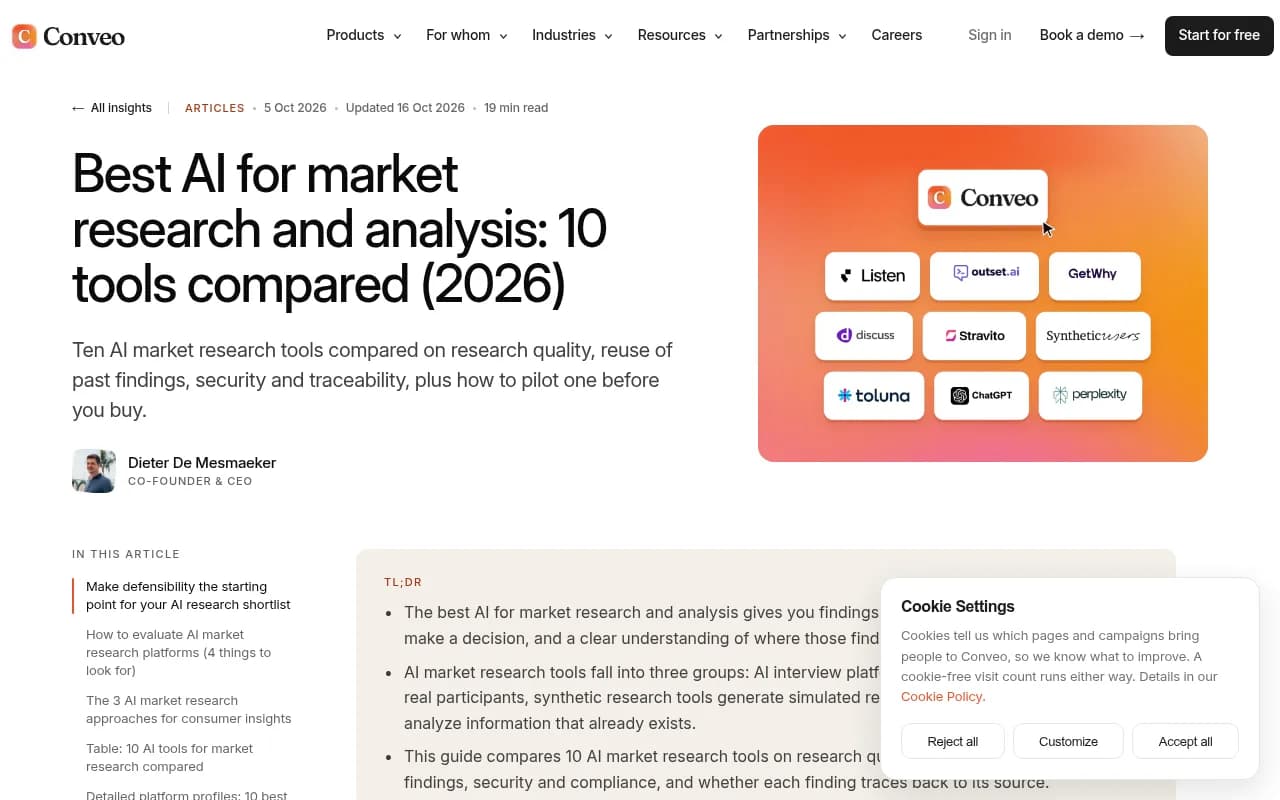
The Conveo guide is worth skimming for its evaluation criteria, particularly the question of whether every finding traces back to a source. Keep in mind it is written by a vendor that sells interview software, so read the framing with that in mind. The criteria still hold up regardless of who wrote them.
What AI search tools can replace
Desk research and first-draft market sizing
This is the clearest win. Questions where the evidence already sits online or in your files are exactly what these tools are built for. Conveo notes that ChatGPT's Deep Research feature can pull from multiple sources into a report, and that free tools like ChatGPT and Perplexity can handle desk research, trend analysis, and competitive analysis.
Typical jobs you can hand over:
- A first pass at market size and growth drivers for a category
- A summary of how five competitors position their pricing and features
- A digest of analyst commentary on a trend
- Pulling the common objections out of a few hundred public reviews
Tools worth knowing here: [tool:claude] and [tool:gemini] sit alongside ChatGPT and Perplexity as general-purpose assistants. [tool:notebooklm] is useful when you want answers grounded only in documents you upload, such as your own past research decks, which cuts down on invented statistics.
Competitive monitoring
Continuous tracking used to mean a quarterly report from an agency. Now it is an alert. Social listening and monitoring tools such as [tool:brandwatch-consumer-intelligence], [tool:talkwalker], [tool:meltwater], and [tool:brand24] watch conversations passively and flag shifts. [tool:similarweb] and [tool:semrush] cover competitive traffic and search demand, which Simular rightly describes as a proxy for market demand. A proxy is not the same as a reason, but it is a fast and cheap signal.
Synthesis and reporting
Transcribing, coding open-ended responses, and drafting the first version of a readout are chores that AI does well. Outset's own roundup says it plainly: tools speed up research, they do not replace researchers. Humans keep interpretation and strategy. I agree with that, and it applies even when you did the fieldwork yourself.
Audience data you can query
Platforms like GWI Spark and [tool:pulsar] let you ask questions of large pre-collected audience datasets. That is a legitimate shortcut for sizing a segment or sanity-checking a persona. It is secondary data, though. Outset's table puts it bluntly: not primary research.
What AI search tools cannot replace
The "why" behind customer behavior
A model can tell you what people say publicly about your category. It cannot tell you why a specific buyer picked your competitor last Tuesday. That requires asking, and then asking a follow-up. Qualitative depth is the thing the old research world did well and the thing summaries cannot fake.
Concept, packaging, and creative testing
The Conveo example of a snack brand choosing between three packaging designs makes the point well. If the tool cannot show you what individual participants said about each design, you cannot tell whether the result was right, and you cannot diagnose it when sales disappoint. Stakes this high need respondents you can inspect.
Independent opinion
This one gets overlooked. Look at what AI search actually leans on. Promptwatch Data's analysis of ChatGPT citations (Sep 28 to Oct 4, 2026) found product pages were the most cited content type at 22.4%, with landing pages at 16.8%. That means roughly 39% of classified citations point to pages describing what a company sells. Listicles add another 13.6%, and reviews are only 1.7%.
The implication for research is uncomfortable. When you ask an AI search tool about a market, a large share of what it reads is vendors describing themselves. That is useful for understanding positioning and competitor claims. It is a poor stand-in for independent customer opinion.
Broad, stable sourcing
An AI answer draws on a small and shifting source set. Promptwatch Data's average sources per response page shows ChatGPT citing about 5 sources per web-search answer, while Google AI Overviews and Perplexity sit around 10. That page is dated September 2025, so treat the exact numbers as a snapshot. The more recent unique-domains report found almost half of ChatGPT responses cite 10 or more unique domains in the Sep 28 to Oct 4, 2026 window. Either way, a research summary built on an AI answer inherits whatever narrow slice the model happened to retrieve that day. Run the same question next week and the sources can change.
Synthetic respondents
I am skeptical of this category, and I would not use it for a decision you cannot reverse. A synthetic respondent is a model guessing what a person would say. Conveo's guidance is that with synthetic research there is no participant behind an answer to check. Perspective AI's roundup excluded synthetic panels entirely and cited academic critique, though I could not verify that specific citation, so I would not lean on it. The underlying logic stands on its own: you cannot audit an answer that no one gave.
The middle path: AI-moderated interviews
This is the category that changes the economics without giving up real people. The AI recruits or receives participants, runs the conversation, probes vague answers, and returns analyzed themes. Because actual humans answer, the findings trace back to a recording and a quote.
The vendors in this space include Conveo, Listen Labs, Outset, Perspective AI, Discuss, GetWhy, Strella, and Remesh for live groups. Several claim huge speedups, like hours instead of weeks. Those are vendor claims. Perspective AI's roundup also says AI replaces execution work at roughly a tenth of the cost and cites a McKinsey "4x faster" figure. I could not confirm either against a primary source, and the page ranks its own product first, so weigh it accordingly.
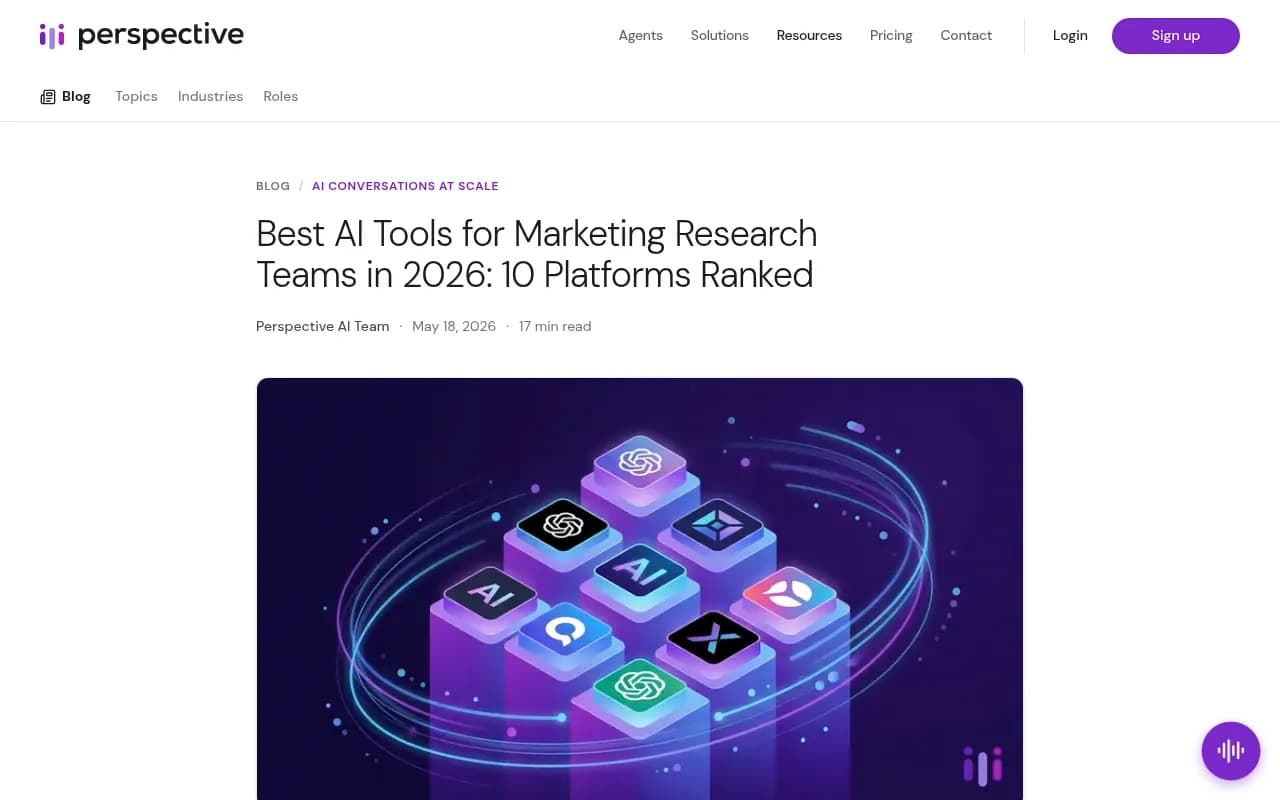
What is useful in that article is the lane model: qualitative discovery, brand tracking, audience and segmentation, and ad or concept testing. No single tool wins all four. That matches what I see in practice.
Replace, supplement, or keep: a working table
| Research job | AI search tools | AI interview platforms | Traditional research |
|---|---|---|---|
| Market size first draft | Replace | Not needed | Only for board-level numbers |
| Competitor positioning scan | Replace | Not needed | Rarely worth it |
| Review and social synthesis | Replace | Supplement | Rarely worth it |
| Customer motivation (the "why") | Cannot do | Replace most agency work | Keep for sensitive topics |
| Concept and packaging testing | Cannot do | Supplement | Keep for high-stakes launches |
| Brand tracking over time | Partial signal only | Diagnostic follow-up | Keep or use a tracker |
| Study design and framing | Assist | Assist | Keep in-house expertise |
| Synthetic persona "interviews" | Not research | Not research | Avoid for real decisions |
A new research question: what do AI engines say about you?
There is one research job that did not exist a few years ago. Buyers now ask ChatGPT, Gemini, and Perplexity which product to pick, and your brand either shows up in those answers or it does not. That is market research about perception, and it is worth tracking like any other brand metric.
Tools that monitor this include Promptwatch, which tracks how brands appear across AI engines and shows which sources the models cite. Other options in the category are [tool:profound], [tool:otterly-ai], [tool:peec-ai], and [tool:athenahq]. For a broader list, the GEO software directory at bestgeosoftware.com is a good place to compare them.

The reason this belongs in a research article is the point made earlier: AI answers reflect a narrow, vendor-heavy source set. If you want to change what the models say about your category, you first need to see which pages they read. Promptwatch Data also found that reddit.com's share of ChatGPT citations fell from about 4% to 0.5% on August 14, 2026, a reminder that the sources shaping these answers can shift overnight. Any research habit built on a fixed assumption about where AI gets its information goes stale fast.
How to build the stack in 2026
Step 1: Split every question by evidence type
Before opening any tool, ask whether the answer already exists somewhere. If yes, it is desk research and an AI assistant can take the first pass. If it requires something nobody has said yet, it needs fieldwork.
Step 2: Make AI cite, then check the citations
Conveo makes a sharp point: a language model can cite a statistic that does not exist. Require every claim to link to a source and open a sample of them. Treat uncited numbers as drafts.
Step 3: Spend real-respondent money on the decisions that hurt
Pricing changes, repositioning, packaging, a new market entry. These deserve actual participants, whether through an AI-moderated platform or a traditional agency. For recurring "why did the score move" questions, AI interviews are the cheaper way to keep that depth.
Step 4: Keep a human owner of method
The consensus across Outset, TrendCandy, and a handful of practitioners on Quora is the same: AI replaces tasks, not judgment. Someone on your team still has to frame the question, pick the sample, and decide what the findings mean. That skill is moving in-house rather than disappearing.
Step 5: Track perception inside AI engines
Add AI visibility to your brand metrics alongside awareness and consideration. It is a cheap, continuous signal, and it feeds back into how buyers discover you.
If you want outside help turning that signal into search strategy, agencies such as 1001 SEO Media work on this side of the problem, combining SEO with generative engine optimization. That is a separate decision from how you run customer research.
A quick sanity check before you cut a research budget
- Does the finding trace back to a named person, recording, or document?
- Would you be comfortable defending it to the CFO if the launch failed?
- Is the source independent, or is it mostly the vendors in the category describing themselves?
- Could the answer change next week simply because the model retrieved different pages?
If you answer no to the first two or yes to the last two, keep a real respondent in the loop.
Bottom line
AI search tools have earned the desk research job. Cutting that line from your agency invoice is reasonable, and the savings are real. What they have not earned is the job of telling you why customers behave the way they do. For that, the 2026 answer is real people, with AI doing the moderation and analysis instead of the recruiting spreadsheets and transcript typing. Replace the middle of the process, and keep the ends: a human framing the question, and real customers answering it.