Key takeaways
- Free AI visibility checks give you a snapshot. They are good for a baseline, not for ongoing tracking, and one prompt on one engine tells you very little.
- Most free checkers run in English by default. Before trusting a result, test whether the tool lets you set Dutch prompts and the Netherlands as a market.
- Run at least two or three tools and compare. Where they disagree is usually where the interesting findings are.
- Write down a baseline now: mention rate, which competitors show up, which sources get cited. That is what you measure a paid platform against later.
- Buy something only if a free check shows a gap you can act on, and you need daily tracking, crawler data or content workflows to close it.
Why check before you buy
The AI visibility market is crowded. Our catalog alone lists well over 200 tools that claim to show how your brand appears in ChatGPT, Gemini, Perplexity and Google AI Overviews. Most of them want a demo call or a credit card before you see anything.
For a Dutch brand that is a bad way to start. You do not yet know whether you have a problem. Maybe ChatGPT already recommends you for your core category in Dutch. Maybe it names three competitors and has never heard of you. A free check answers that in about ten minutes, and the answer decides whether you need a budget conversation at all.
There is a second reason. Several free tools are lead magnets for paid products, and they are built to make you feel behind. Treat the score as a conversation starter, not a verdict.
What a free check can and cannot tell you
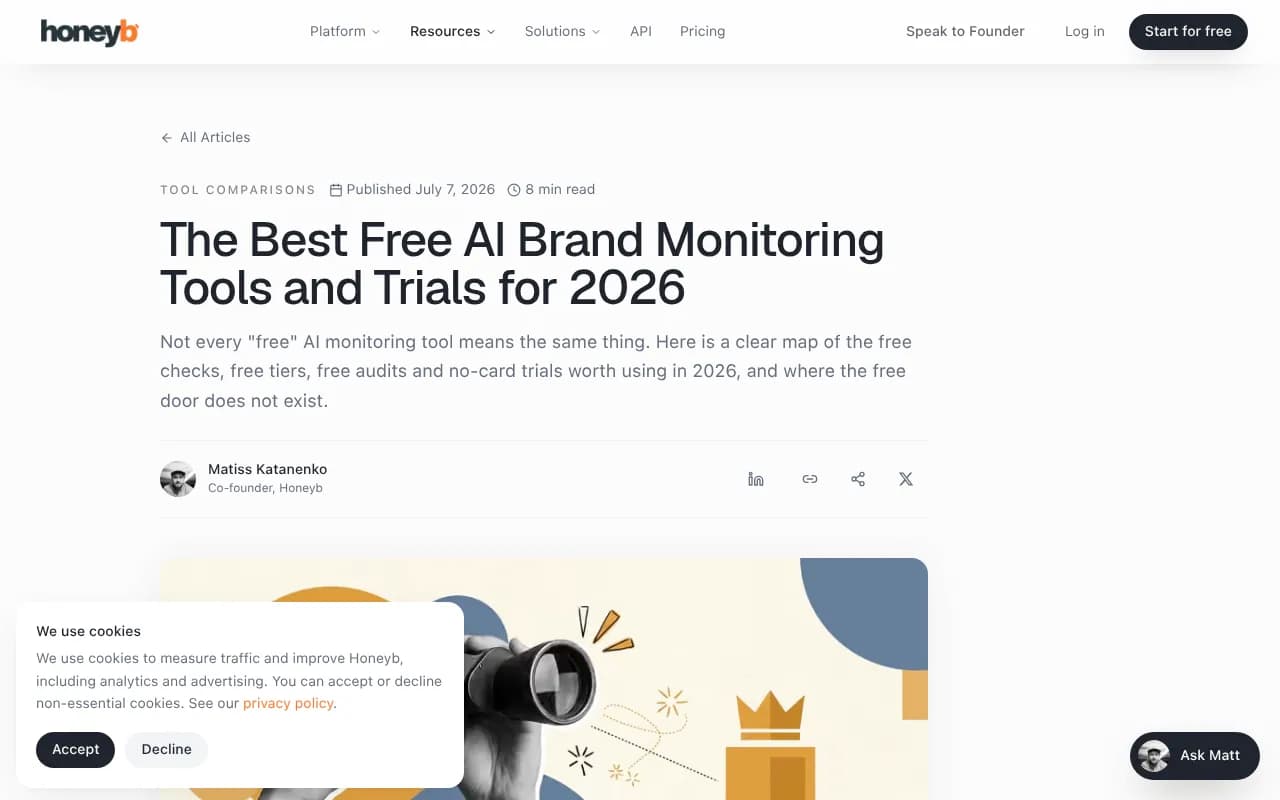
The Honeyb guide on free AI brand monitoring makes a useful distinction. "Free" covers at least four different things: a one-off check, a capped free tier, a one-off audit, and a time-limited trial. They are not interchangeable.
A one-off check runs your brand through a model once. That is useful, but there is a statistical problem. AI answers vary from run to run, and they vary a lot by prompt type. Promptwatch Data's report on unique domains per ChatGPT response (Sep 28 to Oct 4, 2026) found that 52.5% of organic prompts, meaning no brand named, cite 10 or more different domains. For brand-specific prompts that drops to 21.3%. So a check where you type your own brand name will look very different from a check where you ask a category question. You want both. The full report is worth a read before you interpret any score.
What a free check usually cannot tell you:
- How your visibility changes over time
- Whether AI crawlers can actually read your site
- How much traffic AI sends you
- What happens in Dutch, in the Netherlands, on the real ChatGPT interface rather than an API
Keep that list in mind. It is also your shopping list if you do end up buying.
The Dutch-language problem
I could not verify Dutch or Netherlands-specific support for any of the free tools below. The research behind this guide found nothing either way. Treat that as an open question to test, not an assumption.
The test is simple. Run the same question twice, once in English and once in Dutch, such as "best accounting software for freelancers" and "beste boekhoudsoftware voor zzp'ers". If the tool only lets you enter English prompts, or silently translates, you are measuring the English-language market. For many Dutch brands, that is not the market that pays the bills.
Also check which sources get cited. Dutch answers often lean on Dutch publishers, comparison sites and forums that never appear in English results.
The 7 free checks, compared
| Tool | What you get free | Best for | Check before trusting |
|---|---|---|---|
| Promptwatch free tools | AI Visibility Report, Agentic Readiness Check, AI SEO Audit | Baseline plus crawler readiness | Run Dutch prompts manually alongside |
| Omnia | Free checker for ChatGPT and Google AI Mode | Visibility score and share of voice | Prompt language options |
| HubSpot AEO Grader | One-off grader | Quick brand-level read | Depth of competitor detail |
| Honeyb | Free one-engine check (Gemini), no card | No-commitment second opinion | Single engine only |
| Leapd | Instant report, no signup | Fast look across several engines | Report depth |
| Semrush AI Visibility | Free checker | Teams already in Semrush | May need a suite account |
| Ahrefs Brand Radar | Free access to limited views | Teams already in Ahrefs | Scope of free data |
The details of each tool's limits change often. Confirm on each site before relying on a number.
1. Promptwatch free tools
Promptwatch is the platform that 1001 SEO Media uses for GEO work, so I am biased, and you should know that. But its free tools are genuinely useful without ever touching the paid product. The Free AI Visibility Report scans how ChatGPT, Gemini and Perplexity talk about your brand with no login. The Agentic Readiness Check tests which AI crawlers can read your site and which agent standards you support, such as llms.txt. The AI SEO Audit covers the on-page side.
That crawler-readiness angle matters more than it sounds. If your site blocks GPTBot or returns errors to AI crawlers, no amount of content work will help, and most free brand checkers will never tell you.

2. Omnia
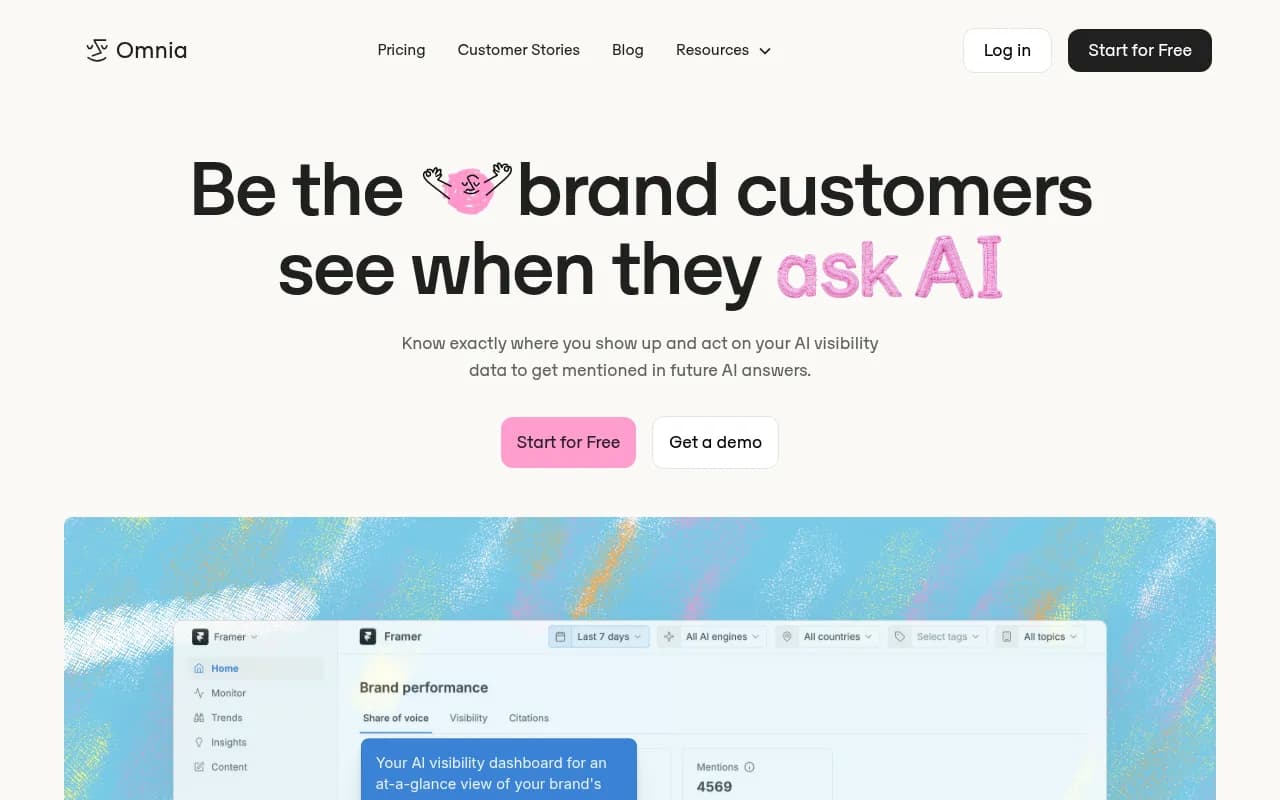
Omnia's free Agent checks how your brand appears in ChatGPT and Google AI Mode using prompts relevant to your category. You get a visibility score and share of voice view. It is a good test of whether a tool picks sensible category prompts on its own, which is exactly the thing you want to know before paying anyone.
3. HubSpot AEO Grader
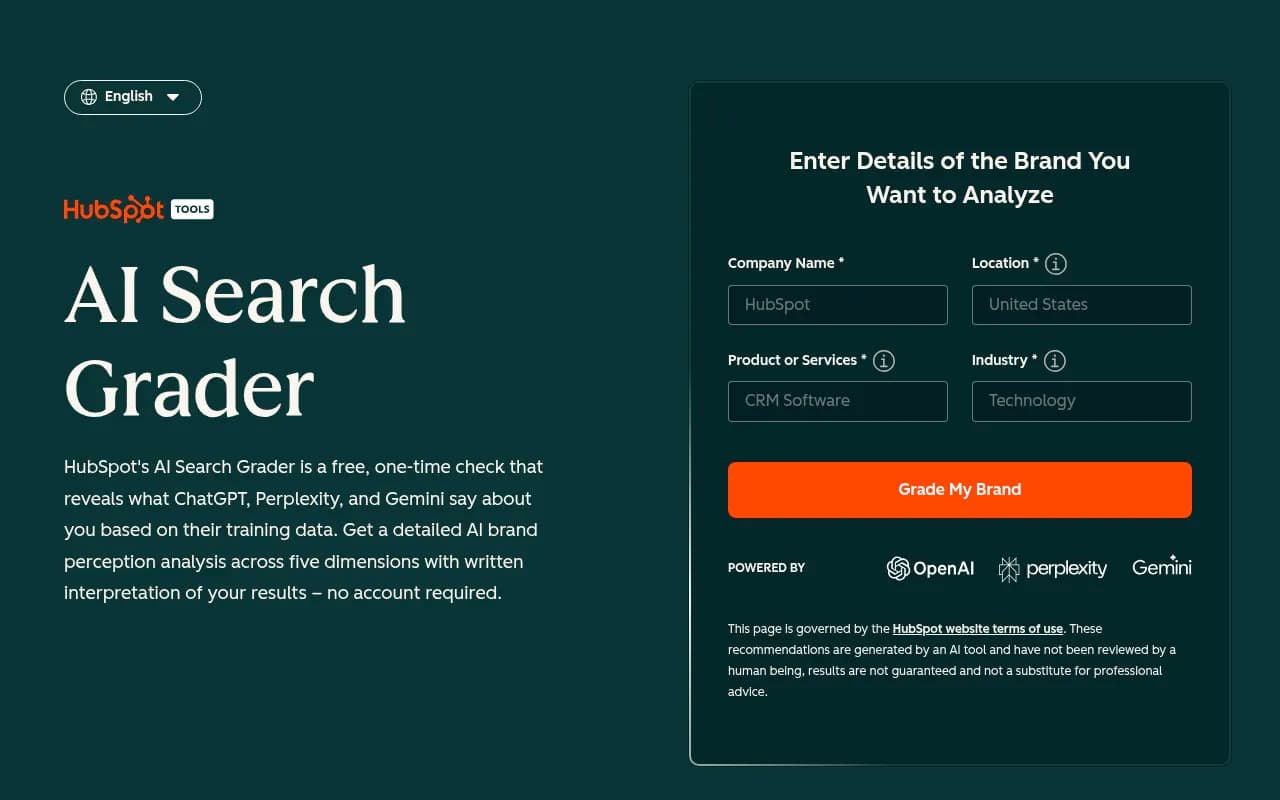
The HubSpot AEO Grader is a free one-off grader for answer engine visibility. It is the lowest-friction option here if you want a general read without setting anything up. Expect a brand-level picture rather than deep prompt-by-prompt data.
4. Honeyb free check
Honeyb offers a no-card check on one engine, Gemini. One engine is a real limitation, but that is also the point: it is a clean second reading to set against another tool's result. Honeyb publishes the guide I cited above, so note it is also listing itself first.
5. Leapd
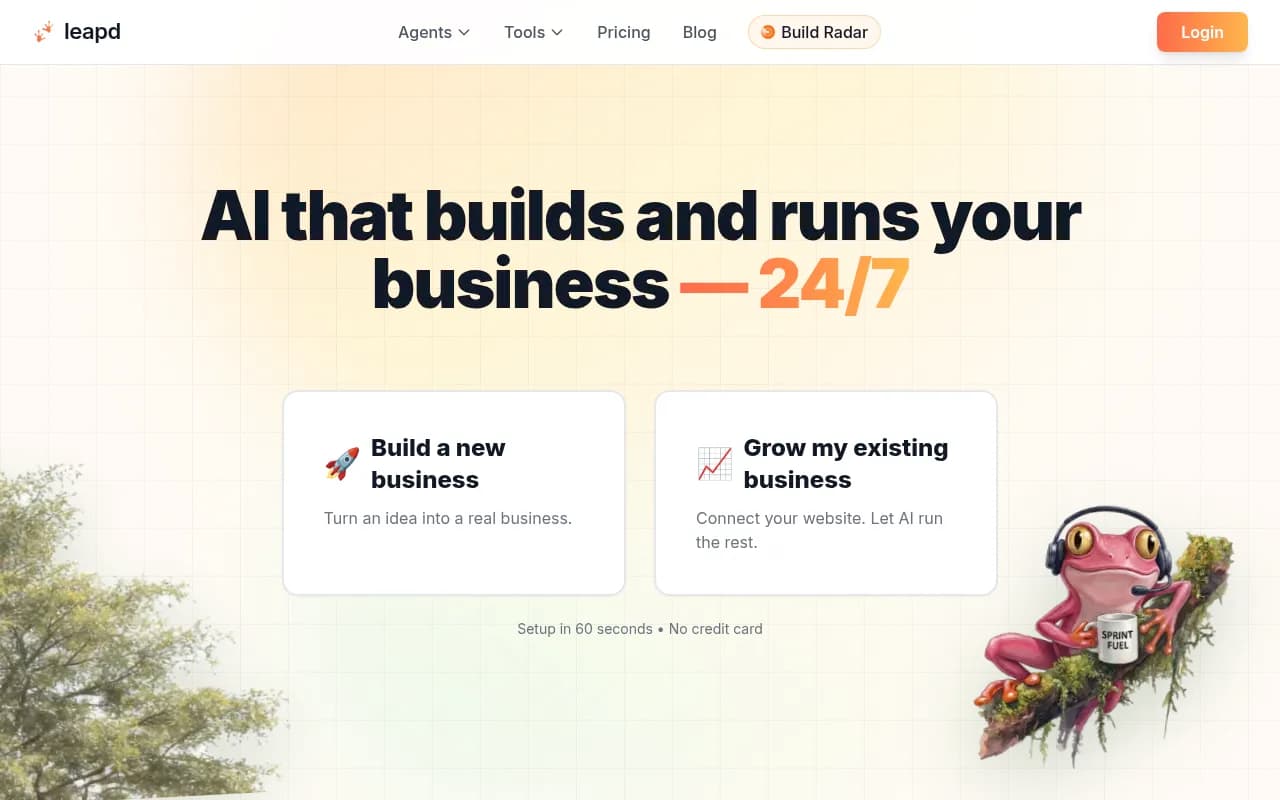
Leapd's free checker promises an instant report across ChatGPT, Gemini, Perplexity and Google AI with no signup. Run it, then look at whether the report shows the actual answers or just a score. Scores without the underlying responses are hard to act on.
6. Semrush AI Visibility
If you already have a Semrush account, run its free AI visibility checker as an extra data point. If you do not, it is probably not worth creating one just for this. The Honeyb guide notes it sits as an add-on to the suite.
7. Ahrefs Brand Radar
Ahrefs Brand Radar brings AI mention data into a suite many Dutch SEO teams already use. Check how much is visible without a paid plan. The upside is that it sits next to your existing search data, so you can compare how you rank in Google with how you show up in AI answers.
A free week, in order
Here is a sequence that costs nothing and takes a few hours spread over a week.
- Day 1. Write 15 to 20 prompts. Half should be organic category questions with no brand named. A few should name you. A few should be "you vs competitor". Write them in Dutch and in English if you sell in both.
- Day 2. Run two free checkers, say Promptwatch's report and Omnia. Save the output.
- Day 3. Run a third, such as Honeyb or Leapd, and compare. Note where they disagree.
- Day 4. Test the same prompts by hand in ChatGPT, Gemini and Perplexity. Real interfaces, logged out if you can, since personalization muddies results.
- Day 5. Run the Agentic Readiness Check and a basic site audit. Look for blocked crawlers.
- Day 6. Look at which sources get cited. Third-party listicles, review sites and forums are often how a brand gets into an answer, so list the ones that matter in your category.
- Day 7. Write a one-page baseline: mention rate, competitors that show up, top cited sources, crawler issues.
That page is the most valuable thing you will produce. Everything you buy later should be judged against it.
Reading the results without fooling yourself
A few habits that save you from bad conclusions.
- One prompt is noise. Promptwatch Data also shows that average source counts differ by engine. Perplexity cites almost exactly 10 sources per answer, while Copilot's average swung from under 2 to nearly 17 within weeks, per the average sources per response report. That page dates from September 2025, so treat the numbers as older than the October 2026 ChatGPT figures, and do not mix them directly. The takeaway still holds: judge engines by trends, not single snapshots.
- Look at position and framing, not just presence. Being mentioned fifth in a list with a lukewarm description is not the same as being the first recommendation.
- Competitors matter more than your score. A score of 40 means nothing until you know your competitors are at 20 or 70.
- Check the sources. If answers cite three review sites you have never contacted, that is your to-do list.
- Stay skeptical of alarm. Free tools are sales funnels. A red score is not proof you need their product.
When free is not enough
Free checks stop being useful when you need things they cannot give you:
- Daily tracking across many prompts and several engines, in Dutch, from the Netherlands
- IP-verified AI crawler logs showing what bots actually read on your site
- AI-referred traffic and conversions in your analytics
- A way to turn gaps into published content and measure whether it worked
At that point you are choosing between monitoring-only tools and platforms that also help you act. Promptwatch's paid plans start at $95 a month for Essential, with a 7-day free trial on monthly plans, so confirm current pricing at promptwatch.com/pricing. For a wider comparison, the GEO software directory at bestgeosoftware.com lists many alternatives, including lighter trackers like Otterly.AI and Peec AI.


If you would rather hand the whole thing to people, an agency is the other route. 1001 SEO Media runs GEO programs for brands, and it is the company behind this site, so weigh that accordingly.
Questions to ask any paid tool
- Does it monitor the real ChatGPT and AI Overviews interfaces, or only API outputs? The two can differ.
- Can I set Dutch prompts and the Netherlands as a country, and city-level if I am local?
- How many responses per month do I get, and what does a response cost me?
- Does it show crawler activity and AI traffic, or only mentions?
- Can I export everything if I leave?
Bottom line
Run three free checks this week, test them in Dutch by hand, and write the one-page baseline. If the baseline shows you are already named and cited where it counts, spend your budget elsewhere. If it shows competitors owning your category answers and crawler problems on your own site, you have a concrete case for buying, and a yardstick for judging whatever you buy.