HubSpot AEO Grader Review 2026
A free grader that shows how your brand appears in AI answer engines. It gives a quick snapshot rather than continuous tracking.
Key takeaways
- Free, no-account snapshot of how ChatGPT, Perplexity, and Gemini describe your brand, scored out of 100 across five dimensions.
- Monitoring and tracking are not included. Compared with Promptwatch, it lacks prompt tracking over time, content gap analysis, a Content Agent with CMS publishing, IP-verified AI crawler logs, and AI traffic attribution.
- The score reflects model training data, not live web search or real user interfaces, so treat the numbers as rough orders of magnitude.
- Best as a lead-in for marketers who want a quick sanity check, or a pitch exercise for agencies. Not suited to reporting to executives.
- HubSpot's own materials contradict each other on whether it is one-time or unlimited.
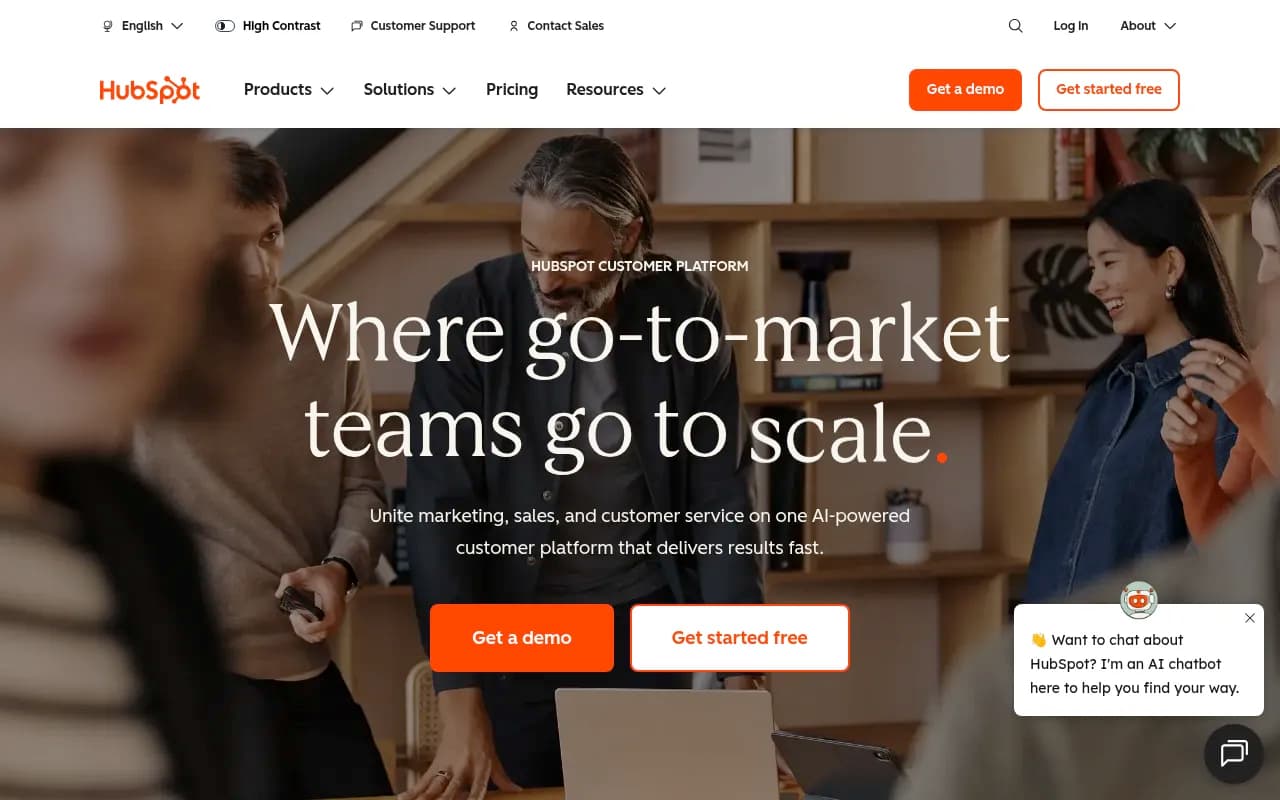
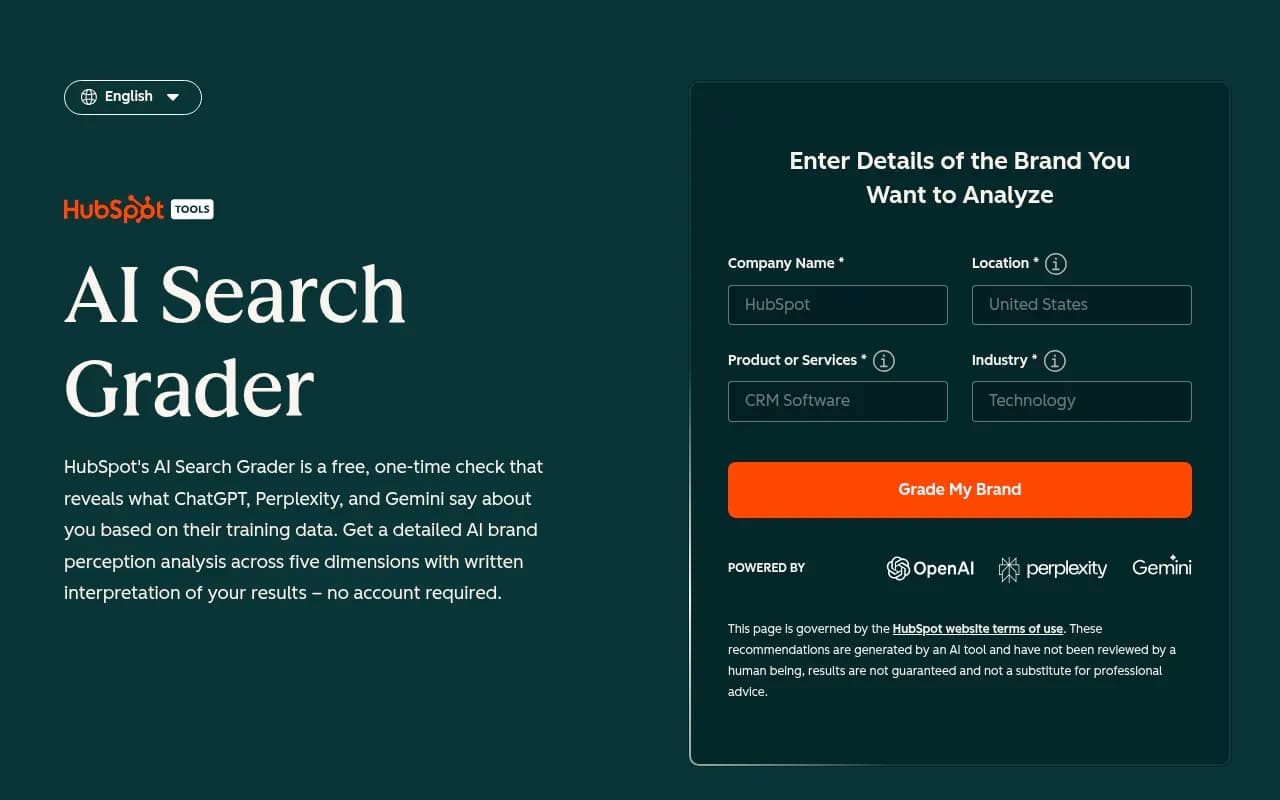
HubSpot's AI Search Grader, still widely known by its old name AEO Grader, is a free diagnostic that asks three AI models what they think of your brand. You type in a company name, location, product or service, and industry. A couple of minutes later you get a composite score out of 100 and a written interpretation. It was built by HubSpot as a top-of-funnel tool for its new paid product, HubSpot AEO, which is currently in beta.
The audience is marketing leaders, brand managers, SEO professionals, and content strategists who have heard they should care about AI answers and want a first look without a sales call. It will take any brand name, so you can also run competitors through it. Think of it as a mirror, not a dashboard. It shows you one reflection, once.
That framing matters, because the product is easy to over-read. The page itself says that the results are AI-generated, not reviewed by a human, and not guaranteed. I would take that disclaimer seriously.
Key features
The Grader's whole job is to produce one score from five weighted dimensions. Here is what each does in practice.
- Sentiment results (40 points). The heaviest weighting by far. It looks at general sentiment (positive, negative, neutral), contextual sentiment (how tone shifts between topics such as support versus innovation), and source-based sentiment (how credible the sources shaping the description are). Phrases like "praised for intuitive interface" count as positive signals.
- Presence quality (20 points). Measures mention depth, source quality, and data richness. A brand that gets a throwaway mention scores lower than one the models can discuss in detail.
- Brand recognition (20 points). How widely the models appear to know you. A high score means the model can speak with specifics instead of just acknowledging you exist.
- Share of voice (10 points). Your estimated percentage of category voice plus a rank bonus, relative to competitors at the moment of the check. This is a single point-in-time reading, so it tells you nothing about trend.
- Market competition (10 points). Classifies your category role (Leader, Challenger, Niche Player) and innovation perception (Innovator, Disruptor, Traditionalist). Low scores usually mean the models have thin or contradictory signals about where you sit.
- Cross-platform analysis. The same brand details go to OpenAI (currently GPT-5.4 mini), Perplexity, and Gemini. Scoring uses schema validation and retry logic, which HubSpot calls deterministic. Results are cross-validated across the three.
- Written interpretation. After a short form you get the composite score, the breakdown, and a plain-language explanation. The form is the price of admission: no account, but you do hand over contact details.
- Competitor checks. Any brand name works, so running two or three rivals gives you a rough comparison point.
One important detail. HubSpot says the grader reflects what the models say based on their training data. That is different from measuring what real users see in the ChatGPT or Perplexity interface with live search turned on. Answers, citations, and shopping recommendations in the live products can differ meaningfully from what a model says in a bare query. Tools like Promptwatch monitor the actual user interfaces for that reason, and they track which sources get cited, which this grader does not report.
Compared with the paid tier, the contrast is clear. HubSpot AEO tracks specific prompts, compares competitors, analyzes citations, and gives prioritized recommendations. The Grader gives you none of that. It is an audit, a word Rankability uses for it too.
Who is it for
The best fit is a marketing lead at a mid-size SaaS company who has been asked "what does ChatGPT say about us?" in a Monday meeting and needs an answer by lunch. Run it, screenshot the score, and you have a conversation starter. Agency strategists pitching new clients can run a prospect and its top three competitors before a call. Brand managers wanting a quick sentiment reading will find the sentiment breakdown the most interesting part.
It also suits small businesses and solo consultants that cannot justify a paid platform yet. There is no cost, and in under two minutes you learn whether the models know you at all. If the answer is "barely," that is useful information.
Who should skip it? Anyone who needs to measure change over time. Salesdorado's review calls it a one-time snapshot, unsuitable for month-over-month tracking, and says the numbers are not robust enough for executive reporting. Mention counts are not audience reach, and models may not know about recent brand changes. SEO teams with 100+ prompts to monitor, agencies running dozens of client workspaces, and enterprises needing crawler data or traffic attribution need a real platform. Ecommerce brands wanting shopping visibility or developer-tool companies tracking coding agents will find nothing here.
Integrations and ecosystem
There is not much to report, because the Grader is a standalone web form. There is no API, no export described on the page, no browser extension, and no mobile app. The report is delivered after you complete the form.
The ecosystem value is on HubSpot's side. The paid HubSpot AEO product connects to Marketing Hub, where prompts can be informed by CRM data and recommendations tie into HubSpot's content creation tools. HubSpot Academy also offers a free Implementing AEO certification aimed at turning your score into a plan. Beyond HubSpot CRM and Marketing Hub, I found no documented integrations. HubSpot's company accounts exist on X and GitHub, but there is no tool-specific community or Discord.
If you want data piped into Looker Studio, Slack, or a CMS, this is not the product. Dedicated platforms such as Promptwatch offer an MCP server, REST API, Looker Studio connector, and CMS publishing to WordPress, Webflow, and Framer.
Pricing and value
The Grader is free. No credit card, no account, no trial clock.
There is a wrinkle. The main page calls it a free one-time check. HubSpot's own comparison page against Otterly.ai describes it as "Analyze Any Brand, Unlimited Times, for Free" with no usage limits. Those two statements do not match. In practice, expect to be able to run multiple brands, but do not rely on unlimited access for anything critical.
The paid upsell is HubSpot AEO:
- Standalone: $50/month, or $45/month billed annually, with 25 prompts included and more available for purchase. A free trial with no credit card is offered.
- Marketing Hub Professional: 25 prompts run daily across 3 engines, about 2,500 answers per month. Marketing Hub Professional itself starts around $800/month.
- Marketing Hub Enterprise: 50 prompts, about 5,000 answers per month, at roughly $3,600/month for the hub.
- An AEO Answers Limit Increase add-on is sold separately.
As a free tool, the value is obvious. As a funnel into the paid tier, it is less so. The $50 plan is cheap, but 25 prompts is tight, and one Reddit user in r/hubspot called the paid tool "a little rote," essentially prompt tracking capped at 25 or 50 prompts. That is one anecdote, but the cap is real. By comparison, Promptwatch's Essential plan is $95/month for 50 prompts, 6,000 responses, all AI models, site audits, content gap analysis, and API access, with the free Explore tier for 10 prompts. Always confirm current numbers at the vendor pricing pages.
Strengths and limitations
What it does well
- Zero friction. No account, no card, results in under two minutes.
- Clear scoring rubric. The five dimensions and point weights are published, so you know what a 62 means.
- Multi-model view. Three engines are polled, so one model's quirk does not dominate.
- Sentiment emphasis. Weighting tone at 40 points rewards what AI actually says about you, not just whether it knows your name.
- Works on any brand. Competitor comparisons cost nothing.
Limitations
- Training-data based, not live UI data. It does not show what users see with search turned on.
- Snapshot only. No history, trend lines, or alerts.
- Thin on actionable detail. HubSpot sends you to the paid product and a certification for next steps.
- Inconsistent messaging about one-time versus unlimited use.
What it lacks versus Promptwatch
This is a lightweight audit in a market where Promptwatch is an end-to-end platform. Missing from the Grader:
- Content gap analysis and Answer Gap reports
- A Content Agent with CMS publishing to WordPress, Webflow, and Framer
- IP-verified AI crawler logs and crawl-to-citation tracking
- AI traffic attribution and visitor analytics
- Google Search Console and Bing Webmaster data next to AI data
- Reddit, YouTube, and LinkedIn citation tracking
- AI Shopping and Ads Radar
- Prompt volumes, difficulty scores, and query fan-outs
- Page-level citation tracking, Agent Chat, and a prioritized Action Board
- Real-UI tracking across 15+ engines, including Codex and Claude Code
That gap matters because citation behavior is volatile. Promptwatch Data shows, for example, that reddit.com's share of ChatGPT citations fell from about 4% to 0.5% on August 14, 2026. A training-data snapshot cannot see that sort of shift.
Bottom line
Use the AI Search Grader as a free first look. It is quick, transparent about its scoring, and good enough to start an internal conversation or open a client pitch. Do not mistake it for measurement. It reflects what models say from training data, once, with no sources or traffic data behind it.
If you want to improve visibility, not just read a score, look at Promptwatch for optimization with tracking, content creation, crawler logs, and traffic attribution. For more options, the GEO software directory at bestgeosoftware.com lists the field. Best use case in one sentence: a free, two-minute sanity check of how AI models describe your brand before you commit to a real tracking platform.

Frequently asked questions
What is HubSpot AEO Grader?
Is HubSpot AEO Grader really free?
How is it different from HubSpot AEO?
How accurate is the score?
What are better alternatives for ongoing AI visibility?
Similar and alternative tools to HubSpot AEO Grader