Yotpo Discover Review 2026
Tracks product and category-level visibility across ChatGPT, Gemini, Perplexity and Claude with onsite, content and activation agents for retail brands.
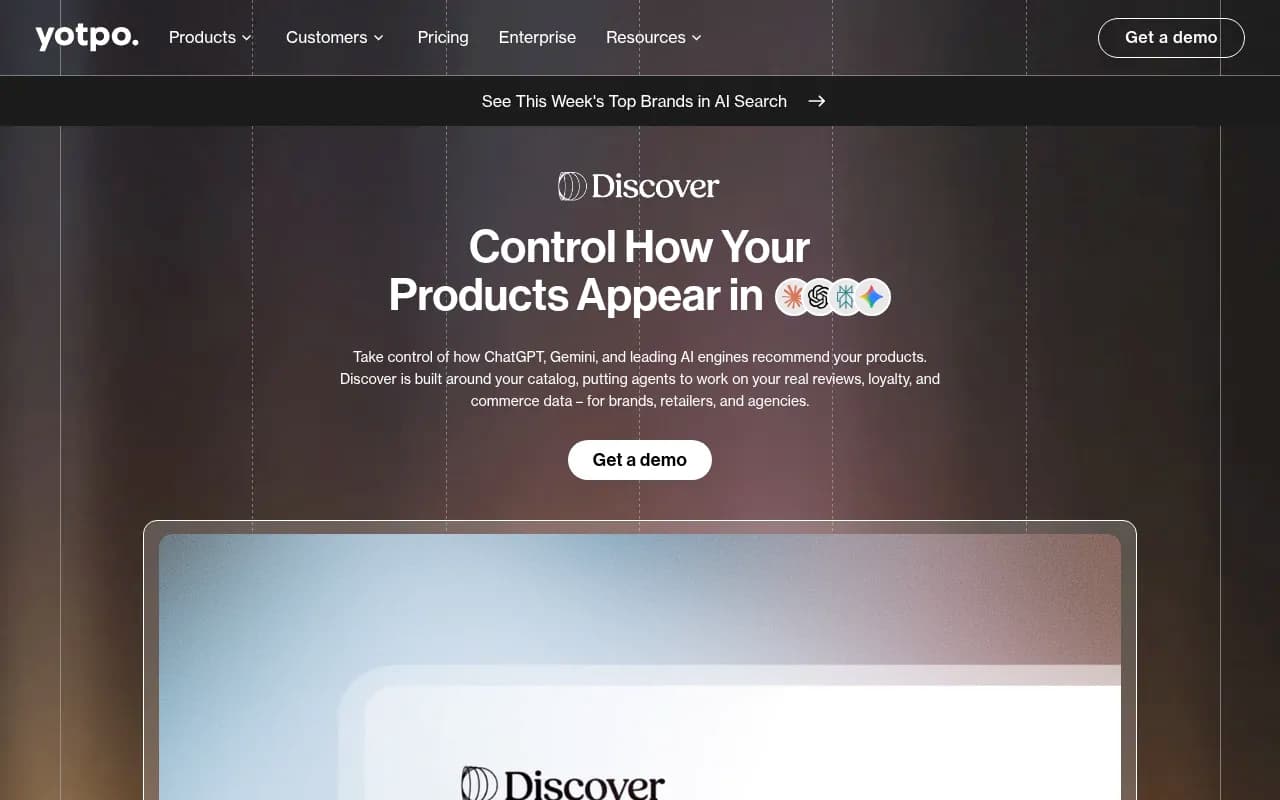
Key takeaways
- Yotpo Discover is an ecommerce-first AI visibility platform. It tracks products, categories and funnel stages rather than generic brand mentions, and it is built on Yotpo's reviews, loyalty and UGC data.
- Compared with Promptwatch, it lacks IP-verified AI crawler logs, visitor analytics tying AI traffic to conversions, Reddit/YouTube/LinkedIn citation reports, prompt volume and difficulty scoring, query fan-outs, and a Google Search Console and Bing data overlay. It also has no ChatGPT Shopping or Ads Radar tracking that we could confirm.
- Pricing is custom-quoted and demo-gated, with no free plan or trial. The first release targets brands with $10M+ in annual GMV.
- Results (+62% #1 placements for Aetrex, +33% awareness-stage visibility for Pair) come from Yotpo's own case studies. I found no independent reviews on G2 or elsewhere.
- Best fit: mid-market and enterprise Shopify, Salesforce Commerce or Adobe Commerce brands already using Yotpo Reviews.
Yotpo Discover is the AI visibility product from Yotpo, the ecommerce reviews, loyalty and UGC company that says it powers 35k+ commerce brands. Where most AI visibility tools ask what your brand is and which prompts to track, Discover starts from your product catalog. It pulls your products and categories from your commerce stack and tracks where they show up in answers from ChatGPT, Gemini, Perplexity and Claude, by product, category, region and buying stage.
The pitch is aimed at ecommerce growth, SEO, content and merchandising teams, plus agencies that manage retail clients. Yotpo says the first release is designed for brands generating $10M+ in annual GMV, and it keeps a waitlist for a version aimed at smaller, scaling stores. The product appears to be recent. A Yotpo blog post still mentions a waitlist for early access, while the pricing page already sells it, which suggests a staged rollout.
I'll be upfront about one thing: most of what is public about Discover comes from Yotpo itself. That includes the case studies and the blog post ranking AI visibility tools, which is self-ranked and should be read as marketing. What follows is based on the vendor's documentation, with the gaps flagged.
Key features
Product, category and funnel-level tracking. This is the headline difference. Discover imports your catalog and lets you prioritize which products, categories and personas matter. It then runs structured prompts across AI engines and scores brand mentions, product presence, competitor exposure, answer quality and funnel coverage. Output is a visibility score plus an opportunity list. Generic prompt trackers usually work at the brand or topic level, so product-level breakdowns are genuinely useful for merchandising teams.
Prompts built from shopper language. Yotpo says its prompts are derived from billions of real shopper engagements, reviews and Q&A. In theory that gives you prompts that resemble how real customers compare products, rather than keyword lists someone brainstormed. I can't verify the quality independently, but the data source is plausible given Yotpo's review footprint.
AEO competitor discovery. Discover surfaces which brands appear ahead of you in AI answers, including ones you wouldn't call competitors. David Protein's quote on the page captures it well: brands they don't view as competitors become competitors in AI results. You also see what drives their rankings.
Onsite Agent. It looks at your storefront for technical and structural problems that hurt AI readability, such as missing schema and weak internal links, and gives page-by-page recommendations. Yotpo says it can act on them, not just flag them. The distinction between onsite and off-site matters in the product: Onsite measures how ready your own properties are for AI agents and conversational commerce, while Everywhere measures how you appear in AI search, chat assistants and shopping copilots.
Content Agent. It generates brand-guided blog content and citation-focused publisher briefs, drawing on review data and authentic shopper voices. Aetrex's Senior Director of eCommerce describes asking the agent where the greatest opportunity is and getting a prioritized content strategy in minutes.
Activation Agent. This is the most unusual piece. It engages real reviewers and loyalty community members on ecosystems AI engines trust, including Reddit, retail marketplaces and expert publisher sites. Because Yotpo syndicates millions of reviews to major retailers, it has a distribution channel most pure-play visibility tools lack. Whether it works at scale is something only customers can say, and the quotes on the site are vendor-selected.
Discover MCP for Claude. Connect Claude to Discover to pull insights, create content, check citation performance and run recurring workflows from within the assistant. Useful for teams already living in Claude.
Agency workspace. There is a separate agency track covering referral, managed services or white-label models, a multi-tenant dashboard and per-client pricing, with the option to start with one client. Every customer also gets a dedicated AEO consultant from Yotpo's customer success team.
Market-level and ranking-movement tracking. Tracking by region and market, with movement over time, so you can see whether changes actually shift placements.
Who is it for
The sweet spot is a DTC or omnichannel brand doing $10M or more in GMV on Shopify, Salesforce Commerce, Adobe Commerce or BigCommerce, with an ecommerce lead who owns SEO, content and merchandising together. If you already run Yotpo Reviews, Discover inherits your catalog and tracking, which removes a lot of setup. Brands in consumer categories where reviews drive purchase decisions, like footwear, eyewear, supplements, drinkware and apparel, are the logical fit based on the customer list (Aetrex, Pair, David Protein, Stanley, Beekman 1802, Paul Fredrick).
Agencies that already manage AEO for retail clients can use it as a shared workspace. Yotpo explicitly says it works alongside AEO agencies and can connect you with one from its partner network.
Who should skip it? Small stores under $10M GMV are outside the initial scope. SaaS, B2B, publishers and service companies get little from a catalog-centric design. Teams that want self-serve signup, a public price and a trial will be frustrated, as Discover is demo-only. And anyone who needs technical diagnostics on how AI crawlers actually hit their site, or attribution from AI traffic to revenue, will find this thin compared with end-to-end GEO platforms.
Integrations and ecosystem
- Commerce platforms: Shopify, Salesforce Commerce, Adobe Commerce, BigCommerce and others, used to pull catalog, categories and buyer behavior.
- Yotpo's own Reviews, Loyalty and UGC products, which supply the shopper-voice data underneath Discover.
- Review syndication to major retailers and partnerships with social platforms.
- Discover MCP for Claude.
- A free AI visibility score audit at commerce-gpt.yotpo.com.
I found no public API documentation for Discover, no listed CMS publishing connectors, and no export details. Ask about these in the demo.
Pricing and value
Discover is custom-quoted. There are no public tiers, no free plan and no free trial. Yotpo says it does not price Discover per order like Reviews and Loyalty. Cost depends on catalog breadth, number of markets and languages, and optimization depth. A plan covers AI rankings by product, category and funnel stage, competitor insights, the three agents, onsite recommendations, blog generation, publisher briefs, customer activation, market-level tracking and the MCP integration.
For context, the wider Yotpo platform is public: Reviews & UGC has a free plan up to 50 monthly orders and paid plans from $15/month, and Loyalty & Referrals has a free plan with paid tiers from $199/month. Competing AI visibility platforms publish prices, such as Promptwatch's $95/month Essential and $579/month Business plans, so Discover is harder to benchmark. Given the $10M GMV gate, expect enterprise-style contracts. Value depends heavily on whether you would use the Activation Agent and review data, since that is what you can't get elsewhere.
Strengths and limitations
Strengths
- Catalog-native tracking by product, category, persona and funnel stage.
- A real data advantage from Yotpo's review, loyalty and UGC base.
- Execution agents, including off-site reviewer activation, rather than monitoring alone.
- Agency track and a dedicated AEO consultant included.
- Claude MCP connection for conversational workflows.
Limitations
- Opaque pricing, demo-gated access and a $10M+ GMV threshold.
- No independent reviews or verified case studies that I could find. The +16% and +20% headline figures don't say what they average over.
- Engine coverage is described inconsistently: the product page names ChatGPT, Gemini, Perplexity and Claude, the FAQ names ChatGPT, Gemini, Google AI Mode and on-site assistants, and a blog post lists AI Overviews.
What it lacks compared with Promptwatch
Promptwatch is the stronger option for teams that want measurement down to revenue and technical diagnosis. Based on public material, Discover does not show:
- IP-verified AI crawler logs and crawl-to-citation tracking
- Visitor analytics that attribute AI traffic and conversions
- Google Search Console and Bing Webmaster data overlaid on AI data
- Reddit, YouTube and LinkedIn citation reports
- Prompt volumes, difficulty scores and query fan-outs
- Page-level tracking and offsite mention detection
- ChatGPT Shopping, Amazon Alexa product tracking and Ads Radar
- Agent Chat, a prioritized Action Board and CMS publishing to WordPress, Webflow and Framer
- Real-UI tracking of 15+ engines, including coding agents
For more options, see the GEO software directory at bestgeosoftware.com.
Bottom line
Discover is a credible choice for mid-market and enterprise ecommerce brands that already sit in the Yotpo ecosystem and want product-level AI visibility with review-driven content and reviewer activation. The data advantage is real. The proof, pricing and technical depth are not yet public.
If you want optimization with crawler diagnostics, traffic attribution, transparent pricing and broader engine coverage, Promptwatch is the stronger alternative, since it fixes gaps and tracks whether the fix worked. Best use case in one sentence: a $10M+ Yotpo Reviews customer wanting its catalog tracked across AI shopping answers.

Frequently asked questions
What is Yotpo Discover?
How much does Yotpo Discover cost?
Who is Yotpo Discover for?
Does Discover replace SEO tools?
How does Discover compare with Promptwatch?
Which commerce platforms does it support?
Similar and alternative tools to Yotpo Discover