
Key takeaways
- Most GEO platforms stop at monitoring -- they show you visibility gaps but don't help you close them.
- Of the four platforms compared here, Promptwatch and Relixir offer the most complete gap-to-content workflows; Whitebox takes an agentic approach that auto-generates fixes; AthenaHQ remains primarily a monitoring tool.
- The right choice depends on whether you need content generation, autonomous publishing, or deep analytics -- and how much control you want over the output.
- Pricing ranges from ~$99/mo (Promptwatch Essential) to enterprise-only contracts (AthenaHQ, Relixir), so budget is a real differentiator.
- If you're an agency or mid-market brand that wants to track, generate, and publish AI-optimized content in one place, Promptwatch is the most complete option at a transparent price.
The GEO tool market has a dirty secret: most platforms are dashboards dressed up as optimization suites. They show you a score, maybe a list of prompts your competitors rank for, and then... nothing. You're left to figure out what to write, who to assign it to, and how to get it published.
That gap between "you're invisible for this prompt" and "you now rank for this prompt" is where most tools fall apart. So this comparison focuses on exactly that question: which platform actually automates the path from identifying a content gap to getting something published?
The four platforms in this comparison -- AthenaHQ, Promptwatch, Relixir, and Whitebox -- each claim to do more than monitor. Let's see how they actually stack up.
What "gap to published content" actually means
Before comparing tools, it's worth being precise about what this workflow involves. A full gap-to-content pipeline has at least four stages:
- Identify which prompts AI models answer without citing you (gap discovery)
- Understand why -- what content is missing, what competitors have that you don't (gap analysis)
- Generate content that addresses those gaps, grounded in real prompt data (content creation)
- Publish or push that content somewhere it can be crawled and cited (distribution)
Most tools do step one. Some do step two. Very few do steps three and four. The platforms that do all four are genuinely different products from the ones that stop at a dashboard.
AthenaHQ

AthenaHQ tracks brand visibility across eight or more AI search engines and does a solid job of surfacing where you're missing from AI-generated answers. Its content gap identification feature highlights missing topics and entities that influence whether AI models include your content -- which is more than a lot of monitoring tools offer.
Where it falls short is the action layer. AthenaHQ is built around analytics: share of voice, sentiment tracking, competitor comparisons, prompt-level visibility. The platform tells you what's wrong with real clarity, but it doesn't generate content to fix it. You take the insights and hand them off to your content team or a separate writing tool.
That's not necessarily a flaw -- some teams prefer clean separation between analytics and content production. But if you're evaluating on the gap-to-publish dimension specifically, AthenaHQ gets you through steps one and two and stops there.
Pricing is enterprise-oriented and not publicly listed, which puts it out of reach for smaller teams without a sales conversation first.
Relixir
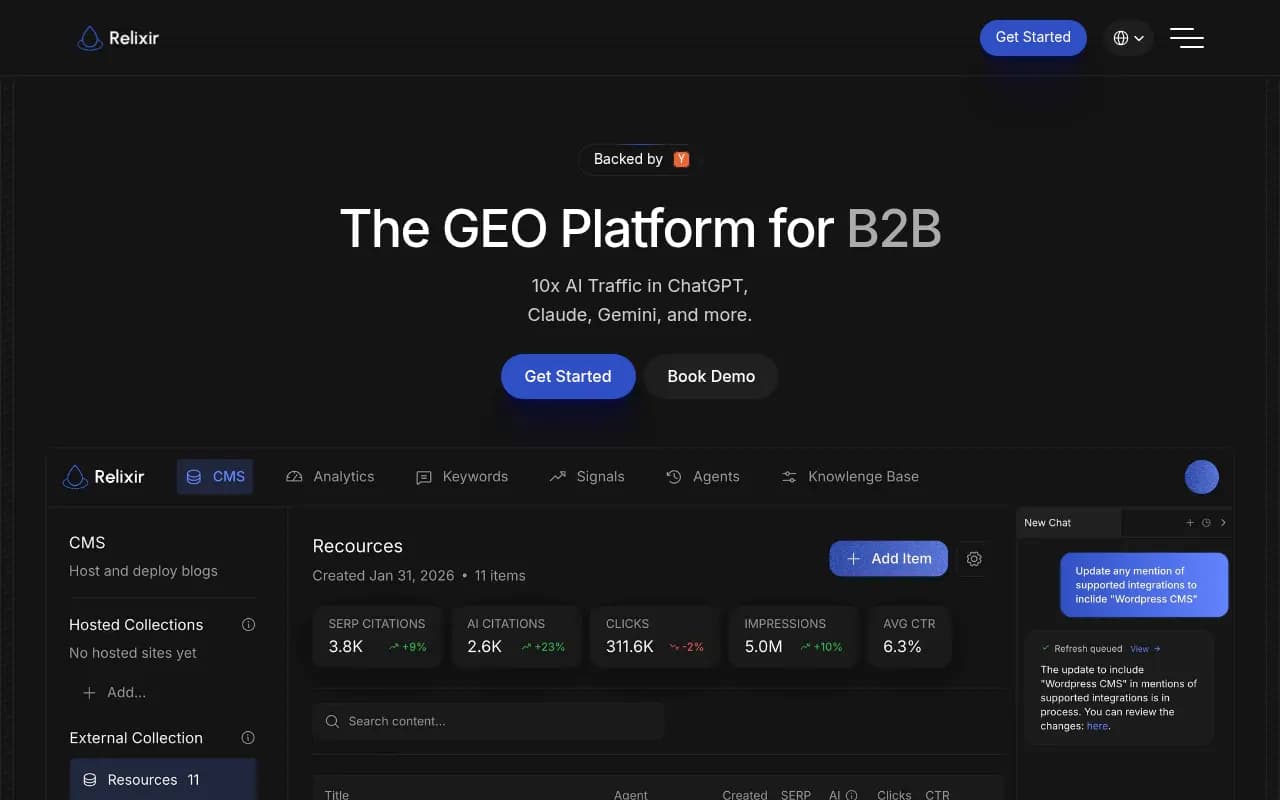
Relixir positions itself as an "AI-native CMS" for GEO, which is a more ambitious claim than most competitors make. The platform combines visibility tracking with autonomous content generation -- it can identify gaps and then produce content designed to close them, without requiring you to switch tools.
The AI-native CMS angle is interesting because it means content lives inside Relixir rather than being exported to a separate CMS. For teams that want a single system of record for AI-optimized content, that's appealing. For teams already running WordPress, Webflow, or a headless CMS, it introduces a workflow question: does the content get published directly, or does it need to be migrated?
Relixir's autonomous content features are genuinely differentiated. The platform can generate articles, optimize existing pages, and track how those changes affect AI citation rates over time. That's a more complete loop than AthenaHQ offers.
The tradeoff is complexity and price. Relixir targets mid-market and enterprise customers, and the pricing reflects that. It's a serious platform for teams with serious budgets.
Whitebox
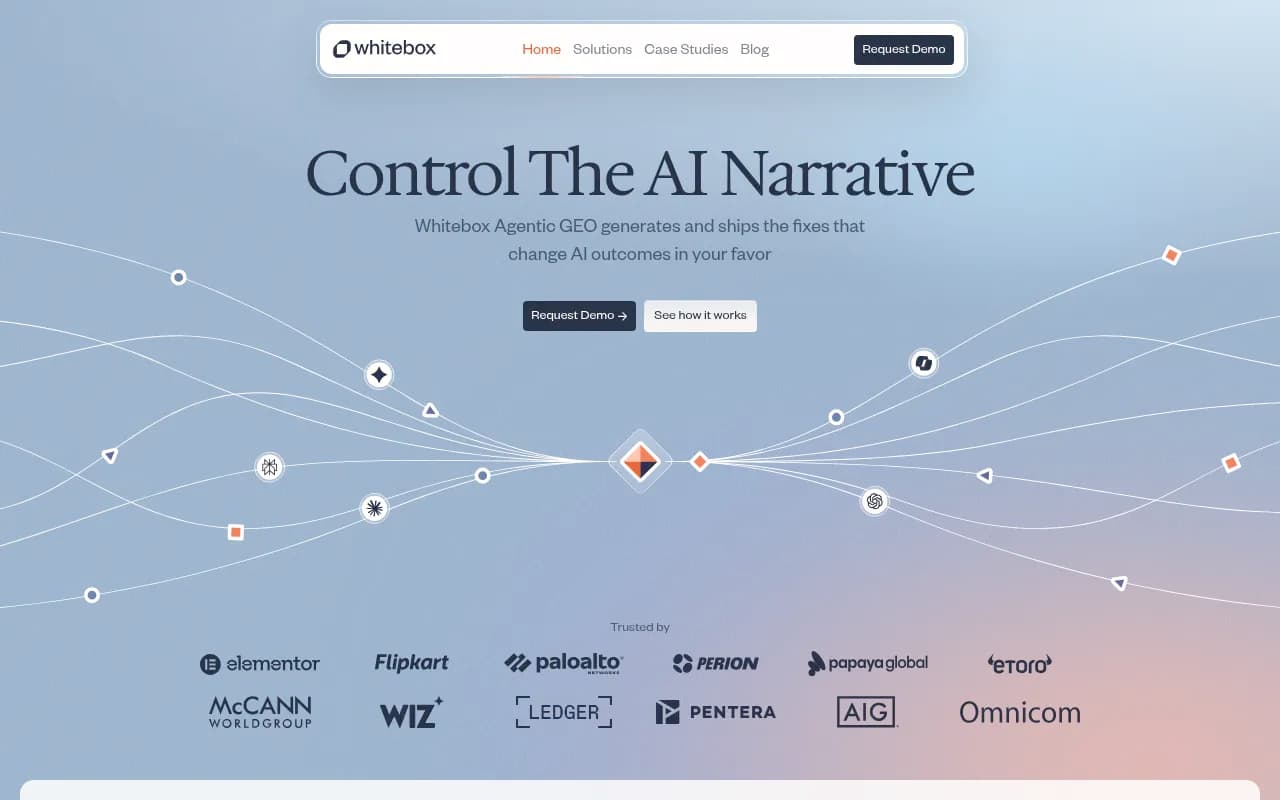
Whitebox takes the most aggressive stance on automation. It describes itself as an "agentic GEO platform" -- meaning it doesn't just suggest fixes, it generates and ships AI narrative corrections automatically. The idea is that you connect your site, define your brand parameters, and Whitebox handles the content generation and publishing loop with minimal human intervention.
This is genuinely novel. Most GEO tools require a human to review gap analysis, write a brief, hand it to a writer, and then publish. Whitebox compresses that into an agentic workflow where the platform does the heavy lifting.
The obvious question is quality control. Fully autonomous content generation is impressive in demos and occasionally terrifying in production. Teams with strong brand voice requirements or compliance constraints may find the hands-off approach uncomfortable. Whitebox is best suited for teams that want speed and volume over fine-grained editorial control.
It's also a newer entrant, which means the track record is shorter than established players like Promptwatch or AthenaHQ. Worth watching, but worth piloting carefully.
Promptwatch
Promptwatch is the platform that most directly addresses the full gap-to-published-content workflow while keeping pricing transparent and accessible.

The core workflow works like this: Answer Gap Analysis surfaces the specific prompts where competitors appear in AI answers but you don't. You see the exact topics, angles, and questions AI models want to answer but can't find on your site. From there, Content Agents generate articles, listicles, comparisons, and briefs grounded in that real prompt data -- not generic SEO filler, but content built around what AI models are actually looking for.
What separates Promptwatch from the monitoring-only crowd is that the content generation is tied directly to the gap data. You're not generating content in a vacuum; you're generating content that addresses specific, identified gaps, with prompt volume scores and difficulty ratings to help you prioritize.
On top of that, the platform tracks what happens after you publish. Page-level citation tracking shows which pages AI models are citing, how often, and from which models. Agent Analytics logs AI crawler activity in real time -- which pages ChatGPT, Claude, and Perplexity are reading, errors they encounter, and when pages move from crawled to cited. That last piece is rare. Most competitors have no visibility into the crawl-to-citation timeline at all.
Promptwatch also covers channels that most GEO tools ignore: Reddit and YouTube insights surface discussions that influence AI recommendations, and ChatGPT Shopping tracking monitors product appearances in AI shopping carousels.
Pricing is public: $99/mo for Essential (1 site, 50 prompts, 5 articles), $249/mo for Professional (2 sites, 150 prompts, 15 articles, crawler logs), $579/mo for Business (5 sites, 350 prompts, 30 articles). A free trial is available.
Head-to-head comparison
| Capability | AthenaHQ | Relixir | Whitebox | Promptwatch |
|---|---|---|---|---|
| AI visibility monitoring | Yes | Yes | Yes | Yes |
| Gap / missing topic analysis | Yes | Yes | Yes | Yes |
| Content brief generation | No | Yes | Yes | Yes |
| AI content generation | No | Yes | Yes (autonomous) | Yes |
| Autonomous publishing | No | Partial | Yes | No (review step) |
| Crawler / agent logs | No | No | No | Yes |
| Page-level citation tracking | Limited | Yes | Yes | Yes |
| Reddit & YouTube insights | No | No | No | Yes |
| ChatGPT Shopping tracking | No | No | No | Yes |
| Prompt volume & difficulty scoring | No | No | No | Yes |
| Query fan-outs | No | No | No | Yes |
| Multi-model coverage | 8+ | Limited | Limited | 10 models |
| Transparent public pricing | No | No | No | Yes |
| Free trial | No | No | No | Yes |
A few things stand out from this table. AthenaHQ is the most monitoring-focused of the four -- it's strong at telling you what's wrong but doesn't help you fix it. Relixir and Whitebox both have content generation, but Whitebox leans heavily on autonomous output while Relixir keeps a human in the loop more explicitly. Promptwatch is the only platform with crawler logs, Reddit/YouTube tracking, and ChatGPT Shopping visibility, which matters if you want to understand the full picture of how AI engines discover and cite your content.
Which platform is right for which team?
The answer depends on what your bottleneck actually is.
If your bottleneck is understanding the data -- you have a content team but need better signal on where to focus -- AthenaHQ or Promptwatch's monitoring features will serve you well. AthenaHQ goes deeper on analytics; Promptwatch gives you more actionable data tied directly to content creation.
If your bottleneck is content production -- you know what to write but can't produce it fast enough -- Relixir or Promptwatch's Content Agents are the right tools. Both generate content grounded in gap data. Promptwatch has the advantage of public pricing and a lower entry point.
If your bottleneck is speed and you're willing to trade editorial control for volume -- Whitebox's agentic approach is worth a pilot. Just go in with clear quality benchmarks and a review process for anything that touches your brand voice.
If you want one platform that covers the full loop -- gap discovery, content generation, crawler monitoring, citation tracking, and traffic attribution -- Promptwatch is the most complete option at a price point that doesn't require an enterprise contract to access.
A note on what "agentic" actually means in practice
Whitebox's agentic framing is compelling, but it's worth being clear-eyed about what autonomy means in a GEO context. AI-generated content that goes straight to production without human review is a real risk for brands with legal, compliance, or brand voice requirements. The efficiency gains are real; so are the failure modes.
Promptwatch's approach -- generate content grounded in real data, then have a human review before publishing -- is less flashy but more defensible for most marketing teams. The agent analytics layer (seeing exactly when AI crawlers visit your pages and when those visits convert to citations) gives you the feedback loop you need to know whether the content is actually working.
The bottom line
Most GEO platforms are monitoring tools with a content strategy problem. They show you the gap; they don't close it.
Of the four platforms compared here, Promptwatch offers the most complete path from gap identification to published content to measurable citation improvement, with transparent pricing and a free trial. Relixir is a strong alternative for teams that want an AI-native CMS and have the budget for it. Whitebox is interesting for teams that want maximum automation and can manage the quality control tradeoffs. AthenaHQ is best for teams that prioritize analytics depth over content production.
The GEO tools that will matter in 2026 are the ones that close the loop -- not just the ones that open it.