
Key takeaways
- No single model wins every SEO writing job. Claude tends to be the strongest at tone and long-form editing, ChatGPT at flexibility and tooling, Gemini at Google-ecosystem research and large inputs.
- Model names, limits and prices change constantly. Check each vendor's pricing page before you commit, and run your own test on your own briefs.
- The model matters less than your inputs: a good brief, real source material and a human editor beat any model choice.
- What gets cited in AI search is pages that answer one question completely, not the prettiest prose. Product and landing pages make up about 39% of ChatGPT citations, per Promptwatch Data.
- Measure results after publishing. Writing speed is easy to see; whether a page gets crawled, cited and clicked is where the real answer lives.
A quick note on how to read this comparison
I'm not going to give you a benchmark table of model versions and token prices. Those numbers go stale within weeks, and I'd rather not hand you figures I can't verify. What I can give you is how these three assistants tend to behave on real SEO writing work, and a method for testing them yourself in an afternoon.
The three contenders:
ChatGPT is OpenAI's assistant, and it is the one most people already have open in a tab.
What SEO content writing actually asks of a model
"Write a blog post" is the least useful way to judge a model. SEO writing is a chain of different jobs, and models are uneven across them:
- Researching a topic and spotting what the SERP already covers
- Building a brief and outline from search intent
- Drafting in a specific brand voice
- Rewriting and tightening existing pages
- Generating structured pieces: FAQs, comparison tables, meta descriptions, schema
- Fact-checking and keeping claims honest
- Scaling the whole thing without every article sounding the same
A model that is great at job one can be mediocre at job five. So compare them by task, not by vibes.
Head-to-head by task
| Task | Claude | ChatGPT | Gemini |
|---|---|---|---|
| Long-form drafting with a natural voice | Often the most natural prose, fewer stock phrases | Solid, but needs style instructions to avoid a generic tone | Competent, sometimes more formulaic |
| Following a detailed style guide | Strong at sticking to long instructions | Strong, especially with custom instructions and saved GPTs | Good, can drift on very long briefs |
| Editing and rewriting existing copy | Very good at tightening without flattening voice | Good, tends to over-polish | Good for quick cleanups |
| Research with live web data | Available through search features, varies by plan | Mature browsing and tools | Tight integration with Google Search and Workspace |
| Large documents (audits, transcripts, many competitor pages) | Handles long inputs well | Good, depends on plan and model | Known for very large context windows |
| Structured outputs (tables, schema, FAQs) | Reliable | Reliable, strong with data analysis tools | Reliable |
| Ecosystem and automation | Projects, connectors, API | Custom GPTs, plugins, broad third-party support | Docs, Sheets, Gmail, Drive |
Treat that table as tendencies, not guarantees. These tools update often and individual experience varies by prompt.
Drafting and voice
This is where people form strong opinions, and mine is that Claude is the one I'd reach for when the draft needs to sound like a person. It tends to produce less filler and fewer of the stock openers that make AI copy obvious. ChatGPT can get to the same place, but you usually need to tell it what to avoid. Gemini's drafts are tidy and accurate-sounding, and in my experience a little more template-like.
That said, voice is the easiest thing to fix with a good prompt and a few paragraphs of sample writing. If you paste in two or three articles you like and say "match this," all three improve a lot.
Research and freshness
If your content depends on current information, tooling matters more than raw writing ability. ChatGPT's browsing is mature. Gemini has the obvious advantage of sitting next to Google Search, Docs and Drive, which is handy if your brief, keyword sheet and competitor notes already live in Google Workspace. Claude is excellent at digesting material you hand it, which makes it good at working from source documents rather than going off to find its own.
Whichever you use, never let a model invent statistics. Ask for the source URL, open it, and confirm the number says what the model claims.
Long inputs
SEO work is full of big inputs: a 40-page audit export, ten competitor articles, a customer call transcript. Gemini has made its name on very large context. Claude also copes well with long documents. ChatGPT works fine for most jobs but check the limits on your specific plan. If you routinely feed in huge files, test this first, because it is the one place where the gap can be real.
Structure and formatting
All three can produce clean headings, tables, FAQs and meta descriptions. The difference is consistency across a batch. If you are generating fifty product descriptions, run the same prompt on ten of them in each model and look for drift. The one that stays closest to your template without becoming robotic wins that job.
What actually gets cited by AI search
Here is the part most model comparisons skip. If you are writing SEO content in 2026, you are also writing for AI answers, and the model you used to draft the page has no bearing on whether ChatGPT or Gemini cites it later.
Promptwatch's data on which content types ChatGPT cites (Sep 28 to Oct 4, 2026) gives a useful steer on what to write:
| Content type | Share of ChatGPT citations |
|---|---|
| Product pages | 22.4% |
| Landing pages | 16.8% |
| Listicles | 13.6% |
| How-to guides | 8.7% |
| Documentation | 7.5% |
| General articles | 6.1% |
| Comparisons | 5.9% |
| News | 5.7% |
| FAQ | 3.3% |
| Reviews | 1.7% |
Two things stand out. Commercial pages beat editorial ones, so the "write ten blog posts" reflex is not always the right plan. And news decays fast: Promptwatch's content half-life report found news pages lose about half their citations in roughly five weeks, while landing pages and docs hold on for months.
There is also a scarcity problem. Per Promptwatch's average sources per response data, ChatGPT cites roughly 5 sources per web-search answer, while Google AI Overviews and Perplexity cite about 10. Fewer slots means each page has to answer one question completely. That is a brief-writing skill, not a model skill.
Which model for which job
Pick Claude when
- Voice and readability are the priority
- You are editing or rewriting existing long articles
- You work from supplied source material and want it to stay close to it
Pick ChatGPT when
- You want one tool for research, data analysis, images and drafting
- Your team already uses custom GPTs or shares prompts
- You depend on a broad set of third-party integrations
Pick Gemini when
- Your workflow lives in Google Docs, Sheets and Drive
- You are processing very large inputs
- You want research tightly tied to Google's own search results
Or use more than one
Many content teams end up using two. A common split: one model for research and outlines, another for drafting and editing. Paying for two subscriptions is cheaper than rewriting weak drafts all week. If you want a model-agnostic setup, automation tools like Zapier or n8n can route briefs to whichever model you choose.
A 60-minute test you can run yourself
Don't trust any comparison, including this one, over your own results. Here is a quick protocol:
- Pick three real briefs: a how-to, a comparison page and a product or landing page.
- Write one detailed prompt per brief, including audience, intent, target keyword, required sections, tone and two sample paragraphs of your brand voice.
- Run the identical prompt in Claude, ChatGPT and Gemini. Do not tweak per model.
- Score each draft blind (have a colleague rate them without knowing the source) on accuracy, voice, structure, originality and how much editing it needs.
- Track edit time. The draft that takes you 15 minutes to fix beats the prettier one that takes 45.
- Fact-check every number and named claim.
Save the winning prompt. That prompt, not the model, becomes your reusable asset.
The tools that sit on top of the models
Raw chat models are not the only option. Several SEO platforms wrap them with SERP data, term scoring and publishing. If you want a content-optimization layer on top of whichever model you draft in, look at tools like Surfer SEO, Clearscope and Frase.
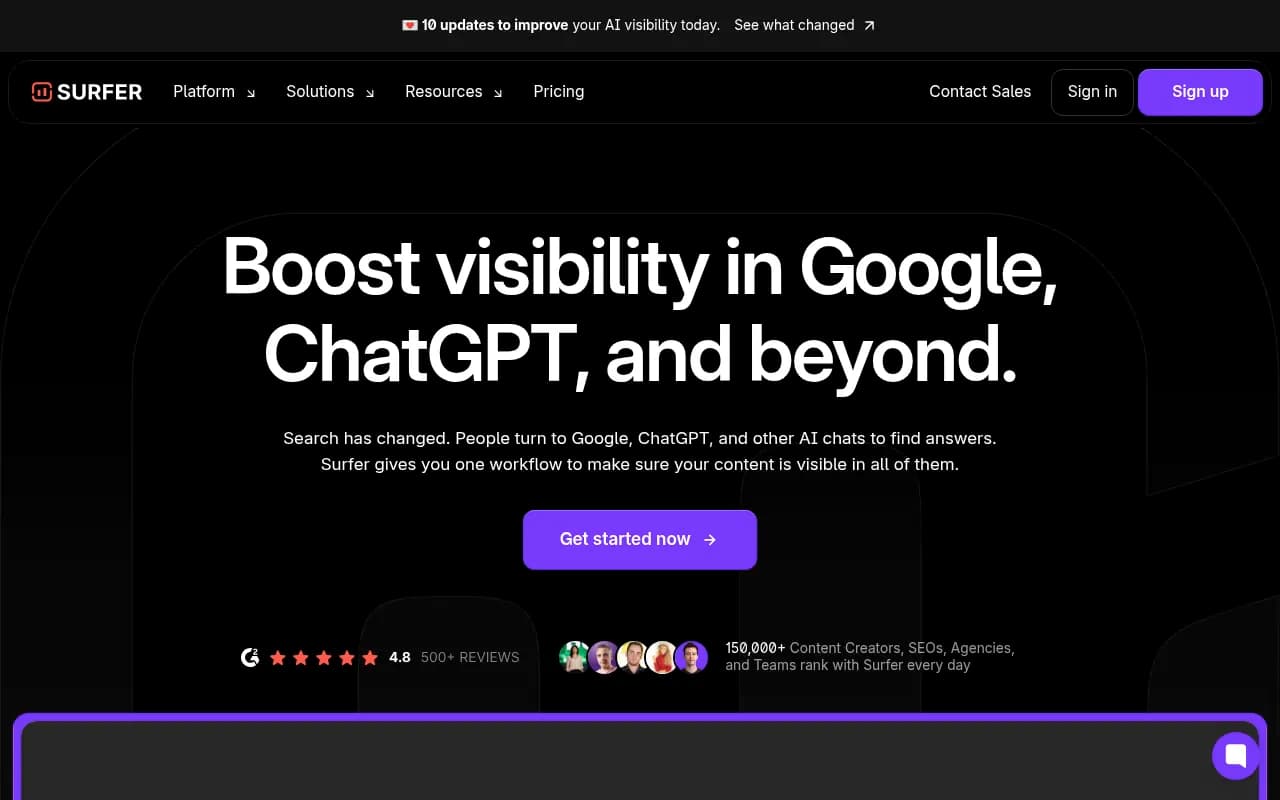
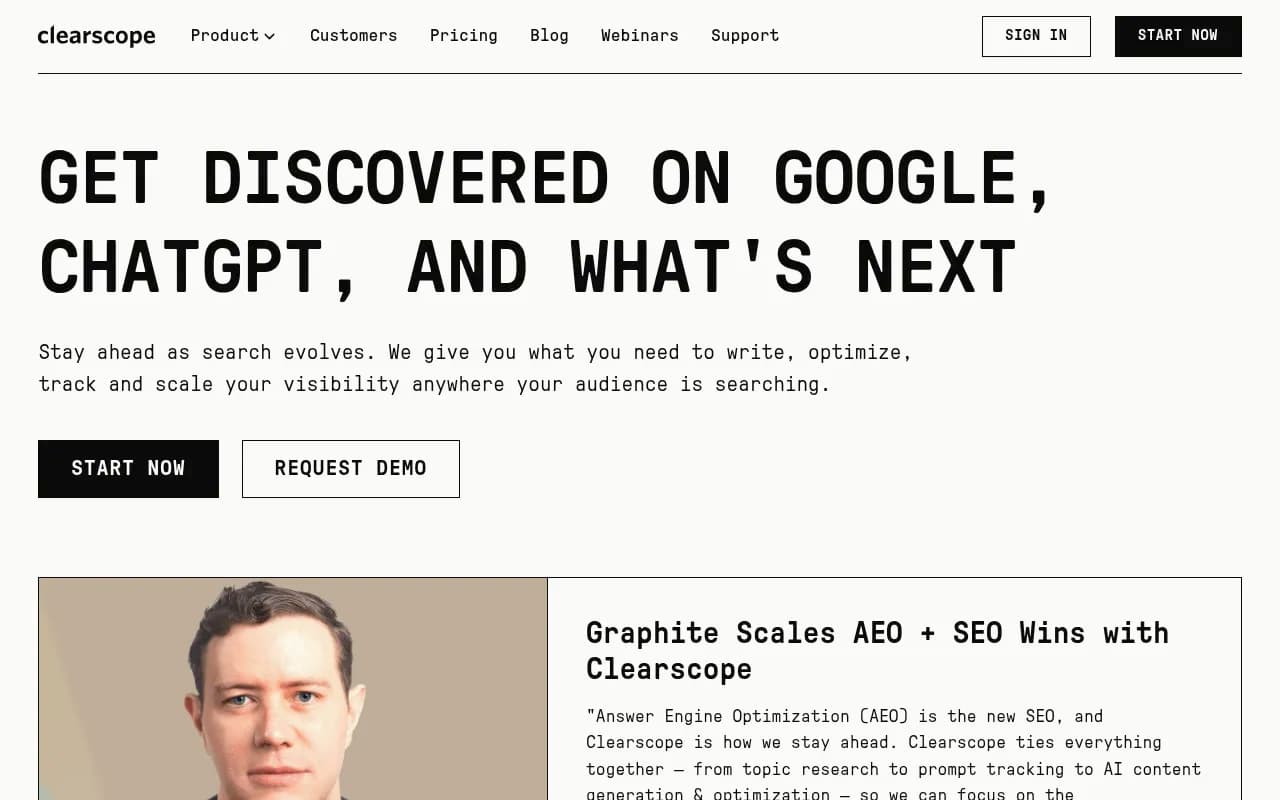
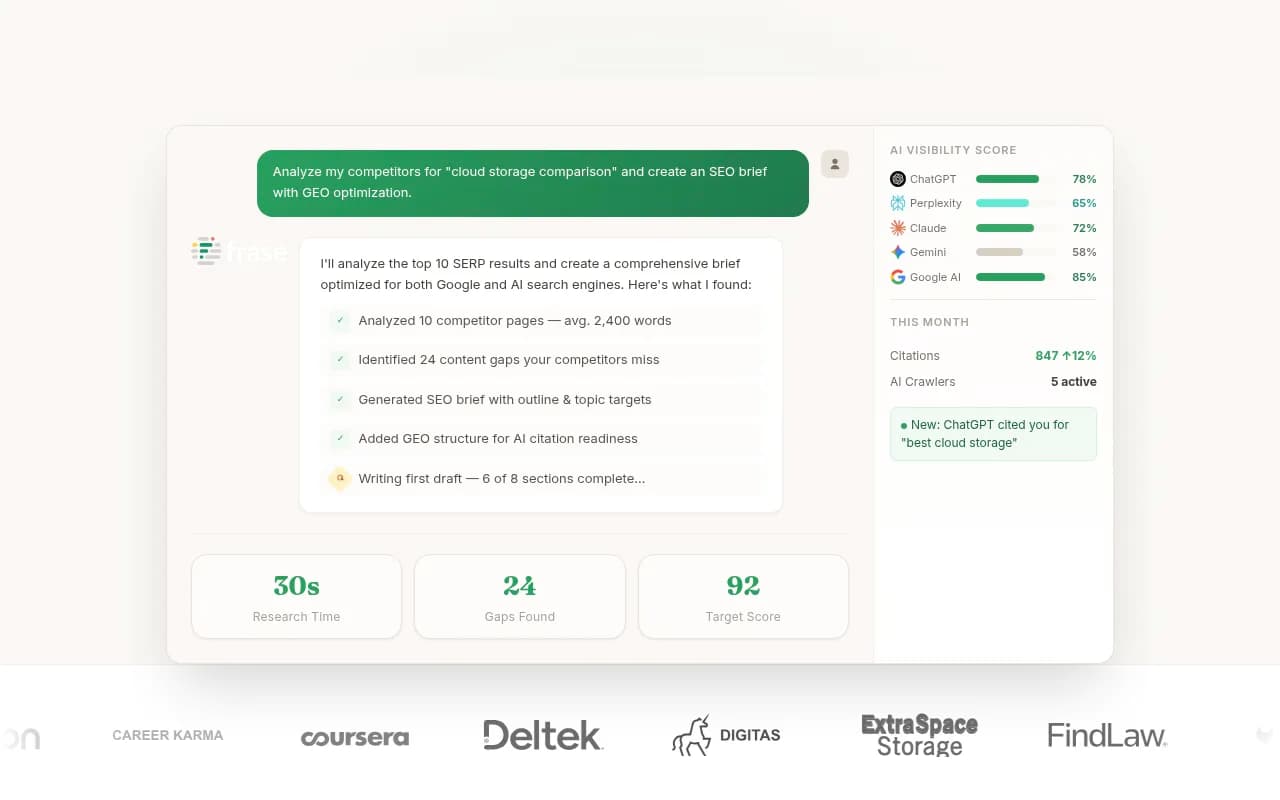
They won't replace a good editor, but they do answer a question the chat models can't: how does this draft compare to what currently ranks?
Measuring whether the content worked
This is the step teams skip. A draft that reads well is not the same as a page that gets cited or sends traffic. After publishing you want to know whether AI crawlers can read the page, whether any AI engine cites it, and whether those citations bring visitors.
Promptwatch is built for that loop: it tracks how ChatGPT, Gemini, Claude, Perplexity and Google AI Overviews mention and cite your brand, shows content gaps against the prompts AI answers, and its Content Agent can draft and publish pages to WordPress, Webflow or Framer. Its AI crawler logs show whether bots actually read a page you shipped, which helps separate an access problem from a content problem.

If you just want a baseline first, the free AI visibility report scans how ChatGPT, Gemini and Perplexity currently talk about your brand. For more options in the category, the GEO software directory at bestgeosoftware.com lists alternatives.
Mistakes to avoid whatever model you pick
- Publishing first drafts. Even the best output needs a human who knows the subject.
- Prompting with just a keyword. Intent, audience and a point of view make the difference.
- Skipping original material. Proprietary data, quotes and screenshots are the things a model cannot generate for you, and they are what make pages worth citing.
- Ignoring page type. Given the citation split above, a well-built landing or product page can matter more than another blog post.
- Mass-producing near-identical articles. Scale without variety reads as filler to people and likely to ranking systems.
So which one should you choose?
If you want a straight answer: start with Claude for drafting and editing if voice matters to you, use ChatGPT if you want the broadest toolbox, and use Gemini if you live in Google Workspace or work with huge documents. Then run the 60-minute test above, because your content, your style guide and your editors will shift the result more than any general comparison can.
Pick the one that costs you the least editing time, write a great brief, and measure what happens after you hit publish.
FAQ
Is Claude better than ChatGPT for SEO writing?
Often for prose quality and editing, yes, in the experience of many writers. ChatGPT has the edge in tooling and integrations. Test both on your own briefs.
Can Gemini write SEO content?
Yes. It is strongest when your workflow is inside Google's ecosystem or when you need to process very large inputs.
Will AI-written content rank?
Content ranks or gets cited because it is useful, accurate and well structured, not because of how it was produced. Weak, unedited AI copy performs poorly either way.
Should I check pricing before subscribing?
Always. Plans, usage limits and model access change often, so confirm on each vendor's official pricing page.