
Key takeaways
- NeuronWriter is the cheapest way in. Its plans run $23 to $117 a month (list price, monthly billing) and it is built around an editor with NLP term suggestions, so it suits people who like to drive the draft themselves.
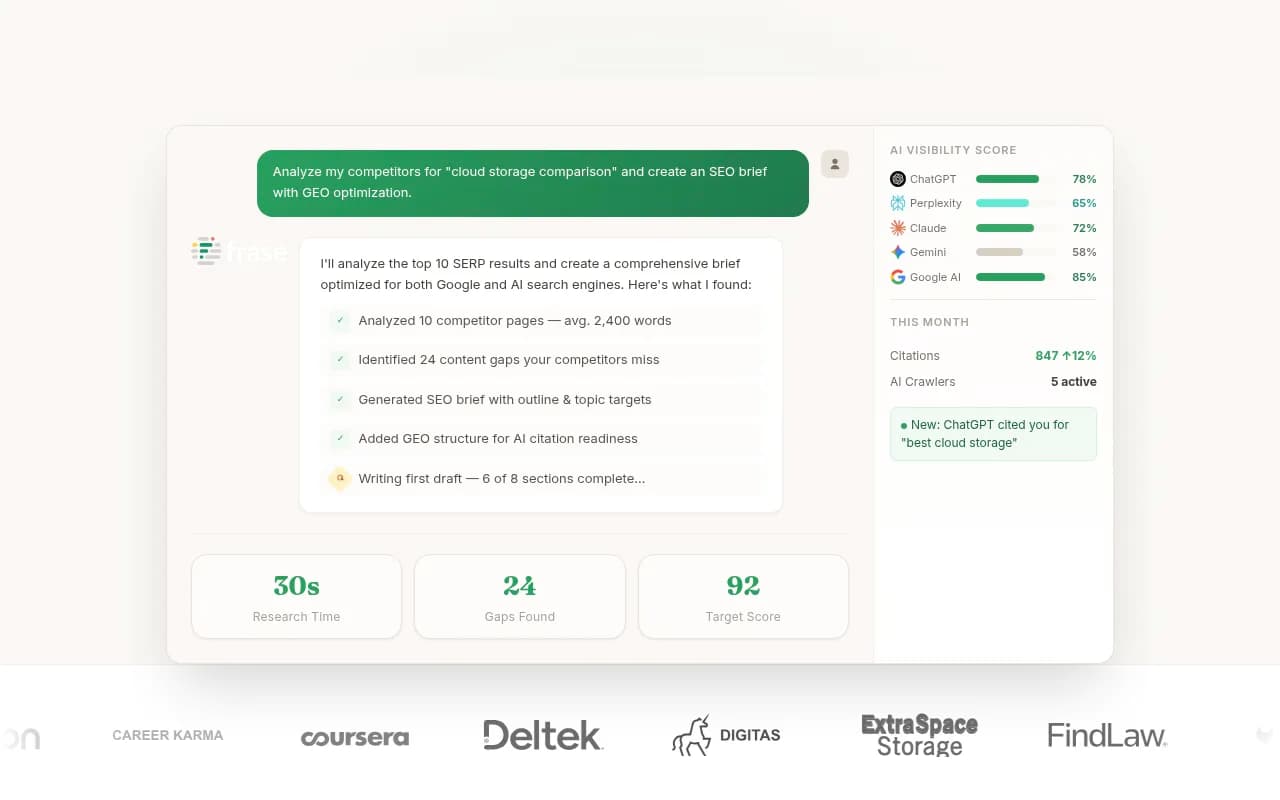
- Frase has the most agent-like workflow of the three. It researches, drafts, auto-publishes and watches ranking decay. Its yearly-billed plans run $39 to $239 a month.
- Scalenut has pivoted hard toward GEO and AI visibility. Check its live pricing page, because the Black Friday figures I saw are temporary and I could only confirm the first two plans.
- None of the three is a full AI visibility platform. If you need to know whether ChatGPT or Gemini actually cites what you publish, pair your writer with a dedicated tracker.
- My pick: NeuronWriter for solo writers and budget teams, Frase for teams who want automation and publishing, Scalenut if the GEO tooling and strategy call appeal to you.
What these tools actually do
All three belong to the same family: you give them a keyword, they look at what ranks, and they help you produce an article that covers the same ground better. Where they differ is how much of the job they do for you.
NeuronWriter is an editor-first tool. It analyzes the SERP, gives you a list of terms and questions, and scores your draft as you write. Frase started the same way and has moved toward agents that draft and publish. Scalenut began as an all-in-one content suite and now sells itself mostly as a GEO and AI visibility platform.
That shift matters. In 2026, a ranking in Google is only half the question. The other half is whether AI answers cite you at all, and which kinds of pages they pick.


Quick comparison
| Frase | Scalenut | NeuronWriter | |
|---|---|---|---|
| Entry price | $39/mo (yearly billing) | $59/mo list (Black Friday annual promo $21/mo) | $23/mo |
| Mid tier | $103/mo Professional | $89/mo Plus list | $69/mo Gold |
| Top published tier | $239/mo Scale | Not confirmed, check live page | $117/mo Diamond |
| Free trial | 7 days, no card | Check site | 7 days on Gold terms, 30-day refund |
| Core approach | Agent drafts, publishes, monitors decay | GEO action center plus content | SERP-driven editor with NLP scoring |
| AI visibility tracking | ChatGPT, Google AI, Perplexity, Claude, Gemini by tier | 10 prompts weekly on starter, ChatGPT and AI Overviews | Add-on, $9/mo for 10 questions |
| Publishing | WordPress, Webflow, Sanity, Wix, FraseCMS | Check site | WordPress and Shopify on Gold |
| Best for | Teams wanting automation | GEO-minded marketers | Solo writers, agencies on a budget |
A caveat on this table. Frase prices are billed yearly with a 20% discount shown, while NeuronWriter figures are its standard monthly prices. Scalenut's page showed Black Friday discounts, and my scrape was truncated after two plans. Treat the numbers as a guide and confirm on each pricing page.
Frase
Frase is the one that has changed most. The old pitch was a research and brief tool. The current pitch is an agent: it drafts articles and can auto-publish on any plan, and a feature called Content Guard watches your existing pages for Google rank decay and proposes fixes.
Pricing and limits
Plans, billed yearly with the 20% discount, are:
- Starter at $39/mo: 1 seat, 1 site, 10 articles a month, 25 AI generations, Content Guard on 10 pages.
- Professional at $103/mo: 3 seats, 5 sites, 40 articles, 100 AI generations, a content calendar, internal linking suggestions and AI crawler monitoring.
- Scale at $239/mo: 5 seats, 10 domains, 100 articles, 350 generations, client-ready reports.
- Enterprise is custom and adds white-label reports, SSO/SAML and an SLA.
One detail I like: the Starter plan stops at its limits instead of billing overage. Professional has optional pay-as-you-go, off by default. For a small team that has been burned by surprise usage bills, that is a real selling point.
Where Frase is strong
The publishing integrations are the practical win. Pushing a draft straight to WordPress, Webflow, Sanity or Wix removes a copy-paste step that adds up when you ship 40 articles a month. The content calendar and internal linking suggestions on Professional also make it feel like a workflow tool rather than a single-use editor.
Its built-in AI Visibility tracking is a nice touch, with coverage that grows by plan: ChatGPT and Google AI on Starter, Perplexity on Professional, Claude and Gemini on Scale.
Where it falls short
The monthly article counts are tight at the low end. Ten articles on Starter is fine for a single blog, thin for anyone doing programmatic or cluster work. And the agent approach means you are trusting the draft more, so you still need an editor with real subject knowledge.
Scalenut
Scalenut is the hardest of the three to pin down right now, partly because its pricing page was mid-promotion and partly because the product keeps repositioning.
What it sells today
The current pitch is a GEO and AI Visibility platform. It lists a GEO Action Center, AI Visibility tracking, Social Upreach and a Backlinks Marketplace, and it offers a free VIP strategy call. The Starter plan tracks 10 prompts with a weekly refresh across ChatGPT and Google AI Overviews, on one workspace.
Pricing
The page I saw listed Starter at $59/mo and Plus at $89/mo. A Black Friday annual promo dropped them to $21 and $31 a month and tripled the limits, so Starter's 5 GEO articles, 5 article optimizations and 5 keyword clusters a month became 15 each. I could not capture the higher tiers or word limits, so check the live page before you commit. Promo pricing ends, and the normal limits are much smaller.
Where it fits
Scalenut makes sense if you want one vendor covering keyword clustering, article optimization and some AI visibility reporting, and you like having a strategy call included. The caution is the same as with any suite: tracking 10 prompts weekly is a sampler, not a monitoring program. I also found no independent head-to-head tests of its output quality, so run your own trial.
NeuronWriter
NeuronWriter is the value pick. It is not trying to be an agent. It gives you a SERP-based editor, NLP term recommendations, a content planner and a score, and lets you write.
Pricing
Plans (list prices, monthly billing; yearly is two months free):
- Bronze at $23/mo: 2 projects, 25 documents, 15,000 AI credits.
- Silver at $45/mo: 5 projects, 50 documents, 30,000 credits.
- Gold at $69/mo (most popular): 10 projects, 75 documents, 45,000 credits, unlimited team members, plagiarism checks, Content Designer, custom AI templates, GSC, WordPress and Shopify integrations, bring-your-own OpenAI key and API/MCP access.
- Platinum at $93/mo: 25 projects, 100 documents.
- Diamond at $117/mo: 50 projects, 150 documents.
AI monitoring is an add-on at $9/mo for 10 questions, scaling to 1,000, covering Google, AI Overviews, AI Mode, ChatGPT and Perplexity. There is a 7-day trial on Gold terms and a 30-day refund on your first plan.
Strengths
Unlimited team members on Gold and the bring-your-own OpenAI key are the standouts. If you already pay for API access, you stop paying twice for generation. Agencies running many small client projects get a lot of project slots for the money.
Weaknesses
It is more of a tool you operate than one that operates for you. There is no equivalent of Frase's rank-decay watchdog described in my notes, and the interface rewards people who already understand on-page SEO.
Which one should you choose?
Solo writer or small blog
NeuronWriter Bronze or Silver. Cheapest, enough documents, and the editor score is useful training wheels. If you want publishing built in, Frase Starter is the alternative, but at 10 articles a month it caps you sooner.
Content team shipping steadily
Frase Professional. Three seats, 40 articles, a calendar and internal linking suggestions cover most small-team workflows, and the decay monitoring helps you maintain old pages rather than only making new ones.
Agency with many clients
NeuronWriter Gold gets you unlimited team members and ten projects at $69/mo. Frase Scale has client-ready reports and ten domains if reporting matters more than price.
Marketer who wants GEO guidance
Scalenut, with the caveat that you should verify the plan limits and test the output. Its strategy call is a low-risk way to see whether the pitch holds up.
What to judge an AI writer on in 2026
Word counts and SERP scores are the old yardstick. A better test is whether the tool can produce the formats AI assistants actually cite.
Promptwatch Data looked at ChatGPT citations from Sep 28 to Oct 4, 2026 in its content type report. Product pages were the most cited type at 22.4%, then landing pages at 16.8% and listicles at 13.6%. How-tos were 8.7%, comparisons 5.9% and FAQ pages 3.3%. For commercial prompts, listicles and comparisons together reached about 23%.
So a plain blog post is not the whole game. When you trial any of these tools, ask for a listicle, a comparison page and a how-to with an FAQ, and see which handles the structure best. Also remember freshness: Promptwatch's content half-life data shows news pages losing half their citations in about 36 days, while landing pages and docs last for months. Refresh tooling, which Frase pushes with Content Guard, matters for the shorter-lived formats.
Writing is only half the loop
The built-in AI visibility add-ons in these three tools are light: a handful of prompts, weekly or limited tracking. They tell you something, but they do not show which of your pages get cited, whether AI crawlers can reach your site, or what traffic AI sends you.
For that, a dedicated platform is a better fit. Promptwatch tracks how ChatGPT, Gemini, Perplexity, Claude and Google AI Overviews mention and cite your brand, shows IP-verified AI crawler logs, and its Content Agent can write and publish pages against the gaps it finds. A reasonable setup is to keep a cheap editor like NeuronWriter for drafting and use Promptwatch to decide what to write and to check whether it worked. You can start with the 7-day free trial or run the free AI visibility report first.

If you want to compare more options, the GEO software directory lists tools in this category, and Surfer SEO and similar editors are worth a look on SurferStack too.

Final verdict
There is no single winner, and I would be suspicious of anyone who names one without testing your niche.
- Best value: NeuronWriter. Gold at $69/mo is the sweet spot.
- Best workflow: Frase. Publishing, calendar and decay monitoring in one place.
- Most GEO-flavored: Scalenut, pending a look at its full current pricing.
All three offer a trial or refund window, so the cheapest way to decide is to write the same article in each and compare the drafts. Use a keyword you know well, so you can spot the factual slips.
FAQ
Is NeuronWriter better than Frase?
It is cheaper and more hands-on. Frase does more of the work for you, including publishing and monitoring. Pick based on whether you want an editor or an agent.
Does Scalenut have a free trial?
I could not confirm this from the pricing page I saw. Check the live site.
Can these tools get me cited in ChatGPT?
They can help you produce well-structured content, but none guarantees citations. Track results with a dedicated AI visibility tool.
Are the prices final?
No. Frase shows a yearly-billing discount, and Scalenut and NeuronWriter were running Black Friday promotions when I checked. Confirm on each vendor's pricing page.