Key takeaways
- Half-life figures for ChatGPT citations range from 11 days to more than 74 days because studies measure different things. Check the definition before you act on a number.
- Promptwatch Data (July 6 to Oct 4, 2026) shows landing pages, docs, comparisons and listicles stay cited longest. News loses half its pages in 36 days.
- Profound's 12-month study of 883,000 pages found that 78% of cited pages fall to half their peak citation share within two weeks of peaking.
- Pages cited by five or more engines are 5.5 times as likely as single-engine pages to still be above half their peak share after eight weeks.
- Track three things: whether a page is still cited, how much citation share it holds, and when it was last updated.
Why you get such different answers
Search for the half-life of an AI citation and you will find 11 days, 3.4 weeks, 4.5 weeks and "more than 74 days". They look like they contradict each other. They mostly don't. They answer different questions.
I think this is the single most useful thing to understand before you build a refresh calendar around any of these numbers. A team that reads "11 days" and decides to rewrite everything every fortnight is going to burn a lot of budget. A team that reads "most pages are still cited at 60 days" and does nothing will watch their share slip anyway.
There are two basic ways to measure citation lifespan:
- Survival: is the page cited again at any later point? This is a yes/no question per page, and it tends to produce long lifespans.
- Share decay: how much of the engine's daily citations does the page hold compared to its own peak? This tends to produce short lifespans, because a page that is cited heavily for a few days and then at a modest rate has "decayed" even though it is still being cited.
Promptwatch's data is a survival measure. Profound's is a share decay measure. Both are valid. They just answer different questions about the same pages.
What Promptwatch Data shows for ChatGPT
Promptwatch published a report on this in October 2026: What is the half-life of content in ChatGPT? The method is simple. Take every classified page ChatGPT cited on July 6, 2026 (day 0), then check each later day through October 4 to see which of those pages were still being cited.
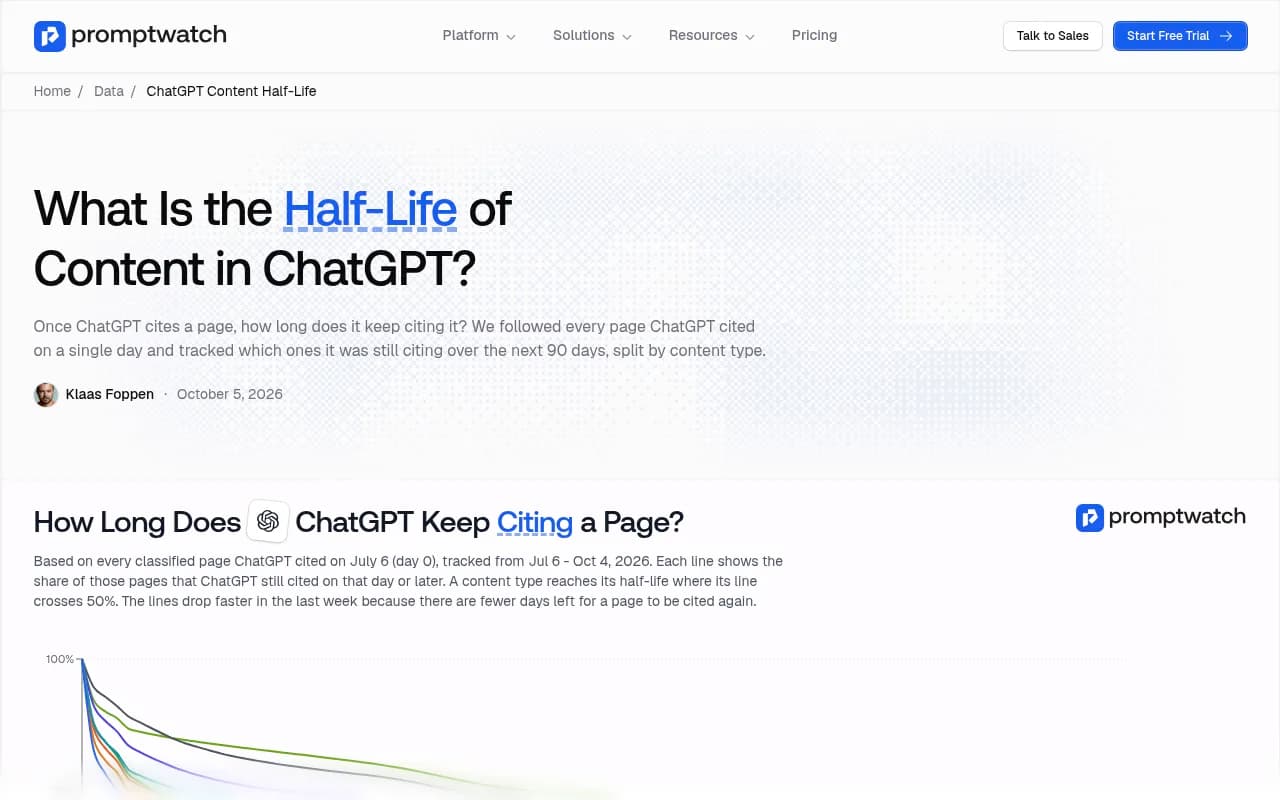

Here are the numbers from that report, split by content type:
| Content type | Still cited at 30 days | Still cited at 60 days | Notes |
|---|---|---|---|
| Landing pages | 78% | 69% | Pricing pages are classified as landing or product pages |
| Docs | 76% | 67% | 93% were cited again at some point after day 0 |
| Comparisons | 72% | 63% | Half-life likely close to or beyond 90 days |
| Listicles | n/a | 60% | Hold up better than product pages |
| Product pages | n/a | 55% | Half-life reached at 74 to 77 days |
| Reviews | n/a | about 55% | Half-life reached at 74 to 77 days |
| How-to guides | n/a | about 55% | Half-life reached at 74 to 77 days |
| News | n/a | 41% | Half of pages gone after 36 days |
A few things stand out to me.
First, news is the clear loser. Almost a quarter of news pages are never cited again after day 0, and half are gone after 36 days. If your visibility plan leans on press coverage, expect a short burst, not a lasting asset.
Second, product pages are weaker than most people assume. They land at about 55% after 60 days, level with reviews and how-to guides. That matters because product pages are the most cited content type in ChatGPT, at 22.4% of citations in the week of Sep 28 to Oct 4, 2026 according to Promptwatch's content type data. A page type that is cited a lot is not necessarily one that stays cited without maintenance.
Third, a caveat the report states itself. Landing pages, docs, comparisons and listicles only cross 50% in the final week, and that is an artifact of the window ending, since fewer days remain for a page to be cited again. Their real half-life is probably close to or beyond 90 days, but that was not observed. Treat the 90-day tail with care.
What Profound found across seven engines
Profound took a different approach in its September 30, 2026 study. It measured 883,000 pages across ChatGPT, Perplexity, Claude, Google AI Overviews, Google AI Mode, Gemini and Microsoft Copilot over twelve months. Each page is measured per engine, which gives 1.19 million page and engine lifecycles.
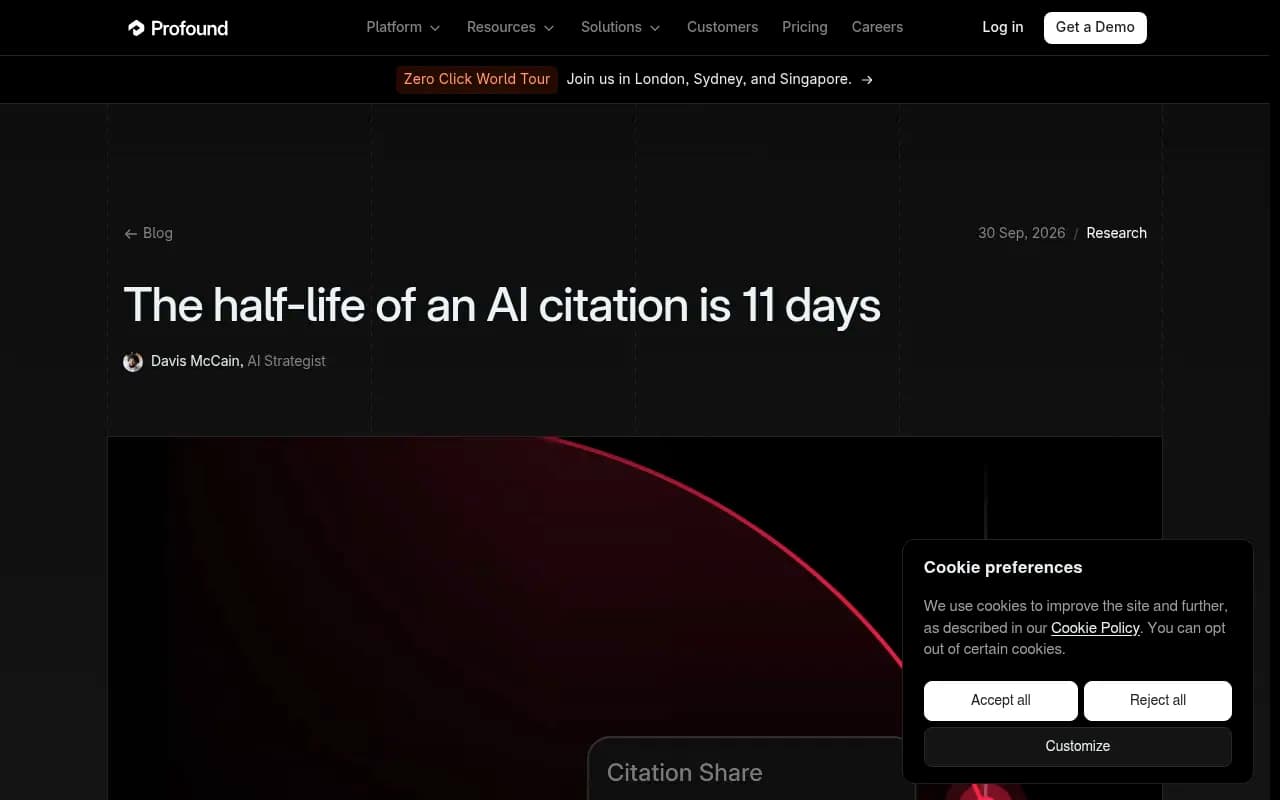

Its headline: the median page loses half its citation share within 11 days of peaking. The median interval from first citation to that half-peak point is 42 days. Profound defines half-life as the days after the peak needed for the page's smoothed citation share to fall to half and stay there for 14 consecutive days.
The four findings worth knowing:
- 78% of cited pages fall to half their peak share within two weeks of peaking. The remaining 22% have a median half-life of 27 to 29 days.
- Among pages that last beyond two weeks, a Claude citation is 2.8 times as likely as a ChatGPT citation to still be relevant eight weeks later.
- Cross-engine correlations of decay run between 0.03 and 0.09. When a page fades on one engine, that tells you almost nothing about the others.
- Pages cited by five or more engines are 5.5 times as likely as single-engine pages to be above half their peak share after eight weeks.
Profound's breadth table is the most useful part for planning:
| Engines citing the page | Pages | Median rise | Still above half-peak at day 56 |
|---|---|---|---|
| 1 | 679,077 | 19 days | 1.2% |
| 2 | 275,530 | 31 days | 2.0% |
| 3 to 4 | 190,439 | 33 days | 3.5% |
| 5 or more | 43,770 | 46 days | 6.8% |
Even the best group is under 7% at day 56. That is a share decay number, and it is harsh by design. It says your page's slice of the pie shrinks quickly, not that the page vanishes.
On engine behavior, Profound notes that Perplexity and Claude return to a page repeatedly, so citations spread across weeks. ChatGPT, Google AI Mode and Gemini tend to cite a page intensively over a few days and then stop. Content that is tied to a date or event fades first. In the family it labels "Choose" (comparisons, listicles, individual reviews), the median half-life is 29 days with 11.2% still above half-peak at day 56.
Third-party half-life studies
Two more sources come up often. Treat them with some caution.
AuthorityTech summarized a Scrunch and Stacker study of 3.5 million citation events from September 2025 to March 2026. It reports a median half-life of 4.5 weeks, with ChatGPT shortest at 3.4 weeks and Perplexity longest at 5.8 weeks. Google AI Mode was reported at 4.3 weeks, AI Overviews at 4.7 and Gemini at 4.8. I only saw a snippet of this material, so I haven't verified the figures independently. An SSRN paper by Tandeep Sangra reports the same 4.5, 3.4 and 5.8 week figures.
The pattern across all of these sources is consistent in direction even when the numbers differ: ChatGPT churns sources faster than Perplexity, and Google's surfaces sit in between.
| Source | What it measures | ChatGPT-relevant finding |
|---|---|---|
| Promptwatch Data | Whether a page is cited again at any later point | 55% to 78% of most types still cited at 60 days, news at 41% |
| Profound | Decay of a page's citation share from its peak | Median half-life 11 days across engines |
| Scrunch/Stacker (via AuthorityTech) | Weeks until half of a source cohort drops out | ChatGPT 3.4 weeks, median 4.5 weeks |
The Scrunch/Stacker summary also claims that content distributed through editorial networks lasted 2.1 times longer, at almost 10 weeks versus 4.5. That is a single study and a distribution claim, so I'd test it before betting a budget on it.
Reconciling the numbers
Here is how I would read all of this together.
Promptwatch shows most pages are still cited again months later. Profound shows most pages are cited heavily around a peak and then settle at a much lower share. Both can be true at once. A page can get a burst of citations in week one, drop to a trickle, and still show up occasionally on day 60. In survival terms it is alive. In share terms it has decayed a lot.
So which should you care about? It depends on the page.
- For a page whose job is to be a durable source (docs, pricing, a core comparison), survival is the right lens. Is it still being cited at all?
- For a page you expect to drive real traffic or mentions, share is the right lens. Is it holding its slice of the answers?
The two sets of numbers are not directly comparable, and neither one can be replicated from the other. Don't average them.
What affects how long a citation lasts
Some patterns repeat across the data:
- Content type. Landing pages, docs and comparisons outlast news and how-tos. Promptwatch's citation types over time data also shows the mix shifting month to month, so no type is permanent.
- Breadth. Being cited by several engines predicts lasting on any of them (Profound).
- Freshness. Quattr cites an Apiserpent study claiming pages updated in the last 30 days earn roughly 3.2 times more AI citations than older pages. I haven't verified that one.
- Engine behavior. ChatGPT itself changes. Promptwatch Data recorded that ChatGPT's citations per response dropped around the GPT-5.3 rollout on March 4, 2026, and that ChatGPT started using the site: operator at scale on August 8, 2026. Part of any decay curve is the model changing under you, not your page getting worse.
- Source mix. Reddit's share of ChatGPT citations fell from about 4% to 0.5% on August 14, 2026 (Promptwatch Data). If you relied on a Reddit thread for visibility, that fell out for reasons unrelated to freshness.
And one more number that explains why lifespans are hard to pin down: almost half of ChatGPT responses cite 10 or more unique domains in the week of Sep 28 to Oct 4, 2026 (Promptwatch Data). With that many slots, a page has lots of ways to drop in and out.
What to track
If you take one thing from this guide, make it a short list of metrics that cover both views of lifespan.
Per-page metrics
- Last cited date. The simplest survival signal. If a page you care about hasn't been cited in 30 days, look at it.
- Citation count or share by week. This gives you the decay curve for that page and shows the peak and the slope after it.
- Prompts that cite the page. When a page falls out, you want to know which prompts it lost.
- Number of engines citing it. Single-engine pages are the fragile ones.
- Date of last content update. Compare against the citation curve to see whether refreshes help.
Portfolio metrics
- Share of cited pages by content type still cited at 30, 60 and 90 days. Run your own version of the Promptwatch cohort analysis on your own pages.
- Ratio of news and dated content to evergreen content in your citations. A news-heavy mix is volatile.
- Crawl activity. If AI crawlers stop visiting a page, citations usually follow. Crawler logs help separate "not read" from "read but not picked".
A practical refresh plan
Based on the Promptwatch content-type data, here is a sensible order of operations. These are my recommendations, not rules from a study.
- Landing, pricing and docs pages first. They stay cited longest, so errors on them cost you for months. Keep prices, features and positioning accurate.
- Comparison pages and listicles next. Both keep more than 60% of citations after two months, so they reward upkeep.
- Product pages, reviews and how-tos on a rolling schedule. They hit half-life around 74 to 77 days in Promptwatch's cohort. Refresh specs, availability and prices before that point.
- News and press as bursts. Plan on about five weeks of useful life and don't count on them as lasting assets.
- Pages that fell off. Look for pages whose last cited date is stale, then refresh and recheck.
If you cite figures like the 3.4 week ChatGPT half-life to justify a two-week refresh cycle for everything, be aware that it comes from a different method and a different cohort. Use it as a prompt to check your own data, not as a schedule.
Tools for tracking citation lifespan
You can't see citation lifespan in Google Analytics. You need a tracker that stores citation history per page. Options in the market:
| Tool | What it's useful for here |
|---|---|
| Promptwatch | Page-level citation tracking, IP-verified AI crawler logs, citation trends with first-cited, peak and decay half-life per page, and a Content Refresh workflow |
| Profound | Citation decay metric across seven engines |
| Scrunch | AI visibility tracking and the Scrunch/Stacker half-life research |
| Peec AI | Basic prompt and citation tracking |
| Otterly.AI | Affordable visibility monitoring |
| Semrush | AI tracking bolted onto a traditional SEO suite |


Promptwatch is the one I'd look at first for this specific job, because its Citation Trends classify every citation by content type and show first cited date, ramp-up, peak and decay half-life per cited page, and its crawler logs show whether AI systems are still reading the page. It also connects those findings to a Content Refresh tool and an Action Board so the fix is not a separate project. Confirm current plans at promptwatch.com/pricing. For a broader list, the GEO software directory at bestgeosoftware.com covers more options.
Caveats about all of this
A few honest limits.
- The Promptwatch cohort is one day (July 6, 2026) tracked for 90 days. Cohorts from other days may behave differently, especially around model changes.
- Its chart's final-week drop is an artifact of the window ending.
- Profound's qualification rules exclude pages with fewer than 5 citations at their smoothed peak, so low-volume pages are not in its numbers.
- Prompts, industries and countries differ between studies. Healthcare content, for example, leans on government sites in ChatGPT (Promptwatch Data), and those pages may behave differently from software or travel content.
- Vendor studies come from vendors who sell tracking. That doesn't make them wrong, but it is worth knowing.
Bottom line
ChatGPT citations are not permanent, but they are not all single events either. By survival measures most evergreen page types are still cited two months later, and news is gone in about five weeks. By share measures, most pages lose half their citation share within about two weeks of peaking. Track both, refresh your landing pages, docs and comparisons before the facts on them go stale, and treat news as a short burst.