Key takeaways
- Score vendors on evidence, not on the list of engines they claim to support. Every number in a report should trace back to a prompt, a captured answer, a source record and a formula.
- Use pass/fail gates first, then a weighted 100-point scorecard, then a short proof of concept (POC) on your own prompts.
- Weight action and measurement as heavily as monitoring. A tool that only tells you that you are invisible leaves the fixing to your team.
- Ask every vendor about per-engine baselines and fanout capture. Engines change behavior in steps, and a platform that can't separate engine noise from brand movement will mislead you.
- Decide the pass threshold and disqualification rules before vendor responses arrive.
Why a scorecard, and why now
Procurement teams are being asked to buy a category that barely existed two years ago. The vendor list is long (our catalog at bestgeosoftware.com tracks well over a hundred), the demos all look similar, and every pricing page promises "all major engines."
A scorecard fixes that. It forces the buying committee to agree on what matters before anyone sees a polished dashboard, and it leaves a paper trail that survives a CFO question six months later.
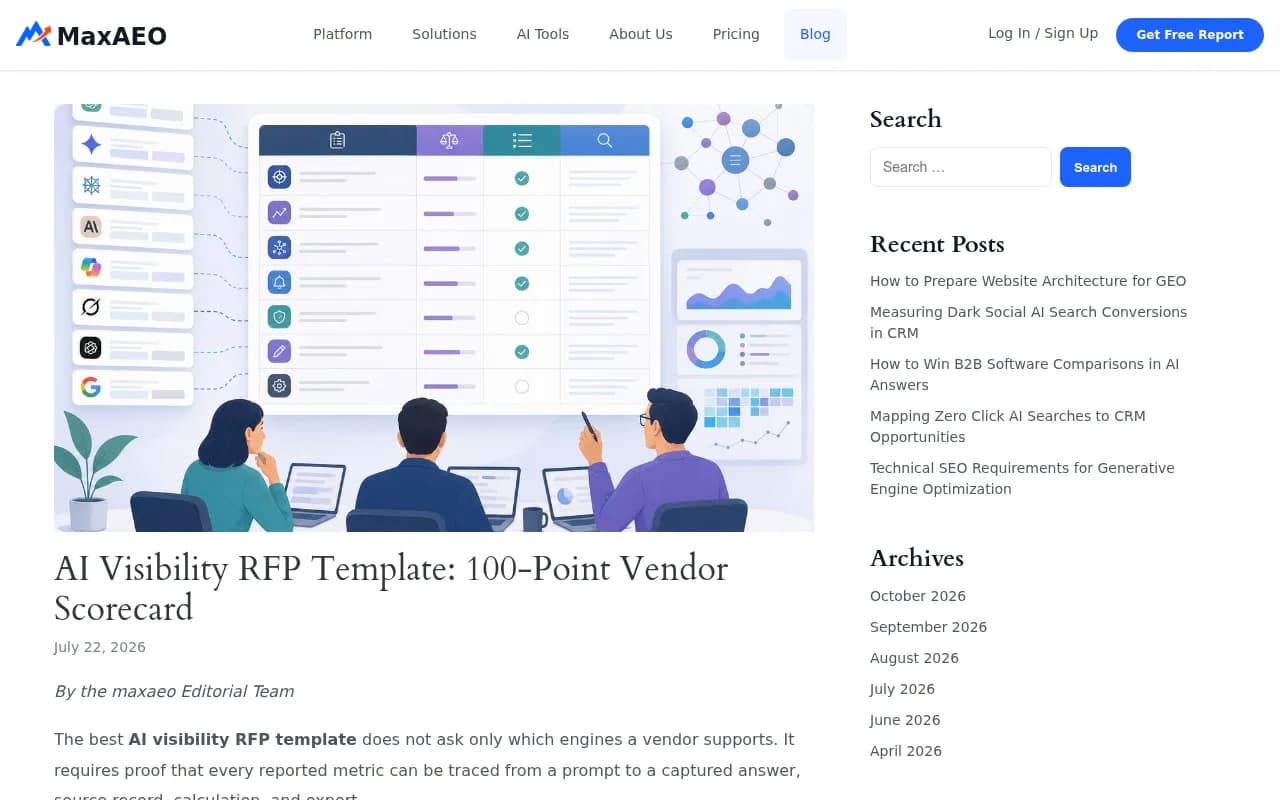
The structure below borrows from a few sources. The MaxAEO AI visibility RFP template (July 2026) frames the buying question well: it asks for proof that every reported metric can be traced from a prompt to a captured answer, source record, calculation and export. Its five evidence requirements are coverage, traceability, reproducibility, transparency and commercial fit. I've kept those, and added two categories that I think matter just as much once you've bought: business impact and the ability to act.
Step 1: Write the scope sheet
Before you contact a single vendor, fill in the scope. Vendors can only be compared against a requirement you wrote down.
- Engines and answer surfaces you need (ChatGPT, Google AI Overviews, AI Mode, Gemini, Perplexity, Copilot, Claude and so on)
- Markets, languages, devices and whether you need state or city level tracking
- Starting prompt volume and the volume you expect in 12 months
- Run frequency and how many months of history you need
- Required evidence: full answer text, citations, timestamps, run metadata
- Reporting, API and warehouse export needs
- Users, roles, workspaces and (for agencies) client separation
- Security, privacy, retention and deletion requirements
- Pricing units, overages, onboarding and support terms
- POC dates, acceptance criteria, pass threshold and disqualification rules
Write the last item down and share it internally before you send the RFP. Teams that set the threshold after seeing the demos tend to rationalize their favorite.
Step 2: Apply pass/fail gates
Gates remove vendors that can't meet a hard requirement, so you don't spend scoring time on them. Keep them short. Six to eight is plenty.
| Gate | Pass condition |
|---|---|
| Required engines | All must-have engines covered, with the collection method stated |
| Raw answer access | Full answer text and cited URLs viewable for any reported mention |
| Documented formulas | Visibility, share of voice and sentiment formulas published, including denominators |
| Export | CSV or API export of prompt-level data, not only aggregates |
| Security | Your required controls (SSO, data retention, deletion on request) confirmed in writing |
| Geography | Required countries and languages tracked from the correct location |
| Pricing transparency | Price per unit (prompts, responses, seats) and overage rules stated |
| Data ownership | You keep your data on termination |
One gate deserves extra attention: collection method. Some platforms read the live user interface of each engine, others call APIs. Answers and citations can differ between the two, so ask which one produces the number on the dashboard. Neither is wrong, but you should know which you're paying for.
Step 3: The 100-point scorecard
Here is the weighting I'd start from. Adjust it to your situation, but keep it to a total of 100 and lock it before scoring.
| Category | Weight | What you are scoring |
|---|---|---|
| Coverage and collection | 15 | Engines, surfaces, markets, languages, method of collection |
| Traceability and reproducibility | 15 | Raw answers, timestamps, repeat runs, failure logs, stable prompt cohorts |
| Metric transparency | 10 | Documented formulas, classifications, exclusions |
| Prompt intelligence | 10 | Prompt volumes, difficulty, fanout capture, suggestions |
| Citation and source analysis | 10 | Which pages get cited, by what source type, third-party and social mentions |
| Business impact | 10 | Crawler logs, AI referral traffic, conversions, Search Console and Bing joins |
| Action and workflow | 15 | Gap analysis, content generation, publishing, task prioritization, verification |
| Security, integrations and admin | 10 | SSO, roles, API, connectors, white-label reporting |
| Commercial fit | 5 | Total cost, overages, support, contract terms |
Score each line 0 to 5 using the same anchors for everyone:
- 0: not offered
- 1: claimed but not evidenced
- 2: partial, or manual workaround
- 3: works as described in a demo
- 4: works in your POC on your data
- 5: works in the POC and the vendor shows documentation that backs it
Multiply the score by the weight, divide by 5, and sum. Anything under 70 should be hard to justify. I would also require a minimum of 3 on traceability even if the total looks fine, because a platform you can't audit is a platform you can't defend.
Evidence log
Add one column to your spreadsheet called Evidence, and make it mandatory. A score without a screenshot, doc link, recorded demo timestamp or POC file name doesn't count. This is the single habit that separates a procurement exercise from a vibes check.
Step 4: What good looks like in each category
Coverage and traceability
The question isn't "do you support Perplexity?" It's "show me the captured Perplexity answer for this prompt, from this country, on this date, with the sources in order."
Per-engine baselines matter here more than most buyers expect. In Promptwatch Data's average sources per response dataset, ChatGPT cites about 5 sources per web-search answer, Google AI Overviews about 10, and Perplexity almost exactly 10 every day. Microsoft Copilot is the outlier: its average swung from under 2 to nearly 17 sources within weeks. A vendor that shows a drop in your citation count without flagging that the engine itself changed how many sources it returns is going to send you chasing problems that don't exist. Ask how they separate platform artifacts from real brand movement.
Prompt intelligence and fanouts
Modern engines don't run your prompt as typed. They split it into sub-searches. Ask whether the vendor captures those fanout queries, not only the final answer.
Behavior shifts in steps. In Promptwatch's ChatGPT query fanout data, fanouts per response averaged 2.15 in early December and about 1.84 by early March, and average query length fell from about 117 characters in December to roughly 53 by April. Then, on August 8, 2026, ChatGPT started using the site: operator at scale, jumping from about 0.4% to about 17% of fanout queries overnight, per Promptwatch Data. If your vendor keeps no history and doesn't re-baseline after events like that, your trend lines will have invisible cliffs in them. Score historical retention and change annotation accordingly.
Citation and source analysis
Mentions are the easy part. You want to know which of your pages get cited, which third-party pages name you, and what type of content wins. Content type matters: Promptwatch's content-type data shows product pages at 22.4% of ChatGPT citations from Sep 28 to Oct 4, 2026, so a tool that can't classify citations by type will hide that kind of insight.
Social sources are the other trap. In the same period, ChatGPT drew 0.46% of its citations from social platforms while Google AI Overviews drew 12.2%. Whether the vendor tracks Reddit, YouTube and LinkedIn citations at all will change what your strategy can be.
Business impact
This is the category most procurement templates skip and most CMOs ask about first. Can the platform show AI crawler activity on your site, with verified IPs so spoofed bots are filtered out? Can it attribute visits and conversions from AI platforms? Can it overlay Search Console and Bing data so you see which pages rank but never get cited?
If the answer to all three is "export the data and join it yourself," score it a 2 and budget analyst time.
Action and workflow
There's a real divide in this market between trackers that answer "was my brand mentioned?" and platforms that help you change the answer. Score what happens after the dashboard: a prioritized to-do list, content gap analysis, draft generation grounded in citation data, publishing to your CMS, and a check on whether the published page was crawled, cited and clicked.
In your POC, ask the vendor to take one gap and walk it through to a published page. The time that takes is an honest measure of the workflow.
Step 5: Run a proof of concept
The MaxAEO template proposes a 1,440-observation POC. You don't need to copy the exact number, but the principle is sound: enough repeated runs to see variance, on a fixed prompt set, so vendors can be compared on the same inputs.
A workable version:
- Pick 30 to 50 prompts. Include branded, competitor comparison and category prompts, plus a few where you know the true answer.
- Fix the engines, countries and languages for all vendors.
- Run each prompt on a set schedule for two weeks. Daily is enough.
- Have your team manually check a sample against the live engine UI and note mismatches.
- Ask each vendor to export raw answers and citations for the whole set.
- Compare variance run to run. Large unexplained swings are a red flag.
- Test one end-to-end workflow, such as a content gap to a published page.
- Record failures. Vendors that log failed runs honestly beat vendors whose dashboards never show a gap.
For a gut check before the POC, a free scan helps you build the prompt list. Tools like the LQ Digital AI Search Scorecard give a quick snapshot of mention rate and share of voice against named competitors. Treat it as a starting point for prompts, not as a vendor evaluation.

Step 6: Pricing and commercial questions
Pricing units vary more than the sticker price suggests. Ask each vendor:
- What exactly is the unit: prompts, responses, credits, seats or projects?
- Is multi-engine and multi-country tracking included or priced per engine?
- What happens on overage, and can you cap spend?
- Are crawler logs, visitor analytics and API access in the base plan?
- What do onboarding and support cost, and what is the response time?
- Can you get a 12-month history export if you leave?
Compute cost per tracked response, not cost per month. A $95 plan with 6,000 responses and a $200 plan with 30,000 are not what their headlines suggest. Always confirm current numbers on the vendor's pricing page, since these change often.
Step 7: Shortlist and compare
Once your gates are applied, you will usually have three to five vendors left. The table below is a starting map of how the field tends to sort. It is a general positioning guide, not a scored result, and your own POC scores should override it.
| Segment | Typical strength | Typical gap to test |
|---|---|---|
| End-to-end platforms (Promptwatch) | Tracking plus crawler logs, traffic attribution, content creation and publishing | Check plan limits on prompts and responses |
| Enterprise monitoring (Profound, Scrunch) | Deep monitoring and reporting for large teams | Price, and whether it executes fixes or only reports |
| Lightweight trackers (Otterly.AI, Peec AI) | Quick setup, low cost | Crawler logs, traffic attribution, content workflow |
| Traditional SEO suites (Semrush, Ahrefs Brand Radar) | Familiar interface, bundled with existing contracts | Fixed prompt sets, depth of AI-specific data |
| Content-first tools (AirOps, Jasper) | Production speed | Visibility data to ground the content |
Promptwatch is the one I'd put at the top of most shortlists, mainly because it scores on categories most trackers leave blank: IP-verified AI crawler logs, visitor analytics, Search Console and Bing joins, plus a Content Agent that plans, writes and publishes to Webflow, Framer or WordPress and then tracks whether the page got crawled and cited. It monitors the real interfaces of ChatGPT, AI Overviews, AI Mode, Gemini, Perplexity and Copilot, and its plans run from a free tier to Business at $579 a month, with agency tiers from $199. Verify current plan details at promptwatch.com/pricing.

Profound is a common enterprise contender, so expect to see it in RFP responses.

For budget-limited teams that only need tracking, Otterly.AI and Peec AI are the usual names.


If your organization already lives in a traditional SEO suite, score the bundled option too, so the comparison is fair.
For a wider view of the market, the GEO software directory lists far more options than any scorecard can evaluate.
Step 7b: A scoring example
Here is a simplified run for two fictional vendors, to show how the math works.
| Category | Weight | Vendor A (0-5) | Vendor A points | Vendor B (0-5) | Vendor B points |
|---|---|---|---|---|---|
| Coverage and collection | 15 | 4 | 12 | 5 | 15 |
| Traceability and reproducibility | 15 | 4 | 12 | 3 | 9 |
| Metric transparency | 10 | 3 | 6 | 4 | 8 |
| Prompt intelligence | 10 | 4 | 8 | 3 | 6 |
| Citation and source analysis | 10 | 4 | 8 | 3 | 6 |
| Business impact | 10 | 4 | 8 | 1 | 2 |
| Action and workflow | 15 | 4 | 12 | 2 | 6 |
| Security, integrations, admin | 10 | 3 | 6 | 4 | 8 |
| Commercial fit | 5 | 3 | 3 | 5 | 5 |
| Total | 100 | 75 | 65 |
Vendor B wins on coverage and price, but loses on the categories that connect visibility to revenue. That pattern is common, and it's exactly the sort of thing a headline feature count hides.
Common mistakes
- Scoring the demo instead of the POC. Demos are rehearsed on friendly prompts.
- Treating engine count as quality. Six engines with no raw answers is worse than three with full evidence.
- Ignoring the measurement window. Daily data over 90 days beats a nice snapshot.
- Letting one stakeholder weight the categories after the fact.
- Forgetting the exit. Check data ownership and export on day one, not at renewal.
Procurement research outside this niche helps here too. Suplari's guide on building a supplier scorecard makes a point that applies directly: most scorecards fail because the underlying data is messy, not because the template is wrong. Agree on what data you'll pull and where it lives before you start scoring.
Printable template
Copy this into a spreadsheet or print it as a one-pager.
AI VISIBILITY PLATFORM SCORECARD - 2026
Buyer: ________  Date: ________  Panel: ________

GATES (Pass / Fail / Evidence)
[ ] Required engines covered
[ ] Raw answers + citations viewable
[ ] Formulas documented
[ ] Prompt-level export / API
[ ] Security controls confirmed
[ ] Required geographies tracked
[ ] Pricing unit + overage stated
[ ] Data ownership on exit

SCORING (0-5 x weight / 5)
Coverage and collection .......... /15  Evidence: ____
Traceability + reproducibility ... /15  Evidence: ____
Metric transparency .............. /10  Evidence: ____
Prompt intelligence .............. /10  Evidence: ____
Citation and source analysis ..... /10  Evidence: ____
Business impact .................. /10  Evidence: ____
Action and workflow .............. /15  Evidence: ____
Security, integrations, admin .... /10  Evidence: ____
Commercial fit ................... /5   Evidence: ____
TOTAL ............................ /100

Minimum total: 70   Minimum traceability: 3
POC dates: ________  Decision owner: ________
Do you need help running the process?
Most teams can run this in-house. If you'd rather have outside help scoping the prompts, running the POC or turning the winner's data into a content roadmap, an agency that works in this space can shorten the process. 1001 SEO Media does GEO and AI search work and runs its own client programs on Promptwatch, so disclose that relationship when you weigh our recommendation above.
Final checklist
Lock the scope and weights first. Apply gates. Score on evidence. Run two weeks of repeated prompts. Test one full workflow from gap to published page. Compare cost per response. Then decide, and write down why.