Key takeaways
- Publishers need more than prompt tracking. Crawler logs, citation data by content type, and AI referral traffic matter more than a mention count.
- News is only 5.7% of ChatGPT citations, and half of cited news pages stop being cited within 36 days. Evergreen assets last far longer.
- Check which AI crawlers can actually reach your site before you buy anything. A blocked crawler makes every visibility score meaningless.
- Promptwatch is the strongest end-to-end option for publishers who want to act on the data. Profound, Authoritas, and Semrush suit specific cases, and cheaper trackers cover basic monitoring.
- Vendor claims about publisher dashboards (DeepSeeQ is one example) come from thin sources. Verify with a trial.
Why publishers need a different kind of AI visibility tool
Most AI visibility software was built for brands asking one question: "Does ChatGPT mention us?" That is a fine question for a SaaS company. For a publisher it is the wrong one.
A media company has thousands of URLs, a content mix that is mostly news and analysis, and a business model that depends on clicks, subscriptions, or ad impressions. AI answers can summarize your reporting without sending anyone to your site. So the questions change:
- Are AI crawlers reading our content, and are any being blocked by accident?
- Which of our pages get cited, and for which prompts?
- Does any of that cited content turn into visits, subscribers, or ad revenue?
- Which content types are worth investing in for AI search?
A tool that only answers "were we mentioned?" can't help much with any of those. Keep that in mind as you read through the options below.
What the data says about publisher content in AI search
Before picking a platform, it helps to know what you are optimizing for. Promptwatch Data has two reports that matter a lot for media companies.
News is a small slice of ChatGPT citations
In Promptwatch's ChatGPT citation share by content type report (Sep 28 to Oct 4, 2026), product pages took 22.4% of classified citations, landing pages 16.8%, and listicles 13.6%. How-tos got 8.7%, general articles 6.1%, comparisons 5.9%, and news just 5.7%. Documentation took 7.5%.
Editorial formats combined (listicles, how-tos, articles, comparisons, news, reviews) make up 43% of citations. That is a real share, but it is spread across formats. If your newsroom publishes mostly breaking news, you are competing for the smallest slice.
For informational prompts the picture is friendlier to publishers: how-tos reach 10.7% and articles 7.7%. Explainers and guides are where editorial teams have a shot.
News decays fast
Promptwatch's content half-life report tracked every page ChatGPT cited on July 6, 2026, through Oct 4, 2026. News lost the most ground. Almost a quarter of news pages were never cited again after day 0, and half were gone after 36 days. Landing pages and docs held up best: 78% and 76% were still cited at 30 days. Listicles kept 60% at day 60. Comparisons kept 63%.
The practical takeaway: news coverage gives you short bursts of visibility. Evergreen explainers, comparisons, and reference pages are your long-term citation assets. A good platform should let you see this split on your own site, not just in aggregate studies.
Crawler access is a business decision
Publishers often block AI crawlers deliberately, and sometimes by accident through CDN or WAF rules. Promptwatch's AI crawler traffic data (June 8 to Sep 6, 2026) shows OpenAI at 79.8% of IP-verified AI crawler requests in the week of Aug 31 to Sep 6, down from 94.8% in early June. Only requests whose source IP matches the operator's published ranges are counted, so spoofed user agents don't inflate the numbers.
The advice from that report is simple. Check robots.txt, CDN, and WAF rules for every provider. If a provider is big in the overall mix but near zero in your logs, you are probably blocking it. Whether you want that is your call, but you should know.
What to look for in a platform
For a publisher, I would weigh these features in roughly this order:
- AI crawler logs. Verified logs showing which bots hit which pages and what errors they got. Very few trackers have this.
- Citation analytics at page level. Which URLs are cited, by which model, for which prompts, and how that changes over time.
- Traffic attribution. Visits from AI platforms, ideally tied to conversions or subscriptions.
- Real interface tracking. Answers from the actual ChatGPT, AI Overviews, and Perplexity interfaces can differ from API output.
- Content action tooling. Gap analysis, refresh suggestions, and publishing workflows, if your team wants help closing gaps.
- Reporting. Scheduled reports for editors, commercial teams, and executives.
- Pricing that scales with prompts and responses. Large topic coverage gets expensive on per-prompt plans.
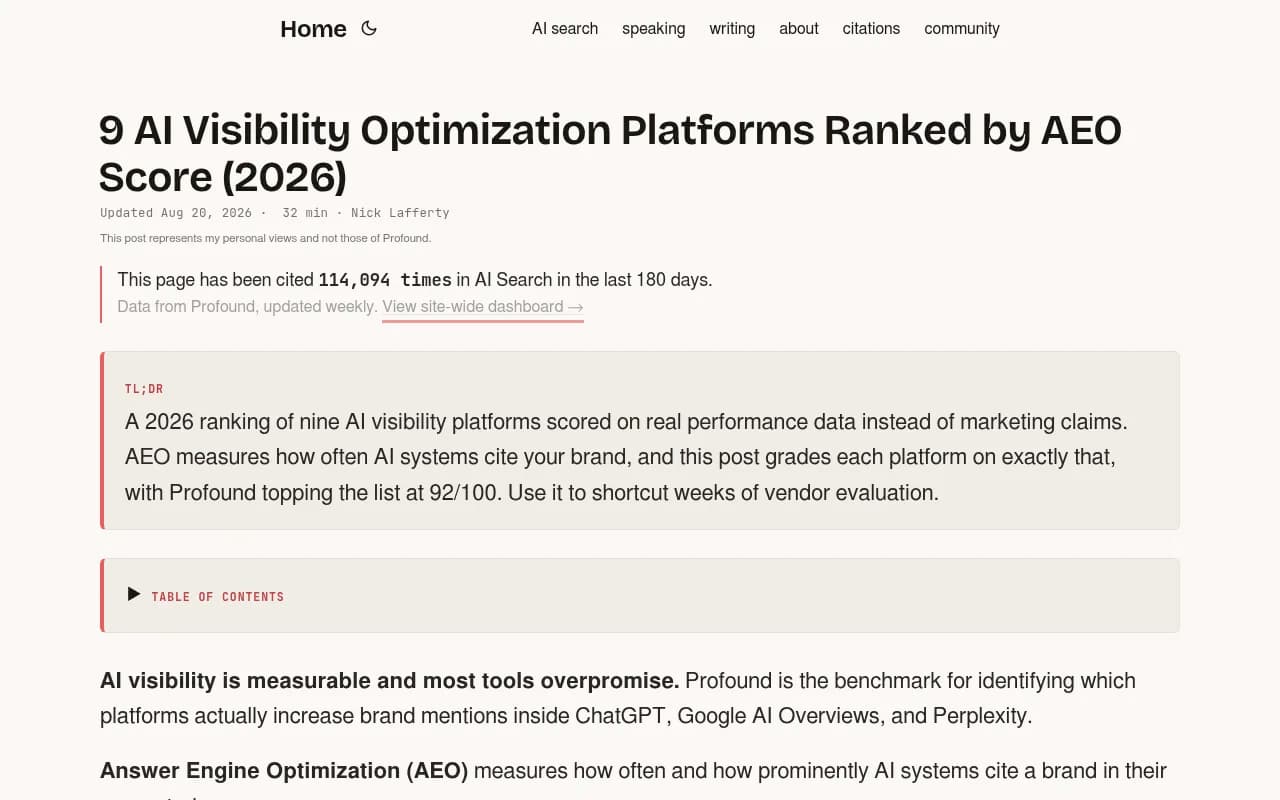
Third-party roundups like the one above are a useful starting list, but treat their rankings with care. Many rely on a single scoring method, and publisher-specific claims (for example, that DeepSeeQ offers editorial dashboards) come from one blog post and I could not verify them elsewhere.
Platform comparison for publishers
| Platform | Best for | Crawler logs | Content action tools | Notes |
|---|---|---|---|---|
| Promptwatch | Publishers who want to find gaps and fix them | Yes, IP-verified | Yes, Content Agent, Action Board | From $95/mo, confirm on promptwatch.com/pricing |
| Profound | Large enterprise teams | Verify with vendor | Verify with vendor | Strong monitoring, higher price tier |
| Authoritas AI Tracker | Publishers and retailers wanting SERP plus AI views | Verify with vendor | Limited | Positioned for brands, publishers, retailers |
| Semrush One | Teams already on Semrush | No | Some | Fits existing SEO workflows |
| Ahrefs Brand Radar | Ahrefs users | No | No | Brand mention monitoring in AI results |
| Peec AI | Multi-language monitoring | No | No | Prompt tracker |
| Otterly.AI | Budget monitoring | No | No | Affordable tracker |
| ZipTie | Deep analysis and reporting | Verify with vendor | No | Analysis focus |
I did not verify vendor pricing for everything outside Promptwatch, so check each vendor's page before budgeting.
The platforms worth shortlisting
Promptwatch
Promptwatch is the one I would start with for a publisher, mainly because it covers the parts publishers care about most and others skip. Its IP-verified crawler logs show which AI bots read which pages and what errors they hit. Citation Trends classify every citation into content and source types, with a first-cited date and decay half-life per page, which is exactly the news-versus-evergreen question from the data above. Visitor analytics connect AI platforms to real traffic, and Search Insights overlay Google Search Console and Bing data so you can find pages that rank but never get cited.
It tracks the real interfaces of ChatGPT, Google AI Overviews, AI Mode, Gemini, Perplexity, and Copilot, plus Reddit, YouTube, and LinkedIn citations. That last part matters because Promptwatch's social media citations report found ChatGPT drew only 0.46% of citations from social platforms from Sep 28 to Oct 4, 2026, while Google AI Overviews drew 12.2%. Different surfaces reward different sources.
Where it separates from monitoring-only tools is the action side. The Content Agent plans, writes, and publishes to WordPress, Webflow, or Framer with a review inbox, so editors stay in control. Content Refresh gives diff-style updates to existing articles, handy for evergreen pages that are slipping. Pricing starts at $95/mo for Essential, with Business at $579/mo and agency plans from $199/mo.

Profound
Profound is the name that comes up most in enterprise comparisons, and Profound's research is cited widely across the industry. It is strong on monitoring and has agency features. The trade-offs are price and, as far as I can tell, a lighter focus on crawler-level diagnostics. If you have a large budget and an analytics team who will use dashboards heavily, it deserves a demo.

Authoritas AI Tracker
Authoritas describes its AI tracker as built for brands, publishers, and retailers, and it brings long SERP-analysis experience. That is a reasonable fit if your team already thinks in terms of search features and wants AI results alongside them.

Semrush and Ahrefs Brand Radar
If your SEO team lives in Semrush or Ahrefs, the AI add-ons are convenient. The limit is depth: fixed prompt sets and no crawler logs. They answer "are we showing up?" but rarely "why not?"
Peec AI, Otterly.AI, and ZipTie
These are the budget-to-mid-range trackers. Otterly.AI is known for affordability, Peec AI for multi-language tracking, and ZipTie for deeper analysis and reporting. For a small regional publisher that only needs a weekly view of how often it appears, any of them is a reasonable start. Just know you will need other tools for crawler access and traffic.


Adjacent tools for PR and newsroom workflows
Publishers often also care about media monitoring and press distribution. Meltwater and Mention handle classic media monitoring, and Supernewsroom.AI pitches itself around AI visibility through news. Notified's 2026 press release analytics guide makes the point that AI citations are becoming a PR metric, with structured content and trusted distribution influencing whether releases get reused by AI systems. These tools complement an AI visibility platform rather than replace one.
For more options, the GEO software directory at bestgeosoftware.com lists far more trackers than fit here.
A practical rollout for a newsroom
Week 1: audit access
Connect crawler logs through your CDN (Cloudflare, Fastly, Vercel, or raw server logs). Look at which AI bots visit and which get 403s or timeouts. Decide deliberately what you want to allow. If licensing deals are in play, make sure the policy matches the contract.
Week 2: map your prompts
Build a prompt set around the beats you cover. Informational and how-to style prompts are where articles get cited, so weight your set toward them. Include a few branded prompts to see how AI describes your publication.
Week 3: split news from evergreen
Segment cited pages by content type and age. Based on the half-life data, expect news to spike and fade. Identify evergreen explainers that earn repeat citations and plan refreshes for them on a schedule.
Week 4: connect to outcomes
Tie AI referrals to subscriptions, newsletter signups, or ad revenue. If AI traffic converts better than average, that justifies more investment. If it barely converts, you may focus on brand presence and licensing instead.
What about agencies?
Some publishers prefer outside help, especially for crawler policy, structured data, and digital PR. Agencies like 1001 SEO Media combine technical SEO, content strategy, and AI search work, and run Promptwatch as their own GEO platform. Others, like New Engen, focus on consumer brands with owned editorial properties.
If you go the agency route, ask for reporting that shows crawler activity and citations by page, not just a visibility score.
Common mistakes
- Buying a tracker and calling it done. Monitoring without a path to action produces dashboards nobody uses.
- Treating all citations equally. A cited news piece that fades in five weeks is not the same asset as a cited reference page that lasts for months.
- Ignoring Google surfaces. AI Overviews and AI Mode behave differently from ChatGPT, particularly on social sources.
- Trusting vendor rankings blindly. Many "best of" lists are written by vendors or agencies with a stake. Run a trial on your own content.
Bottom line
For most publishers I would trial Promptwatch first because it connects crawler access, citations, traffic, and content action in one place. Add a lighter tracker like Otterly.AI or Peec AI if budget is tight, or look at Profound if you are an enterprise with a dedicated analytics team. Whatever you pick, start with the crawler logs. If the bots can't read your site, nothing else matters.