Leapd Alex Review 2026
Autonomous agent that tracks AI visibility, audits sites, reverse-engineers competitors and drafts AEO articles across major AI engines.
Key takeaways
- Alex is one of four named agents inside Leapd (alongside Jack, Milo and Cassy), focused specifically on AI search visibility, AEO audits and long-form content generation.
- It lacks the crawler log analytics, Reddit/YouTube citation tracking, ChatGPT Shopping monitoring, and traffic attribution that Promptwatch offers — Alex tracks mentions and writes content, but doesn't show you why AI crawlers do or don't read your pages.
- Pricing starts cheap ($39/mo for ChatGPT-only tracking) but platform add-ons stack fast — tracking Gemini, Perplexity, AI Overview, AI Mode and Claude all at once on the Starter tier would cost well over $100/mo in add-ons alone.
- The product is brand new. Public reviews are thin (two 5-star G2 reviews and one Trustpilot review, all from April 2026), and the growth-percentage claims on the marketing site ('8% to 42% visibility in three weeks') are vendor-supplied case studies, not independently audited numbers.
- Best suited to solo founders and small teams who want a single cheap entry point into AI search tracking and don't need deep technical diagnostics.
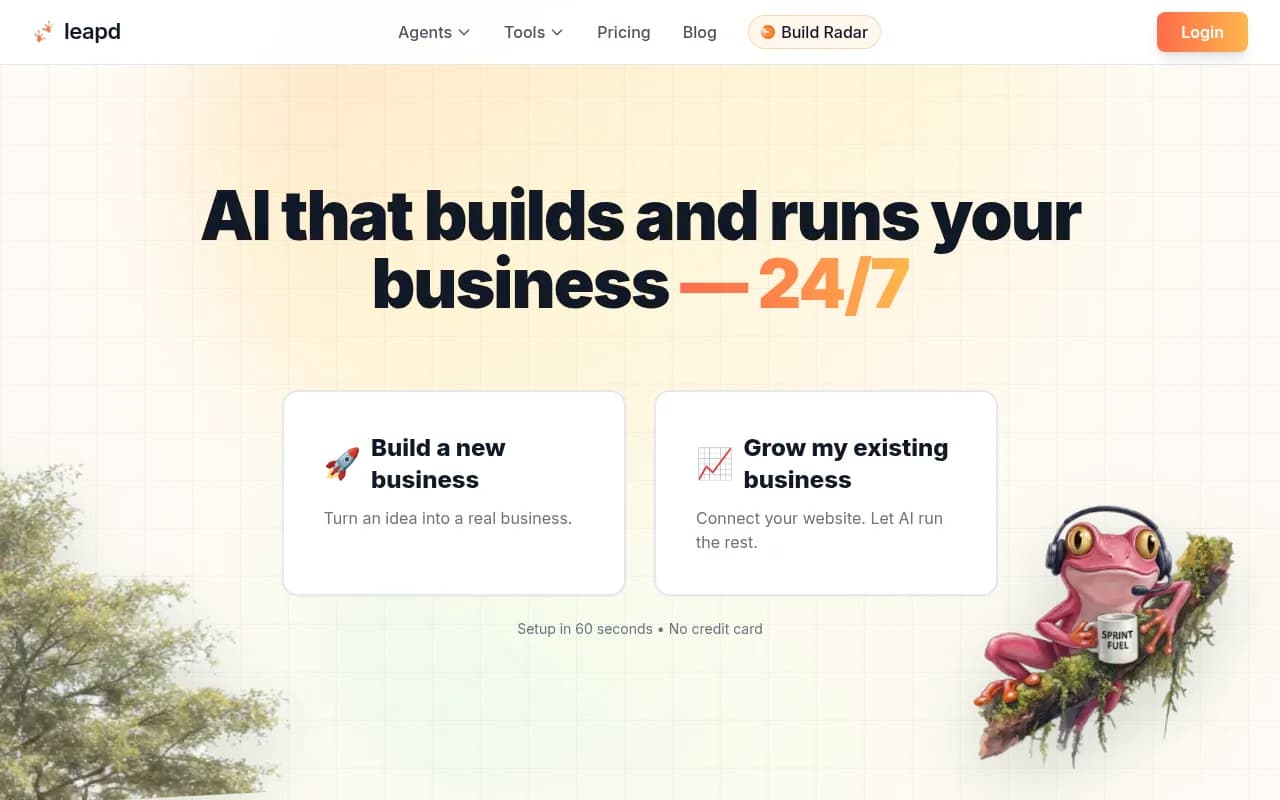
Leapd bills itself as an AI co-founder, a platform of autonomous agents that build, launch, and run a business end to end. Alex is the agent inside that suite responsible for AI search visibility: it tracks brand mentions across large language models, audits websites for answer-engine readiness, and drafts articles meant to get cited. It's a narrower, cheaper cousin to the dedicated GEO platforms that have emerged since ChatGPT Search and Google AI Overviews started reshaping how people find things online.
The company behind it, Leapd, launched its broader multi-agent system in 2026 with four agents under one roof: Jack coordinates everything and is thrown in free, Milo handles outreach and ad campaigns, Cassy runs LinkedIn content, and Alex covers AI search. That packaging is the real story here. Alex isn't trying to be a standalone AEO platform in the way Profound or Scrunch are — it's one module in a bundle aimed at founders who want a single dashboard instead of five separate tools.
Who should care about this: mostly solo founders and small SaaS teams who have never tracked their AI search presence before and want the cheapest possible entry point, bundled with other growth tasks they're already paying someone (or something) to do. It's a much thinner product than the dedicated GEO platforms built specifically around this problem, and that shows up quickly once you look past the pricing page.
Key features
- Multi-platform visibility tracking. Alex tracks brand mentions, citations and sentiment across ChatGPT, Gemini, Claude, Perplexity, Google AI Overviews, AI Mode, and Grok. On the cheapest plan, though, only ChatGPT is included by default; every other platform is a separate $20-$120/mo add-on depending on tier. That's a meaningfully different pricing structure than platforms that bundle full multi-model coverage into one subscription.
- 60-second AEO audit. Alex scans a site's schema markup, llms.txt, robots.txt, crawlability and Core Web Vitals and returns a report almost immediately. It's a reasonable entry point for someone who has never thought about whether their site is readable by an AI crawler, but it's a point-in-time audit rather than ongoing crawler log monitoring.
- Competitor reverse-engineering. The tool builds a leaderboard of competitors and tries to explain why they get cited more often in AI answers than you do. Useful for a first pass, though it stops short of the page-level citation trend data (ramp-up, peak, decay per page) that more mature GEO tools provide.
- AI-optimized article generator. Alex writes long-form content, the vendor claims 4,000+ words with around 28 citations and 10 inline images plus FAQ/Article schema per article. Article volume is capped by plan: 3/month on Starter, 10/month on Pro, 40/month on Advanced. It writes the piece; publishing to a CMS and ongoing refresh of existing pages are not part of the workflow.
- Prompt-based keyword research. Instead of pulling traditional search volume, Alex builds keyword/prompt lists based on real buyer questions people type into AI chat interfaces. A sound idea in principle, though the site doesn't disclose a prompt difficulty score or volume methodology the way some competitors do.
- AI copilot chat. A chat interface sits on top of the dashboard so you can ask Alex questions about your own visibility data rather than digging through charts yourself. Credits are capped (4M/month on Pro, 8M on Advanced), which is an unusual constraint to put on a chat feature.
- Jack, the free co-founder agent. Every Alex plan includes Jack, which acts as a cross-agent orchestrator and sends a daily report. It's a nice touch for someone running the whole Leapd stack, less relevant if you only want AI visibility tracking.
Who is it for
Alex fits a solo founder or two-person marketing team at a very early-stage SaaS or DTC company who has read that ChatGPT and AI Overviews are starting to send traffic and just wants a cheap dashboard confirming whether their brand shows up at all. At $39/mo for ChatGPT-only tracking, it's a lower financial commitment than most dedicated AI visibility platforms, and bundling it with Leapd's other agents (LinkedIn content, outreach) could appeal to someone trying to run marketing on autopilot with minimal headcount.
It is not built for SEO agencies managing a dozen client accounts, enterprise marketing teams that need crawler-level diagnostics, or anyone who has already outgrown basic mention tracking and needs to understand the mechanics of why AI engines cite (or ignore) specific pages. Teams at that stage will hit the ceiling of what Alex reports quickly, since it has no crawler log data, no Reddit or YouTube citation tracking, and no automated CMS publishing pipeline.
Anyone evaluating this against the broader GEO software directory at bestgeosoftware.com will notice Alex sits closer to the "starter tracker bundled into a bigger product" category than the dedicated, deep-data platforms that have built their entire business around AI search visibility.
Integrations and ecosystem
Integration depth is thin. The top Advanced plan ($399/mo) lists API access plus integrations with HubSpot and Attio; lower tiers get none. There's no public mention of Google Search Console, Slack, Zapier, Looker Studio, or CMS publishing integrations (Webflow, Framer, WordPress) that some competitors build in from day one. G2 lists
Frequently asked questions
What is Leapd Alex?
What does Leapd Alex do?
Who is Leapd Alex for?
How much does Leapd Alex cost?
Is Leapd Alex free to use?
What is AEO and why does it matter?
How does Leapd Alex track AI visibility?
Can Leapd Alex analyze competitors?
Does Leapd Alex write content automatically?
How is Leapd Alex different from traditional SEO tools?
What AI engines does Leapd Alex monitor?
Does Leapd Alex require technical setup?
Similar and alternative tools to Leapd Alex