Gushwork Review 2026
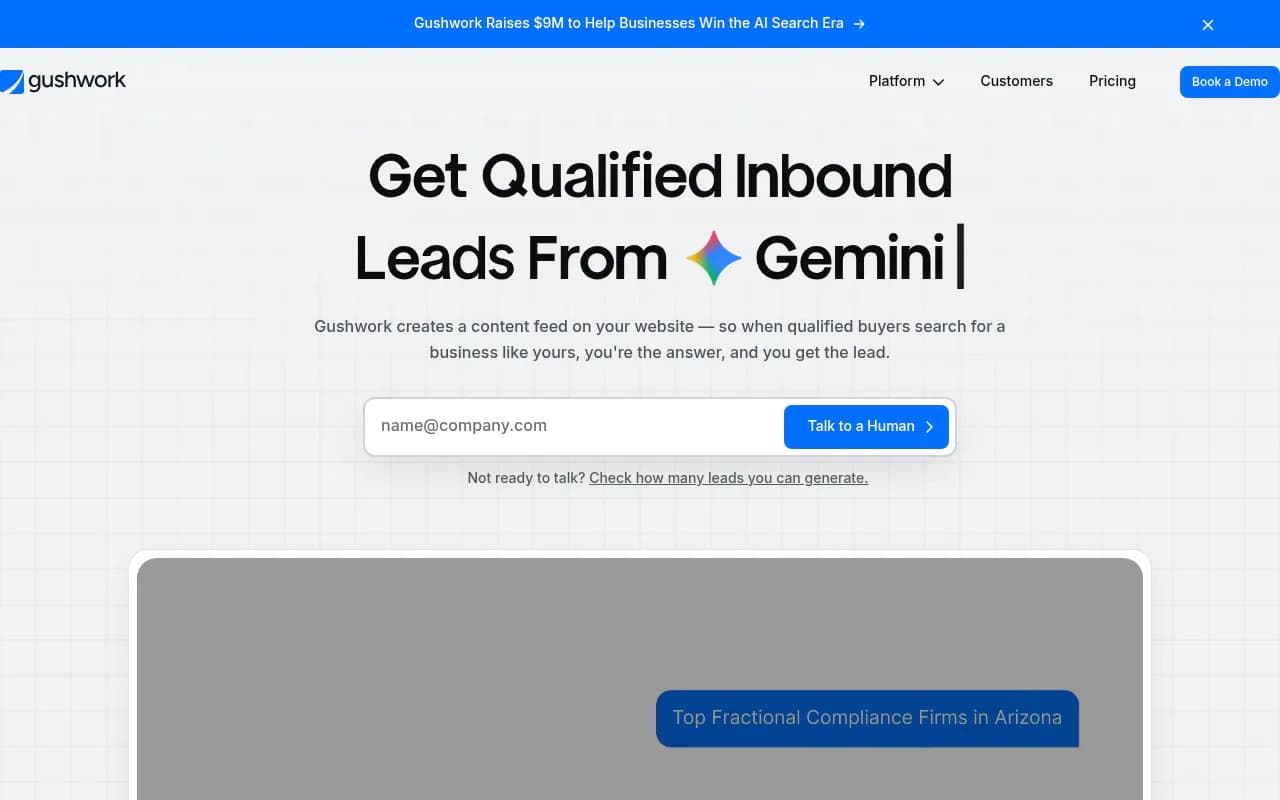
Gushwork is an AI-driven lead generation platform that automatically creates and publishes 100+ optimized pages on your website to capture high-intent search traffic from Google and AI search engines. Built for B2B service businesses, it uses specialized AI agents to research buyer queries, generate content, build backlinks, and deliver qualified leads within 90 days—completely hands-off.
Key takeaways
- Fully automated lead generation: Gushwork builds 100+ pages, publishes them to your site, and optimizes for both Google and AI search engines—no manual work required
- Proven results: Customers report 10-40+ qualified leads per month within 3-4 months, with case studies showing $500K+ in contracts generated
- AI agent architecture: Eight specialized agents handle research, content creation, publishing, backlinking, and optimization in a continuous cycle
- Monitoring-only limitation: Unlike Promptwatch, Gushwork focuses on content generation and SEO but lacks AI crawler logs, real-time citation tracking across multiple LLMs, or detailed AI visibility analytics that show exactly how AI models are citing your brand
- Premium pricing: Starting at $800/month with 6-month minimum commitments—a significant investment that works best for B2B companies with high customer lifetime value
Gushwork is a lead generation platform that promises to turn your website into an inbound inquiry machine. The pitch is simple: hand over your business details, and their AI system will automatically research what your buyers are searching for, create 100+ pages of content, publish it to your site, build backlinks, and start delivering qualified leads within 90 days. For B2B service companies tired of inconsistent lead flow, it's an appealing proposition—set it and forget it.
The company raised $9 million in seed funding from SIG and Lightspeed in early 2025 and claims over 300 paying customers, mostly in the United States. Their case studies feature industrial equipment distributors, B2B SaaS companies, and service providers—businesses where a single customer can be worth tens of thousands of dollars and where traditional outbound sales is expensive and time-consuming.
What makes Gushwork different from hiring an SEO agency or content team is the level of automation. You're not managing writers, editors, or SEO specialists. You're not reviewing drafts or approving publishing schedules. The system handles everything from keyword research to page design to backlink acquisition. It's a black box that promises results, and for the right buyer, that's exactly what they want.
Key features
Business context ingestion: Gushwork starts by building what they call a "living profile" of your business. You provide details about your products, services, brand voice, target markets, geographic focus, and ideal customer profile during onboarding. Their Memory Agent stores this in a shared knowledge layer that every other AI agent references when making decisions. This means the content generated isn't generic—it's supposed to reflect your actual offerings, terminology, and positioning. The system continuously updates this profile as it learns more about your business and market.
Search demand research: The Research Agent scans millions of real searches happening on Google, ChatGPT, Perplexity, and other AI tools to identify what your prospective buyers are actually asking. It's not just pulling keyword volumes from a tool like Ahrefs—it's analyzing the specific questions, comparisons, and problem statements people type when they need what you sell. The system prioritizes searches based on intent, volume, and competitive difficulty, then builds a target list of queries to address. This research phase is continuous—new opportunities get added as search behavior evolves.
Competitive analysis: For every target search query, Gushwork analyzes what's currently ranking on Google and appearing in AI-generated answers. The system reverse-engineers what works: which content formats perform best, what depth of information is required, which competitors are dominating, and where gaps exist. This intelligence feeds into the content creation process so the pages Gushwork builds are designed to outperform what's already out there. The competitive layer updates regularly as rankings shift.
Automated content generation: The Content & Design Agent generates landing pages, educational guides, FAQ content, and blog posts based on the research and strategy. It writes in your brand voice, incorporates your product details, and structures content to answer the specific buyer questions identified in the research phase. The system also handles design—it pulls your site's colors, fonts, and layout patterns to make sure new pages feel native to your existing website. Content isn't just text dumps; it includes proper formatting, internal linking, and calls-to-action designed to convert visitors into leads.
Direct website publishing: The Publishing Agent publishes content directly to your website in a dedicated resource center or content hub. It handles all the technical SEO details: metadata, schema markup, XML sitemaps, internal linking structure, and mobile optimization. The pages are structured so Google and AI crawlers can easily discover, read, and index them. You don't need to manually upload anything or configure settings—the system integrates with your CMS or hosting platform and handles deployment automatically.
Backlink and citation building: The Backlinking Agent creates citations and references across third-party websites to signal credibility to search engines and AI models. This isn't spammy link farming—the system targets relevant, trusted sites where mentions make sense contextually. The goal is to build domain authority and increase the likelihood that AI models cite your content when answering related queries. Backlink acquisition is ongoing, with new links added as content matures and rankings improve.
Performance optimization: The Optimization Agent monitors rankings, traffic, and lead flow in real time. It identifies which pages are climbing in search results and which are stalling. Based on performance data, it triggers rewrites, redesigns, or strategic pivots. If a page isn't converting visitors into leads, the system adjusts the call-to-action or content angle. If a competitor overtakes you, it analyzes what changed and updates your content to regain position. This optimization loop runs continuously—the longer the system runs, the smarter it gets.
Lead capture and dashboard: Inquiries generated from the content flow into a clean lead dashboard where they're organized, spam-filtered, and tracked. Each lead includes context about which page they came from, what search query brought them to your site, and what information they requested. The dashboard integrates with CRMs and email systems so leads can be routed to your sales team automatically. You're not digging through form submissions or website analytics—everything is presented in a single, actionable view.
Who is it for
Gushwork is built for B2B service companies and industrial businesses where customer lifetime value is high and sales cycles are long. Think equipment distributors, specialized manufacturers, B2B SaaS companies, professional services firms, and niche consultancies. The ideal customer is a business owner or marketing leader who knows they need more inbound leads but doesn't have the time, budget, or expertise to build and manage a content marketing operation in-house.
The case studies are telling: Midwest Power Products (industrial equipment), Source Equipment (machinery distributor), Fraxtional (fractional CFO services), John Maye Company (industrial supplies), Pazago (B2B logistics software). These are companies selling complex products or services to other businesses, often with deal sizes in the tens or hundreds of thousands of dollars. For them, generating 10-40 qualified leads per month can translate to millions in revenue.
Gushwork is not for e-commerce brands, consumer apps, or businesses with low-margin products. The pricing (starting at $800/month with 6-month commitments) only makes sense if a single customer is worth thousands of dollars. It's also not ideal for companies that need tight control over messaging or brand voice—you're handing over content creation to an AI system, and while it's trained on your inputs, you're not reviewing every page before it goes live.
Team size doesn't matter much. Solo founders and 50-person companies both use Gushwork because the value proposition is the same: outsource the entire lead generation engine to an AI system so you can focus on closing deals instead of creating content. If you're a marketing team of one at a B2B company, this is a way to punch above your weight. If you're a larger team, it's a way to scale content production without hiring more writers or SEO specialists.
Integrations and ecosystem
Gushwork integrates directly with your website's CMS or hosting platform to publish content. The specifics depend on your tech stack—WordPress, Webflow, custom-built sites—but the system is designed to work with most modern platforms. The Publishing Agent handles the technical connection so you don't need developer involvement after the initial setup.
The lead dashboard integrates with CRMs like HubSpot, Salesforce, and Pipedrive, as well as email marketing tools. Leads captured through the content flow automatically into your existing sales workflow. There's also integration with Google Search Console and Google Analytics to track traffic and performance, though much of the analytics are surfaced in Gushwork's own dashboard.
Backlink building happens across third-party sites, but the specifics of which platforms and publications are used aren't publicly detailed. The system targets relevant, high-authority sites based on your industry and target audience. There's no API or developer platform—Gushwork is a managed service, not a tool you build on top of.
One notable gap: Gushwork doesn't provide AI crawler logs, real-time citation tracking across multiple LLMs, or detailed visibility analytics showing exactly how AI models like ChatGPT, Claude, or Perplexity are citing your brand. If you want to monitor and optimize your presence in AI search engines at a granular level—tracking which prompts you're visible for, which competitors are outranking you, and which content gaps are costing you citations—you'd need a dedicated AI visibility platform like Promptwatch alongside Gushwork.
Pricing and value
Gushwork offers two main pricing tiers with 6-month minimum commitments:
Launch Plan: $800/month — Includes 100 pages published (the "AI Feed"), 10 high-quality backlinks, and the core lead generation system. This is the entry point for smaller B2B companies or those testing the platform for the first time. At $4,800 for six months, you're betting that the leads generated will more than cover the investment.
Grow Plan: $1,200/month — Includes 200 pages published, more aggressive backlink building, and additional optimization cycles. This tier is for companies with larger product catalogs or multiple service lines that need more content to cover all buyer queries. At $7,200 for six months, it's a significant commitment, but the case studies suggest the ROI can be substantial if you're in the right market.
There's also a custom Scale Plan for larger businesses or agencies managing multiple clients, but pricing isn't publicly listed. The 6-month minimum is non-negotiable—Gushwork's pitch is that results take 90-150 days to materialize, so shorter commitments don't make sense.
Compared to hiring an in-house content team or SEO agency, Gushwork is competitively priced. A single SEO specialist costs $60K-$100K per year, plus you need writers, designers, and backlink specialists. An agency might charge $3K-$10K per month for similar services. Gushwork's automation brings the cost down, but you're also giving up control and customization.
The value equation depends entirely on your customer lifetime value. If a single customer is worth $50K and Gushwork generates 10 leads per month with a 10% close rate, you're looking at $50K in monthly revenue from a $1,200 investment—a 40x return. But if your average deal size is $2K, the math doesn't work. The case studies (Fraxtional adding $500K ARR, Source Equipment generating 40+ leads/month) suggest the platform delivers for the right buyer, but it's not a fit for every business.
Strengths and limitations
Gushwork's biggest strength is the level of automation. You're not managing a content calendar, reviewing drafts, or coordinating with freelancers. The system handles everything from research to publishing to optimization. For time-strapped business owners, this is the entire value proposition—set it up once and let it run.
The AI agent architecture is genuinely sophisticated. Most content marketing tools are just keyword research dashboards or AI writing assistants—you still have to do the work. Gushwork's agents operate as a coordinated team, each handling a specific job and feeding insights to the others. The continuous optimization loop means the system gets smarter over time, not just more prolific.
The case studies are strong. Real companies with real names reporting real results—40+ leads per month, $500K in contracts, 228K website visitors. These aren't vague testimonials; they're specific, verifiable outcomes. The fact that Gushwork raised $9 million from top-tier VCs (SIG, Lightspeed) and has 300+ paying customers suggests the product works for its target market.
The limitations are equally important. First, you're handing over content creation to an AI system. While it's trained on your business context, you're not reviewing every page before it goes live. If brand voice and messaging precision are critical, this could be a dealbreaker. Second, the 6-month minimum commitment and $800-$1,200/month pricing mean you're making a significant upfront investment with no guarantee of results. The case studies are impressive, but not every business will see the same ROI.
Third, Gushwork focuses on content generation and traditional SEO but lacks the AI visibility and citation tracking capabilities that platforms like Promptwatch provide. You won't get AI crawler logs showing which AI models are reading your content, real-time citation tracking across ChatGPT/Claude/Perplexity/Gemini, or detailed prompt-level analytics showing where competitors are outranking you in AI search. If your goal is to optimize for AI search engines specifically—not just Google—you'd need a dedicated GEO platform alongside Gushwork.
Finally, the black-box nature of the system means you're trusting Gushwork's algorithms to make the right strategic decisions. You don't see the keyword research, competitive analysis, or content strategy before it's executed. For some buyers, that's a feature. For others, it's a risk.
Bottom line
Gushwork is a strong fit for B2B service companies and industrial businesses with high customer lifetime value who want a fully automated lead generation engine. If you're tired of inconsistent inbound flow, don't have the bandwidth to manage a content team, and can afford the $800-$1,200/month investment, it's worth a demo. The case studies suggest it delivers real results for the right buyer.
But if you need granular control over AI search visibility—tracking exactly how ChatGPT, Claude, Perplexity, and other AI models are citing your brand, identifying content gaps with Answer Gap Analysis, or generating AI-optimized content grounded in real citation data—Promptwatch is the stronger choice. Gushwork automates content creation for traditional SEO; Promptwatch optimizes your entire presence in AI search engines with tools Gushwork doesn't offer: AI crawler logs, multi-LLM citation tracking, prompt intelligence, and AI traffic attribution.
Best use case in one sentence: B2B companies with $10K+ deal sizes who want a hands-off system to generate 10-40 qualified leads per month through automated content and SEO.
Tags:
Frequently asked questions
What is Gushwork?
How much does Gushwork cost?
Who is Gushwork best for?
How long does it take to see results?
Does Gushwork track AI search visibility like ChatGPT or Perplexity?
Is there a free trial?
Similar and alternative tools to Gushwork