Atyla Review 2026
Low-cost GEO platform tracking brand mentions across ChatGPT and other AI engines, aimed at small businesses on tight budgets.
Key takeaways
- Atyla is a low-cost GEO monitoring tool starting at €19/month, built by the French company Senthor.io, which also runs AI crawler traffic analytics for media groups.
- It lacks content generation, AI crawler logs, visitor analytics, and automated optimization workflows that Promptwatch offers, Atyla is monitoring plus audit recommendations, not an execution engine.
- Pricing scales from 15 tracked prompts and 2 AI models on the entry tier up to 100 prompts and 7 models on the Growth plan, with a separate €99/month agency tier covering 11 models and white-label reporting.
- Social proof is thin: one G2 review, roughly 53 Product Hunt reviews, and no public X or GitHub account, which matters if you're trying to gauge long-term reliability.
- Good fit for solo marketers and small agencies who just need a cheap way to see if their brand shows up in ChatGPT answers; not a fit for teams that need to act on citation gaps at scale.
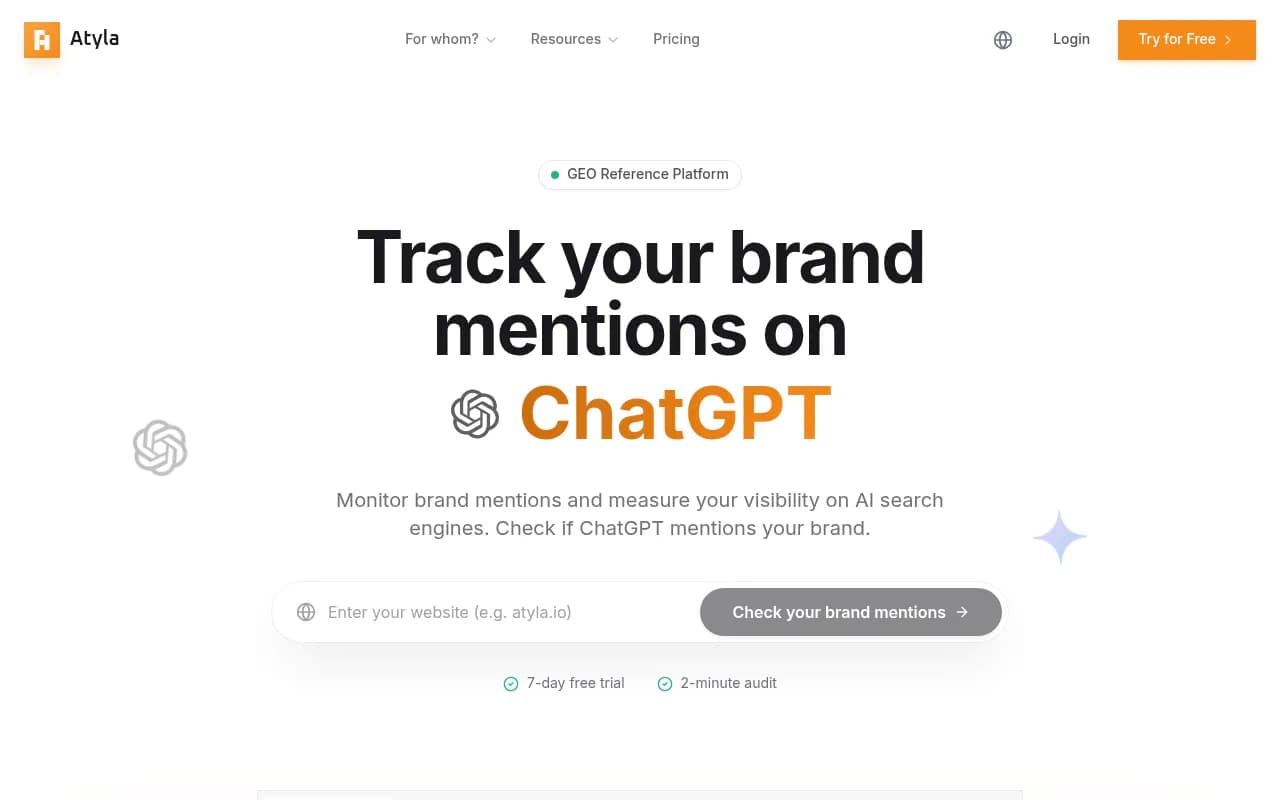
Atyla is a Generative Engine Optimization platform built by Senthor.io, a French company that already sells AI crawler and bot traffic analytics to media publishers. The pitch is straightforward: track whether ChatGPT, Gemini, Perplexity, Claude, Grok, Mistral, and DeepSeek mention your brand, benchmark that against up to five competitors, and get an audit that tells you what content gaps to fix. It launched on Product Hunt roughly eight months before this review and appears to be bootstrapped, run by CEO Tristan Berguer and CTO Matt El Mouktafi.
What differentiates Atyla from the growing pile of "check if ChatGPT knows your brand" tools is the price tag. At €19 to €149 a month, it undercuts most of the category by a wide margin. Profound and AthenaHQ sit closer to $99-$295/month, and plenty of newer entrants start around $29. Atyla is clearly chasing the budget end of GEO, not the enterprise end, and its own marketing leans into this with lines about turning AI visibility into "a monetizable service line" for small agencies rather than a strategic platform for large brands.
Who built this for? Mostly small marketing teams and boutique agencies that want a cheap first step into AI search monitoring, not a full optimization suite. The product itself admits as much: the lowest tier only covers ChatGPT and Gemini, with weekly scans, which is a pretty thin slice of the AI search landscape given how much traffic and citation activity happens on Perplexity and Claude too.
Key features
- Prompt tracking: You define the prompts that matter to your brand (think "best CRM for 10-person B2B SaaS teams") and Atyla suggests related prompts with estimated search volumes. The Essential plan caps this at 15 prompts, Starter at 25, Growth at 100. For context, that's a modest ceiling compared to platforms that track hundreds of prompts per client.
- Multi-model monitoring: Scans run against ChatGPT and Gemini on the base tier, adding Perplexity on Starter, and Claude, Grok, Mistral, and DeepSeek on Growth. The separate agency tier bumps this to 11 models, adding Copilot, Meta AI, Apple Intelligence, and You.com. Scan frequency is weekly on Essential and daily from Starter up.
- Competitive benchmarking: You can add up to five competitor brands and see Share of Voice comparisons, plus alerts when your position shifts relative to them.
- Source and citation discovery: Atyla surfaces which domains (Reddit, Wikipedia, your own site, a competitor's site) AI models actually cite when answering your tracked prompts. This is useful for spotting where you're losing citation share, though it stops short of the kind of page-level citation trend analysis or content-type classification that more mature platforms provide.
- GEO audit and action plan: An automated crawl of your site (100 pages/month on lower tiers, 1,000 on Growth) flags structural and editorial weaknesses, then generates an action plan with article ideas and missing content topics. It produces recommendations; it does not write or publish the content for you.
- Agency white-label tooling: The dedicated agency plan at €99/month supports up to 10 client brands with 15 prompts each, white-label PDF reports, and a multi-client dashboard. Atyla frames this around a "SEE, ACT, REPORT" framework: crawler visibility, semantic gap analysis, and client-facing reporting.
- Slack and email alerts: Starter plan and above get notifications piped into Slack or email when rankings or mentions change. There's no mention of a broader integrations library, no Google Search Console connector, no Zapier, no CMS publishing hooks.
Who is it for
Atyla fits solo marketers, small SaaS founders, and boutique SEO or marketing agencies who want a cheap entry point into AI visibility tracking and don't yet need deep analytics. A two-person startup that just wants to know if ChatGPT mentions them when someone asks for "the best project management tool for freelancers" is a reasonable Atyla customer. Agencies managing a handful of small clients who want a white-label report to hand over once a month are another plausible fit, especially given the €99/month agency tier's 10-client allowance.
It's a weaker fit for mid-market or enterprise marketing teams that need to actually act on what they find. There's no content generation, no CMS publishing, and no crawler log analysis showing which AI bots hit which pages and what they did when they got there. Teams at companies like the kind that use Duolingo-scale GEO programs, with dozens of content writers and a need to prioritize work across hundreds of prompts, will outgrow Atyla's 100-prompt ceiling and its thin feature set quickly.
Companies in industries where AI citation nuance matters a lot, finance, healthcare, anything YMYL, probably want deeper source and sentiment analysis than Atyla currently provides. If your main goal is understanding why you're not cited and then fixing it automatically, this isn't that tool.
Integrations and ecosystem
Atyla's integration story is thin: Slack and email notifications, available from the Starter plan up. There's no public mention of a REST API, no Zapier connector, no Google Search Console integration, and no CMS publishing support for Webflow, Framer, or WordPress. Payments run through Stripe. There's no browser extension and no mobile app referenced anywhere in the product material.
Social presence is also sparse. Atyla has a LinkedIn company page and a Product Hunt listing (around 4.4/5 from roughly 53 reviews, 249 followers), but no dedicated X/Twitter account or GitHub repository turned up in research. For a product in a fast-moving category like AI search optimization, that's a thinner public footprint than you'd expect from a tool asking for a monthly subscription.
Pricing and value
Atyla runs four tiers, billed monthly with a 20% discount for annual billing:
- Essential, €19/month: 15 prompts, 2 AI models (ChatGPT, Gemini), weekly scans, 100 pages audited monthly, GEO audit included, unlimited seats.
- Starter, €69/month: 25 prompts, 3 models (adds Perplexity), daily scans, 100 pages/month, Slack and email integrations, GEO recommendations.
- Growth, €149/month, labeled most popular: 100 prompts, 7 models (adds Claude, Grok, Mistral, DeepSeek), daily scans, 1,000 pages/month, PDF exports, advanced recommendations, priority Slack support.
- Enterprise: custom pricing, unlimited prompts, all models, dedicated account manager.
- Agency: €99/month, up to 10 client brands, 15 prompts per client, 11 AI models, weekly scans, white-label PDF reports, multi-client dashboard.
Every plan includes a 7-day free trial with no credit card required, which is a nice low-friction way to test it. The pricing is genuinely cheap relative to the GEO category; most competitors start closer to $29-$99/month and climb into the hundreds for meaningful multi-model coverage. But the catch is that Atyla's cheapest tier barely covers two models with weekly scans, so you're likely paying at least €69/month to get a usable picture of ChatGPT plus Perplexity, and €149/month if Claude and the rest matter to you too. At that point the price advantage over more full-featured platforms starts to shrink.
Strengths and limitations
Atyla does a few things well. It's genuinely cheap at the entry tier, the interface (prompts, models, brands, sources) is clear and easy to onboard into, and the agency tier with white-label reporting is a sensible add-on for small shops wanting to sell GEO as a service. The audit and recommendation engine gives non-technical marketers a starting checklist rather than just a dashboard of numbers.
Where it falls short compared to Promptwatch is substantial. Atyla has no AI crawler log analysis, so you can't see when ChatGPTBot, ClaudeBot, or PerplexityBot actually visit your pages or what errors they hit. It has no AI traffic attribution or visitor analytics tying AI citations to real site traffic and conversions. There's no Reddit or YouTube-specific citation tracking, no ChatGPT Shopping or Ads Radar, no prompt volume and difficulty scoring beyond basic AI-suggested estimates, and no query fan-out analysis showing how a single prompt expands into sub-queries. Most critically, Atyla generates recommendations but doesn't generate or publish content, it leaves the
Frequently asked questions
What is Atyla used for?
How much does Atyla cost?
Is there a free trial for Atyla?
Who is Atyla best suited for?
How does Atyla compare to Promptwatch?
Does Atyla have an API or integrations?
Similar and alternative tools to Atyla