Snezzi Review 2026
Done-for-you generative engine optimization service for small businesses without marketing staff, starting at $999/month.
Key takeaways
- Snezzi is more than a tracker: it combines AI visibility tracking with a Content Engine (15 articles a month), a Backlink Building Agent and weekly site audits.
- Compared with Promptwatch, it lacks IP-verified AI crawler logs, prompt volume and difficulty scoring, query fan-outs, Brand Narrative and Fact Check, Reddit/YouTube/LinkedIn/Instagram citation reports, AI Shopping and Ads Radar, and tracking beyond five AI engines.
- The $500/month entry price with no cheaper tier is steep for small teams, and the 200 prompts are shared across every brand in an account.
- Proof is self-reported: the case studies are published by Snezzi and I found no independent reviews.
- Best for growing B2B and DTC brands that want the work done, not just a dashboard.
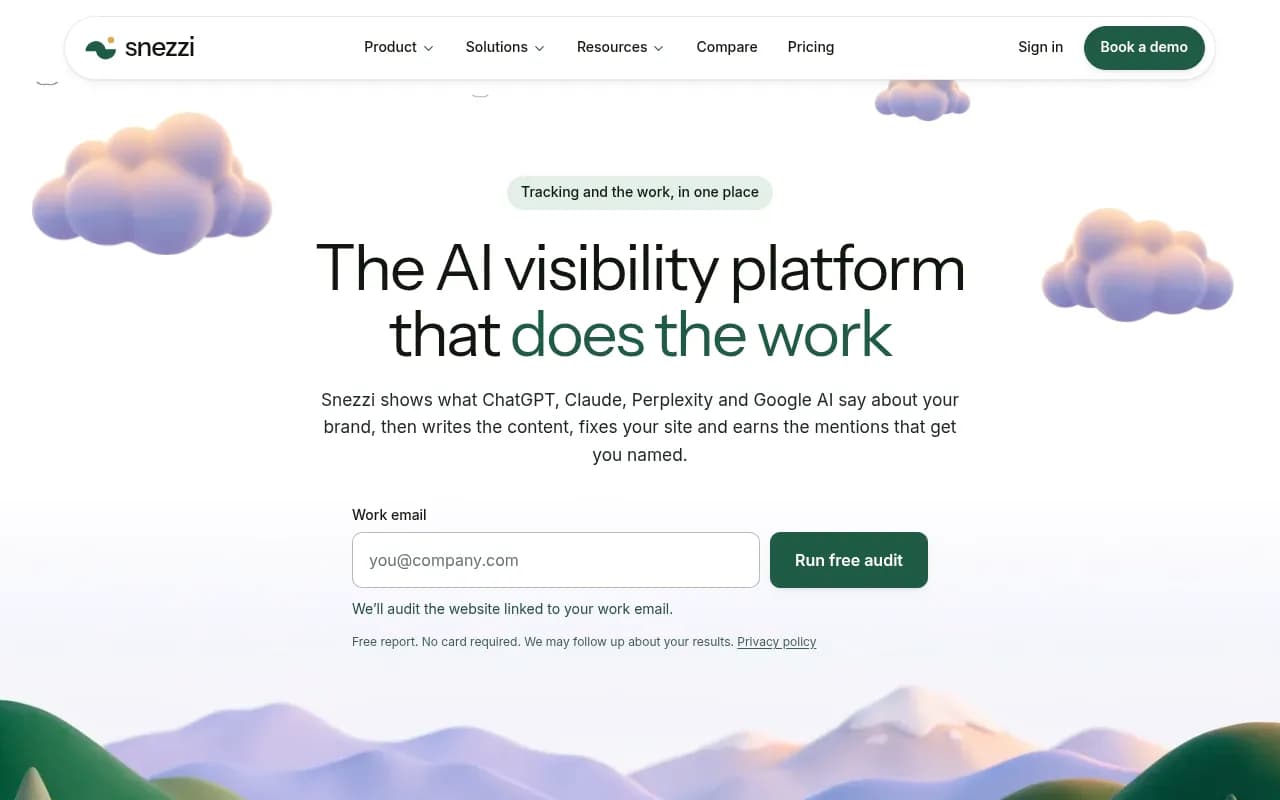
Snezzi is an AI visibility platform that pairs tracking with execution. It asks ChatGPT, Claude, Perplexity, Google AI Overviews and Google AI Mode your buyers' questions on a schedule, records who gets named and which sources get cited, then produces a ranked plan of fixes. From there it drafts content, finds link and community opportunities, and reports on traffic coming back from AI assistants.
The pitch is aimed squarely at the gap most trackers leave open. You see a score drop on a dashboard, and nobody tells you what to do about it this week. Snezzi's answer is a weekly plan called Signals, a content pipeline that publishes to your CMS after you approve it, and an optional done-for-you team. Customer logos on the site include Unleash Wellness, Orbrick, Virohan, Bugni Labs and StartupOG, so the audience is growing brands rather than big enterprises.
There are two ways to buy. The Platform plan is $500 a month, and the done-for-you plan starts at $1,999 a month and includes the same platform plus a team. That is a notable shift from the earlier positioning of the product as a fully managed service for small businesses only.
Key features
AI visibility tracking. Snezzi runs your tracked buyer questions across five engines: ChatGPT, Claude, Perplexity, Google AI Overviews and Google AI Mode. You choose daily or weekly runs at onboarding. For each prompt you see position, the competitors named, a gap score and the sources each engine cites. Answers come from fresh sessions with no chat history, from the country you choose, so they reflect what a new buyer sees rather than what your logged-in account shows. The dashboard reports an AI Visibility percentage, Share of Voice across tracked brands, a Top-3 rate and a per-platform breakdown.
Signals, the weekly plan. Every Monday you get a short ranked list of plays, each with the reason behind it and the buyer questions it targets. In the demo, a typical play is publishing a comparison page for prompts where a competitor is cited first. Plays move through In progress, Shipped and Verified states, and Snezzi checks afterwards whether the AI answer changed. This closed-loop idea is the most interesting part of the product.
Content Engine. The Platform plan includes 15 articles per calendar month, written to win a specific tracked question and published after approval. Drafts use sources and your brand facts, and Brand rules (goals, voice, banned words, claim rules) keep every draft consistent. Unused articles do not roll over, though articles imported from WordPress or Shopify do not count toward the cap. A content refresh flow turns pages that lose clicks or citations into refresh drafts.
Approval workflow. Nothing goes public without a yes from the person you pick. The platform shows the draft, the target prompts and the rationale, and can notify the content owner in Slack. Every action is logged with what shipped, when, and whether the answer moved afterwards.
Backlink Building Agent. It finds prospects from the sites AI engines already cite, drafts outreach and verifies that links go live. Snezzi says it is white-hat only, with no PBNs or spam link sellers. On the Platform plan you send the outreach yourself. On the done-for-you plan the team sends, replies and follows up.
Reddit and Quora opportunities. The tool surfaces threads and questions that AI cites and drafts replies. Again, self-serve users do the posting. The done-for-you team posts from accounts set up with you.
Site health and indexing. A weekly audit covers per-page health, indexing checks and Bing submission. On the Platform plan your own team makes the fixes. The managed team fixes what it can and briefs your developer for the rest.
AI referral traffic. Sessions from AI assistants appear next to Search Console and GA4 data, including engaged sessions, share of site traffic and conversions. In the sample dashboard, ChatGPT accounts for 40% of AI sessions. The Traffic screen reads GA4, Search Console and Bing Webmaster Tools.
Snezzi AI and extras. A chat assistant answers questions about your numbers, with a warning that brand-scoped answers can be incomplete and sources should be reviewed. There are also social posts and YouTube videos generated from your pages, plus a Monday digest. Domain Rating data from Ahrefs sits alongside competitor benchmarks.
Who is it for
The sweet spot is a growing company with a real marketing goal but not enough hands. Think a B2B SaaS with a two-person marketing team that wants to appear in ChatGPT answers for "best X for Y" questions, or a DTC brand like a supplements company that needs comparison pages and community mentions but has no content staff. The done-for-you plan fits founders who want an account manager, a strategy call every two weeks and a shared Slack or WhatsApp channel.
The self-serve Platform plan suits in-house marketers who can execute. You get the plan and the drafts, but outreach, Reddit and Quora posting, social scheduling and site fixes are still yours.
Who should skip it? Solo founders and very small shops will balk at $500 a month with no lower tier (Snezzi even has a page explaining why). Agencies with many clients will hit the 200-prompt cap shared across all brands in an account. Teams that want deep analytics, such as crawler logs, prompt volumes or shopping data, will find the feature set thin.
Integrations and ecosystem
Publishing goes to WordPress, Shopify, Webflow, Sanity, Strapi, Astro and TinaCMS, which is a better headless CMS list than many competitors offer. For measurement it reads Google Analytics 4, Google Search Console and Bing Webmaster Tools, and the pricing page mentions your social scheduler. Slack is used for approval notifications.
I found no public API, MCP server or browser extension documented. Plan details mention no seat limit and no credits, so nothing is metered per user. An affiliate program reportedly pays 20% recurring commission on referred platform plans, though I could not verify that on the page itself.
Pricing and value
- Platform: $500/month or $5,000/year. Includes 200 tracked prompts across five engines, daily or weekly tracking, 15 articles a month, Signals, Snezzi AI, the Backlink Building Agent, technical audits and AI traffic reporting. There are no credits or seat caps.
- Done for you: from $1,999/month, quote-based on your site, market and needs. It includes the platform plus an account manager, biweekly strategy calls, content, technical fixes, link earning, outreach, Reddit and Quora posting, social publishing and written reports. A 3-month pilot comes first, then quarterly or annual terms.
- Trial: a 7-day trial for $10 with onboarding help. There is also a free audit that scans the site tied to your work email, no card required.
Is it good value? Against monitoring-only tools at $29 to $100 a month, $500 looks expensive. But the bundle includes 15 articles and backlink tooling, which would cost more from freelancers. For comparison, Promptwatch's Essential plan is $95/month and its Business plan with the automated Content Agent is $579/month, with unlimited seats and 20 tracked engines and models. The managed tier at $1,999 is in line with small SEO retainers, but because it is quote-based you should get a proposal before comparing.
Strengths and limitations
Strengths
- Tracking and execution live in one product, with a weekly plan that explains its reasoning.
- The approval workflow and action log make it safe to let a tool publish for you.
- Wide CMS support, including Sanity, Strapi, Astro and TinaCMS.
- AI referral traffic sits next to Search Console and GA4.
- A clean upgrade path from self-serve to managed, with data carrying over.
Limitations
- $500 a month is the floor, and 200 prompts are shared across every brand.
- Five engines only. No Meta AI, Amazon Alexa, Copilot, Gemini app or coding-agent coverage.
- Self-serve users still do outreach, community posting and site fixes by hand.
- Evidence is self-reported, with a single enterprise case study and no independent reviews found.
What it lacks compared with Promptwatch
Promptwatch is the stronger pick when you need depth. It has IP-verified AI crawler logs with crawl-to-citation tracking, prompt volumes and difficulty scores, query fan-outs, Brand Narrative and Fact Check, Reddit, YouTube, LinkedIn and Instagram citation reports, Page Tracker and Offsite Mentions, ChatGPT and Alexa shopping insights, Ads Radar, local GEO targeting at exact coordinates, hourly tracking, an Action Board, Agent Chat in Slack, and an MCP server plus REST API. It also tracks real interfaces across 20 engines and models. Snezzi covers the core loop, but not these. See Promptwatch vs the alternatives.
Bottom line
Snezzi is a credible choice for a growing brand that wants an AI visibility tool that also ships content and links, and is willing to pay $500 a month for it. The approval gates and the biweekly managed option make it easy to hand off work without losing control. Treat the case-study numbers as vendor claims until you see your own data in the trial.
If you want optimization with deeper data, crawler logs, shopping, social-citation tracking and broader engine coverage, Promptwatch is the stronger alternative, with a 7-day free trial and a free AI visibility report. For more options, browse the GEO software directory at bestgeosoftware.com.
Best use case: a small marketing team that wants AI visibility tracking and a steady stream of approved content and backlinks without hiring an agency.
Frequently asked questions
What is Snezzi?
How much does Snezzi cost?
Which AI engines does Snezzi track?
Does Snezzi publish content for me?
Is there a free plan?
How does Snezzi compare to Promptwatch?
Similar and alternative tools to Snezzi