Waikay Review 2026
Prompt tracking tool with Brand Visibility Tracker, Fact Tracker, Source Tracker, and GEO Action Plans built by a knowledge-graph team.
Key takeaways
- Waikay is a niche AI visibility tool built around knowledge graphs: it compares a graph built from your website against a graph built from what LLMs say about you, then scores the gap.
- It lacks AI crawler logs, visitor/traffic analytics, Reddit and YouTube citation tracking, content generation with CMS publishing, and prompt volume/difficulty scoring, all of which Promptwatch includes.
- Its Fact Tracker and Source Tracking features are genuinely distinctive, a dedicated hallucination-catching workflow that most competitors don't bother building.
- Pricing starts at $24.95/month for a light plan and climbs to $449.95/month for 880 tracked prompts, which a third-party roundup (gtmonly.com) already flags as pricey for startups.
- It only covers 4 AI models (ChatGPT, Gemini, Claude, Perplexity/Sonar) with ChatGPT and Claude responses limited to training-data mode rather than live search, a real methodological constraint worth knowing before you buy.
What Waikay actually is
Waikay comes out of InLinks, the entity-SEO company Dixon Jones and Fred Laurent started back in 2016. It launched on March 19, 2025, as a standalone product, and the knowledge-graph DNA shows in almost every feature. Instead of just screenshotting what ChatGPT says about your brand, Waikay builds an actual knowledge graph from your website and another from aggregated LLM outputs, then diffs the two to produce what it calls an AI Knowledge Score. That's a more rigorous approach than a lot of "ask the bot and count mentions" tools, and it shows Waikay's team understands NLP at a technical level most prompt trackers don't bother with.
The pitch is "what AI knows about you," and the product leans hard into accuracy rather than volume. Waikay's own comparison page is unusually candid: no sentiment analysis (they wrote a whole piece arguing sentiment scores are unreliable), no prompt volume tracking, and no content generation. They call themselves the "accuracy specialist" in a market full of broader AEO platforms, explicitly positioning against Profound (enterprise), Peec AI (mid-market), Otterly.AI (budget SMB), and Writesonic (content + GEO). That kind of self-awareness is refreshing, but it also tells you exactly where the gaps are.
Key features
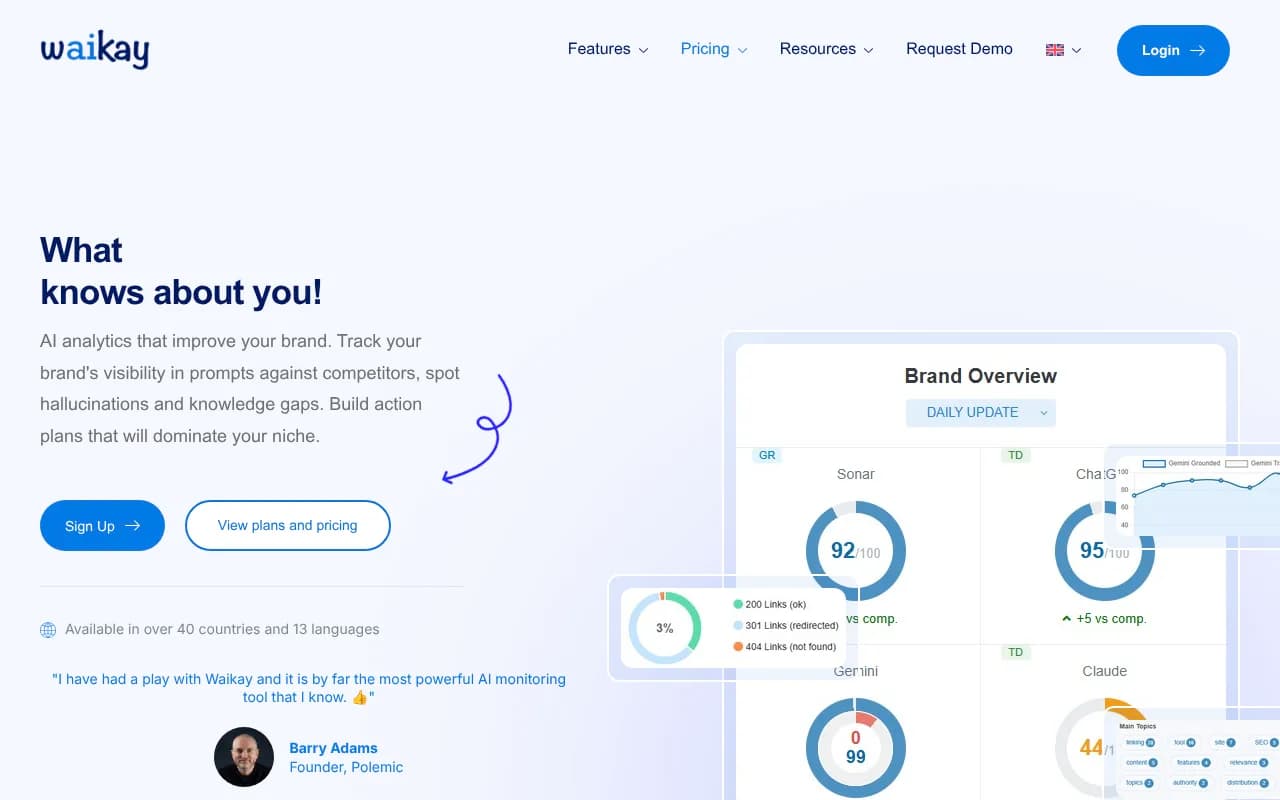
- Brand AI Visibility Tracking. Tracks your brand across 6 AI models and hundreds of prompts, producing Share of Voice and Topical Presence scores per prompt, with competitor benchmarking and trend lines over time. In practice this is the core dashboard you'll live in day to day.
- Topic Reports and AI Understanding Score. Each topic gets tested against both Training Data (TD, the model's baked-in knowledge) and Grounded Reports (GR, live retrieval-backed answers from Gemini and Sonar). The split matters: a brand can look great in training data and invisible in live search, or vice versa, and Waikay is one of the few tools that separates the two cleanly.
- Fact Tracker. This is Waikay's standout idea. It surfaces specific claims AI models make about your brand as a checklist, and you mark each one correct, flag it as wrong, or delete it. It's built specifically to catch hallucinations before a bad claim about your pricing, founding date, or product lineup spreads across more models. Nobody else in this space has built out hallucination-correction as a dedicated workflow quite like this.
- Source Tracking. Splits citations into Knowledge Sources (the pages actually shaping how AI understands your brand) versus Commercial Sources (pages cited in competitive or purchase-intent prompts). Filterable and exportable, useful for figuring out which third-party pages you need to fix or get cited more on.
- GEO Action Plans. Prioritized, topic-level recommendations for content and backlinks, with progress tracking as AI models pick up the changes. You get up to 30 action plans on the Small Teams tier, scaling to 220 on the top self-serve plan.
- Competitor benchmarking, capped at 2 rivals per Topic Report. Waikay caps this deliberately to control query costs (4 LLMs x 3 brands = 12 queries per check), though Brand Visibility Reports separately auto-detect any brand surfacing in live prompt results, so you're not totally boxed in.
- API access (launched ~May 2026). Lets you create, update, and delete prompts programmatically, plus pull Overview, Rankings, and Sources data as JSON. It plugs into Looker Studio, n8n, Zapier, Make, BigQuery, Snowflake, and Postgres, though these are DIY integrations via raw API calls rather than pre-built connectors. Available from the $69.95/month Small Teams plan up.
- EntityMap. A newer, separate initiative: a structured, machine-readable file describing your brand as a knowledge graph meant to feed AI models cleaner entity data. Waikay ran this on its own site and reported strong Gemini/Sonar gains; a Bing Webmaster Tools case study over 19 weeks claimed +267% AI citations overall and +406% bottom-of-funnel citations. Promising, but it's effectively a structured-data experiment bolted onto the core product, not a mature feature yet.
- MCP server. Read-only and limited to about 5 tools. By Waikay's own admission this trails Otterly.AI's MCP/Claude Skill setup, which has roughly 20 tools and write access.
Who is it for
Waikay fits SEO practitioners and agencies who already think in terms of entities and knowledge graphs, often because they or their clients already use InLinks. It also suits PR and communications teams whose main worry isn't "are we visible" but "is AI saying something wrong about us," since the Fact Tracker is built exactly for that job. Brand managers at mid-size companies watching 1-3 brands across a handful of core topics will get real value from the Topic Reports and the TD/GR split.
It's a weaker fit for teams that want to go from insight to published content without leaving the platform. There's no content generation or autonomous agent layer, Waikay explicitly says so, and you'd need to pair it with InLinks or another writing tool to close that loop. Agencies managing 20+ client sites who need AI traffic attribution, crawler-log diagnostics, or Reddit/YouTube citation data will find Waikay's scope too narrow; it simply doesn't track those surfaces.
Integrations and ecosystem
Waikay's integration story runs through its API: JSON output usable with Looker Studio, n8n, Zapier, Make, GitHub Actions, BigQuery, Snowflake, and PostgreSQL. There's no native Looker Studio connector or Semrush integration out of the box, something Waikay's own comparison page admits competitors like Peec AI and Otterly.AI handle better. The sister product InLinks can be layered on for content generation and internal linking, which is the closest thing to a content workflow Waikay offers. No GitHub repo exists for Waikay itself; it's closed-source and hosted at app.waikay.io.
Pricing and value
- Free: one-time 3 credits (1 Brand Overview, 1 Topic Report + Action Plan, up to 20 prompt-tracking calls), full feature access but credits don't renew.
- Early Adopter / solo tier: $24.95/month, 8 credits/month, up to 160 prompts, one seat.
- Small Teams: $69.95/month, up to 120 prompts, 30 AIO Action Plans, 2 seats, API access starts here.
- Large Teams: $199.95/month, up to 360 prompts, 90 Action Plans, unlimited seats, team training included.
- Bigger Projects: $449.95/month (listed as $444 in Waikay's own credit calculator, a minor site inconsistency), up to 880 prompts, 220 Action Plans.
- Enterprise: custom, 200+ credits, via a Calendly call.
Credits scale with prompt frequency times number of models tracked, so a weekly check on one model costs 0.25 credits while a daily check across all four models costs 8. That's a reasonable system once you understand it, but it adds friction for buyers trying to compare Waikay's price against flat-rate competitors. A third-party roundup (gtmonly.com) already calls Waikay likely expensive for startups, and at $69.95-$199.95/month for what's still a monitoring-first tool, that's a fair read for smaller teams without a dedicated budget for AI visibility.
Strengths and limitations
Waikay does a few things exceptionally well. The knowledge-graph scoring methodology is more technically grounded than most "ask ChatGPT and screenshot it" competitors. The Fact Tracker is a genuinely useful, underbuilt idea elsewhere in the category. The TD vs GR split on Topic Reports gives a clearer read on training-data knowledge versus live search behavior than most dashboards offer.
But measured against a full-stack platform like Promptwatch, the gaps are real. Waikay tracks only 4 models (ChatGPT, Gemini, Claude, Sonar/Perplexity), with ChatGPT and Claude limited to training-data mode rather than live search results, versus Promptwatch's coverage of ChatGPT, Gemini, Claude, Perplexity, Grok, Meta Llama, DeepSeek, Mistral, Copilot, Google AI Overviews, and AI Mode. Waikay has no AI crawler logs, so you can't see when ChatGPTBot or PerplexityBot actually visits your pages. It has no visitor analytics or AI traffic attribution, so there's no way to tie AI citations back to actual site visits or conversions. It doesn't track Reddit or YouTube citations, doesn't monitor ChatGPT Shopping or ads, and has no prompt volume or difficulty scoring, no query fan-out analysis, and no content generation or CMS publishing agent. Waikay's own comparison page admits most of this outright, which at least makes for an honest buying decision.
Bottom line
Waikay is a solid pick if your main problem is "AI is saying something inaccurate about my brand" and you want a knowledge-graph-grounded way to prove and fix it, especially if you're already in the InLinks ecosystem. If you need the fuller picture, crawler logs, traffic attribution, Reddit and YouTube tracking, and an agent that actually writes and publishes GEO content rather than just recommending it, Promptwatch covers that ground and then automates the fix, which makes it the stronger choice for teams that want optimization, not just monitoring.

Frequently asked questions
What is Waikay?
How much does Waikay cost?
What AI models does Waikay track?
Does Waikay offer content generation?
How does Waikay compare to Promptwatch?
Is there a free plan?
Similar and alternative tools to Waikay