Key takeaways
- Perception tracking is different from visibility tracking. Visibility asks whether you were mentioned. Perception asks what the AI said, in what tone, and whether it was true.
- The useful features to look for are claim-level analysis, sentiment by topic, fact checking against your own pages, and source tracing.
- Brand prompts in ChatGPT draw on fewer sources than general prompts, so a short list of review sites and forums shapes how you get described.
- Legacy listening tools (Meltwater, Talkwalker, Brand24) now offer AI tracking, but AEO-native platforms go deeper on prompts and citations.
- Most vendor listicles rank the vendor first. Treat them as input, not as a verdict, and test two or three tools on your own prompts.
What perception tracking actually means
A mention is a binary event. Your brand name appeared in an answer, or it did not. Perception is everything around that: the adjectives, the comparisons, the claims about price and support, the order in which you were listed, and whether any of it is right.
I think this is the part most teams skip. They set up a dashboard, see a visibility score creep from 12 to 18, and call it progress. Meanwhile ChatGPT is telling buyers your product "lacks integrations" because it read a two-year-old forum thread. The score does not catch that.
A proper perception setup answers four questions:
- How are we described? Tone, attributes, and the specific claims AI makes.
- Is it accurate? Which claims are wrong, and which page taught the model the wrong thing.
- Where does it come from? Which sources the model cited when it said it.
- How do we compare? The same questions answered for your competitors.
The tools below differ mostly in how many of those four they cover.
Why brand prompts behave differently
Perception is shaped by a narrower set of sources than most people assume. Promptwatch Data's report on unique domains per ChatGPT response (Sep 28 to Oct 4, 2026, responses with at least one citation) splits this by prompt type:
| Prompt type | Responses citing 10+ domains | Responses citing 5 or fewer |
|---|---|---|
| Organic (no brand named) | 52.5% | Low |
| Competitor comparison | 49.1% | Low |
| Brand-specific ("is Asana good for small teams") | 21.3% | 40.7% |
For brand-specific prompts the most common count is 5 domains, at 14.9% of responses. That is a short list. Whoever sits on it, usually review sites, forums, and your own pages, gets to define you. The same report recommends tracking where you appear in the response and how ChatGPT describes you, measuring across many prompts rather than one, and checking which sources get cited for your competitors. That is a decent checklist for evaluating any tool.
One caution on numbers: a separate Promptwatch Data report on average sources per response counts citations per answer, not unique domains, so the two figures measure different things. It is also an older snapshot, so use it for the shape of the pattern (Perplexity steady near 10 sources, Copilot volatile) rather than current values.
What to look for in a perception tool
Claim-level analysis
Sentiment scores are a blunt instrument. A 62 out of 100 tells you nothing about what to fix. The better approach pulls individual claims out of responses ("affordable for small teams", "mobile app lacks features"), groups repeats, and shows which models say them. Few tools do this well.
Accuracy checking
Presence is not accuracy. Some tools flag misinformation, some only report it, and a few trace it back to the page that caused it. If you sell something with pricing tiers, regulated claims, or a history of product changes, this matters more than anything else on the list.
Real interfaces, not just APIs
What a user sees in ChatGPT or Google AI Overviews can differ from what the API returns. If perception is the goal, you want data from the actual user-facing answers, in the countries and languages you sell in.
Source tracing
Knowing the model said something unflattering is half the job. You also need the URL, Reddit thread, or review page it learned it from.
Personas
A CFO and a junior marketer ask different questions and sometimes get different answers. Tools that let you prompt as distinct buyers expose gaps a single generic prompt set hides.
The platforms, grouped by approach
The Rework guide to AI brand monitoring tools draws a useful line between AEO-native point trackers and legacy listening platforms that added AI features. I will use a slightly different split: platforms that fix problems, trackers that report them, and listening suites that extend an existing contract.
Platforms that track perception and act on it
Promptwatch is the one I would start with if the goal is understanding and then changing what AI says. Its Brand Narrative feature pulls individual claims out of every tracked response, groups repeated ones, and files them under themes such as Pricing, Features, Support, and Reputation with a 0-100 score per theme you can compare against competitors. Fact Check lets you mark a claim Accurate or Inaccurate, then reads the pages crawled from your site to find the ones that state it or its opposite, so you know which page the model is learning the wrong thing from. Brand Narrative is on every plan; Fact Check is on Business and above.
The rest of the loop matters for perception too. It collects answers from the real interfaces of ChatGPT, Google AI Overviews, AI Mode, Gemini, Perplexity, Copilot and others, supports personas with a radar chart against the general audience, traces citations to Reddit, YouTube and LinkedIn, and has a Content Agent that writes and publishes corrections. IP-verified crawler logs show whether AI bots can even read the page you are trying to fix. For a quick first look, the free AI visibility report needs no login.

Pricing starts at $95/mo (Essential) and $245/mo (Professional), with Business at $579/mo; confirm at promptwatch.com/pricing. There is a 7-day free trial on monthly billing.
Profound is the other enterprise name you will see everywhere. It has a FactCheck Agent that corrects misinformation rather than only flagging it, and an agency mode with client workspaces. The Rework guide notes there was no self-serve paid tier at the time of writing, so expect a sales call. Pricing may have changed, so verify before you commit. Profound's own claim of 1.9+ billion real user prompts is a vendor number I could not check.

Evertune markets an AI Brand Index and sentiment and perception tracking with associated attributes across models. Its "10 best AI visibility tools" list puts Evertune first and omits both Promptwatch and Profound from its comparison table, so read it as a vendor pitch. The product itself is aimed at enterprises.
Monitoring-focused trackers
These answer "are we mentioned, and roughly how" at lower price points. None of the research I read credits them with content generation or deep source-to-page diagnosis.


Peec AI is known for share of voice and citation sources, Otterly for fast, cheap setup, AthenaHQ for an action center on top of monitoring, and Scrunch for accuracy and misinformation alerts. Rankscale is often cited for the lowest floor price and for naming sentiment directly.
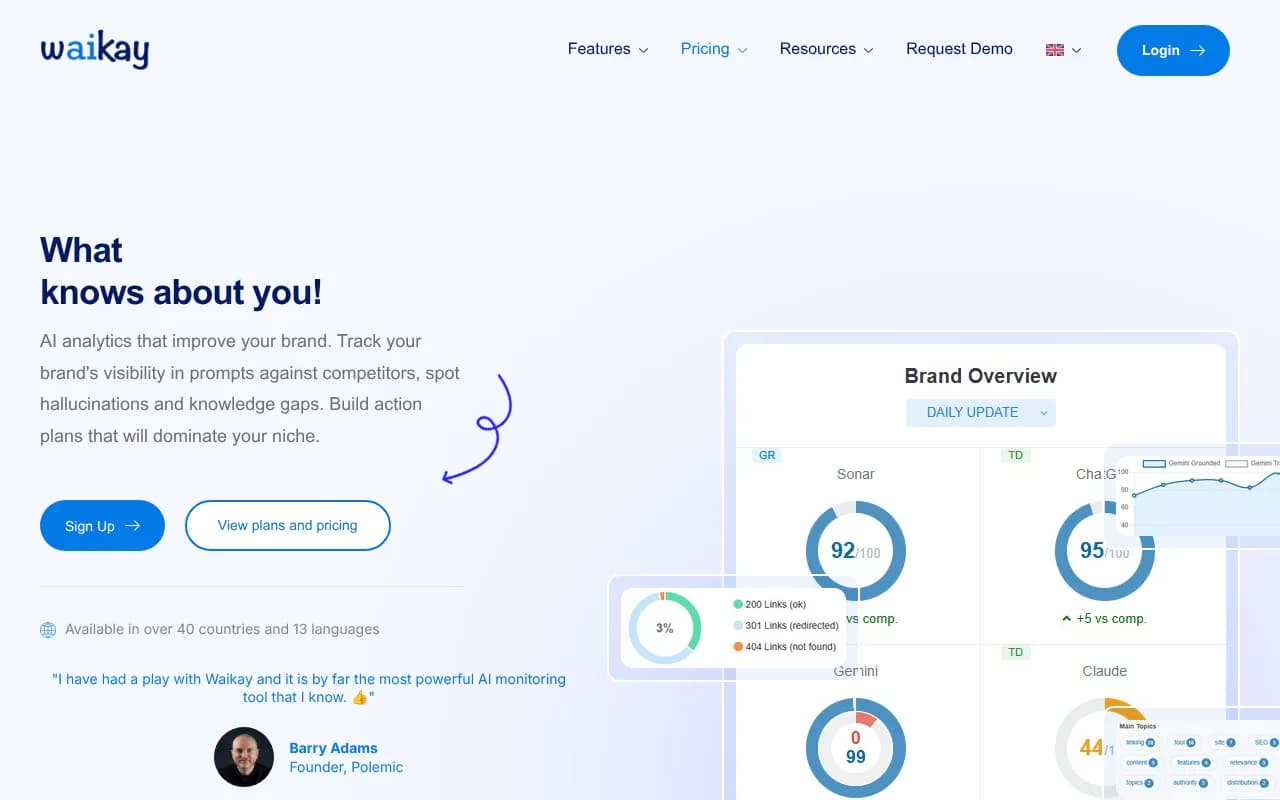
Waikay takes a narrower angle: it focuses on the factual accuracy of what AI says about you, using a knowledge-graph approach.
SEO suites with AI add-ons
If your team already lives inside an SEO platform, the bolt-on is the path of least resistance. The trade-off is depth: fixed prompt sets and shallower AI-specific data.
Listening platforms that added AI tracking
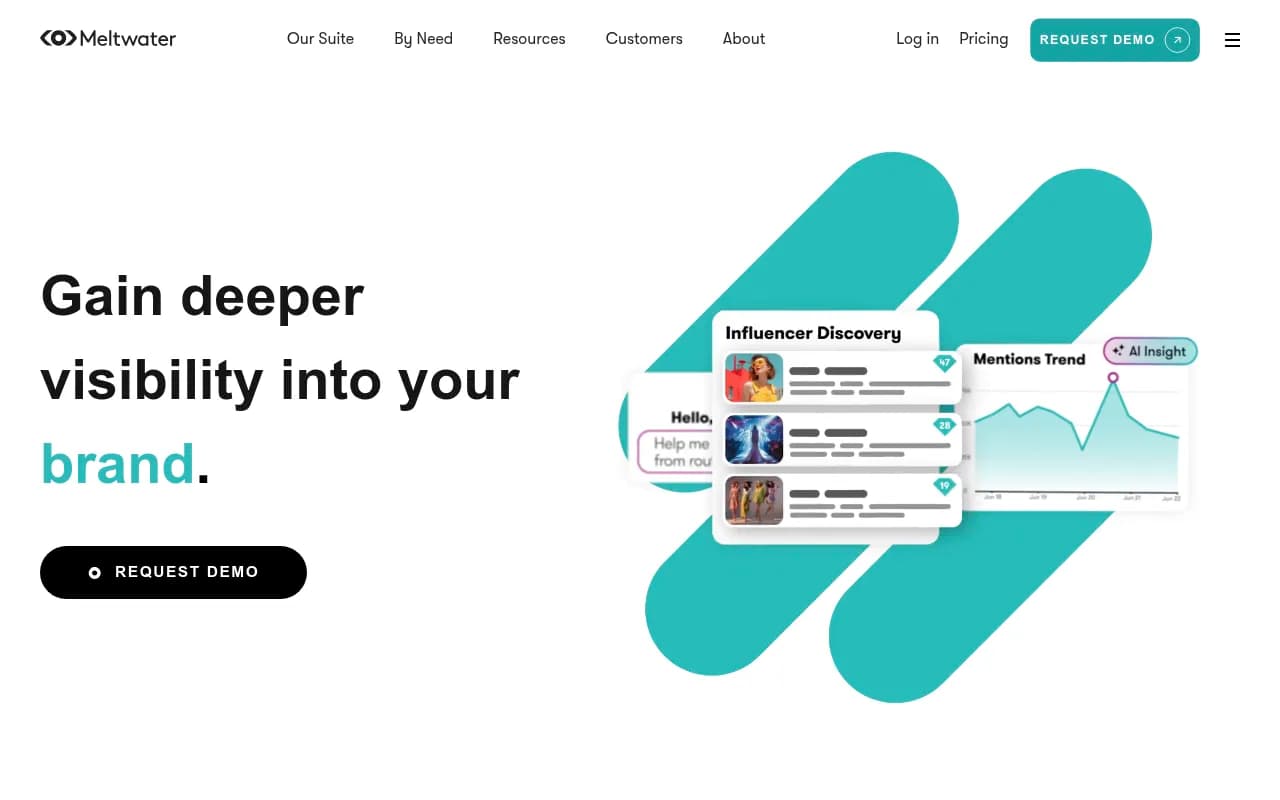
Meltwater (GenAI Lens), Talkwalker (LLM Insights) and Brand24 (AI Visibility) are real extensions, not rebrands. Meltwater tracks nine AI platforms according to the Rework guide, and both Meltwater and Talkwalker include misinformation detection. The catch is access and price: neither publishes pricing for the AI feature, so they realistically suit existing customers.
Brandwatch belongs in a different bucket. It monitors what people already say about you in the wild, which is useful context, but it does not query AI engines.
Brandwatch Consumer Intelligence
Side-by-side comparison
| Tool | Claim-level perception | Accuracy / fact checking | Acts on findings | Best for |
|---|---|---|---|---|
| Promptwatch | Yes (Brand Narrative) | Yes (Fact Check, Business+) | Content Agent, Action Board | Teams that want to change the answer |
| Profound | Sentiment and narrative | FactCheck Agent | Content creation | Enterprises and agencies |
| Evertune | Sentiment and attributes | Not confirmed | Optimization guidance | Enterprise brand teams |
| Scrunch | Monitoring | Accuracy alerts | Limited | Misinformation watch |
| Waikay | Fact-focused | Yes | Action plans | Accuracy-first audits |
| Peec AI | Share of voice | No | Reports | Cheaper ongoing tracking |
| Otterly.AI | Basic | No | Briefs | Solo marketers, small agencies |
| Ahrefs Brand Radar / Semrush | Shallow | No | Reports | Teams already on those suites |
| Meltwater / Talkwalker | Sentiment trends | Misinformation detection | Reports | Existing listening customers |
Treat the cells marked "not confirmed" as gaps in my research, not as proof the feature is absent. Pricing for most of these changes often, so check vendor pages.
Matching tool to team size
The Rework guide's stage-based advice holds up reasonably well, with my own tweaks:
- Under 20 people, just curious: use a free grader or the free tier of something. Promptwatch's free report, HubSpot AEO Grader and similar one-off checks are enough to see whether there is a problem.
- 20 to 100 people, validating the category: a cheap tracker (Otterly, Rankscale, Trakkr) works if you only need to watch mentions. If you already suspect AI is saying wrong things, skip straight to a tool with claim-level analysis.
- 100 to 500 people, building a process: you need an action layer. That is where Promptwatch, AthenaHQ and Profound compete.
- 500+ already on an SEO suite: Ahrefs Brand Radar or Semrush as a first step, then add a specialist when the gaps show up.
- 500+ already on a listening platform: try the AI feature you already pay for before buying another login.
- Agencies: look at agency plans with unlimited projects and white-label options. Promptwatch's agency tiers start at $199/mo, and Profound has client workspaces.
For broader directories, the GEO software directory at bestgeosoftware.com lists far more options than I can cover here.
How to test a tool in a week
Do not pick from a feature page. Run a short trial on your own brand.
- Write 20 to 30 prompts across three types: general category questions, "is [your brand] good for X", and "[you] vs [competitor]". The brand-specific ones matter most for perception.
- Run them in the tool and compare against what you see by hand in the real ChatGPT or Gemini interface. If the numbers do not roughly match, the tool is leaning on API outputs.
- Pull out the claims. Can the tool show you the specific statements, or only a score?
- Pick two claims you know are wrong. Can the tool show which source produced each?
- Check the competitor view. Perception is relative, and "neutral" sentiment means something different when your rival is praised.
- Look at refresh rate. Daily is fine for most. Faster tracking only matters around launches or crises.
Repeat across several days. One response from one model on one afternoon proves nothing, which is the same warning the unique-domains report gives about single prompts.
Common mistakes
Trusting a single sentiment number. It hides which claim is hurting you.
Tracking only ChatGPT. Models disagree. Gemini, Perplexity and AI Overviews can describe you differently, and so can models answering from training data alone.
Ignoring where the model got it. If the source is a stale review page or a forum thread, the fix is outreach or a better page of your own, not a prompt tweak.
Buying on a vendor ranking. The Evertune list ranks Evertune first. The Profound list ranks Profound first. The Leapd list ranks Leapd first. This is normal, and it is why a trial beats a roundup.
Treating monitoring as the finish line. A dashboard that tells you the problem and leaves the rewrite to you is half a tool. For perception, the useful loop is monitor, trace, fix the page, then re-measure.
Final recommendation
If you only want to know whether you are mentioned, a cheap tracker is fine and you will be happy with it. If you care what AI actually says, and you want to correct it, pick a platform with claim-level analysis, fact checking tied to your own pages, and a way to ship the fix. Of the options above, Promptwatch covers that whole loop in one product. Start with the free AI visibility report, then run a trial against two other tools using the same 25 prompts. The one that shows you a wrong claim and the page behind it is the one to keep.
For more on how AI answers get built, browse Promptwatch Data, and for other rank-tracking options see ai-rank-tools.com.