Key takeaways
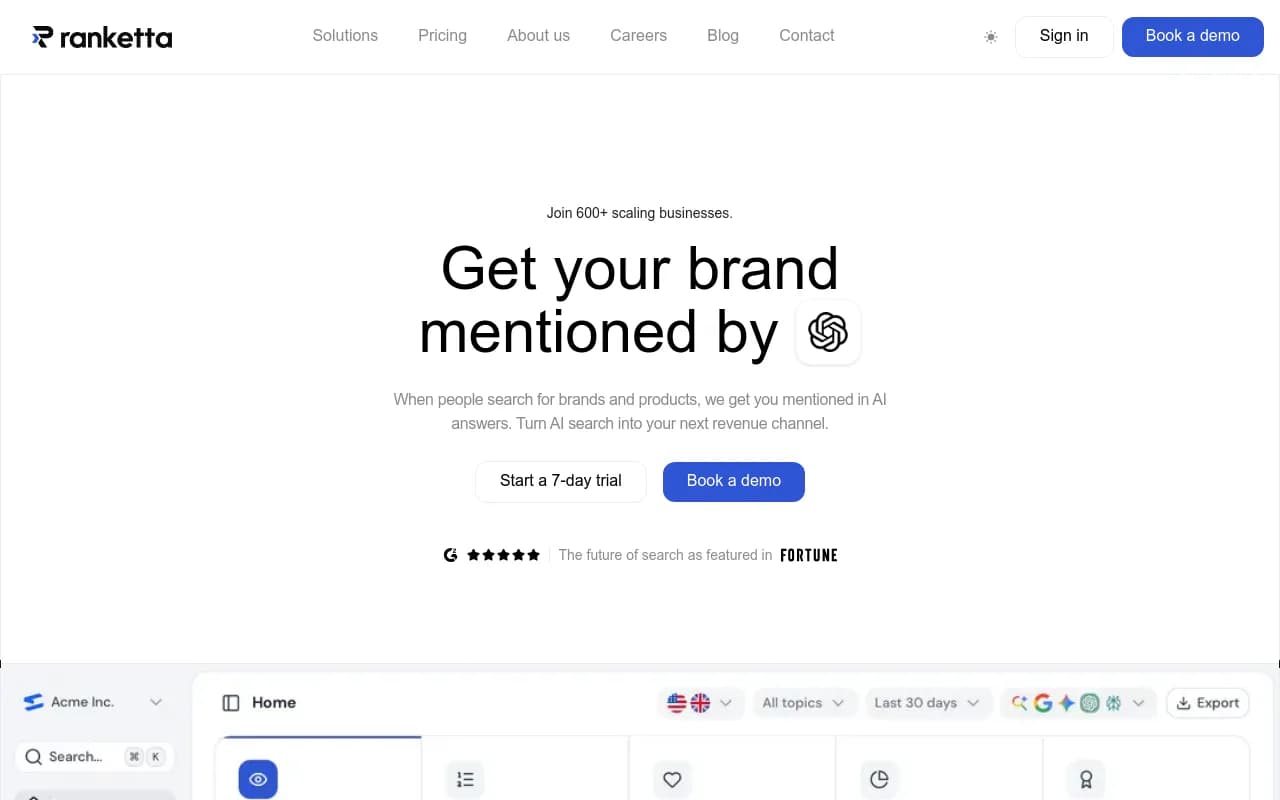
- Ranketta Starter costs EUR 79/mo for stores and EUR 69/mo for brands (3 models, 50 prompts per model, 1 website). Its main differentiator is SKU-level product tracking, which most startups do not need.
- Cheaper entry points exist: Rankscale from roughly $17 to $20/mo (billed yearly), Otterly.AI Lite at $29/mo for 15 prompts, HubSpot AEO at $50/mo, and Semrush's AI Visibility Toolkit at $99/mo.
- Cheap trackers tell you whether you were mentioned. They rarely tell you why, or help you fix it. Budget for that gap.
- Track each AI engine separately. Promptwatch Data shows ChatGPT cites about 5 sources per web-search answer while Google AI Overviews and Perplexity cite about 10.
- All prices here come from third-party listings and search snippets. Confirm them on vendor pricing pages before you buy.
Why startups look for a Ranketta replacement
Ranketta is a decent product with a clear point of view: it is built for online stores and brands that care about how individual products show up in AI answers. Its pricing page lists SKU-level tracking, product data scored on identifiers like brand, GTIN/MPN and category, and engine bundles of 2, 3, 4 or 5 models per plan, with 10+ on custom.
That is great if you sell 4,000 products. It is a lot of machinery if you are a seed-stage SaaS company that mostly wants to know whether ChatGPT recommends you when someone asks for a tool in your category.
The usual reasons people leave:
- You are not an e-commerce store, so the SKU and merchandising credits are dead weight.
- EUR 69 to 79 a month for 50 prompts per model on 3 models feels thin when you are watching every dollar.
- You want actions and content help, not only a dashboard.
- You want the same data but with more engines, or in a suite you already pay for.
One caveat on the research here. Much of the Ranketta comparison material is published by Ranketta itself, including the claim that only Ranketta and Peec AI list SKU-level tracking on their pricing pages. Treat vendor-written comparisons, including that one, as marketing until you check the pricing pages yourself.
What "tight budget" actually means in this category
Published entry prices across the category run from roughly $17 to $20 a month at the bottom to about $295 at the higher end of tools that publish pricing, with Profound, Brandlight and Conductor keeping pricing behind a demo. For a startup, the sensible band is $20 to $100 a month. Above that you should be getting content execution or analytics, not just more prompts.
The cost that does not show up on the pricing page is time. A $29 tracker that you check twice and abandon is more expensive than a $99 tool that tells you what to publish this week.
How to judge a cheap tool before you pay
The 2026 buyer guides agree on a few checks, and they matter more at the low end because cheap plans cut corners in specific places.
- Collection method. Some tools capture answers from the real web interfaces of ChatGPT and others, and some use APIs. User-facing answers and citations can differ from API output. Semrush and Ahrefs both describe real-request or web-version collection; ask any budget tool the same question.
- Engines on the entry plan. Otterly includes four engines (ChatGPT, AI Overviews, Perplexity, Copilot) and sells Claude, AI Mode and Gemini as add-ons. Those add-ons are where a $29 plan quietly becomes a $70 plan.
- Prompt limits. 15 prompts is a sampler. 50 is a start. Neither covers a real buyer journey.
- Frequency. Daily is the norm. Monthly refreshes on custom prompts are not enough if you are shipping content weekly.
- Whether it connects to traffic. A tool that sits next to your analytics shows you the visits and conversions behind the mentions.
- Seats and clients. Unlimited seats matter more than you think once a founder, a marketer and a contractor all want logins.
The Promptwatch Data report on average sources per response gives one more reason to care about per-engine tracking. ChatGPT cites about 5 sources per web-search answer, Google AI Overviews about 10, and Perplexity almost exactly 10 every day. Copilot's average swung from under 2 to nearly 17 within a few weeks before settling low. A single blended score hides all of that, so a tool that lets you read each engine on its own is worth more than one that gives you a pretty average.
Budget AI visibility tools compared
Prices below come from third-party roundups and snippets, not vendor pages. Verify before purchase.
| Tool | Listed entry price | Notable detail | Best for |
|---|---|---|---|
| Rankscale | ~$17 to $20/mo billed yearly; Pro $99/mo for 4,800 AI answers | Credit-based, claims 17+ engines, AI-readiness audit | Tinkerers who want engine breadth |
| Otterly.AI | $29/mo (Lite, 15 prompts) | 4 engines included, others as add-ons, daily tracking | Cheapest serious starting point |
| Geoptie | From $49/mo | Daily tracking, white-label for 10 client brands (vendor-adjacent listing) | Small teams and freelancers |
| HubSpot AEO | $50/mo; free for 25 prompts | ChatGPT, Gemini, Perplexity on entry plan | Teams already in HubSpot |
| Ayzeo | From $39/mo; Pro $149 | GA4 integration, white-label (vendor content) | Teams wanting analytics alongside visibility |
| Peec AI | From about EUR 70/mo billed annually | Unlimited seats, multi-engine tracking | Growing brands and agencies |
| Semrush AI Visibility Toolkit | $99/mo | Your prompts plus a prompt database | Existing Semrush users |
| Promptwatch Essential | $95/mo | 50 prompts, all AI models, Agent Chat, crawler-aware analytics via add-on plans | Startups that want to act, not just watch |
The tools, one by one
Otterly.AI: the cheap, honest starting point
Otterly is based in Austria and is the name that comes up most when people ask for a low-cost tracker. Lite is listed at $29/mo for 15 prompts, with ChatGPT, AI Overviews, Perplexity and Copilot included. It is a monitoring tool and does not pretend otherwise. If you only need to see whether you show up, it is a fine place to start.

Rankscale: most engines for the least money
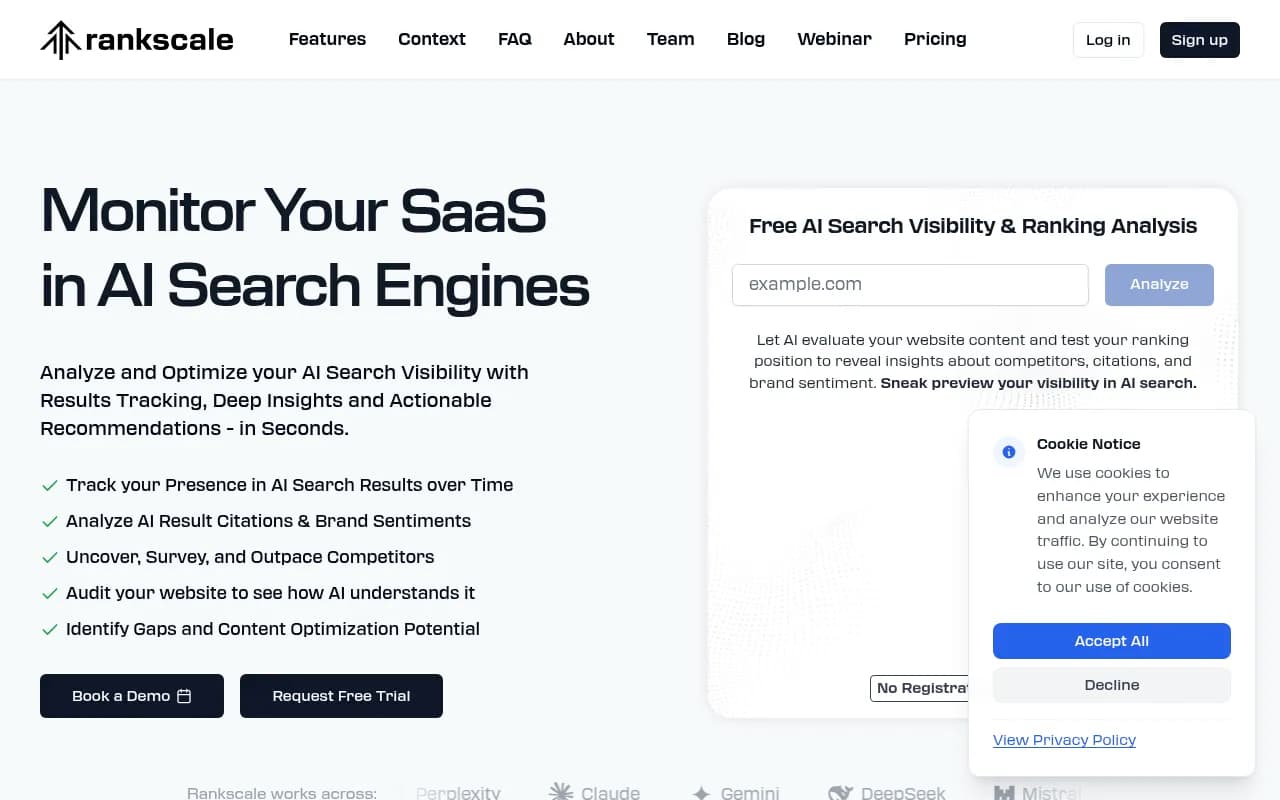
Rankscale is credit-based, listed from roughly $17 to $20 a month billed yearly, scaling to $780 a month at the top. Pro is $99 monthly for up to 4,800 AI answers. It claims 17-plus engines and includes an AI-readiness audit for your pages. A small Vienna-based team ships updates quickly. The credit model rewards people who like to tune things and punishes people who forget to watch their usage.
Peec AI: clean tracking with unlimited seats
Peec is repeatedly named the strongest mid-market tracker in the roundups I read, with unlimited seats from around EUR 70/mo on annual billing. It also lists SKU-level tracking, so it is the closest like-for-like swap if you actually liked what Ranketta did for products. For a startup with no catalog, it is simply a solid dashboard.

Semrush and Ahrefs Brand Radar: only if you already pay
The consistent advice is that if your team already has Semrush or Ahrefs, try their AI add-on before buying anything new. Semrush's toolkit starts at $99/mo and captures answers from real requests rather than LLM APIs. Ahrefs Brand Radar covers AI Overviews, AI Mode, ChatGPT, Perplexity, Gemini and Copilot. Starting from scratch, though, neither is the cheap option.
Smaller budget names worth a look
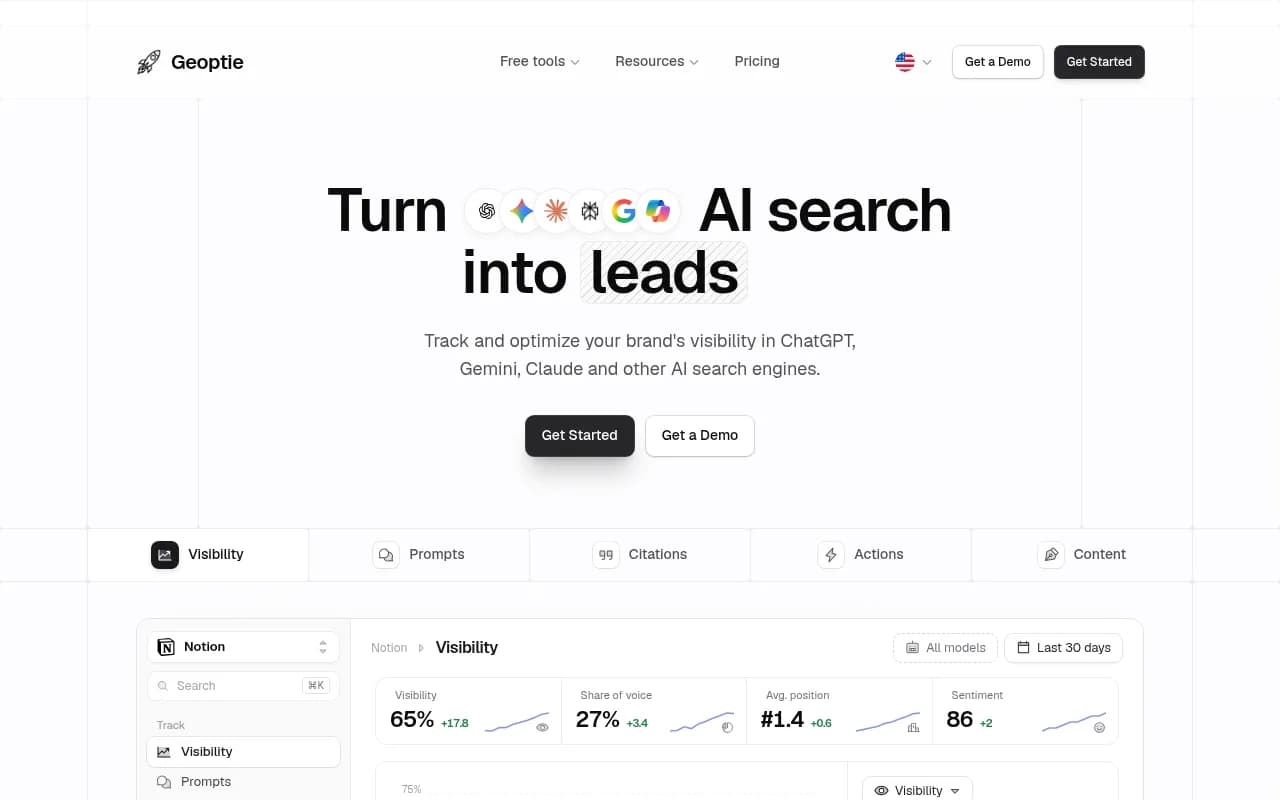
The catalog is crowded with low-cost entrants. A few that position themselves explicitly at small teams: BrandAxis, Atyla, Radix AI, Answer Socrates and Geoptie. I have not tested these, and pricing for most of them is unverified, so treat them as trial candidates rather than recommendations.
Promptwatch: when you want the fix, not only the score
Promptwatch is the option on this list that goes past tracking. Besides prompt monitoring across ChatGPT, Gemini, Perplexity, Claude, AI Overviews and AI Mode, it traces which pages AI cites, flags content gaps, and its Action Board turns the gaps into a prioritized to-do list. Agent Chat lets you ask questions of your data in plain language. Essential is $95/mo (EUR 85) with 50 prompts, daily tracking, unlimited team seats and a 7-day free trial on monthly billing. Content Agent and crawler logs sit on higher plans, so on Essential you are buying a strong tracker plus analysis, and the publishing machinery arrives at Business ($579/mo). Confirm current details at promptwatch.com/pricing.
It is not the cheapest. It is the one where the monthly fee has a plan attached. There is also a free AI visibility report if you want to see your baseline before paying anything, and head-to-head pages like Promptwatch vs Peec and Promptwatch vs Otterly.

Which one fits which startup
| Your situation | Pick | Why |
|---|---|---|
| Pre-revenue, just curious | Otterly Lite or a free grader like HubSpot AEO Grader | Lowest commitment |
| Want many engines, comfortable tinkering | Rankscale | Credit model, broad coverage |
| Had real SKU needs on Ranketta | Peec AI | Closest like-for-like |
| Already on Semrush or Ahrefs | Their AI add-ons | No new vendor |
| Small team that wants to publish and improve | Promptwatch | Gap analysis, Action Board, Agent Chat |
| Freelancer serving a few clients | Geoptie or a Promptwatch agency plan (from $199/mo) | White-label and multi-client |
Make the cheap tool earn its keep
A budget tracker only pays off if you use it the same way every week. A routine that works for a small team:
- Pick 20 to 30 prompts that real buyers would type. Include a few comparison prompts ("X vs Y") because those are where recommendations get made.
- Read engines separately. ChatGPT with about 5 citation slots behaves differently from AI Overviews or Perplexity with about 10.
- Look at which pages get cited, not just whether you were named. If you are mentioned without a citation, the problem is usually content or crawlability.
- Fix one page a week. Refresh the best candidate, add the missing comparison section, publish the one article a competitor is winning with.
- Check back in two to three weeks. If nothing moved, change the page, not the tool.
For product pages, note that Promptwatch Data on ChatGPT citation share by content type shows product pages as the most cited type at 22.4% of citations (Sep 28 to Oct 4, 2026), followed by landing pages and listicles. If you have one page to improve, a clear product or landing page is a good bet.
What none of these tools tell you
AI answers are non-deterministic, so two tools can give you two different numbers for the same brand, and neither is wrong. Treat the trend line as the signal and the absolute number as a rough guide. Also remember that the cheap plans measure; they do not build authority, earn mentions on third-party sites, or fix a site that AI crawlers cannot read.
If you want a person to handle strategy rather than another dashboard, agencies like 1001 SEO Media work on GEO and AI search visibility alongside traditional SEO. For most startups under a few hundred thousand in revenue, a $30 to $100 tool plus a weekly hour of focused work is the better first step.
Where to look next
If none of these fit, the GEO software directory at bestgeosoftware.com lists far more options than I covered here, and Promptwatch's research hub is useful for understanding how each engine picks sources before you commit to a tracker.
Bottom line
If you are leaving Ranketta because you are not an online store, start with Otterly or Rankscale to prove you will use a tool at all, then move up to Peec or Promptwatch once you know you want to act on the data. Run any shortlist through a trial, and check every price on the vendor's own page. The numbers in this guide were collected from third-party listings and will have shifted by the time you read it.