Answer Socrates Review 2026
Checks AI visibility across ChatGPT, Perplexity, and other models, paired with keyword and content idea generation for small businesses.
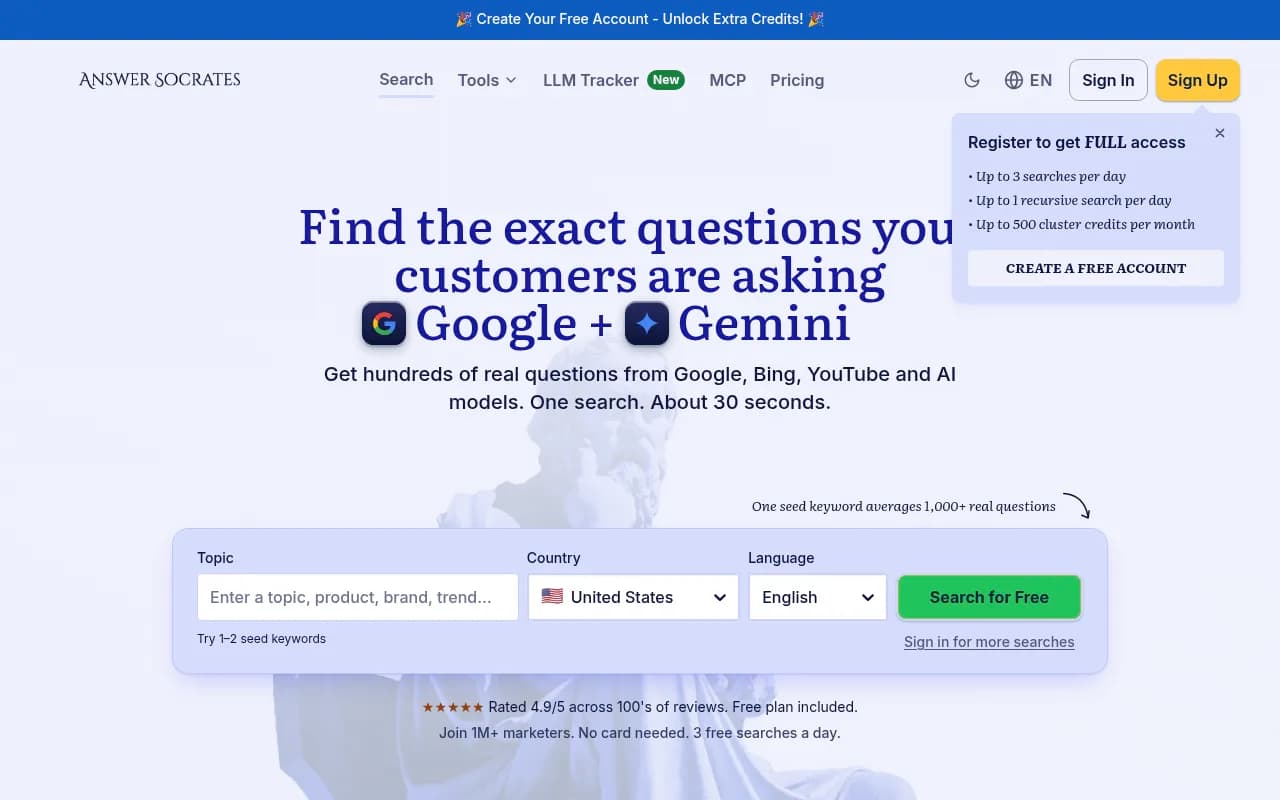
Key takeaways
- Answer Socrates is primarily a keyword research and clustering tool (questions, People Also Ask, recursive search) with a bolted-on LLM Brand Tracker, not a dedicated GEO platform.
- The LLM Brand Tracker lacks content gap analysis, AI crawler logs, traffic attribution, Reddit/YouTube citation tracking, and automated content generation that Promptwatch offers -- it's monitoring-only, and even then only ChatGPT and Gemini are free, with Grok, Claude, Perplexity, and DeepSeek gated behind a $19/mo plan.
- The free tier is genuinely generous for keyword research: 3 searches a day, 500 cluster credits a month, no credit card required.
- Keyword clustering is the standout feature, with reviewers calling it one of the better clustering tools on the market, though the company itself admits roughly 80% accuracy and recommends manual sense-checking.
- Paid plans run from about $15.83 to $249.17/mo billed yearly, scaling by search/cluster/API credits rather than feature access, which makes the pricing ladder a bit confusing to parse at a glance.
Answer Socrates started as a question-keyword generator, the kind of tool built to answer a simple question: what are people actually typing into Google before they land on a page. Over time it added recursive keyword search (digging several layers past the seed term), one-click clustering, Trending Topics, and, more recently, an LLM Brand Tracker that checks whether ChatGPT, Gemini, Perplexity, Claude, Grok, and DeepSeek mention your brand when asked relevant questions.
The tool is aimed squarely at people who do their own content planning: niche site owners, solo SEO consultants, small content teams, and agencies juggling a handful of clients. It's not trying to be Ahrefs or Semrush. It's trying to be the fast, cheap way to go from "I need to write about X" to a spreadsheet of 500 question-based keywords clustered into articles, in about a minute. The company claims over 1 million marketers have used it, and it's picked up logos from HubSpot, Buffer, AIOSEO, and MakeUseOf as mentions or backlinks, along with a #4 Product Hunt launch finish.
Key features
Question keyword generation. Enter a seed keyword and Answer Socrates pulls hundreds, sometimes over a thousand, real search phrases from Google Suggest, People Also Ask, and Google Trends. The output is organized into categories like questions, prepositions, comparisons, and related terms, which is a familiar structure if you've used tools like AnswerThePublic, but Answer Socrates leans harder into volume and clustering than its older competitors do.
Recursive search. This is the feature power users actually pay for. Instead of stopping at the first layer of autocomplete results, recursive search automates the method Steve Toth popularized on SEO Notebook: taking each returned keyword and searching it again, several layers deep, to surface long-tail terms you'd never find by hand. It's rate-limited by plan (1/day free, up to 24,000/year on the top tier), which tells you it's computationally expensive to run at scale.
One-click keyword clustering. Dump a list of keywords in and the ML clustering groups them by topic and intent, surfacing total search volume, average CPC, and competition per cluster. LearnWire called it one of the better clustering tools they've reviewed, and in practice it is fast, a few seconds per batch, and good enough to build a pillar-and-supporting-article structure from. The company is upfront that accuracy sits around 80%, and independent reviewers confirm you still need to sense-check groupings, especially when US and UK search variants get mixed together.
Trending Topics. A real-time feed of spiking topics by country and language, with a "more questions" expansion on any trend that hands you SEO post ideas, digital PR angles, and social content angles. Useful for anyone doing reactive content or digital PR who wants to catch a topic before it peaks rather than after.
People Also Ask extraction. Pulls the exact PAA questions Google shows for a keyword, which is handy for FAQ sections or for directly targeting the PAA box as a secondary ranking opportunity.
Social content idea generation. YouTube and TikTok title generators built on the same underlying question data, so one keyword search can feed both a blog content plan and a social content calendar.
CSV export everywhere. Every search, cluster, or trend report exports to CSV with volume, CPC, and competition included. Free users get 1 export/month; paid plans get unlimited.
LLM Brand Tracker. This is the feature most relevant to anyone evaluating AI visibility tools, and it's also the one where Answer Socrates is weakest relative to dedicated GEO platforms. It runs prompts through ChatGPT, Gemini, Perplexity, Claude, Grok, and DeepSeek and reports whether your brand gets named, alongside basic share-of-voice scoring over time. The free plan only covers ChatGPT and Gemini; the other four models require a paid plan starting at $19/mo. Compare that to Promptwatch, which tracks all of these plus Microsoft Copilot, Meta Llama, Google AI Overviews, and Google AI Mode as standard, and pairs the tracking with citation analytics, AI crawler logs, visitor analytics showing real traffic from AI platforms, content gap analysis, and an automated Content Agent that writes and publishes GEO content to your CMS. Answer Socrates tells you if you got mentioned. It doesn't tell you why you weren't, what AI crawlers are actually reading on your site, or generate the content needed to fix it.
Who is it for
Answer Socrates fits solo SEO consultants and niche site owners who need a fast way to turn one topic idea into a year's worth of article titles without paying for Ahrefs or Semrush. It also works for small agencies managing a handful of client sites, the Seneca and Aurelius plans are explicitly marketed at "power users & consultants" and "teams & agencies." A photographer running a one-person fine art business, a physical therapist building a content-driven health coaching site, a financial advisor doing their own SEO, these are the kinds of users quoted in the testimonials, and they're a believable fit: people who need question-led content ideas without a steep learning curve or a big budget.
It's a poor fit for anyone who needs competitor backlink analysis, technical SEO auditing, or a full-featured SEO suite. One independent reviewer flat out recommends Mangools, Keywords Everywhere, or Keysearch instead if that's your need. It's also a weak choice if AI visibility tracking is your primary goal rather than a nice-to-have bolted onto keyword research. Teams that need to actually act on AI visibility data, not just see a mention count, should look at a dedicated GEO platform instead.
Integrations and ecosystem
Answer Socrates recently shipped a REST API and MCP server (at https://answersocrates.com/api/mcp), which connects to Claude.ai, ChatGPT in developer mode, Perplexity via Connectors, Gemini, Claude Code, and Cursor. Exposed tools include get_rising_topics, get_trends, get_keywords, cluster_keywords, save_to_project, and get_usage, which means you can pull keyword and trend data straight into an AI coding or chat assistant rather than exporting CSVs manually. This is available starting on the Seneca plan and up, with separate API credit allowances from in-app search credits.
The free Chrome extension is arguably more useful day to day than the API for most users. It adds a sidebar to Google search results showing questions, long-tail keywords, and a 12-month Google Trends chart, and now also works inside ChatGPT and Claude chats, surfacing live trends data and "query fan-out" (the actual queries the AI ran behind the scenes) next to the conversation. Paid users get full keyword-tree scans and unblurred volume data directly in the sidebar.
CSV import/export is solid in both directions. You can export anything from Answer Socrates, and reviewers note you can import keyword exports from Ahrefs or Semrush into its clustering tool, which is a smart way to get clustering value even if you already pay for a bigger suite elsewhere.
Pricing and value
Answer Socrates uses a credit-based ladder rather than a feature-gated one, which takes a minute to parse:
- Free: $0, no card required. 3 keyword searches/day, 1 recursive search/day, 500 cluster credits/month, 1 CSV export/month, free Chrome extension, ChatGPT + Gemini only on LLM Brand Tracker.
- Socrates Lite: $19/mo, or $15.83/mo billed yearly ($190/yr). 1,200 keyword searches/yr, 360 recursive searches/yr, 36,000 cluster credits/yr, 600 LLM Brand Tracker credits/yr, SEO metrics unlocked, unlimited CSV, 2 projects.
- Seneca (most popular): $39/mo, or $32.50/mo billed yearly ($390/yr). 6,000 keyword searches/yr, 2,400 LLM Brand Tracker credits/yr, API + MCP access with 6,000 API credits/yr, 5 projects.
- Aurelius: $69/mo, or $57.50/mo billed yearly ($690/yr). Unlimited keyword searches, 6,000 LLM Brand Tracker credits/yr, 30,000 API credits/yr, 10 projects, 2 team seats.
- Senate: $299/mo, or $249.17/mo billed yearly ($2,990/yr). Unlimited searches, 36,000 LLM Brand Tracker credits/yr, 300,000 API credits/yr, 100 projects, 5 pooled team seats.
All paid plans carry a 7-day money-back guarantee rather than a free trial. Credits don't roll over between billing periods, which is a real downside if your usage is spiky. One independent reviewer (That Marketing Buddy) flagged inconsistent pricing messaging across the site, the homepage says "from $19/month" while the pricing page's yearly math works out to $15.83/mo, which is worth double-checking before you commit.
For pure keyword research, this pricing is competitive, cheaper than Semrush or Ahrefs for a tool that doesn't try to do everything they do. For AI visibility tracking specifically, it's cheap but shallow: Promptwatch's Essential plan at $95/mo covers 50 prompts across all major AI models with crawler logs, visitor analytics, and 5 AEO articles included, which is a different category of product solving a different problem than a few thousand LLM Brand Tracker credits bundled into a keyword tool.
Strengths and limitations
What it does well: the recursive search and clustering combination genuinely saves hours of manual keyword organizing, and the free tier is generous enough to actually be useful rather than a sales gate. The Chrome extension working inside ChatGPT and Claude chats is a clever, low-friction way to get trends data without leaving your workflow. Pricing for the core keyword product undercuts the big SEO suites for teams that don't need backlink or technical audit features.
Where it falls short, particularly on the AI visibility side: the LLM Brand Tracker has no content gap analysis, no AI crawler logs, no visitor analytics tying AI mentions to actual site traffic, no Reddit or YouTube citation tracking, no ChatGPT Shopping monitoring, and no automated content generation or CMS publishing. It tells you whether you were named and gives a share-of-voice trend line, full stop. Clustering accuracy sits around 80% by the company's own admission, so plan on spot-checking groupings on anything client-facing. And credits not rolling over is a real friction point for anyone with uneven monthly usage.
Bottom line
Answer Socrates is a strong, affordably priced keyword research and clustering tool for solo SEOs, niche site builders, and small agencies who want question-led content ideas without buying a full SEO suite. If you're evaluating it specifically for its LLM Brand Tracker, treat that as a convenience add-on rather than a serious GEO solution, teams that actually need to understand and act on AI search visibility, with crawler logs, traffic attribution, and automated content optimization, should look at Promptwatch instead.

Tags:
Frequently asked questions
What is Answer Socrates?
Is Answer Socrates free?
How good is the LLM Brand Tracker compared to dedicated AI visibility tools?
What's the standout feature in Answer Socrates?
Does Answer Socrates have an API or integrations?
Who should avoid Answer Socrates?
Similar and alternative tools to Answer Socrates