Geoptie Review 2026
AI visibility tracking with a content optimization studio, GEO audit tool and keyword finder, priced for small teams from $49/month.
Key takeaways
- Geoptie bundles AI visibility tracking, a GEO audit, content generation and an MCP server into plans starting at $49/month, with unlimited audits, content and team seats on every tier.
- It is a direct competitor to Promptwatch, and it lacks IP-verified AI crawler logs, Brand Narrative and Fact Check, Reddit/YouTube/LinkedIn/Instagram citation reports, AI Shopping and Ads Radar, query fan-outs, prompt difficulty scoring and a closed-loop publishing workflow to WordPress, Webflow or Framer.
- Each brand can track only 4 of the 7 supported engines, and each prompt covers one market, so multi-country tracking eats the prompt quota quickly.
- No free trial and no scheduled report delivery, by the vendor's own admission. The free GEO tools help, but they are not a trial of the paid product.
- Best for startups, small marketing teams and lean agencies who want a cheap, simple entry into GEO. Larger teams will outgrow it.
Geoptie is a GEO platform that sells itself as the cheap all-in-one option. It tracks how ChatGPT, Gemini, Claude, Perplexity, Microsoft Copilot, Google AI Overviews and Google AI Mode answer the questions your buyers ask, shows which sources feed those answers, and then gives you a content studio and a list of ranked actions. The homepage claims 500+ brands and agencies, with logos such as HSBC, LG, Kia and Dentsu. Those are self-reported and I could not verify them independently.
The product is aimed at people who have just been told to "do something about AI search" and have a small budget. Starter is $49/month, which is well below most dedicated GEO platforms. Geoptie also publishes a set of free tools (a GEO audit, a GEO rank tracker, a GEO content checker, and a keyword cannibalization checker), which have worked as its top-of-funnel since mid-2025. The paid dashboard appears to have gone live around September 2025, so this is a young product.
The pitch is a workflow rather than a single report: find prompts, see how AI answers them, find the cited sources, get ranked actions, write content, measure traffic. On paper that covers a lot. In practice, depth varies by step, and that is where the price shows.
Key features
Prompt research and tracking. You start by discovering the questions buyers ask AI, with suggested prompts shown alongside volume and region. You pick the ones you want and add them to tracking. Every tracked prompt runs daily, and you can track in 123 countries, setting a default country per brand and overriding it per prompt. The catch is the counting rule: each prompt is tracked in one market at a time, so the same question in three countries uses three prompts. On a 15-prompt Starter plan, that disappears fast.
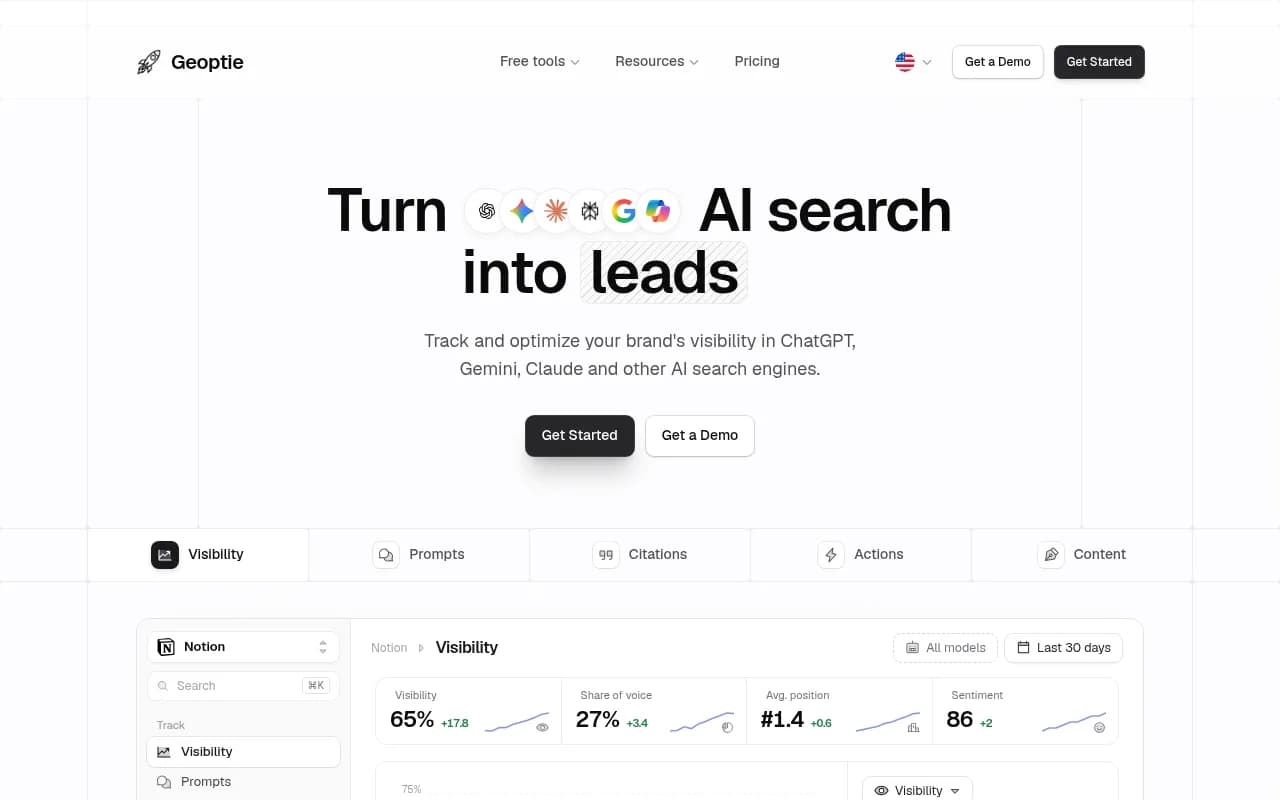
Visibility dashboard. The main view shows visibility, share of voice, average position and sentiment, with a trend line and a ranked competitor list (the demo shows a brand ranking #1 of 12). There is a per-model breakdown so you can see, say, strong ChatGPT numbers and weak Claude numbers side by side. Competitor tracking supports grouping and exclusions. It is a clean, readable dashboard, closer in spirit to Peec AI or Otterly than to an enterprise suite.
Engine coverage. Seven engines are supported: ChatGPT, Gemini, Claude, Perplexity, Copilot, Google AI Overviews and Google AI Mode. The limit is that each brand can track any four, on every plan. You can swap the selection at any time and it is not tier-gated, which is fairer than locking engines behind higher plans, but it does mean you cannot see all seven at once for a brand. By contrast, Promptwatch tracks around 20 engines and models on every plan, including Meta AI, Amazon Alexa and coding agents.
Citation and source analysis. Geoptie shows which domains and URLs AI engines cite in your category, with percentage shares (the demo shows zapier.com, g2.com, reddit.com and forbes.com) and citation trends. For a given cited page it shows which brands are recommended and whether yours is missing. This is the feature that makes the rest useful, because it tells you where to get listed or what to write. It does not appear to break out Reddit threads, YouTube videos, LinkedIn or Instagram posts into dedicated reports the way Promptwatch does.
Ranked actions. Gaps are turned into an action list ranked by estimated impact: engage in a discussion thread, optimize a page, create a video, run outreach to get included in a roundup. Each action shows an expected visibility gain and a status (open, in progress). It is a sensible feature and one that many pure monitors lack. It is also a list, not an agent: nothing is executed for you. Promptwatch's Action Board adds a weekly Discovery agent, assignees, and Agent Chat that can move work along.
Content studio. Geoptie includes an editor that writes drafts grounded in the sources AI already trusts, with a GEO score you check before publishing. Content generation, optimization and audit reports are unlimited on every plan with no credits, which is a real selling point against tools that meter content on a credit pool. What I did not find is native CMS publishing to WordPress, Webflow or Framer, or a content gap map that links pages to the prompts they should answer. You copy and paste, essentially.
GEO audit. The audit checks how ready a site is for AI search, and it is unlimited on all plans. A free version is available without signing up. It is useful as a baseline, though one independent review (AI Rank Lab, which looks dated since it quotes an $89 entry price) rated audit depth as moderate.
Traffic tracking. The homepage shows visits from AI engines (ChatGPT, Perplexity, Gemini, Copilot) over 30 days, so you can connect visibility changes to visitors. Details on setup and conversion attribution are thin in public materials. Promptwatch, for comparison, offers visitor analytics with conversions plus IP-verified crawler logs that show whether AI bots actually read your pages.
MCP server and REST API. Professional and Business include a REST API and a hosted MCP server sharing one key. You can connect Claude Code, Cursor or Codex and ask in plain English for visibility numbers or an article about your top recommendation. The setup is three lines of config. This is a modern touch at a low price point.
Reporting. Every plan has a PDF brand report and CSV export. Professional and Business add white-label reports with your own logo, accent color and no Geoptie footer. There is no scheduled report delivery, which the vendor lists as a con.
Who is it for
The sweet spot is a founder or a one-person marketing team at a SaaS startup tracking maybe 15 to 50 prompts in a single country, who wants to know whether ChatGPT recommends them and what to write next. Starter at $49/month fits that, and unlimited content generation makes it feel generous. A small SEO agency with five to ten clients also fits Professional well: 10 brand workspaces, white-label PDFs, unlimited read-only client seats and API access for $99/month is a hard package to beat on price.
Business ($249/month, 300 prompts, unlimited brands) targets multi-brand companies and bigger agencies. Here I would be more careful. 300 prompts across unlimited brands is thin once you add countries and personas, and extra prompts cost $99/month per 100. A 10-client agency tracking 30 prompts each in two markets would already need 600 prompts.
Who should skip it? Enterprise teams with security reviews, brands that need every engine tracked at once, e-commerce companies that care about ChatGPT Shopping, and teams that want the platform to publish content and measure results end to end. Anyone who wants a free trial to test the product should also know there is none, only a demo and the free tools. Local and multi-location businesses will find no exact-coordinate local targeting either.
Integrations and ecosystem
The integration story is short but modern. The MCP server works with Claude Code, Cursor and Codex, and the REST API (api.geoptie.com/v1) exposes brands, visibility with period comparison, competitor and citation data. Both are on Professional and above, not Starter, and API key management is part of that gating. Exports are PDF and CSV.
I found no native connectors to Google Search Console, Bing Webmaster Tools, Looker Studio, Slack, Zapier, or CMS platforms in the public materials. If you need those, you would build them yourself on the API. There is no browser extension or mobile app listed. Promptwatch, by comparison, covers Cloudflare and other CDN logs, WordPress, Webflow, Framer, Search Console, Bing, Looker Studio, Slack and a 110+ tool MCP server.
Pricing and value
Pricing is straightforward and month-to-month:
- Starter, $49/month: 15 prompts, 2 brands.
- Professional, $99/month (marked Most Popular): 100 prompts, 10 brands, white-label reports, REST API, MCP server.
- Business, $249/month: 300 prompts, unlimited brands. Add 100 prompts for $99/month.
- Annual billing: two months free, so roughly $41, $83 and $208 per month.
Every plan includes daily tracking, 123-country coverage, prompt discovery, competitor tracking, sentiment analysis, citation trends, recommendations, unlimited audits, unlimited content generation and unlimited team members. You cannot exceed your prompt limit without upgrading.
There is no free trial. You can book a demo or use the free tools instead.
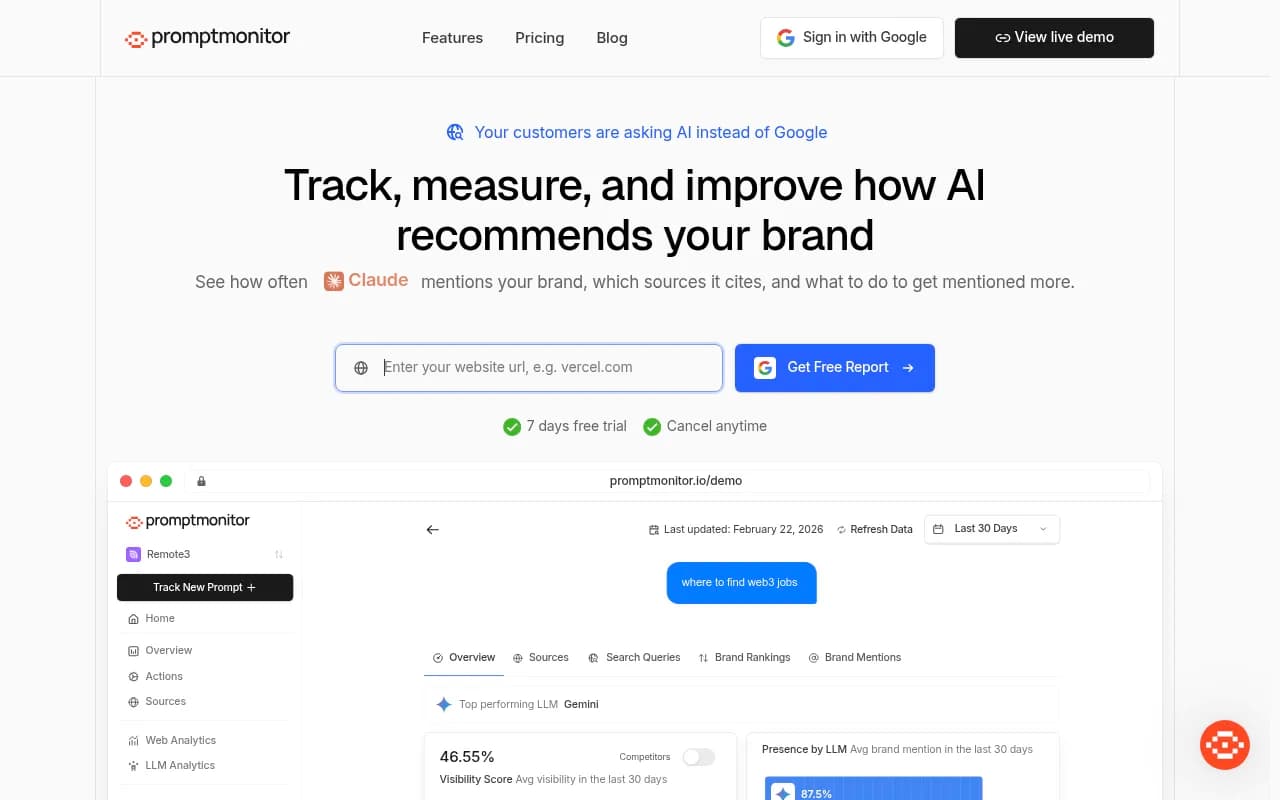
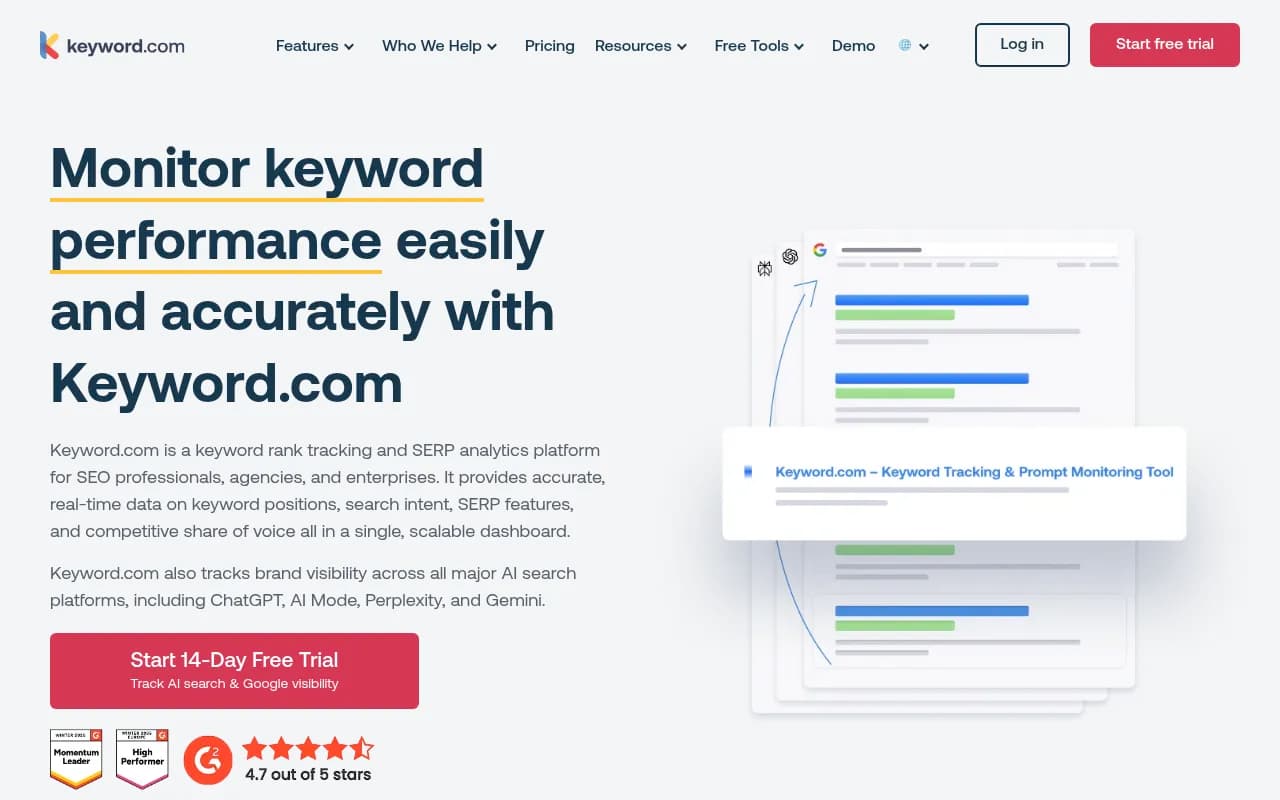
On value, the headline numbers are good. Peec AI starts near $95/month, Rankshift around $92, and Brandi AI, Ahrefs Brand Radar and Slate cost several times more. Geoptie's own comparison blog lists these figures, so treat them as vendor-sourced. Promptwatch costs more at the entry level (Essential is $95/month with 50 prompts and 6,000 responses, Professional $245/month), but its Essential plan includes all AI models, Agent Chat, Brand Narrative, visitor analytics and site audits, and Business adds the Content Agent and CMS publishing. Check promptwatch.com/pricing for current numbers. Per prompt, Geoptie Professional at about $1 per prompt is cheap, but only if you can live with four engines and manual publishing.
Strengths and limitations
What it does well
- The price is the lowest of the full-featured GEO platforms I have seen, with unlimited seats and unlimited content.
- Agency features arrive early: white-label PDFs and 10 brand workspaces at $99/month.
- The citation-to-action-to-content flow is coherent and easy to understand.
- MCP and API access on mid-tier plans is rare at this price.
- Month-to-month billing with no contract.
Limitations
- Only 4 of 7 engines per brand, and prompts count once per market.
- No free trial, no scheduled report delivery.
- Little independent validation. I found no G2 or Reddit reviews, and the customer logos are self-reported. An older independent review gave it 82% on monitoring accuracy and 2.5/4 on LLM coverage.
What it lacks compared with Promptwatch
Geoptie is a direct competitor to Promptwatch, and the gaps are meaningful:
- No IP-verified AI crawler logs or crawl-to-citation tracking, so you cannot tell an access problem from a content problem.
- No Content Agent with automated scheduling and publishing to WordPress, Webflow or Framer, and no Content Refresh for existing pages.
- No closed-loop tracking of a published page through crawls, citations, traffic and Search Console or Bing data.
- No Brand Narrative or Fact Check against your own pages.
- No dedicated Reddit, YouTube, LinkedIn or Instagram citation reports, and no offsite mentions.
- No AI Shopping or Ads Radar.
- No query fan-outs, prompt volume and difficulty scoring in the way Promptwatch provides them, and no local GEO targeting at exact coordinates or hourly tracking.
- No Agent Chat, no Slack delivery, no coding agent visibility, no Meta AI or Amazon Alexa tracking.
- No ISO/IEC 27001 certification mentioned.
For a fuller look at the market, see the GEO software directory at bestgeosoftware.com.
Bottom line
Geoptie is a sensible first GEO tool for a small team that wants tracking, a rough audit and a content editor for under $100 a month, and I think the pricing is its real argument. It does the monitoring-plus-suggestions job competently, and the MCP access is a nice surprise.
If you want optimization rather than monitoring, Promptwatch is the stronger choice: it traces citations, reads crawler logs, writes and publishes content to your CMS, then measures whether the page was crawled, cited and clicked. It starts at $95/month with a 7-day free trial, and there is a free AI visibility report. See the Promptwatch comparison of GEO platforms for the full picture. Best use case for Geoptie: a startup or small agency tracking a modest prompt set in one or two markets on a tight budget.
Tags:
Frequently asked questions
What is Geoptie?
How much does Geoptie cost?
Does Geoptie have a free trial?
Which AI engines does Geoptie track?
Is Geoptie good for agencies?
How does Geoptie compare with Promptwatch?
Similar and alternative tools to Geoptie