Segment Review 2026
Twilio Segment is a customer data platform (CDP) that collects, cleans, and activates first-party data from websites, apps, and devices into unified customer profiles. Used by data teams, marketers, and product managers to route data to 550+ destinations, build audiences, and power personalized expe
Summary
- Best for: Mid-market to enterprise companies (B2C and B2B) that need to collect customer data from multiple sources and route it to analytics tools, marketing platforms, and data warehouses
- Core strength: Industry-leading integration catalog (550+ destinations) and robust data pipeline infrastructure that handles billions of events per month
- Main limitation: Pricing scales quickly with monthly tracked users (MTUs) -- can become expensive for high-traffic consumer apps
- Not a fit for: Small startups with simple analytics needs or companies that only need basic event tracking (Google Analytics alone is cheaper)
- Bottom line: The gold standard CDP for companies serious about data infrastructure, but overkill if you're just getting started with analytics
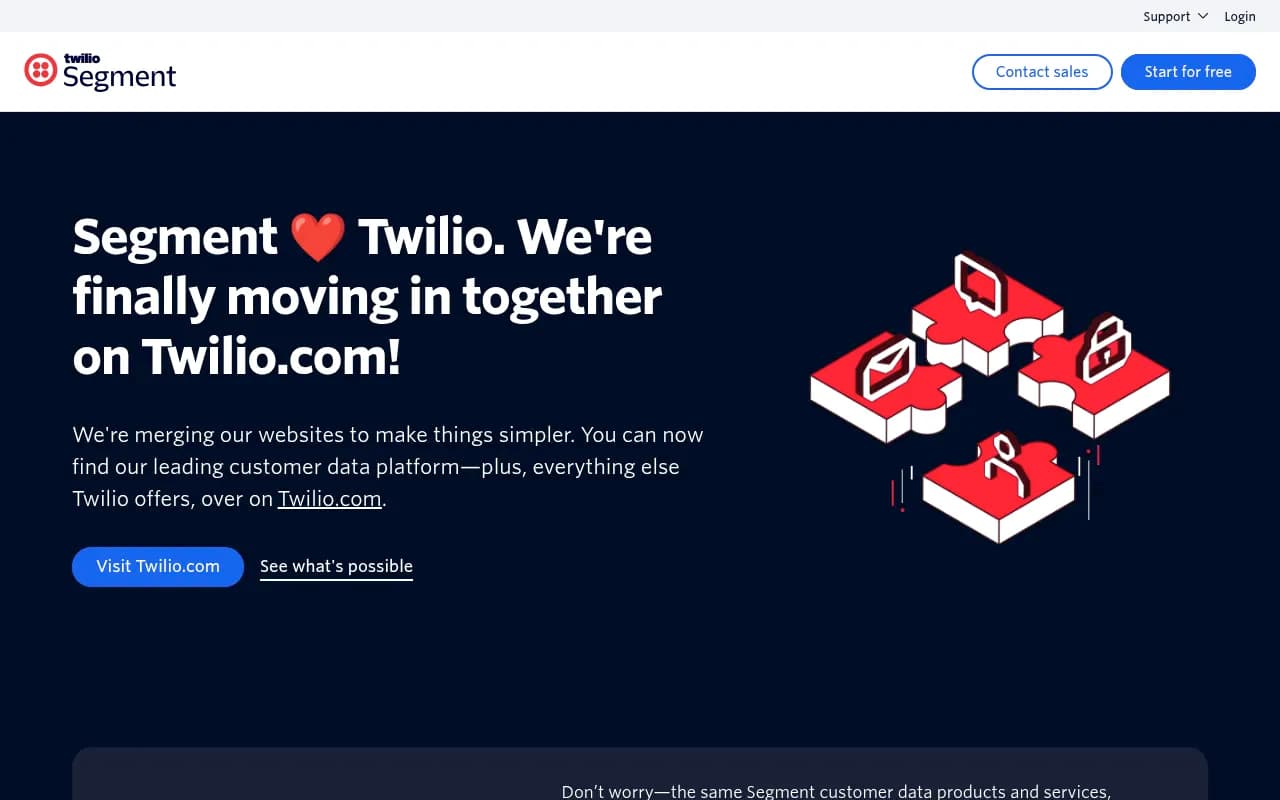
Twilio Segment is the customer data platform that became the backbone of modern data stacks. Originally launched in 2011 as a simple analytics API, Segment evolved into the infrastructure layer that collects customer data from every touchpoint -- websites, mobile apps, servers, cloud tools -- and routes it to hundreds of destinations in real time. Twilio acquired Segment in 2020 for $3.2 billion, and in 2024 fully integrated it into the Twilio platform, combining customer data infrastructure with communications APIs.
The core value proposition: instead of implementing tracking code for Google Analytics, Mixpanel, Amplitude, Facebook Ads, your data warehouse, and 20 other tools separately, you implement Segment once. It becomes the single source of truth for customer data, then pipes that data wherever you need it. For data teams, this means one implementation, one schema, one place to manage data quality. For marketing and product teams, it means consistent data across every tool they use.
Segment serves two main use cases. First, as a customer data pipeline (the Connections product) -- a pure routing layer that collects events and user traits, then forwards them to destinations. Second, as a full customer data platform (Connections + Unify + Engage) -- which adds identity resolution, unified profiles, audience building, and journey orchestration on top of the pipeline. Most companies start with Connections, then upgrade to the full CDP as their data needs mature.
How Segment actually works in practice
You instrument Segment's tracking libraries (JavaScript, iOS, Android, server-side SDKs for Node, Python, Go, etc.) into your product. Every time a user performs an action -- page view, button click, purchase, form submission -- your code fires a track() call to Segment's API. You also send identify() calls with user traits (email, name, plan type, etc.) and page() or screen() calls for navigation events.
Segment receives these events, validates them against your tracking plan (optional but recommended), then forwards them to every destination you've enabled in the UI. The magic: you can add or remove destinations without touching code. Want to try a new analytics tool? Flip a switch in Segment's dashboard. Want to stop sending data to an old marketing platform? Turn it off. Your engineering team never has to redeploy.
The data flows through Segment's infrastructure in near real-time (typically under 1 second for most destinations). For destinations that support it, Segment batches events for efficiency. For others, it sends individual API calls. Either way, you're not managing these integrations yourself.
Connections: The customer data pipeline
This is Segment's foundational product. It includes:
Sources: 200+ pre-built integrations to collect data from web, mobile, server, and cloud tools. The most common sources are Segment's own SDKs (analytics.js for web, iOS/Android SDKs, server libraries), but you can also pull data from cloud apps like Salesforce, Zendesk, Stripe, or your data warehouse (reverse ETL). Each source sends events in Segment's standardized format -- track, identify, page, screen, group, alias calls with properties and traits.
Destinations: 550+ integrations to send data to analytics platforms (Google Analytics, Mixpanel, Amplitude, Heap), marketing tools (Braze, Iterable, Customer.io, Klaviyo, Facebook Ads, Google Ads), data warehouses (Snowflake, BigQuery, Redshift, Databricks), and business intelligence tools (Looker, Tableau, Mode). Each destination has its own mapping logic -- Segment translates your events into the format that tool expects. For example, a track('Product Purchased') call becomes a conversion event in Google Ads, a revenue event in Mixpanel, and a row in your warehouse's tracks table.
Protocols: Data quality and governance features. Define a tracking plan (a schema for your events and properties), then enforce it. Segment blocks events that don't match the plan, flags unexpected properties, and alerts you when data quality degrades. You can also transform events in-flight (rename properties, filter out PII, enrich with additional context) using Segment's Functions feature -- custom JavaScript code that runs on every event before it reaches destinations.
Privacy and consent management: Built-in tools to respect user consent preferences (GDPR, CCPA). You can block destinations based on consent categories, automatically delete user data on request, and audit data flows for compliance.
Connections pricing starts at $120/month for up to 10,000 monthly tracked users (MTUs). An MTU is a unique user who triggers at least one event in a calendar month. Beyond 10K MTUs, you pay $12 per additional 1,000 MTUs up to 25K, then volume discounts kick in. For 50K MTUs, expect around $1,200-1,500/month. For 500K MTUs, you're likely in the $5,000-10,000/month range depending on negotiation. Enterprise contracts (1M+ MTUs) are custom priced.
Unify: Identity resolution and unified profiles
This is where Segment becomes a true CDP. Unify takes the raw event stream from Connections and stitches it into unified customer profiles. The challenge: a single user might visit your website anonymously, then sign up on mobile, then contact support from a different email, then make a purchase on desktop. Segment's identity graph connects these touchpoints into one profile.
The identity resolution engine uses deterministic matching (same user ID, email, or phone number) and configurable merge rules. You define which identifiers take precedence and how aggressively to merge profiles. Segment also supports cross-device tracking via anonymous IDs (cookies, device IDs) that get linked to known identifiers when a user logs in.
The result: a 360-degree profile for each customer showing every event they've triggered, every trait you've collected, and their journey across channels. These profiles live in Segment's Profile API and can be queried in real-time by your applications. You can also sync profiles to destinations -- for example, send the unified profile to Salesforce so your sales team sees the customer's full history.
Unify also includes Traits Enrichment: automatically compute traits from event data (e.g. "total purchases", "last seen date", "favorite product category") and attach them to profiles. These computed traits update in real-time as new events arrive, and they're available in every downstream tool.
Engage: Audiences and journey orchestration
Engage is Segment's activation layer. It lets you build audiences (segments of users based on traits and behaviors), then sync those audiences to marketing and advertising tools. It also includes journey orchestration -- multi-step campaigns triggered by user actions.
Audiences: Define audiences using a visual builder or SQL. Examples: "Users who viewed pricing page in last 7 days but didn't sign up", "Customers who spent >$500 in last 30 days", "Free trial users in their last 3 days". Audiences update in real-time as users enter or exit the criteria. You can sync audiences to 200+ destinations -- Facebook Custom Audiences, Google Ads, Braze, Iterable, your data warehouse, etc. This replaces the manual CSV uploads and audience syncs you'd otherwise do in each tool.
Journeys: Multi-step campaigns that trigger based on user behavior. Example: when a user signs up (trigger), wait 1 day, then send an onboarding email via SendGrid, wait 3 days, then send a push notification via Braze if they haven't completed setup. Journeys support branching logic (if/then conditions), delays, and multi-channel orchestration. The key difference vs. tools like Braze or Iterable: Journeys runs on top of your unified profiles, so you can trigger actions based on data from any source, not just what's in your email tool.
Predictive Traits: Machine learning models that predict user behavior (likelihood to convert, churn risk, lifetime value). These predictions become traits on the profile, which you can use in audiences and journeys. For example, target high-LTV users with premium offers, or re-engage high-churn-risk users with retention campaigns.
The full CDP (Connections + Unify + Engage) starts around $1,000-2,000/month for small volumes, but most companies using Engage are paying $5,000-20,000/month depending on MTUs and feature usage. Enterprise pricing (custom contracts) is common for companies with complex needs.
Reverse ETL and warehouse integrations
Segment's Reverse ETL feature lets you pull data from your warehouse (Snowflake, BigQuery, Redshift, Databricks) and send it to operational tools. This is the opposite of the normal flow -- instead of Segment sending data to the warehouse, the warehouse becomes a source. Use case: your data science team builds a churn prediction model in the warehouse, then you use Reverse ETL to sync those predictions to Salesforce, Braze, and your support tool.
This positions Segment as the hub of a composable CDP architecture: raw data lives in the warehouse (the source of truth), Segment handles identity resolution and activation, and downstream tools consume the enriched data. It's a popular pattern for data-mature companies that want warehouse-native infrastructure but need Segment's integration layer and real-time capabilities.
Who should use Segment
Segment is built for companies that have outgrown basic analytics and need a scalable data infrastructure. Typical users:
B2C companies with high traffic: E-commerce, media, SaaS, fintech, travel. If you're tracking millions of events per month and sending data to 5+ tools, Segment saves engineering time and ensures data consistency. Example: an e-commerce company tracking web, mobile app, and in-store purchases, sending data to Google Analytics, Facebook Ads, Klaviyo, Snowflake, and Looker.
B2B SaaS companies with product-led growth: Segment is popular in PLG because it connects product usage data (from the app) with marketing data (from the website) and sales data (from Salesforce). This gives go-to-market teams a complete view of the customer journey. Example: a SaaS company tracking free trial behavior, then using that data to trigger sales outreach in Salesforce and personalized emails in Customer.io.
Data teams building a modern data stack: Segment is often the first layer in a stack that includes a warehouse (Snowflake, BigQuery), a transformation tool (dbt), and a BI tool (Looker, Tableau). Segment handles data collection and loading, dbt handles transformation, BI handles reporting. This is the "ELT" pattern (extract, load, transform) that's become standard in data engineering.
Marketing and growth teams that need multi-channel activation: If you're running campaigns across email, push, SMS, ads, and web, Segment ensures every channel has the same customer data. You can build an audience once in Segment, then sync it to 10 different tools instead of rebuilding it in each tool's UI.
Who should NOT use Segment: Early-stage startups with <10K users and simple analytics needs. If you only need Google Analytics and maybe one other tool, Segment is overkill. The pricing and complexity don't make sense until you're managing multiple data destinations and need consistent data across them. Also not ideal for companies with very tight budgets -- the MTU-based pricing can get expensive fast for high-traffic consumer apps.
Integrations and ecosystem
Segment's integration catalog is its biggest moat. 550+ destinations cover every category: analytics (Google Analytics, Mixpanel, Amplitude, Heap, Pendo), marketing automation (Braze, Iterable, Customer.io, Klaviyo, Marketo, HubSpot), advertising (Facebook Ads, Google Ads, TikTok Ads, Snapchat Ads), data warehouses (Snowflake, BigQuery, Redshift, Databricks), CRMs (Salesforce, HubSpot), support tools (Zendesk, Intercom), and more.
Each integration is maintained by Segment's team, so you're not relying on third-party connectors. When a destination's API changes, Segment updates the integration. This is a huge time-saver compared to managing integrations yourself.
Segment also has a robust developer ecosystem. Open-source libraries for every major language and platform (JavaScript, iOS, Android, Node, Python, Go, Ruby, PHP, Java, .NET). A Functions feature for custom transformations and destinations (write JavaScript code that runs on Segment's infrastructure). A Public API for programmatic access to Segment's configuration and data. And a Partner Program where technology vendors build their own Segment integrations.
Strengths
Best-in-class integration catalog: 550+ destinations is unmatched. If a tool exists, Segment probably integrates with it. This makes Segment the de facto standard for data infrastructure.
Reliable infrastructure: Segment processes billions of events per month with 99.9%+ uptime. The data pipeline is battle-tested and scales effortlessly. You don't worry about data loss or downtime.
Data quality and governance: Protocols (tracking plans, schema enforcement, data validation) is a killer feature for data teams. It prevents bad data from entering the system and makes debugging much easier.
Unified profiles and identity resolution: Unify does a solid job stitching together cross-device and cross-channel user journeys. The Profile API is fast and reliable for real-time lookups.
Warehouse-native architecture: Reverse ETL and tight warehouse integrations make Segment a good fit for companies building on a modern data stack. You can use the warehouse as the source of truth and Segment as the activation layer.
Limitations
Segment is not perfect. Here are the honest trade-offs:
Pricing scales aggressively with MTUs: The MTU-based pricing model can get expensive fast, especially for consumer apps with millions of users. A mobile app with 1M monthly active users could pay $10,000-20,000/month or more. Competitors like RudderStack (open-source, self-hosted) or Freshpaint (healthcare-focused) offer more predictable pricing.
Engage is less mature than dedicated tools: While Engage (audiences and journeys) is useful, it's not as feature-rich as dedicated marketing automation platforms like Braze, Iterable, or Customer.io. If you need advanced journey orchestration (complex branching, A/B testing, multi-channel coordination), you'll still use a dedicated tool and just sync audiences from Segment.
Learning curve for non-technical users: Segment is built for data teams and engineers. Marketers and product managers can use the UI for audiences and destinations, but setting up sources, debugging tracking issues, and managing Protocols requires technical knowledge. Smaller teams without dedicated data resources may struggle.
Latency for some destinations: While Segment's infrastructure is fast, some destinations have inherent latency (batch processing, API rate limits). For example, syncing audiences to Facebook Ads can take 15-30 minutes. This is partly a limitation of the destination's API, not Segment, but it's worth knowing.
Limited data transformation capabilities: Segment Functions (custom JavaScript for transformations) is powerful but limited compared to a full ETL tool like Fivetran or Airbyte. If you need complex data transformations (joins, aggregations, enrichment from external APIs), you'll do that in your warehouse with dbt, not in Segment.
Vendor lock-in risk: Once you've built your data stack on Segment, migrating off is painful. You'd need to reimplement tracking in every source, rebuild integrations to every destination, and migrate historical data. This is true of most CDPs, but worth considering.
How Segment compares to competitors
The CDP market is crowded. Here's how Segment stacks up:
vs. RudderStack: RudderStack is open-source and offers a self-hosted option, which appeals to companies that want full control over their data infrastructure. Pricing is more predictable (event-based, not MTU-based). However, RudderStack has fewer pre-built integrations (200 vs. 550) and a smaller community. Choose RudderStack if you want to self-host or need cheaper pricing at scale. Choose Segment if you want the most integrations and a fully managed service.
vs. mParticle: mParticle is Segment's closest competitor in the enterprise CDP space. It has similar features (data pipeline, identity resolution, audiences) and a comparable integration catalog. mParticle is stronger in mobile (better SDKs, more mobile-specific features). Segment is stronger in warehouse integrations and developer experience. Pricing is similar. Both are expensive at scale.
vs. Hightouch: Hightouch is a pure Reverse ETL tool -- it syncs data from your warehouse to operational tools. It doesn't collect data from sources like Segment does. Use Hightouch if you already have data in a warehouse and just need activation. Use Segment if you need the full pipeline (collection + activation).
vs. Census: Similar to Hightouch -- a Reverse ETL tool, not a full CDP. Census is slightly more enterprise-focused with better governance features. Same trade-off: use it for warehouse-to-tool syncing, not for data collection.
vs. Lytics or Bloomreach: These are marketing-focused CDPs with built-in personalization and campaign tools. They're less technical than Segment (easier for marketers to use) but less flexible (fewer integrations, less control over data). Choose them if you want an all-in-one marketing platform. Choose Segment if you want a flexible data infrastructure that integrates with best-of-breed tools.
Pricing breakdown
Segment's pricing is based on monthly tracked users (MTUs) and which products you use:
Connections (data pipeline only): Free tier for up to 1,000 MTUs. $120/month for up to 10,000 MTUs. Beyond that, $12 per 1,000 MTUs up to 25K, then volume discounts. Expect $1,200-1,500/month for 50K MTUs, $5,000-10,000/month for 500K MTUs. Enterprise contracts (1M+ MTUs) are custom priced, often $50,000-200,000+/year depending on volume and features.
Full CDP (Connections + Unify + Engage): Starts around $1,000-2,000/month for small volumes. Most companies using the full CDP pay $5,000-20,000/month. Enterprise deals can reach $100,000-500,000+/year for large-scale deployments.
Support plans: Free support included. Premium support (8% of license fee or $4,800/year minimum) adds faster response times and a dedicated Slack channel. Enterprise support (15% of license fee or $15,000/year minimum) adds a technical account manager and SLA guarantees.
Segment offers annual contracts with discounts (typically 10-20% off monthly pricing). Free trials are available for Connections. The full CDP usually requires a sales conversation.
Bottom line
Segment is the industry-standard customer data platform for a reason. If you're a mid-market or enterprise company that needs to collect data from multiple sources, send it to dozens of destinations, and maintain data quality at scale, Segment is the safest bet. The integration catalog is unmatched, the infrastructure is rock-solid, and the developer experience is excellent. Data teams love it because it eliminates integration headaches. Marketing and product teams love it because they get consistent data across every tool.
The trade-offs: it's expensive at scale (MTU-based pricing adds up fast), and it's overkill for small startups or simple use cases. If you're just getting started with analytics, use Google Analytics and a basic event tracking library. If you're a high-growth company managing 5+ data tools and struggling with inconsistent data, Segment is worth every dollar.
Best use case in one sentence: Mid-market to enterprise companies (50K+ users) that need a reliable, scalable data infrastructure to power analytics, marketing, and data science across a modern tech stack.
Tags:
Frequently asked questions
What is Segment and what does it do?
How much does Segment cost?
Does Segment have a free plan?
Who should use Segment?
What are the main benefits of using Segment?
Is Segment worth it for small startups?
What integrations does Segment support?
When did Twilio acquire Segment?
Similar and alternative tools to Segment