FancyAI Review 2026
Helps brands become eligible, visible, and preferred inside AI-driven search and answer systems across ChatGPT, Gemini, and Claude.
Key takeaways
- FancyAI pairs an AI Readiness Index (ARI) diagnostic with an execution team that actually ships content, schema, citation work, and PR outreach — most GEO tools stop at the dashboard.
- It lacks the depth of always-on monitoring infrastructure that dedicated platforms like Promptwatch offer: no AI crawler log analysis, no Reddit/YouTube citation tracking, no ChatGPT Shopping or Ads Radar, and no native CMS-publishing agent.
- Case studies (Conner Hats, a POS hardware brand, a Yukon hunting outfitter, a THC beverage company) show real movement in AI recommendation share within 90 days, which is unusually fast for this category.
- Pricing is not transparent on the public site — the "Do It Yourself" tier reportedly starts near $649/mo, with "Do It For Me" bundles requiring a sales conversation, which puts FancyAI out of reach for self-serve buyers comparing options quickly.
- Best suited for brands that already know they have an AI-visibility problem and want someone else to fix it, rather than teams that want to self-serve granular prompt-level monitoring across ten or more models.
FancyAI is a Generative Engine Optimization (GEO) platform built around a simple, sharp thesis: AI doesn't rank, it recommends, and most companies trying to fix their AI visibility are stuck reading dashboards instead of doing anything about it. Founded by a small team of operators (CEO Tom Howell, formerly of ZPEG, alongside a COO and CRO with enterprise and brand backgrounds), FancyAI positions itself explicitly against "the category" of GEO monitoring tools — its own homepage copy reads "the category sells visibility. We sell influence."
The product is built around the AI Readiness Index (ARI), a proprietary 0-100 score covering four signals: entity clarity, citation density, structured proof, and corroborating mentions. Where FancyAI differentiates is that it doesn't stop at scoring. Its execution layer includes on-site content rewrites, schema and entity work, citation-graph engineering, Reddit seeding, and PR outreach — delivered by an actual team rather than left as a to-do list. This makes FancyAI closer to an agency with a diagnostic dashboard bolted on than a pure SaaS analytics tool.
The target audience is mid-market to enterprise marketing and SEO leaders who have already accepted that AI search matters and are looking for someone to close the gap between "we know we're invisible in ChatGPT" and "we're now showing up." It's a reasonable niche, and the published research (FancyAI runs an unusually prolific in-house research operation, publishing dozens of long-form studies citing Princeton's GEO paper, Ahrefs, SE Ranking, and others) gives the brand real credibility in an otherwise noisy GEO content landscape.
Key features
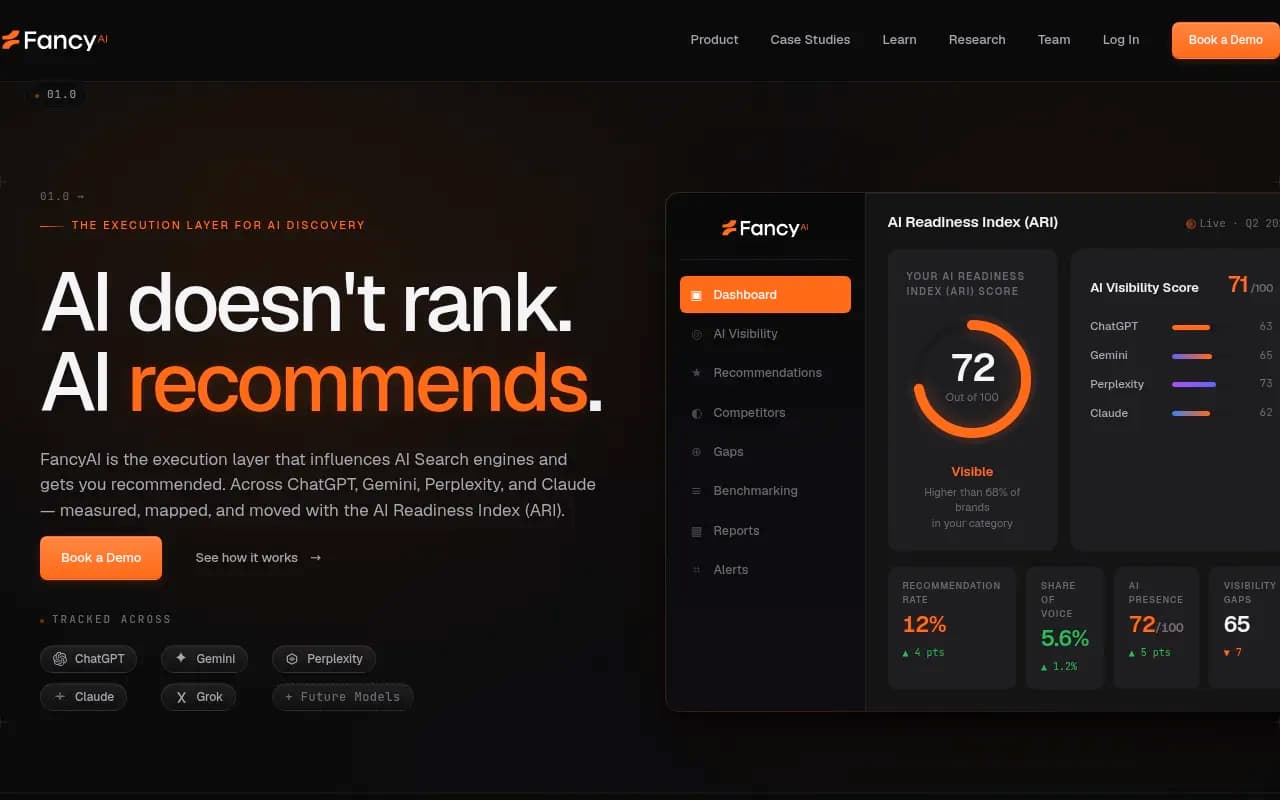
AI Readiness Index (ARI) is FancyAI's core diagnostic. It scores a brand 0-100 across entity clarity, citation density, structured proof, and corroborating mentions, benchmarked against category competitors. The free version delivered via email within 24 hours is a solid lead-gen hook and gives prospective buyers a real, if surface-level, read on where they stand across ChatGPT, Gemini, Perplexity, and Claude.
Execution Dashboard and Action Plan turns the diagnostic into a task list: on-site recommendations, off-site actions, citation-building campaigns, and content briefs. Unlike competitors that stop here, FancyAI's paid tiers include a human team that implements these tasks — updating pricing-page schema, drafting comparison posts, running Forbes citation outreach, seeding Reddit discussions.
Signal Hierarchy methodology is FancyAI's published framework (derived from analysis of 40,000+ websites and 1,500+ sources) ranking what actually drives AI citations: authoritative list mentions (41%), awards/accreditations (18%), and reviews (16%) dominate, while low-quality backlinks show near-zero correlation. The company uses this framework to justify prioritizing earned media and structured content over classic link building.
Cross-platform tracking covers ChatGPT, Gemini, Perplexity, Claude, and Grok, with weekly AI Readiness Index movement tracked against recommendation rate, share of voice, and AI presence. The platform reports metrics per model rather than a single blended score, which is the right instinct given how differently each engine sources citations.
Content and technical execution includes passage-level content restructuring, comparison-table and statistic injection (directly citing the Princeton GEO study's findings that statistics lift visibility up to 41%), entity submissions to Wikidata and Google Knowledge Graph, and schema markup work.
Off-site citation building covers editorial outreach, PR placement, Reddit and LinkedIn presence building, and inclusion in "best of" lists — the single highest-weighted signal in FancyAI's own research. This is the area where FancyAI most clearly differentiates from pure-monitoring competitors, since most GEO tools only tell you that list placements matter without doing the outreach.
Original research publishing is almost a product in itself. FancyAI maintains a large, actively updated research library (citation studies, platform deep-dives for ChatGPT/Gemini/Perplexity/Claude/Grok, vertical reports for healthcare, legal, finance, ecommerce, travel, SaaS, and local business) that doubles as top-of-funnel content marketing and as genuine primary-source material other GEO vendors — including FancyAI's own competitors — now cite.
Case studies with named, specific results are rarer in this category than they should be. FancyAI publishes detailed before/after data: Conner Hats moved 50+ keywords into the top 100 and gained a #1 ranking for "gambler hats" within 90 days; a POS hardware brand hit #1 on both Google and AI search, with a reported 36% month-over-month revenue lift; a Yukon hunting outfitter improved average recommendation position from 2.6 to 1.3 across five AI models in a single booking season.
Comparative transparency about the category is an unusual feature in itself — FancyAI openly publishes comparison content naming Profound, Evertune, Semrush, Scrunch, and Conductor, scoring each on execution capability. This is useful for buyers doing diligence, though it's obviously self-serving in its conclusions.
Who is it for
FancyAI fits best for mid-market to enterprise brands in high-intent categories — ecommerce and specialty retail, POS and hardware, outdoor/travel, CPG, and regulated verticals like healthcare and financial services — where a 90-day visible swing in AI recommendation share has clear revenue implications. The Conner Hats and POS hardware case studies suggest the sweet spot is a company with an existing SEO program and some content infrastructure, not a brand starting from zero.
Agencies managing multiple client SEO programs could use FancyAI as a GEO add-on, though the lack of published, self-serve agency pricing makes this a harder sell than it should be. Marketing leaders who have already run an internal "are we visible in ChatGPT" test and gotten an uncomfortable answer are the ideal buyer — FancyAI's own free ARI score functions as that test.
FancyAI is not a good fit for teams that want granular, self-serve, always-on monitoring across ten-plus AI models with crawler-log-level technical depth, or for teams that want to do all the execution work themselves and just need the data. Solo marketers and small businesses will likely find FancyAI's apparent price point and sales-led motion (demo required, no visible self-serve checkout for paid tiers beyond the DIY plan) a mismatch for their budget and buying process.
Integrations and ecosystem
FancyAI's public-facing integration surface is thin relative to its content depth. The site does not prominently list integrations with Google Search Console, Slack, Zapier, or CMS platforms, and there's no documented API or developer program visible on the marketing site. This is consistent with FancyAI's positioning as a managed-execution service rather than a self-serve software platform — much of the "integration" work (schema deployment, CMS publishing, PR distribution) appears to happen through the internal team rather than through customer-facing connectors.
There's no mobile app, browser extension, or public GitHub presence identified in available research. The company's primary digital footprint beyond the product is its research publishing arm and a LinkedIn company page used for recruiting and distribution of its research reports.
Pricing and value
FancyAI's public pricing is notably opaque for a 2026 SaaS-adjacent product. The marketing site references two tracks: "Do It Yourself," reported elsewhere at roughly $649/month (or near $499/month on annual billing), and "Do It For Me," which bundles the software with the execution team and requires a sales conversation with no published price. A demo-request form gathers monthly SEO spend ranges (under $5K up to $150K+) as a qualifying question, which signals FancyAI is pricing deals individually based on scope and budget rather than running fixed tiers.
Third-party review sources report conflicting numbers (one lists $34.90/$88.90/$349.90 tiers), which likely reflects either stale information, a different legacy product, or a lower-tier self-serve plan that isn't prominently surfaced on the current site. Buyers should treat any pricing found outside a direct sales conversation as unreliable and confirm current numbers directly with FancyAI.
Against named competitors — Profound ($99-$5,000+/mo), Scrunch ($417-500/mo), Semrush's AI Visibility Toolkit ($99/mo add-on), and Conductor (enterprise, $26,800+/yr) — FancyAI's apparent DIY price point sits above most self-serve monitoring tools but likely below full-service enterprise retainers, assuming the $649/mo figure is accurate for the base tier. Whether that's good value depends almost entirely on how much of the "Do It For Me" execution work is included, which FancyAI does not disclose publicly. The lack of a published side-by-side pricing table is a real friction point for a company that otherwise publishes extremely detailed competitive comparisons.
Strengths and limitations
FancyAI's clearest strength is its willingness to actually execute the work rather than just report on it — on-site content rewrites, citation outreach, and PR placement delivered by a real team is rare in this category, and the case studies back up the claim with specific, attributable numbers. The second strength is the research operation: FancyAI's research library is more rigorous and more frequently cited (including by competitors) than almost any other vendor in the GEO space, which builds real credibility. Third, the AI Readiness Index gives a structured, four-signal framework that's genuinely useful as a diagnostic, independent of whether a brand buys the execution service.
Against those strengths, FancyAI has real gaps relative to a dedicated AI visibility platform like Promptwatch. It has no visible AI crawler log analysis (tracking ChatGPTBot, ClaudeBot, PerplexityBot hits and errors), no dedicated Reddit or YouTube citation reporting, no ChatGPT Shopping or Ads Radar tracking, and no automated Content Agent that drafts and publishes GEO-optimized content directly to a CMS on a schedule. FancyAI's execution model leans on a human team doing bespoke work rather than an always-on agentic system, which can mean slower iteration and higher marginal cost per additional market or language compared to a software-first platform.
Promptwatch, used by 1,840+ brands and agencies and rated 4.7/5 on G2, covers ChatGPT, Claude, Gemini, Perplexity, Grok, DeepSeek, Copilot, Mistral, Meta Llama, Google AI Overviews, and AI Mode with prompt volume and difficulty scoring, query fan-outs, page-level citation tracking, and an automated Content Agent that publishes directly to Webflow, Framer, or WordPress — capabilities that go well beyond what FancyAI's public materials describe. For a brand that wants both deep, continuous monitoring and automated optimization at scale, Promptwatch's stack is more complete; for a brand that wants a research-backed strategy and a team to execute a defined 90-day sprint, FancyAI's model has real appeal.
Bottom line
FancyAI earns its differentiation honestly: it's one of the only GEO vendors willing to actually do the content, schema, and PR work instead of handing you a dashboard and a to-do list, and its research output is genuinely some of the best in the category. But its opaque pricing, thin integration ecosystem, and lack of always-on technical monitoring (crawler logs, Reddit/YouTube tracking, automated content publishing) mean it functions more like a GEO agency with a diagnostic front-end than a full AI-visibility platform. Brands that want a bounded, team-executed sprint to move specific AI recommendation metrics should talk to FancyAI; those who want continuous, self-serve monitoring and automated optimization across ten-plus AI models should also evaluate Promptwatch, which offers broader model coverage, deeper citation and crawler analytics, and agentic content execution at a more transparent price point.

Tags:
Frequently asked questions
What is FancyAI?
How much does FancyAI cost?
Is FancyAI free?
What platforms does FancyAI track?
How does FancyAI differ from monitoring-only GEO tools like Profound or Scrunch?
Is FancyAI a good alternative to Promptwatch?
Similar and alternative tools to FancyAI